
 Türkçe
 Deutsch
 Français
Medically reviewed by Dr. Barış Duman · Reviewed:
Short answer: 3 weeks after a hair transplant, the crusts have come off, the grafts have become secure and the redness is starting to fade. At this stage it is normal for the transplanted hairs to start falling out: shock loss usually happens between weeks 3 and 8, and the root stays in place under the skin. New hairs grow in the following months, and the final result settles in 12-18 months.
The third week is the most confusing stage of recovery. The skin looks almost normal again, but in the mirror you see the transplant area thinning out once more. Below we explain what is normal at this stage, what you can do and when you should write to your clinic.
What does the scalp look like 3 weeks after a hair transplant?
The transplant area
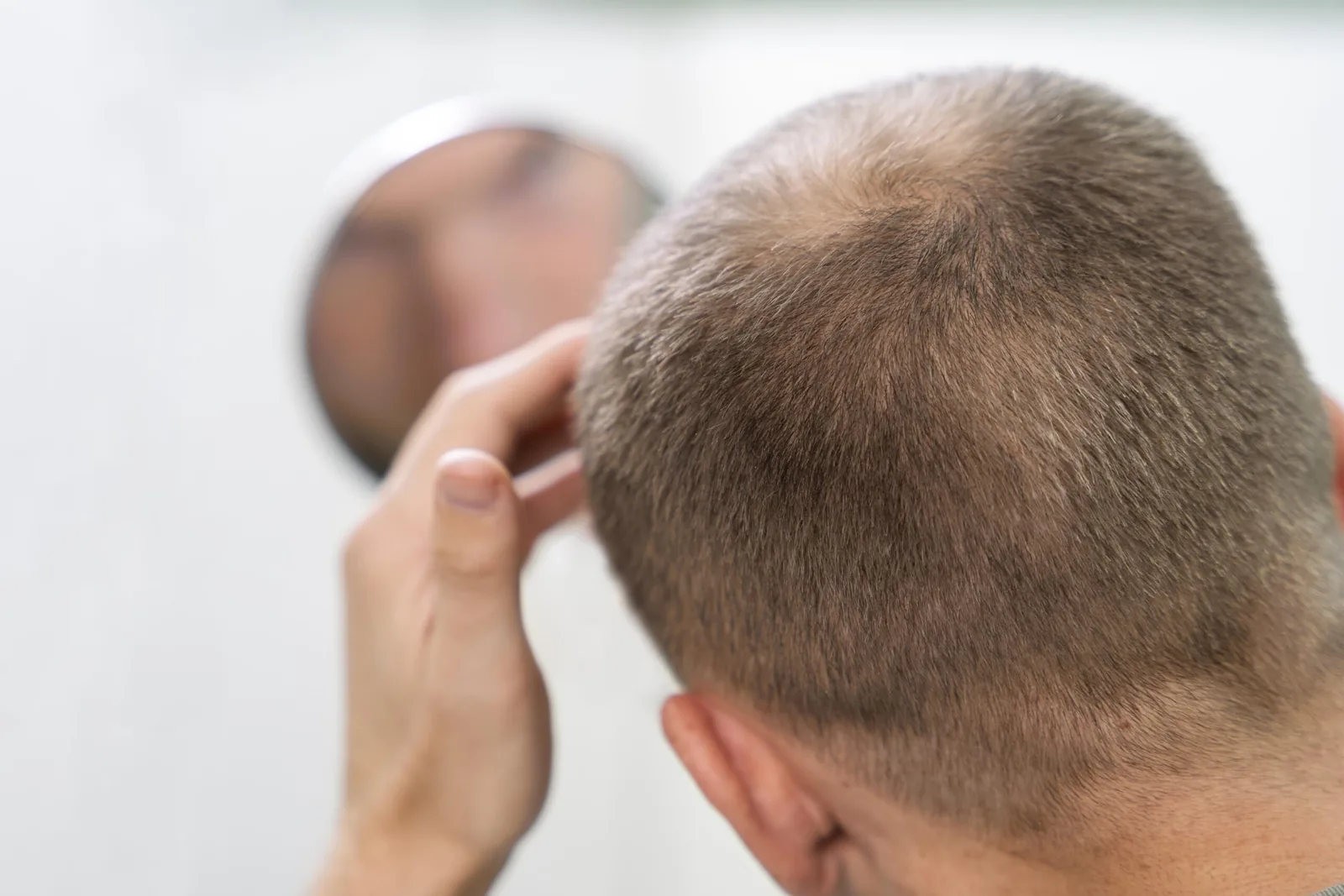
By this point the crusts are largely gone. The skin may look pink or slightly red; this tone can last a few more weeks, especially in people with fair skin, and fades over time. There are short hairs in the transplant area, but some of them start to fall out during these weeks.
The donor area
At the back and sides of the head, where the grafts were taken, the hair keeps growing and the small dots become less and less visible. The donor area often recovers sooner than the transplant area.
How it feels
Pain has usually gone completely. Mild itching, numbness or tingling can still occur at this stage; they ease as the nerves recover. We explain how to cope with itching in our article on itching after a hair transplant. If small bumps or pimples appear in the transplant area, see our article on ingrown hairs and pimples.
Why are the transplanted hairs falling out in week 3?
After the hair roots have been moved to their new place, they enter a resting phase for a while. During this time the hair shaft falls out, while the root stays under the skin. This is called shock loss and it usually happens between weeks 3 and 8. The shedding does not happen all at once but gradually over a few weeks, and for a while the area may look similar to how it did before the operation.
Hairs that fall out at this stage do not mean graft loss. Grafts become secure by days 10-14; hairs that come out in the third week while washing or combing do not show that the roots have been dislodged. We explain the process in detail in our article on shock loss.
What can you do after 3 weeks?
If your recovery is going smoothly, by the third week you are back to most of your daily life. Even so, take every step according to the instructions your doctor has given you.
- Hat and beanie: A loose, breathable hat can be worn after day 10, with your doctor’s approval depending on the type of hat. For a beanie and tight headwear you need to wait until day 40.
- Washing: Washing is now comfortable, but scratching with your nails and rubbing hard are still off limits. For the method, see our week-by-week washing guide.
- Work: Most people with desk jobs went back to work well before this point. For physically demanding work, see our article on going back to work after a hair transplant.
- Exercise: Your doctor tells you when and at what intensity you can return to training. The stages are in our exercise guide.
- Sun: The first 14 days of protection are behind you, but for the first 2 months you avoid sunbathing and long periods in the sun that could cause sunburn. Details are in our article on sun exposure after a hair transplant.
- Pool and sea: Get your doctor’s approval before going into the water. We cover this in our article on swimming after a hair transplant.
- Haircut: Trimming the ends with scissors is not the same as using clippers or a razor close to the transplant area. Ask your doctor when and how you can have your hair cut.
- Medication: If your doctor considers it suitable, finasteride 1 mg can be started 10 days after the operation. Your doctor decides when to start minoxidil; the options are in our article on finasteride and minoxidil.
When should you write to your clinic?
If there are still firmly attached crusts in the third week, do not pick them off; send a photo to your clinic. If any of the following applies, contact your clinic without waiting:
- Redness that spreads, feels warm to the touch or keeps getting darker,
- Discharge, yellow crusts or a bad smell,
- Painful swellings that do not go away or get bigger,
- Pain that increases instead of decreasing,
- Fever or feeling generally unwell.
Hairpol patients can send their photos to their VIP patient managers 24/7 during this period. After the operation, you are followed up with monthly photos via the mobile app for 12 months.
What comes after week 3?
The shedding lasts a few weeks, and the transplant area may look thin for a while. This does not mean the result is poor; once the roots have finished their resting phase, new hairs grow gradually over the following months. The first hairs may be fine and thicken over time, and the final result settles in 12-18 months. We explain this period in detail in our articles on why hair looks thin in the first months and recovery day by day in the first 30 days. If you want to read about the earlier days, see our articles on 10 days after a hair transplant and 2 weeks after a hair transplant.
At Hairpol, growth of the transplanted hairs in the transplant area is covered by a guarantee certificate. You can read what the certificate covers in our article on the hair transplant guarantee certificate. To get to know our polyclinic’s physician, see the Dr. Barış Duman page.
If you are planning your return to training, see exercise after a hair transplant: when you can work out again.
If you are wondering when you can see a barber again, read haircut after a hair transplant: when to cut and style safely.
Frequently asked questions
Is hair shedding normal 3 weeks after a hair transplant?
Yes. Shock loss usually happens between weeks 3 and 8. The hair shaft falls out, while the root stays under the skin and produces new hair in the following months.
Do the grafts fall out with the hairs that shed after 3 weeks?
No. Grafts become secure by days 10-14. Hairs that come out in the third week while washing or combing do not mean that the roots have been dislodged.
Can I wear a beanie 3 weeks after a hair transplant?
Not yet. A loose, breathable hat can be worn after day 10 with your doctor’s approval; for a beanie and tight headwear you need to wait until day 40.
The redness has not gone after 3 weeks. Is something wrong?
Usually not. Redness can last a few more weeks, especially in people with fair skin, and fades over time. If it spreads, feels warm or comes with discharge, write to your clinic.
Can I get a haircut 3 weeks after a hair transplant?
Trimming the ends with scissors is different from using clippers or a razor close to the transplant area. Your doctor decides which is suitable and when.
Free photo analysis
If you are planning a hair transplant and want to know the recovery process from the start, send us your photos; we will share the plan and process that suit you free of charge.
Message us on WhatsApp or see which photos to send.
Find this helpful? Add Hairpol as a preferred source on Google.
Free hair analysis
Planning a hair transplant? Start with a free analysis
Tell us about your hair and our medical team prepares a plan specific to you.
- Transplant carried out by a specialist team under doctor supervision
- Guarantee certificate, valid for 18 months
- All-inclusive package: hotel, VIP transfer, aftercare kit
Free of charge, no obligation to book.
