
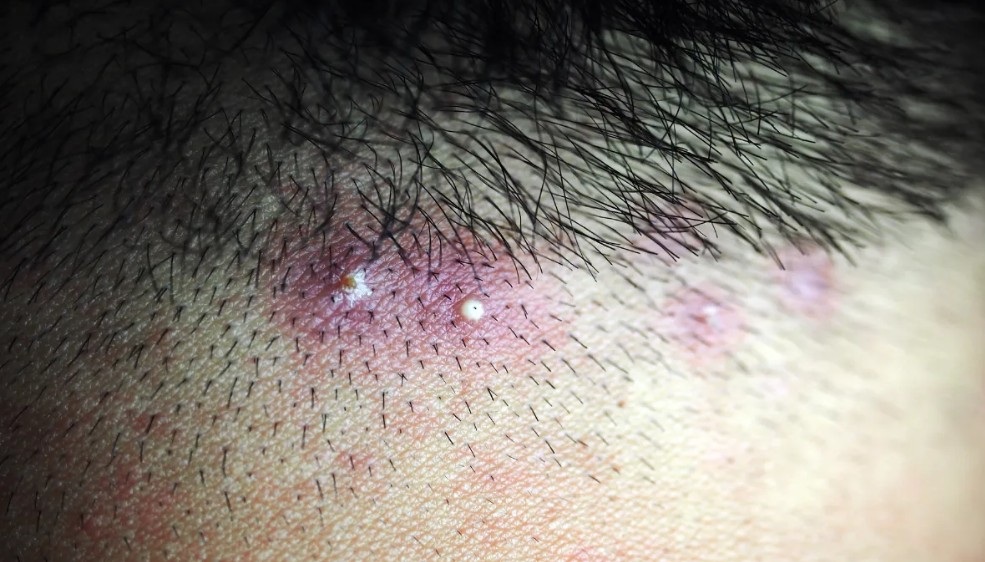
Nobody warns you about month three.
You survive the swelling. You survive the scabs, the awkward hat phase, the shedding that made you quietly panic in a bathroom mirror. And then, right when the first new hairs are pushing through and you’re finally starting to feel optimistic, your scalp erupts in small red bumps that look exactly like teenage acne. Some are white-headed. Some are hard and buried. A few are tender enough that you notice them when you turn your head on the pillow.
And the thought arrives immediately: something has gone wrong.
Almost always, it hasn’t. What you’re looking at is one of the most predictable, most under-explained events in the entire recovery process. At Hairpol we see these messages constantly — a photo taken at arm’s length in bad bathroom lighting, a caption that says “is my transplant getting infected?” — and in the overwhelming majority of cases the honest answer is that the bumps are a sign your follicles are waking up, not dying. But “almost always” isn’t “always,” and that gap is exactly why this deserves a serious explanation rather than a reassuring pat on the head.
What Is Actually Happening Under the Skin
When a graft is placed, the hair shaft inside it is not sitting in the tidy, well-formed channel it grew up in. It’s sitting in a new incision that your body has closed around with scar tissue, fresh collagen, and healing epidermis. That tissue is not identical to the original follicular opening. It’s tougher in places, thicker in others, and the exit path is often slightly narrower or angled differently than the hair “expects.”
Now add the growth cycle. Most transplanted hairs shed within the first six weeks, and the follicle underneath goes dormant. Somewhere between month two and month four, it fires back up and pushes a brand-new hair shaft toward the surface. That shaft has to break through skin that has, in the meantime, healed shut.
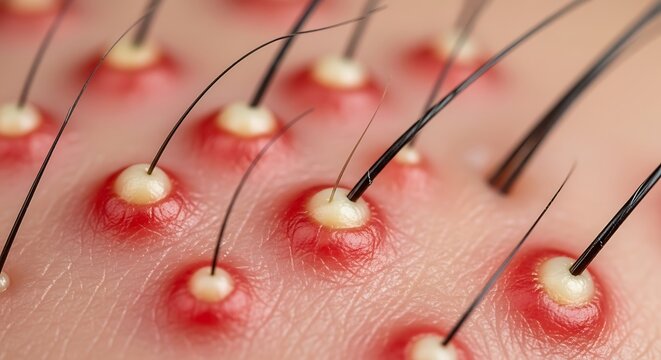
Sometimes it does so cleanly. Sometimes it doesn’t. When the hair can’t find the exit, it curls back on itself or grows sideways under the epidermis. Your immune system correctly identifies a keratin shaft where keratin shouldn’t be and mounts an inflammatory response. White blood cells arrive. Fluid accumulates. You get a red bump, and if it collects enough inflammatory debris, a white head.
That’s folliculitis. In this context it’s usually sterile — meaning it’s an inflammatory reaction, not a bacterial invasion. It’s your body reacting to a trapped hair, in the same way it reacts to a splinter. The bump is the reaction, not the disease.
The Timeline: When to Expect Them
There’s a rhythm to this, and knowing it removes most of the fear.
The first two weeks rarely produce true folliculitis. What you see there is crusting, scabbing and the normal redness of fresh wounds. If you’re getting genuine pustules in week one, that’s a different conversation — see the red flags section below.
Weeks three to six are quiet. The transplanted hairs shed, the scalp looks calm, and many patients describe this as the “nothing is happening” phase.
Months two through five are peak ingrown hair season. This is when the bulk of new shafts attempt their first emergence, and it’s when almost all folliculitis appears. Some patients get three bumps total across the whole period. Others get waves — a cluster appears, resolves over a week, and another cluster shows up somewhere else. Both are normal. Density of bumps does not correlate with density of final results, which is the first thing worth internalising.
Months six to twelve should be largely clear. The occasional bump still happens — you can get an ingrown hair on a transplanted scalp for the same reason you can get one on your face — but a scalp that’s still erupting in significant folliculitis at month eight deserves a proper look.
What a Normal Bump Looks Like
Specificity helps more than reassurance. A benign post-transplant pimple is small — usually two to four millimetres. It’s red or pink at the base. It may have a white or yellowish head. It’s sometimes slightly tender to direct pressure but doesn’t hurt when you’re not touching it.
Crucially, it’s localised. The redness stops at the edge of the bump rather than spreading outward into the surrounding skin. It doesn’t feel hot. It doesn’t throb. It rises, sits around for three to seven days, and then either drains a tiny amount of fluid on its own or flattens and disappears. Very often, if you look closely once it settles, you’ll find a new hair standing where the bump used to be. That’s the whole story, right there.
The deeper ones behave differently. A hair trapped further down produces a firmer, more painful lump with no visible head — sometimes described as a cyst-like bump. These take longer, up to two weeks, and are more uncomfortable, but they’re still usually the same benign process happening at a lower level. They’re the ones most likely to make you want to intervene, and the ones where intervening does the most damage.
What Is Not Normal: The Real Red Flags
Here’s where the honest line sits. Contact your clinic — properly, with photos — if you see any of the following.
- Spreading redness. Not a red bump, but redness expanding outward from it across the scalp, sometimes with a defined advancing edge.
- Warmth. The area feels noticeably hotter than surrounding skin.
- Genuine pain that’s present at rest, not just when pressed, and that’s getting worse rather than better day over day.
- Fever, chills, or feeling systemically unwell.
- Thick, coloured, foul-smelling discharge — as opposed to the small amount of clear or slightly cloudy fluid a normal bump releases.
- Large fluctuant swelling — a soft, fluid-filled pocket rather than a small firm bump. That may be an abscess.
- Timing that doesn’t fit. Multiple pustules in the first week, before any hair is trying to grow, are more suspicious than the same bumps at month three.
- Bumps that won’t resolve. Anything persisting beyond two to three weeks in the same spot.
- Swollen, tender lymph nodes in the neck or behind the ears.
True bacterial infection after a modern transplant is uncommon — well under a few percent in properly run clinics — but it is real, and it’s treatable when caught early and genuinely damaging when ignored. This is not a situation for waiting it out. If you’re one of the many people who travelled for a hair transplant Turkey clinic and are now healing thousands of kilometres away, send us a message on WhatsApp with a clear photo in daylight. It takes two minutes and it’s the single most useful thing you can do. Guessing from a forum thread is not a substitute for someone who knows what your scalp looked like on day one.
Why Picking Is the Worst Thing You Can Do
You know you shouldn’t. You’ll want to anyway.
The urge to squeeze is close to irresistible, especially when there’s a visible white head sitting there. But consider what’s inside that bump. It’s not just pus — it’s a follicle you paid for, one of a finite number your donor area was ever going to give you. Squeeze hard enough to evacuate the bump and you may evacuate the graft with it. It happens. People message us with a small hair-bearing plug in their fingertips and a very specific kind of regret.
Beyond graft loss, picking introduces bacteria from your fingers into an open follicular wound, converting the sterile folliculitis you had into the bacterial one you were worried about. It also drives inflammation deeper, which is what turns a superficial bump into a lasting mark or a small pitted scar in the recipient area — a cosmetic problem far more permanent than the pimple ever was.
If you’re in the first few months, treat your scalp like it isn’t yours to squeeze. Sit on your hands. Keep your nails short. If you catch yourself unconsciously exploring the bumps at your desk, that’s worth noticing — a lot of post-transplant picking is anxiety behaviour rather than a considered decision.
What Actually Helps at Home
The useful interventions are boring, which is a good sign.
Warm compresses are the workhorse. A clean cloth soaked in warm — not hot — water, held gently against the area for five to ten minutes, two or three times a day. This softens the skin over the trapped hair and encourages the follicle to release on its own. It’s the closest thing to a genuinely effective home treatment, and it requires no pressure at all. Rest the cloth. Don’t rub, don’t scrub.
Keep washing. A lot of people react to bumps by washing less, on the theory that they’re irritating the scalp. That’s backwards after the first two weeks. Gentle, regular washing with the shampoo your clinic gave you clears the sebum, dead skin and debris that block follicular openings in the first place. If you’re past the delicate early window, a soft massage with fingertips (never nails) during washing helps free superficial trapped hairs.
Leave the drugstore acne aisle alone. Benzoyl peroxide, salicylic acid, alcohol-based toners and strong exfoliants are formulated for sebaceous acne, not for a healing surgical field. They dry and irritate the recipient area at exactly the wrong stage. The same applies to picking up antibiotics without being told to — self-prescribing is how you end up treating the wrong problem while the right one progresses.
Beyond that: don’t wear tight caps that trap sweat against the scalp, keep pillowcases clean, and if you sweat heavily in the gym, rinse the scalp afterwards rather than letting salt sit on healing skin.
What We Do at the Clinic
When a patient sends us a photo, the first job is triage: benign folliculitis, or something needing intervention.
For the benign majority, the advice is what’s above, plus patience and follow-up photos if it changes. For a deep, painful trapped hair that isn’t resolving with compresses, a clinician can release it — a sterile needle or fine blade used to open the skin over the shaft, freeing it without disturbing the graft. This takes seconds and is genuinely different from squeezing at home, because it’s precise, sterile, and performed by someone who knows the graft’s angle and depth. It’s not a procedure to attempt with a sewing needle and a YouTube video.
For suspected bacterial infection, treatment is topical or oral antibiotics, chosen based on presentation and sometimes a swab. For a true abscess, drainage. Both are straightforward when addressed early.
At Hairpol this kind of question sits inside the aftercare relationship rather than outside it. Every patient has a channel to reach the team, and the follow-up doesn’t end when you leave the building or board a flight. That’s a deliberate choice, and honestly it’s one of the clearer differences between clinics — plenty of operations are excellent in theatre and unreachable in month three. If you’re evaluating options for a hair transplant Turkey based, ask what happens ninety days later, when the bumps show up and you’re at home with a question. The answer tells you a great deal.
Do Pimples Damage Your Result?
This is the question underneath the question, so let’s answer it directly.
Ordinary post-transplant folliculitis, left alone and managed with compresses, does not meaningfully affect your final result. The follicle survives the inflammation. The hair emerges, sometimes a few weeks later than its neighbours, and grows normally. The bump was a doorway problem, not a root problem.
What can damage your result is what happens around the bumps. Aggressive squeezing that extracts grafts. Deep, repeated infection that scars the follicular unit. Picked lesions that heal into small depressions or persistent redness in the hairline, where every millimetre is visible. Weeks of harsh acne products that irritate a whole zone of healing skin.
In other words: the folliculitis is rarely the threat. The response to the folliculitis is. This is a recurring theme in transplant recovery — the same logic applies to shock loss, where the alarming thing is a normal phase and the damage comes from panicking into bad decisions. Most of what we ask patients to do in the first year is a variation on the same instruction: let the process happen, and tell us if something looks genuinely different.
The Donor Area Gets Them Too
Attention naturally goes to the recipient zone, but the back and sides break out as well, and it surprises people.
The donor area has thousands of tiny extraction wounds, each of which heals over. Hairs that were partially transected during extraction, or that were in an early growth phase when the punch passed nearby, can struggle to exit through that healed surface — the same mechanism as the front, different geography. Donor folliculitis tends to appear slightly earlier, around weeks four to eight, and it tends to resolve faster.
The management is the same: warm compresses, clean washing, no picking. The one practical difference is that the donor area is harder to see, so you’re often diagnosing by feel. If you’re running your hand over the back of your head and finding a few small tender bumps at week six, that’s within the range of normal. If you’re finding a large hot swelling, that isn’t. Photos in a mirror — or taken by someone else — are worth the awkwardness. This region matters for the long game, because donor quality determines what’s possible in any future session, and it’s one of the things we look at closely during before-and-after assessment.
Curly, Coarse and Afro Hair: A Higher Baseline Risk
Not every scalp carries the same risk, and pretending otherwise helps nobody.
Tightly curled hair grows in a curved follicle and exits the skin at a sharp angle. That curvature is exactly what makes the shaft more likely to re-enter the skin instead of clearing it — which is why ingrown hairs and pseudofolliculitis are far more common in Afro-textured hair even without surgery. Add a healed surgical channel to that equation and the probability rises.
If this is your hair type, expect more bumps, expect them to last a little longer, and don’t read that as a sign that your procedure went badly. What matters is that the surgical planning accounted for it: curl direction assessed, incision angles matched to the natural curve, extraction technique adapted to curved follicles under the skin. That’s the entire premise of Afro hair transplantation as a distinct discipline rather than a marketing label. A clinic that treats every scalp identically will produce more trapped hairs in curly patients and won’t be able to explain why.
The same is partly true of very coarse, thick straight hair, and of patients with a history of ingrown hairs when shaving. If you got razor bumps on your neck your whole life, tell your surgeon at consultation. It changes what we expect and what we tell you to expect.
Skin Type, Sebum and Pre-Existing Conditions
Your scalp doesn’t arrive at surgery as a blank surface. It has a history.
Oily scalps produce more sebum, and sebum plus dead skin is the classic recipe for a blocked follicular opening. Patients with seborrhoeic dermatitis — the persistent flaking and redness that many people have quietly lived with for years — tend to have more inflammatory activity in the months after surgery. So do patients with a history of acne on the hairline or scalp. None of these are reasons not to have a transplant. They’re reasons to be honest at the consultation, so the aftercare protocol can be adapted rather than handed out as a generic photocopy.
Underlying scalp conditions are also worth stabilising before surgery where possible. An inflamed, flaking scalp is a worse environment for graft survival and a worse environment for clean healing, and treating it in advance is cheaper and easier than firefighting at month two. Where the scalp needs support, medical hair treatments can improve the surface conditions before and after a procedure, which is one of the less glamorous but more useful parts of the plan.
Diabetes, immunosuppression, and smoking all raise infection risk and slow healing. These aren’t disqualifiers either, but they change the threshold at which we want to hear from you about a bump.
Prevention: What Actually Moves the Needle
You can’t prevent folliculitis entirely, and any clinic promising you a bump-free recovery is telling you what you want to hear. But you can shift the odds.
The largest factor is the surgery itself. Correct incision depth, appropriate channel size for the graft, angles matched to native growth, atraumatic handling — these determine how cleanly the skin heals and how easily the new shaft finds its way out. Grafts planted too deep are a well-known cause of persistent folliculitis and buried hairs. That’s a technical problem created in theatre, not a home care problem, and it’s a good reason to look hard at technique rather than price. Precision instrumentation matters here, which is part of why Sapphire FUE and DHI approaches focus so heavily on channel geometry and graft depth control.
After that, it’s the unglamorous list: follow the washing protocol from day one, don’t skip washes because you’re nervous, keep hats loose and clean, don’t let sweat sit, don’t pick. Most of the patients we see with real complications made a series of small reasonable-seeming decisions — a skipped wash here, a squeezed bump there, an acne cream from a pharmacy — rather than one dramatic mistake. Aftercare failures compound quietly, which is a point worth reading more about in our guide to common aftercare mistakes.
The Psychological Part Nobody Mentions
There’s a reason these bumps hit harder than they should.
By month three you’ve been waiting a long time. You’ve had the shedding phase, watched the transplanted hairs fall out, told yourself it was normal, and started scanning your hairline daily for evidence that this was worth it. You’re already primed to interpret every change as a verdict. Then your scalp breaks out and the interpretation writes itself: it’s failing.
It isn’t. But the anxiety is real, and it’s made worse by the fact that most people go through this phase alone, without anyone to compare notes with. A hair transplant is a very private project for most patients. That’s precisely why we’d rather you message us with a bump that turns out to be nothing than sit with a low-grade dread for six weeks. There’s no such thing as a stupid photo at month three. The people who annoy their clinic with questions tend to have better outcomes than the people who quietly wait and hope.
It’s also worth remembering that the bumps are, functionally, evidence of activity. Follicles that are dormant don’t produce ingrown hairs. Something is pushing.
A Practical Rule of Thumb
If you take one thing away, make it this framework.
Small, localised, comes and goes, appears between month two and month five, sometimes leaves a hair behind: normal. Warm compress, gentle washing, hands off, move on with your life.
Spreading, hot, painful at rest, feverish, foul discharge, appears in week one, or refuses to go away: not normal. Photograph it and contact your clinic today, not next week.
That’s genuinely most of it. The middle ground — a bump that’s bigger than you’d like but not alarming — is exactly what your clinic’s messaging channel exists for. Anyone considering a hair transplant Turkey option should factor this in when comparing quotes: the price on the invoice buys you a day in an operating theatre, but the value shows up over the following twelve months, in whether there’s a competent person on the other end of the message when you need one.
Where to Go From Here
Bumps in month three are not a sign that your money was wasted. In the vast majority of cases they’re the physical evidence of follicles doing exactly what you paid them to do — fighting their way through healed skin, a little clumsily, on their way to becoming the result you’re waiting for.
Your job is narrow: don’t squeeze, keep it clean, use warm compresses, and know the red flags well enough to act on them without hesitating. Everything else is time.
If you’re staring at your scalp right now and not sure which category you’re in, don’t spend the evening scrolling forums. Send us a message on WhatsApp with a photo taken in good daylight — a clear shot beats a paragraph of description every time — and we’ll tell you honestly whether it’s a normal bump or something we need to look at. If you’re at an earlier stage and still weighing up the procedure itself, you can read more about how we plan and perform hair transplantation at Hairpol, or just get in touch and ask. We’d rather answer the question now than fix the consequence later.
Find this helpful? Add Hairpol as a preferred source on Google.
Get a Free Consultation
Answer a few questions and the medical team will review your situation.
