
Nobody warns you that the hardest part of a hair transplant is not the surgery. It is the middle of the third week, standing in front of a bathroom mirror at eleven at night, watching hairs you paid for come away on your fingertips.
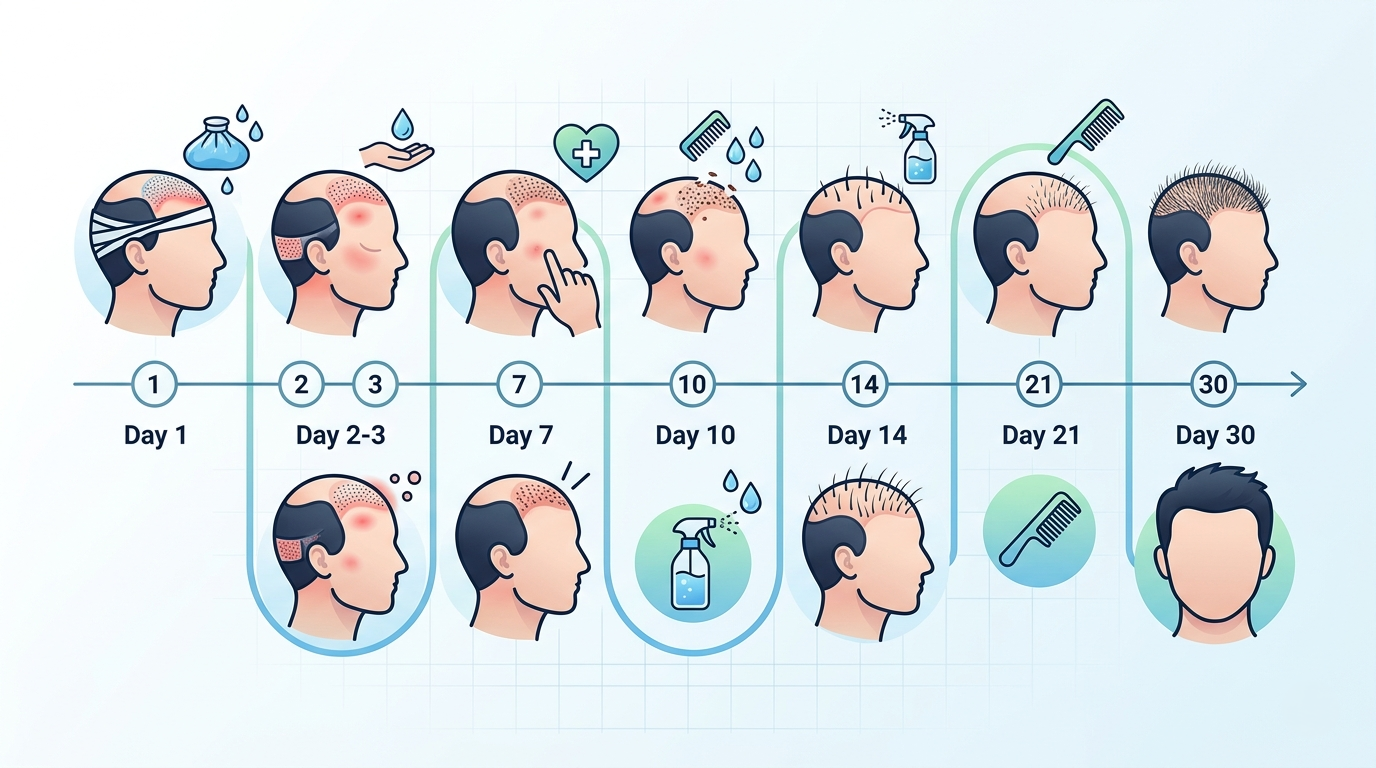
The first week gets all the attention. It has the swelling, the careful sleeping position, the crusts, the first wash, the photographs people post. Clinics prepare you for it in detail because it happens while you are still in contact with them. Then day eight arrives, the crusts wash off, you fly home, and the guidance thins out at exactly the point where the strangest part of the month begins. What follows is a map of all thirty days, with most of the detail placed where most people are left guessing.
The short answer: Expect crusts and swelling on days 1 to 3, your first careful washes on days 4 to 7, crusts fully cleared between day 8 and day 10, a close to normal appearance by days 11 to 14 when most people return to work, shedding of the transplanted hairs from around day 15 onward, and a cautious return to exercise between day 22 and day 30. The shedding is expected. The follicle stays behind.
Days 1 to 3: The Short Version of the Part You Already Read About
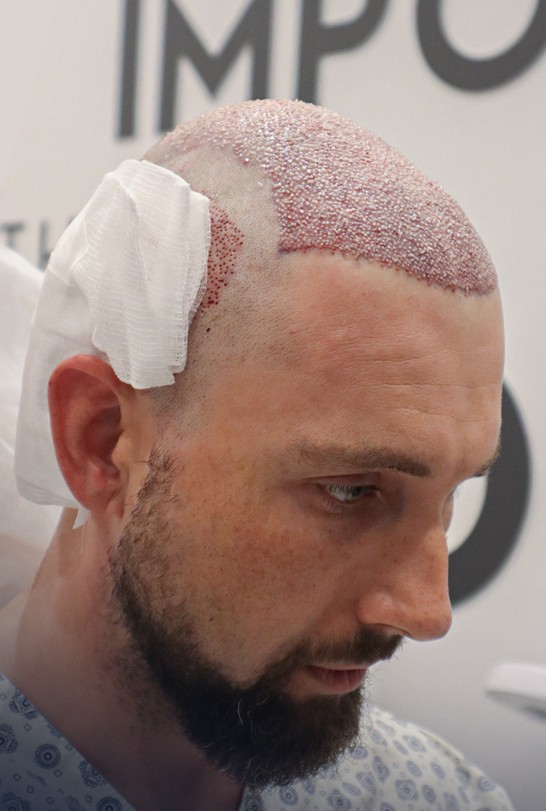
These are the days everyone documents, so we will keep them compressed. Your recipient area is covered in small dark crusts, one over each graft, and they look far worse than they are. Swelling usually appears on day two rather than day one, migrates downward toward the forehead and occasionally the eyes, peaks around day three, then drains away over the following forty-eight hours. Sleeping is done on your back, head raised on two pillows or a travel pillow, and nothing touches the grafted area.
Pain is rarely the problem people brace for. The donor area at the back of the head is typically more uncomfortable than the recipient zone, and it tends to feel tight rather than sharp. What actually bothers most patients in this window is the awkwardness: not being able to lie on your side, not being able to pull a shirt over your head, sleeping badly for three nights in a row.
If you want the hour by hour version of this stretch, we wrote it out separately in what to expect in the first 7 days after a hair transplant. Everything from here forward assumes you have that part handled.
Days 4 to 7: The First Washes, Compressed
Somewhere between day three and day five, depending on your surgeon’s protocol, washing begins. A lotion or foam is applied to soften the crusts, left in place for a set time, then rinsed with lukewarm water poured by hand or from a low-pressure cup. No shower head aimed at the grafts. No rubbing, no fingernails, no towel dragged across the top of your head.
By day seven the crusts have started to loosen at the edges and some have already come away on their own. The skin underneath often looks pink or red, which is normal and fades over the following weeks, more slowly on pale skin than on darker skin. Donor area scabs behave differently and generally clear faster than the ones at the front.
The washing routine changes week by week through the first month, and being too gentle is as much of a problem as being too rough, because crusts still sitting on a graft past day ten irritate it and delay everything. Our week by week washing guide sets out the full progression. At Hairpol we walk through the first wash physically with the patient before discharge rather than handing over a leaflet, because almost every problem we see in this window comes from someone who was too frightened to touch their own head.
Days 8 to 10: The Crusts Come Off and the Site Looks Bare
Day ten is the most searched day of the first month, and there is a good reason for that. It is the day a transplant stops looking like a transplant and starts looking like nothing much at all.
By day eight to ten, with correct washing, the crusts should be gone. Not thinning. Gone. What is left underneath is a field of very short transplanted hairs sitting in slightly pink skin, and the honest reaction from most patients is disappointment, because the crusts were doing a lot of visual work. A crusted scalp reads as dense. A cleared scalp at day ten reads as sparse, because you are now seeing individual hairs at two or three millimetres with scalp fully visible between them.
The pink outlasts the crusts by a long way. On lighter skin it can persist for four to eight weeks and always looks worse under overhead lighting and in photographs than it does in a mirror. On darker skin the recipient area often shows as a slightly darker patch instead, and it settles on a similar schedule.
If you still have stubborn crusts at day twelve, treat it as a signal rather than a disaster. It nearly always means the washing has been too cautious. Softening product left on for longer, more patience during the rinse, and gentle circular fingertip pressure will clear them within a few days. Picking at them will not, and picking is the single most damaging thing a patient can do in the first month.
Is It Normal to See Hairs Coming Away With the Crusts?
Yes, and this is where the first wave of panic tends to hit.
Each crust forms around the base of a transplanted hair. When the crust releases, it frequently takes the visible hair shaft with it. Patients see a small dark speck with a hair attached sitting on a fingertip and conclude that a graft has just been pulled out. What has come away is the hair, not the follicle. The follicle was seated below the surface within the first few days and is no longer removable by washing.
Timing is the useful test here. Grafts are genuinely vulnerable in the first seventy-two hours, when a hard knock or a fingernail can dislodge one. After roughly day seven to ten they are anchored, and by day ten the thing that comes off in your hand is a shed hair. If you are unsure, photograph what came away instead of trying to describe it from memory at your next review.
What is not normal in this band: bleeding from a graft site, a spreading area of redness that feels hot to the touch, discharge, or pain that is increasing rather than decreasing day on day. Those are clinic calls, not forum questions.
Days 11 to 14: Two Weeks In, and Almost Invisible
The two week mark is the practical turning point of the first month. Swelling is long gone. Crusts are cleared. The donor area, if it was shaved, is growing back at roughly a centimetre a month and by day fourteen carries enough stubble to blend. What remains visible is the pink of the recipient zone and the fact that your hair is very short everywhere.
Most patients at this point look like someone who recently had a close haircut and caught a little sun. That is the standard we use when we tell people when they can be seen in public without needing to explain anything.
Sensation is still strange. The recipient area is often numb or tingly, the donor area may feel tight when you raise your eyebrows, and there is frequently itching, which is a healing sign rather than a problem, though it is a miserable one. Scratching is out. A prescribed moisturiser or a saline spray helps considerably more than people expect it to.
Sleeping position usually returns to normal somewhere between day ten and day fourteen, which is the first genuine relief of the month. Confirm the exact day with your own surgeon rather than assuming, because protocols differ and the answer depends partly on how many grafts you had, where they were placed, and whether they were implanted with DHI implanter pens.
Can You Go Back to Work at Two Weeks?
For most desk-based jobs, yes, and a large proportion of our international patients travelling to Turkey plan exactly this: procedure, ten to fourteen days at home or on leave, then straight back.
The variables are the ones people forget to check. If your work involves heavy lifting, heat, dust, or a helmet or hard hat, two weeks is too early and four is the realistic number. If you work outdoors, the recipient area burns easily and sun on healing skin makes the pink worse and slower, so a loose hat becomes necessary rather than optional, and it needs to sit without pressing on the grafts.
Then there is the social variable, which is what actually determines when people go back. If nobody at your workplace knows, day fourteen with a short crop passes without comment. If you had long hair before and turn up shaved, the haircut is what colleagues will notice, and some patients handle that by cutting their hair short two or three weeks before surgery so the change happens in stages.
If you are somewhere in this window and cannot tell whether what you are looking at is ordinary healing or something that needs attention, a photograph settles it faster than any forum thread. Our patients routinely send images at day 10 and again at day 21, and anyone can send photos for a recovery check rather than waiting for a scheduled review to come round.
Days 15 to 21: Three Weeks, and It All Starts Falling Out
This is the part of the first month nobody is emotionally prepared for, no matter how carefully it was explained beforehand.
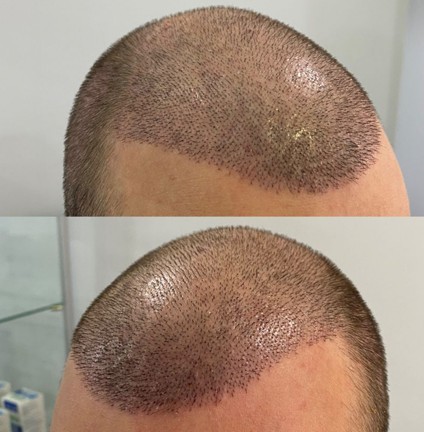
Starting somewhere around day fifteen and running through weeks three, four and five, the transplanted hairs shed. They come out in the shower, on the pillow, on a towel, on your hand when you run it over your head. Over a few weeks the recipient area can return to looking almost exactly as it did before surgery, and sometimes briefly worse, because the surrounding native hair is short too.
The mechanism is straightforward even when the experience is not. Moving a follicle interrupts its growth cycle. The follicle responds by releasing the hair shaft it was carrying and dropping into a resting phase, then re-entering active growth on its own schedule. The shaft you are losing is dead material. The follicle underneath is intact, fed by its new blood supply, and simply dormant.
Timelines vary more than most guides admit. Some patients shed heavily and finish inside three weeks. Others shed gradually across two months. A minority keep a proportion of transplanted hairs that never shed at all, which feels lucky and means very little about the final result. New growth generally starts at month three to four, becomes convincing at month six to eight, and matures through month twelve and beyond.
At Hairpol we tell patients before surgery to expect the three week shed and to send a photograph rather than book an emergency consultation when it arrives. It is not a complication. It is the schedule.
Is Shedding at Three Weeks a Sign Something Went Wrong?
Almost never. The shedding of transplanted hairs is the expected sequence, and its absence tells you nothing useful in the other direction either.
There is a separate phenomenon that overlaps with it, and this is where the confusion usually starts. Shock loss is the temporary shedding of existing native hair around or between the grafts, triggered by surgical trauma to that area. It is more common in patients who still had significant native hair in the transplanted zone, and more noticeable in women having a hair transplant, whose procedures are often performed through existing hair rather than into bare scalp. Shock loss also recovers in most cases, on a timeline of roughly three to six months, though miniaturised hair that was already on its way out may not return.
The distinction matters because it changes what you are actually seeing at week three. Transplant shed alone leaves the recipient zone looking roughly as it did before surgery. Shock loss can make it look briefly thinner than before, which is a very different feeling to sit with. We set out the mechanism, the risk factors and the recovery window in shock loss after a hair transplant: why it happens and when it stops.
What would genuinely concern us at week three is different: an area of persistent redness with swelling and warmth, discharge from graft sites, or a fever. Those point toward infection, which is uncommon, entirely treatable, and worth catching in days rather than weeks.
Days 22 to 30: Numbness Fades and Sweat Comes Back
The fourth week is quiet, and after three weeks of visible drama that is welcome.
Numbness in the recipient and donor areas begins to lift, though it does so unevenly and often with an unpleasant pins and needles stage in between. Full sensation commonly takes two to six months to return, and a small persistent patch near the crown or across the donor zone can last longer than that. This is nerve regeneration doing exactly what nerve regeneration does, which is take its time.
Exercise is the question everyone asks in this window. Light walking is usually fine from the first week. Between day twenty-one and day thirty, most surgeons clear light cardio and moderate resistance work with three conditions attached: no head-down positions, no heavy straining that spikes blood pressure in the scalp, and nothing that drags a strap, helmet or bar across the grafted area. Contact sport, swimming pools, saunas and full intensity training generally wait until week four to six. Sweat itself is no longer dangerous by this point, but it should be rinsed off rather than left to dry on healing skin.
By day thirty your hair is short, the recipient area is mostly or entirely shed, the pinkness is fading, and to anyone who does not know, you look like a person with a very short haircut. That is the correct outcome for day thirty, and our before and after gallery shows what the same heads look like once growth arrives. It is also, visually, the flattest point of the entire process.
Normal, or Call the Clinic? A Line Through Each Band
Most first month anxiety comes from not knowing where the line sits. Here is where we draw it.
- Days 1 to 3: Normal — swelling that migrates to the forehead and eyes, slight oozing on the first night, tightness at the donor site. Call — swelling with fever, or bleeding that does not stop with light pressure.
- Days 4 to 7: Normal — crusts, redness, itching, a few hairs in the rinse water. Call — a graft site that bleeds repeatedly, or pain that increases day on day.
- Days 8 to 14: Normal — crusts clearing, pink skin, numbness, hairs coming away attached to crusts. Call — crusts still firmly attached at day fourteen, discharge, or warmth and spreading redness.
- Days 15 to 21: Normal — heavy shedding of transplanted hairs, itching, small spots as hairs push through. Call — painful boils, an area that stays swollen, or shedding accompanied by pain.
- Days 22 to 30: Normal — continued shedding, patchy numbness, fading pinkness. Call — a hard raised area at the donor site, or a numb patch that turns painful.
The spots deserve a note of their own, because they arrive on schedule and frighten people badly. Small white-headed pimples in the recipient area from week three onward are usually ingrown hairs pushing through healing skin, and they resolve on their own. What needs attention is a cluster that is large, painful, and still there a week later.
What the Donor Area Is Doing While You Watch the Front
Almost all first month attention goes to the recipient zone, and yet the donor area is the part that quietly determines how discreet you look in month two.
Scabs at the back clear faster than at the front, usually within seven to ten days. What follows is a period of redness in the extraction sites that is genuinely more visible than most patients expect, particularly if the donor was shaved to zero and your hair is dark against pale skin. It fades over four to eight weeks and disappears entirely under a few millimetres of regrowth.
Donor hair regrows on the normal cycle, roughly a centimetre a month, so by day thirty you have around a centimetre of cover and the extraction pattern is no longer readable from conversational distance. Tightness across the back of the head is common through the first few weeks and eases without intervention. A donor area that still looks visibly thin at three to four months is a different conversation entirely, and one worth having with your surgeon rather than with strangers online.
Why Day 30 Is a Starting Line Rather Than a Result
The most useful thing you can do at the end of the first month is stop assessing.
Everything visible at day thirty is healing, not growth. The result you paid for begins arriving at month three, becomes recognisable at month six, and finishes somewhere between month twelve and month eighteen depending on the area treated and how much the hair calibre thickens along the way. Judging the outcome in the first month is like judging a building by its scaffolding. We laid out the full arc in our recovery timeline from day 1 to 12 months, and these thirty days occupy a very small corner of it.
Two habits pay off from here. Take a standardised photograph on the same date each month, in the same light, from the same three angles, because gradual change is invisible in a mirror and obvious in a series. And stay on whatever medical hair treatment your surgeon prescribed for you. If minoxidil or finasteride is part of your plan, the timing, the dose and whether you continue at all are decisions for your doctor rather than a forum, and the point of them is to protect the native hair that was never transplanted, which is the most common reason a good result looks worse three years later.
At Hairpol, our first month reviews are deliberately unexciting. We check that the crusts cleared cleanly, that the donor is healing evenly, and that the patient understood the shed before it happened rather than after. If you are in the middle of your own first thirty days and something does not match what you were told, or you are still planning surgery and want an honest account of what the first month will cost you in time and appearance, you can read how we approach hair transplantation at Hairpol and arrange a consultation with our team in Ataşehir for a hair transplant in Istanbul.
Find this helpful? Add Hairpol as a preferred source on Google.
Get a Free Consultation
Answer a few questions and the medical team will review your situation.
