

“Guaranteed results.” It is one of the most comforting phrases a clinic can print, and one of the least informative. Nobody who has spent time around hair surgery uses it lightly, because hair grows from living follicles in living tissue, in people who smoke or don’t, sleep well or don’t, and keep losing native hair at their own pace.
And yet the question behind it is completely fair. You are travelling, paying and trusting a team with something visible for the rest of your life. You want to know what happens if it does not go to plan. Part of the answer is a document, part of it is a process, and it helps to know which is which before you read any certificate.
What it means in practice: a hair transplant guarantee certificate can mean very different documents, so read what yours records and what it does not promise. No certificate can guarantee that every graft grows, and results are judged at 12 to 18 months. At Hairpol, the Hair Transplant Guarantee Certificate records the number of grafts placed during your procedure; it does not guarantee a particular result, a graft survival rate or lifetime cover.
The advert version and the real version
The advert version of a guarantee is simple: if your hair does not grow, you get it fixed or your money back. It sounds like a product warranty, and that is the problem. A hair transplant is not a product. It is a medical procedure whose outcome depends on the surgical team, your donor hair, your skin, your healing and your behaviour during the first weeks.
The real version is more modest and more useful. Some clinics use the word for a record of what was done; others for a description of follow-up; a few for a promise about growth with conditions attached. Each can be legitimate, as long as the document says plainly which one it is.
That is why the most important part of any certificate is not the word “guarantee” at the top. It is the paragraph underneath that says what the document records and what it does not promise. Read that paragraph before anything else.
Are hair transplants guaranteed to work?
No honest clinic will promise that every graft survives. In a well-run procedure, the large majority of grafts usually take, but the figure varies from patient to patient. Graft handling, time outside the body, the density of placement and your own healing all play a part. So do smoking, certain medications and how carefully the first ten days of aftercare are followed. Our article on graft survival rate and how clinics maximise it explains the factors in detail.
There is also the hair you did not have transplanted. A transplant moves follicles that are generally resistant to the hormone behind pattern loss, but the native hair around them can continue to thin. A hairline that looks perfect at 12 months can look different at five years if the hair behind it keeps receding. No certificate can cover that, and a clinic that implies otherwise is overpromising.
Density expectations deserve a sentence of their own. A transplant redistributes a limited supply of donor hair, so the aim is usually convincing coverage at normal viewing distance rather than the density you had at eighteen. A plan that promises both full coverage of a large area and teenage density in one session is promising more grafts than most donor areas can give.
What a clinic can control is the quality of the plan, the technique and the care. Those are the things worth judging before you book, whatever the paperwork is called.
What does a hair transplant guarantee certificate actually cover?
Wording varies between clinics, so it helps to know the building blocks. Depending on the clinic, a written guarantee may contain some of the following, and it is worth knowing which ones yours includes and which it leaves to other documents.
- A record of the procedure: date, technique, the number of grafts placed and the zones treated.
- Follow-up arrangements: what support you receive after you leave, sometimes set out in the package rather than the certificate.
- A review point: when the result is assessed, typically around 12 months for the front and later for the crown.
- What happens if growth falls short: whether a further session is planned and how it is priced.
- Your obligations: following aftercare instructions, sending photos and disclosing health changes.
Read the exclusions with the same care. They are usually where the real scope is defined.
One practical test helps more than any wording: ask the clinic to describe, step by step, how a shortfall was handled for a past patient, without names. You are not asking for a promise; you are asking how the process works in real life. A team that can walk you through photos, review, decision and date without hesitation has usually done it before, and that tells you more than an adjective on a certificate.
The Hairpol guarantee certificate: what it records
At Hairpol, the Hair Transplant Guarantee Certificate is a procedure document: it records the number of grafts applied and placed during your operation. It does not guarantee a particular aesthetic or clinical result, a graft survival rate or lifetime cover. Follow-up after you go home is a separate part of the package, not something the certificate promises.
The health insurance mentioned in our package is a separate document again. Ask what it covers and who provides it before you travel. Our hair transplant package in Turkey shows the rest of what is included in the stay.
If you are comparing clinics, the fairest comparison starts from your own hair. Request a free hair analysis and you will receive a graft range, a proposed technique and the price for that plan; set it next to other offers line by line, including what each clinic’s paperwork actually records.
When can a hair transplant result be judged?
Not before twelve months for the front. Transplanted hair usually sheds in the first weeks, starts growing from around month three or four, and reaches most of its density between months 9 and 12 at the front. The crown is slower and can take 12 to 18 months. Any judgement about growth, under any kind of document, belongs after that point.
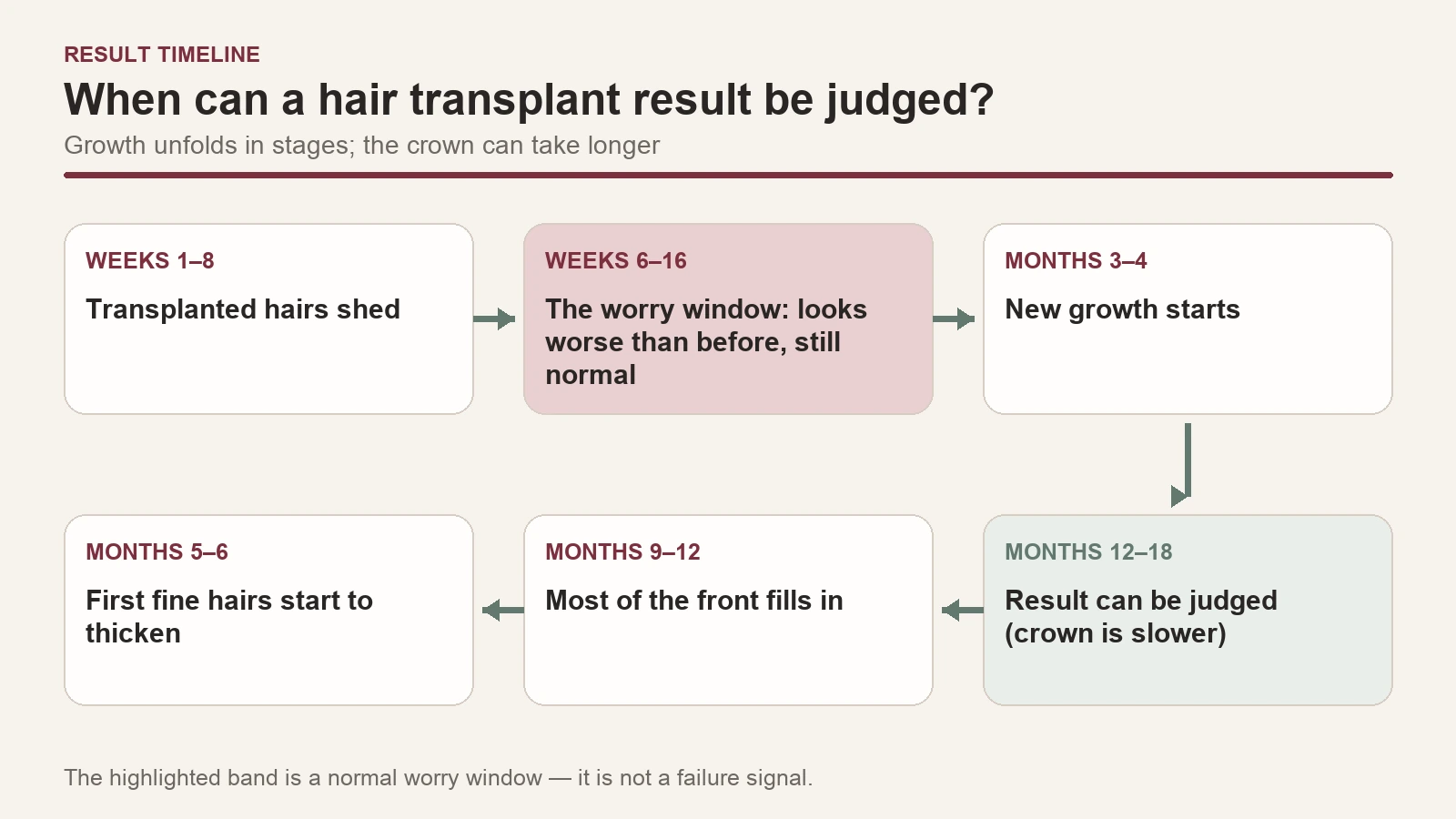
That timeline matters more than any date printed on a certificate. Follow-up that runs through the first year lets you and the team compare photos across the months that count, and the twelve-month set is the one that shows what grew.
You will also see “lifetime guarantee” in some adverts. Transplanted follicles taken from a healthy donor area are generally long-lasting, which is the basis for that phrase. But “lifetime” cannot extend to native hair loss elsewhere, and it rarely means a free procedure at any point in the future. Ask what, exactly, lasts a lifetime.
Month four: when most patients start to worry
There is a predictable moment when people start to worry. It is not at month twelve. It is somewhere between weeks six and sixteen, when the transplanted hairs have shed, the new ones have not yet broken through, and the mirror looks worse than it did before surgery. A patient who felt confident at day ten can feel cheated at month three, even though nothing has gone wrong.
This is where good follow-up shows. A clear timeline turns the answer to “is this normal?” into a date rather than an argument, and a good aftercare team answers the question with a photo comparison and a short explanation. Most of these worries settle by month five or six, when the first fine hairs appear and start to thicken.
If you are in that window now, the best thing you can do is keep taking photos in the same light every four weeks and send them to the clinic. Patterns are much easier to read across a sequence than in a single anxious snapshot, and a sequence is also exactly the evidence a fair review would use later.
Why written terms matter more when you travel
When your clinic is a short drive away, a vague promise is easier to live with. You can walk in, ask, and see the same doctor. When the clinic is in another country, the document does more of the work. It is what you will read at month eight in your own kitchen, without anyone to explain it, and it is what both sides will rely on if a review is needed.
So ask for the certificate in a language you read comfortably, with your name, the procedure date, the technique and the graft count filled in. Keep a digital copy with your pre-operative photos and your aftercare instructions in one folder. If anything is agreed later by message, ask for it to be confirmed in writing and add it to the same folder.
None of this signals distrust. Clinics that work with international patients every day are used to these requests, and a tidy paper trail makes any later conversation faster and calmer for everyone.
What a guarantee usually does not cover
Exclusions are not a trick; they reflect things no surgical team controls. The most common ones are ongoing loss of native hair in untreated areas, results affected by not following aftercare, smoking or certain medical conditions, a change in medication that was agreed as part of the plan, and expectations of density beyond what the donor area could support.
The temporary shedding that most patients see in the first two months is also normal and is not a failure. Many anxious messages arrive at week six, when the grafted area looks thinner than it did on day ten. That is expected, and it is one reason the review point sits much later. Our guide to the most common aftercare mistakes covers the habits that most often reduce growth.
Protecting native hair is a separate part of the plan. Medication such as finasteride or minoxidil, or treatments from our hair treatments department, can help some patients hold on to the hair they have, but they should only be started with a doctor’s approval.
What happens if growth falls short?
The process is usually calmer than people expect. You send standardised photos at the review point, ideally in the same light and angles as your pre-operative set. The medical team compares them with the plan, checks the donor area and assesses whether the shortfall is real or a matter of timing, styling or lighting.
If more grafts would help, the next step is usually a small additional session, planned once the first result has matured. At Hairpol a second hair transplant is priced the same way as a first one, by the plan and graft count, with no separate revision surcharge; packages are typically $2,500 to $5,000, and the exact price follows a free hair analysis.
Timing matters here too. Most careful clinics prefer to wait until the first result has fully matured before planning more surgery, because grafts that are still thickening at month ten can make an early touch-up unnecessary. Rushing a second session can also make the final result harder to judge.
A corrective session also needs donor capacity. That is one reason good clinics avoid using every available graft in the first procedure, and why your certificate should be read alongside your donor assessment rather than on its own.
Questions to ask any clinic about its guarantee
You do not need a lawyer to read a guarantee, but you do need to ask the right questions and get the answers in writing. These are the ones that matter most.
- What exactly does this document record, and what does it not promise?
- Is it a procedure record, a follow-up description or a promise about growth?
- How does follow-up work after I fly home, and who answers?
- If growth falls short at twelve months, how is a further session planned and priced?
- Is the document issued in my name, with the procedure details filled in?
- Does the insurance in the package cover complications, and in which country?
- Can I see a blank copy before I book?
A clinic that is clear about its paperwork will answer all of these without hesitation. Our list of questions to ask at consultation covers the clinical side of the same conversation.
Put the answers from each clinic on a single page and compare them line by line. Patients who do this usually find that two or three offers that looked similar on price are quite different on what happens after the flight home.
Red flags in guarantee language
Some phrases should make you slow down. “100% growth” or “guaranteed density” promises something biology does not allow. A “lifetime guarantee” with no written conditions is a slogan. A promise that exists only in a chat message, never in a document, is hard to rely on later. And a refund or guarantee that is only available if you pay a deposit today is a sales tool, not a safeguard.
A useful counter-test is to ask the same question twice, once by message and once on a call, and see whether the answers match. Consistency is a better sign of a real policy than enthusiasm, and it costs you nothing to check.
Watch, too, for guarantees that shift responsibility entirely to you. A list of patient obligations is normal; a document in which almost any outcome can be blamed on aftercare is not. The balance should feel fair when you read it.
None of this means a clinic with a strong certificate is better than one without. It means the certificate is one piece of evidence among several, alongside the doctor’s involvement, the plan and the results of real patients.
Guarantee, insurance and aftercare are three different things
Patients often merge these into one idea of “being covered”, but each does a different job. The guarantee certificate is whatever its text says it is; at Hairpol, a record of the grafts placed. The insurance, where included, deals with medical complications and unexpected costs during or after the trip. Aftercare is the day-to-day support that prevents most problems in the first place: washing instructions, medication, check-ins and a person to message when something looks strange.
Of the three, aftercare quietly does the most work. A patient who can send a photo at day five and get a clear answer the same day is far less likely to need either of the other two. When you compare clinics, ask how follow-up works once you are home, who answers, and how quickly.
Technique matters as well. Whether your plan uses sapphire FUE or another approach, the choice should be explained by your hair type and goals rather than by a claim that one blade guarantees better growth.
Choose on evidence, then read the certificate
The most reliable way to judge a clinic is still the oldest one: look at results from patients with hair like yours, at 12 months and beyond. Our before and after gallery shows real outcomes at different graft counts, and our practical checklist for choosing a clinic covers the rest of the comparison.
When you look at photos, check the lighting, the angle and the month. A result shown wet, under strong top light, at month six tells you less than a dry, evenly lit photo at month fourteen. Ask whether the patient in the picture had a similar donor area and hair loss pattern to yours; that comparison is the one that predicts your own outcome.
Then read the certificate as what it is: a written record, with exactly the scope its text gives it. If something in any clinic’s paperwork is unclear, ask before you book rather than after.
A plan built for your own hair is the best thing to hold any paperwork against. How the team designs, performs and follows up each procedure is described under hair transplantation, and the first step is a free analysis of your photos.
Find this helpful? Add Hairpol as a preferred source on Google.
Get a Free Consultation
Answer a few questions and the medical team will review your situation.
