
 Türkçe
 Deutsch
 Français
Medically reviewed by Dr. Barış Duman · Reviewed:
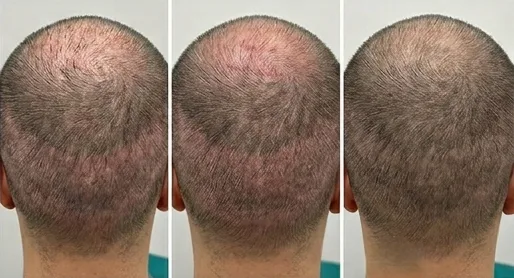
Short answer: 2 weeks after a hair transplant, most of the crusts have come off, some pinkness may remain in the transplant area and the grafts have settled in their new place. The most restrictive period is over: you return to normal washing, a loose hat can be worn and most people are back to their daily routine. Your doctor gives you the date for heavy exercise, the pool and the sauna. After this point it is normal for some of the transplanted hairs to fall out (shock loss).
Below you will find what you will see in the mirror on day 14, what is now allowed, what still has to wait and when you should get in touch with us. This article was written especially for patients who fly home a few days after the operation and spend the second week at home.
What do you see in the mirror on day 14?
- Crusts: With gentle daily washing, most of the crusts come off between days 8 and 10. On day 14 a few small crusts may remain; they come away on their own with washing.
- Redness: A pink tone may remain in the transplant area. In people with fair skin this can last a few more weeks and fades gradually.
- Short hairs: Hairs a few millimetres long are visible in the transplant area. Some of them will fall out over the coming weeks.
- Donor area: At the back and sides of the head, the shaved area starts to fill in with your own hair, and the points where grafts were taken become less and less noticeable.
- How it feels: Mild itching, numbness or a feeling of tightness are common at this stage and ease over time.
In short, what you see on day 14 is not the result itself. The real result appears as the new hairs grow and settles in 12-18 months.
How did the first two weeks go, in brief?
For the first 3-4 days you do not bend your head forward and you sleep with your head raised. The first wash is done at the clinic on day 1 or 2, then you wash gently at home every day. Swelling around the forehead and eyes usually peaks around days 3-4 and goes down by the end of the first week. Around days 8-10 the crusts loosen and come off. For the day-by-day detail, see our articles on 10 days after a hair transplant and recovery day by day in the first 30 days.
What is allowed after 2 weeks?
- Washing: Washing becomes more normal; keep using a mild shampoo and lukewarm water, without rubbing. Details are in our week-by-week washing guide.
- Hat: According to our official schedule, a hat can be worn after day 10; choose a loose model that does not press on the transplant area. For a beanie you wait until day 40. Your doctor has the final say depending on the type of hat.
- Sleep: You can go back to your usual sleeping positions as long as they do not press on the transplant area.
- Work and social life: Most people are ready for desk work and daily life at this point. For physically demanding work, see our article on going back to work.
- Medication: If your doctor has recommended it, finasteride 1 mg can be started 10 days after the operation. For other products such as minoxidil, your doctor decides when to start.
What still has to wait
- Heavy exercise and weights: Return gradually to intense training that raises blood pressure. Ask your doctor when you can start; the stages are in our exercise guide.
- Pool, sea and sauna: Chlorine, salt water, heat and humidity can irritate healing skin. Your doctor gives you the date; details are in our article on swimming after a hair transplant.
- Sun: For the first 14 days, the transplant and donor areas are protected from direct sunlight. After that, avoid sunbathing and long periods in the sun for the first 2 months. See our sun rules.
- Hair dye and styling products: Wait for your doctor’s approval before using gel, spray or hair dye.
Shock loss: why is it normal for hairs to fall out?
After the second week, some of the transplanted hairs may start to fall out. Shock loss usually happens between weeks 3 and 8. The hair that falls out is not the root itself; the root stays under the skin and enters a resting phase. New hairs grow from the same roots in the following months. Do not let the thinner look during this period worry you. Details are in our article on shock loss.
When should you contact us?
If any of the following applies, take a photo of the transplant area and send it to our team:
- Crusts that are still firmly attached after day 14.
- Pain that increases instead of decreasing, redness that spreads or a feeling of heat.
- Yellow or green discharge from the graft sites.
- A fever.
- Itching severe enough to disturb your sleep. See our article on itching after a hair transplant.
At Hairpol you have a VIP patient manager you can reach 24/7, and after the operation you are followed up with monthly photos via the mobile app for 12 months. Once you are back home, you can send your questions the same way.
Frequently asked questions
Can grafts come out 2 weeks after a hair transplant?
By the end of two weeks the grafts have settled in their new place, and everyday contact such as normal washing or a hat does not harm them. Even so, avoid hard knocks and prolonged pressure on the transplant area. We explain when grafts settle in this article.
What should I do if there are still crusts after 2 weeks?
Do not pick the crusts off with your nails. Keep washing the way your doctor showed you and send a photo of the transplant area to our team; if needed, your washing method will be adjusted for you.
My hair is falling out 2 weeks after the transplant. Has it failed?
No. Shedding that begins at this stage is most often shock loss, which is expected between weeks 3 and 8. The roots stay under the skin, and new hairs grow in the following months.
Can I get a haircut 2 weeks after a hair transplant?
Ask your doctor before a careful cut with scissors and comb. You need to wait longer before clippers or a razor touch the transplant area.
Can I fly 2 weeks after a hair transplant?
Yes. Most of our patients already fly home within the first few days. There is no extra restriction on flying after 2 weeks; just avoid tight headwear that presses on the transplant area.
Trust and follow-up
At Hairpol, the guarantee certificate guarantees that the transplanted hair grows in the transplant area and is valid for 18 months after the operation; following the aftercare instructions and sharing your photos are among the conditions. What does the guarantee certificate cover? To get to know our polyclinic’s physician, see the Dr. Barış Duman page.
Free photo analysis
If you are considering a hair transplant, send us your photos; we will share the plan that suits you and the aftercare routine free of charge.
Message us on WhatsApp or see which photos to send.
Find this helpful? Add Hairpol as a preferred source on Google.
Free hair analysis
Planning a hair transplant? Start with a free analysis
Tell us about your hair and our medical team prepares a plan specific to you.
- Transplant carried out by a specialist team under doctor supervision
- Guarantee certificate, valid for 18 months
- All-inclusive package: hotel, VIP transfer, aftercare kit
Free of charge, no obligation to book.
