
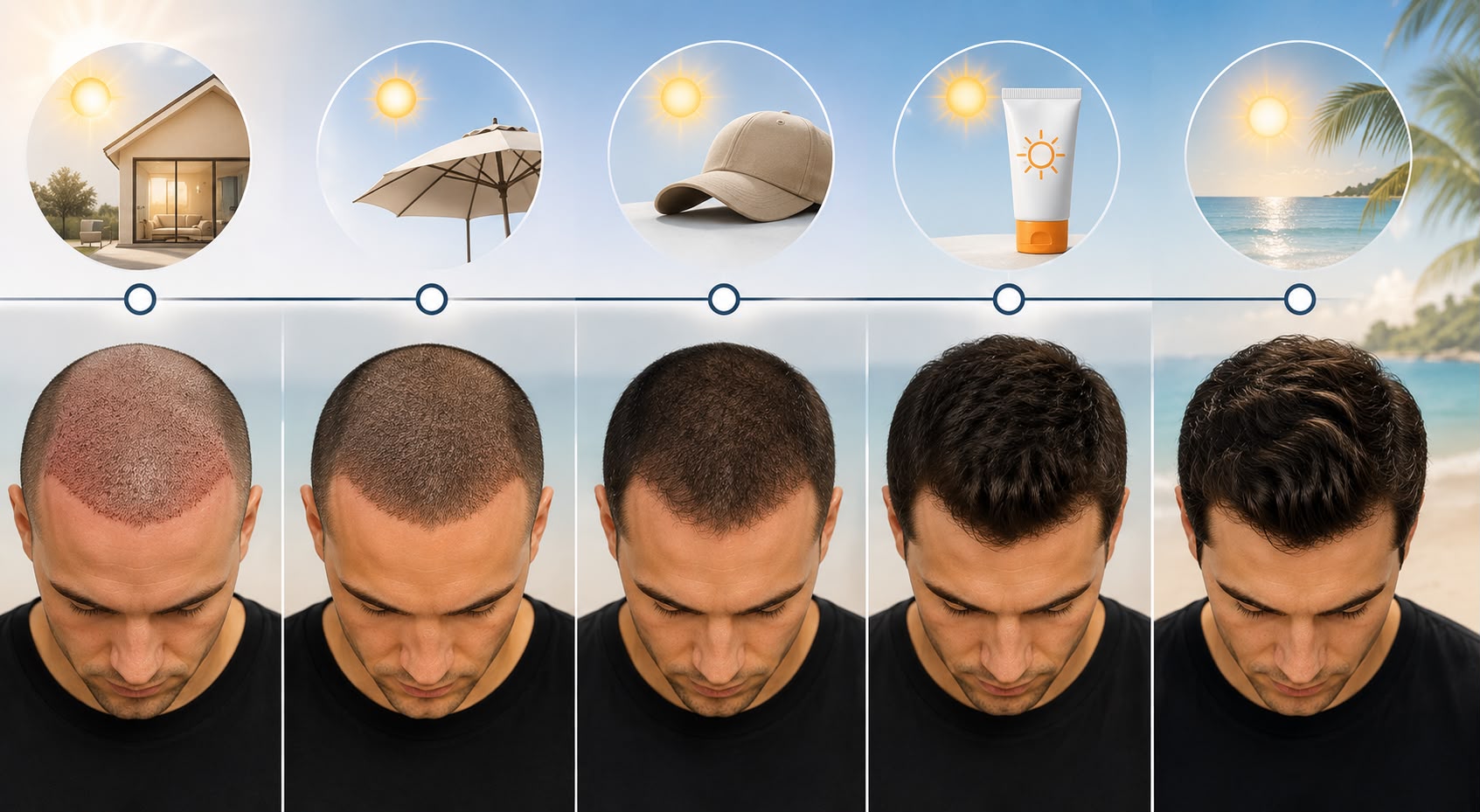
Most people book surgery in spring and think about the sun for the first time in the taxi back from the clinic. Then the questions arrive all at once. Can I sit on the balcony? Can I wear the cap they gave me? Is a fifteen-minute walk in July going to cost me grafts?
The honest version sits between the forum panic and the “you’ll be fine” shrug. Sunlight will not melt your grafts. But the scalp you fly home with on day two and the scalp you have at month four are effectively two different surfaces, and treating them the same is how people end up with a burnt donor area or a recipient zone that stays pink for months longer than it should have. At Hairpol we get more messages about sun than about almost anything else in the first summer, and nearly all of them come down to timing rather than products.
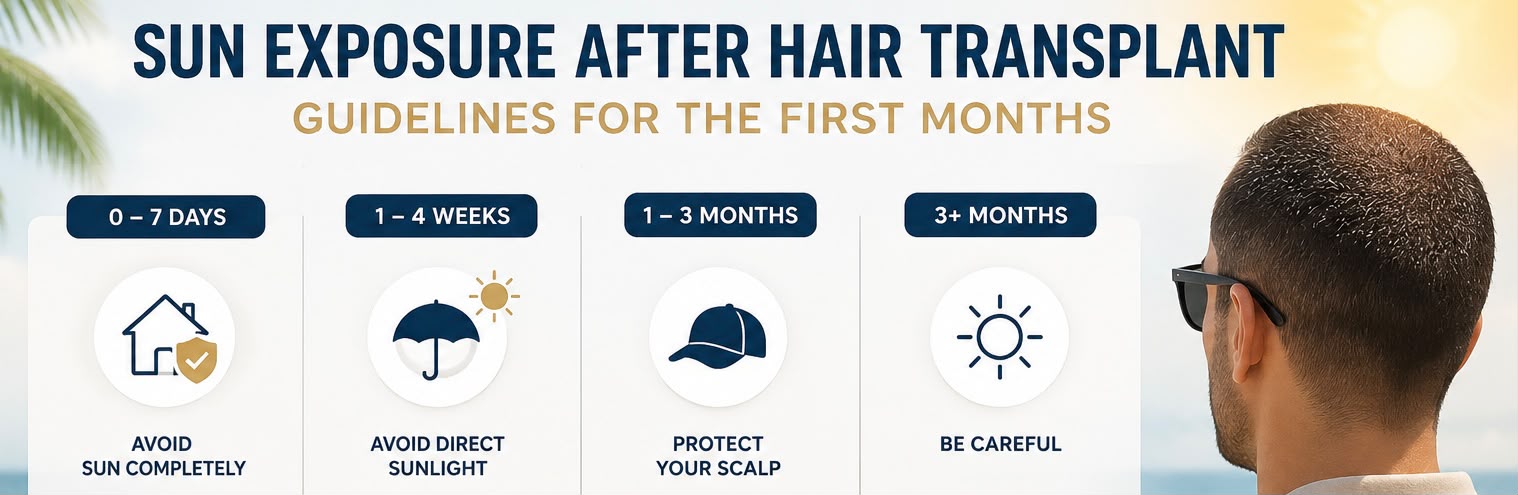
The short answer: For the first 10 days, keep the transplanted area out of direct sun completely — you manage this with shade, timing and a loose hat, not with cream. From day 10 to day 30, short exposure with head cover is fine. Sunscreen on the recipient area usually waits until around week 4 and only with your surgeon’s approval. Between months 1 and 6, midday sun is something you plan around rather than fear.
Day 0 to 10: sun is a wound problem, not a hair problem
In the first ten days, sun exposure after a hair transplant matters for a reason that has nothing to do with hair. Every graft sits in a micro-incision, and every one of those incisions is an open wound with a scab over it. Ultraviolet light hitting healing skin drives inflammation, and inflammation in a freshly grafted scalp shows up as more swelling, more redness, and a slower crust cycle. Heat makes it worse in a second way: you sweat, the crusts soften early, and you start wanting to touch your head.
So the rule for this window is blunt. No direct sun on the recipient or donor area at all. Walk before 10:00 or after 17:00, stay on the shaded side of the street, and treat balconies, terraces and beer gardens as sun even when it feels mild. Car side windows block most UVB but let a lot of UVA through, so a two-hour drive with your head against the window is real exposure. The channels made during surgery — whether they were opened with a sapphire FUE blade or an implanter pen — all close on roughly the same schedule, so the technique you had does not buy you extra freedom here.
Can I wear a hat in the first week?
Usually yes, but not from day one and not any hat. Most surgeons clear head cover somewhere between day 3 and day 5; some prefer day 7 if swelling is still moving down the forehead. The variable that matters is contact, not fabric. A fitted cap that has to be tugged into place, a beanie you pull down over the crown, a snapback with a stiff internal seam — all of them drag across grafts that are still only weakly anchored.
What works is a loose bucket hat or a wide, soft brim that you can lower straight down onto your head without any sideways movement, and lift off the same way. Keep it clean, take it off indoors so your scalp is not steaming under it, and never put a hat on a damp head straight after washing. Our full breakdown of wearing hats after a hair transplant and which types are safe covers the fit details, including what to do if your job requires a helmet.
Day 10 to 30: what changes once the crusts are gone
Crusts usually finish clearing between day 10 and day 14. That changes the risk, but it does not remove it. The skin underneath is closed, thin and often pink, and its pigment response is temporarily unreliable — which is exactly the state in which skin burns fast and then holds onto the discolouration. Recipient sites created with a DHI implanter pen behave no differently here; the surface has sealed, the deeper repair has not finished.
Practically, this is the phase where you can be outdoors normally without sunbathing. Twenty to thirty minutes of morning or late-afternoon sun with a hat on is not going to undo your surgery. An hour at noon on a boat will. The signal to watch is persistence: normal post-operative redness fades gradually between roughly week 3 and week 8, and if yours brightens again every time you spend an afternoon outside, the sun is the thing extending it.
When can you put sunscreen on the transplanted area?
Not early, and the reason surprises people. Sunscreen on the recipient area is usually delayed until around week 4 — not mainly because the formula is dangerous, but because getting it off is. Removing sunscreen means rubbing and washing with more pressure than a two-week-old scalp should take, and that pressure is a bigger threat to grafts than the UV you were trying to block. Add the alcohol and fragrance in many sprays, which sting immature skin, and the maths stops working in your favour.
Once your surgeon clears it, choose a mineral SPF 30 to 50 with zinc oxide or titanium dioxide, fragrance-free, and pat it on rather than rubbing it in. The donor area often gets clearance a little earlier because that skin closes sooner. This is a place to follow your own clinic’s protocol rather than an article: timelines differ by technique, graft count and how your skin actually healed, and a photo review beats a general rule every time.
The donor area burns before the recipient area does
The donor area is the part everyone forgets, and it is the part that burns first. It was shaved to the skin, it has spent years under hair, and it has essentially no tan and no shade of its own. In strong summer sun it can burn in fifteen to twenty minutes. A burn there is not a cosmetic footnote — it means weeks of extra redness and itching over the exact zone that is trying to heal thousands of extraction points, and in some skin types it leaves a patchy tone difference that becomes obvious the next time you crop your hair short.
The nape is the blind spot. Most hats cover the crown and the sides while leaving the lower occipital area open, especially when you tilt your head forward to look at a phone. If you are outdoors for any length of time in the first month, a hat with a back flap, a light scarf or simply a collar you can turn up is worth more than any cream.
Month 1 to 3: the pink phase and why sun keeps it going
Between month one and month three, most of the visible drama is colour rather than structure. The recipient area can look pink, blotchy or slightly darker than the surrounding scalp, and this is when sun does its most annoying damage: post-inflammatory pigment change. Darker skin types are more prone to it, and once a patch of scalp has gone hyperpigmented it can take months to even out rather than days.
If you are three or four weeks out and your scalp still flares angry after every afternoon outside, that is worth a photo rather than a forum thread. You can send photos to the team for a healing check and get a straight read on whether what you are seeing is normal timing, a mild burn, or something that needs attention. It takes a day and it settles the question.
Month 3 to 6: normal life, minus two habits you keep
By month 3 to 6, the scalp behaves like scalp again. Blood supply has stabilised, the pink has usually gone, and the transplanted hairs are in their early growth phase. You do not need to organise your life around shade any more. Two habits are still worth keeping through that first summer.
The first is covering up in strong midday sun, because the hairline is by definition your thinnest coverage and it takes the most direct angle of light. The second is remembering that UV is hard on hair shafts as well as skin — it oxidises the cuticle, and new hair coming through fine and soft is easy to dry out. Nothing dramatic follows from a sunny weekend, but people who spend the whole summer outdoors with no cover often notice their new hair feels brittle by September. Scalp condition responds to the same care as the rest of your hair, and the supportive hair treatments some patients continue after surgery work better on skin that has not been repeatedly burnt.
Does sun exposure make shock loss worse?
No, not directly. Shock loss — the temporary shedding of transplanted or surrounding native hairs, typically between week 2 and week 8 — is driven by the surgical trauma itself, not by daylight. Grafts that shed at week three would have shed whether you spent the month indoors or on a terrace.
What sun can do is add a second insult to skin that is already inflamed. A genuine sunburn over a shedding zone means more swelling, more itch, more temptation to scratch, and a slower return to a calm baseline — and calm skin is what regrowth from month three to month six needs. So the accurate framing is not that sun causes shedding, but that a burn makes an already unsettled scalp take longer to settle. For the broader logic of why UV is worth avoiding across the whole first year, our earlier piece on protecting new grafts from the sun in the first year goes into the reasoning behind the protection rather than the calendar.

Sea, pool and the light you don’t see coming
Water is a double problem. There is the water itself — salt and chlorine on healing skin, which has its own timeline covered in our guide to swimming after a hair transplant, pools, the sea and when it is safe — and there is the light bouncing off it. Reflected UV from water, wet sand and pale concrete can add a substantial amount to what reaches the underside of a hat brim, which is why people burn on boats while feeling shaded.
A boat trip in the first month is the worst possible combination: no shade, reflection from every direction, and enough wind to take your hat off at the moment you stop paying attention. Poolside is more manageable because there is usually a parasol, but the ground around a pool reflects too, and a lounger under an umbrella is not the same as being indoors. If you are going to be near water in the first six weeks, plan for early morning or evening and accept that midday is not your slot this year.
Planning a holiday around your surgery date
The cleanest advice is calendar advice. If you have a beach holiday booked, schedule surgery so that at least 6 to 8 weeks sit between the operation and the trip, and three months if the destination is genuinely hot. Ten days before a week in the Mediterranean is the version that goes wrong: crusts will still be settling, sunscreen will not be an option yet, and you will spend the holiday negotiating with your own hat.
Travelling in the other direction has its own logic. Patients who combine treatment with a trip and are looking at a hair transplant in Turkey during July or August are arriving in a city where the afternoon sun is serious. Plan the sightseeing for early morning and after sunset, keep the middle of the day for the hotel or an indoor plan, and pack the loose hat before you pack anything else. Two or three sensible days in Istanbul cost you nothing and protect the thing you flew in for.
Living in a hot climate: a routine that actually works
If you live in the Gulf, North Africa, southern Europe or anywhere with a real summer, “avoid the sun” is not a plan — you need a routine. The version our patients stick to looks like this: a soft hat that lives in the car and another at the office, so you are never caught choosing between exposure and a tight cap borrowed from a colleague. Sunshade on the driver’s side window if your commute is long. A rinse with cool water after any heavy sweating in the first month, because dried sweat on healing skin is itchy enough to make you scratch without noticing.
Outdoor work needs a real conversation before surgery, not after. Roofers, farmers, site engineers and anyone in a hard hat all day are in a different category, and the honest answer is often two weeks away from the job rather than one. Helmets trap heat, press on the donor area and rub exactly where you cannot afford friction. If your work cannot wait, tell the clinic before you book so the plan is built around it.
I got caught in the sun by accident — what should I do?
First, calibrate. One unplanned hour outdoors at week three is not the end of your result, and most of the messages we get about this describe mild pinkness that resolves in a day or two. What you do in the next 48 hours matters more than what happened.
Cool the area with a cool — not iced — damp cloth held against it, without rubbing or wiping across the grafts. Drink more water than usual, because dehydration makes the skin response worse. Skip the aloe gel, aftersun and menthol products in the first weeks unless your clinic has cleared the specific product; many of them contain alcohol or fragrance that stings raw skin. Do not peel or pick anything that starts flaking over the recipient area, however tempting. Call your clinic if you see blistering, if swelling spreads or returns, if the area weeps or smells, or if pain increases after the first day instead of easing — those are the signals that need a clinician rather than a waiting game.
What we tell Hairpol patients before they fly home
The scalp is unusually good at recovering from a well-managed first month and unusually stubborn about a badly managed one. Almost nobody loses grafts to the sun. Plenty of people spend an extra two or three months with a red or blotchy recipient area because they burnt it at week two, and that shows up in exactly the photos they were looking forward to taking. The before and after results that look clean at month six almost always belong to people whose healing period was uneventful.
So the plan is small and boring: ten days of genuine avoidance, three weeks of shade and a loose hat, sunscreen when your surgeon says so, and a normal summer from month three. If you are planning surgery, planning a holiday, or already three weeks in and unsure whether what you are seeing on your scalp is normal, the team can look at photos and tell you where you stand — start with a consultation about hair transplantation at Hairpol and bring your travel dates with you.
Find this helpful? Add Hairpol as a preferred source on Google.
Get a Free Consultation
Answer a few questions and the medical team will review your situation.
