

 Türkçe
 Deutsch
 Français
Medically reviewed by Dr. Barış Duman · Reviewed:
Short answer: 2 months after a hair transplant it is normal for the transplant area to look thin, or even similar to how it looked before the operation. Shock loss usually happens between weeks 3 and 8 and is largely complete towards the end of month 2, while the hair roots keep resting under the skin. New hairs usually start to grow in months 3-4, and the final result settles at 12-18 months.
The second month is the quietest stage of recovery and the one with the most questions. The skin has healed and you are back to daily life, but the mirror does not show any progress yet. Below we explain what is normal at this stage, what pimples, itching and tenderness mean, and when you should write to your clinic.
What does the scalp look like 2 months after a hair transplant?
The transplant area
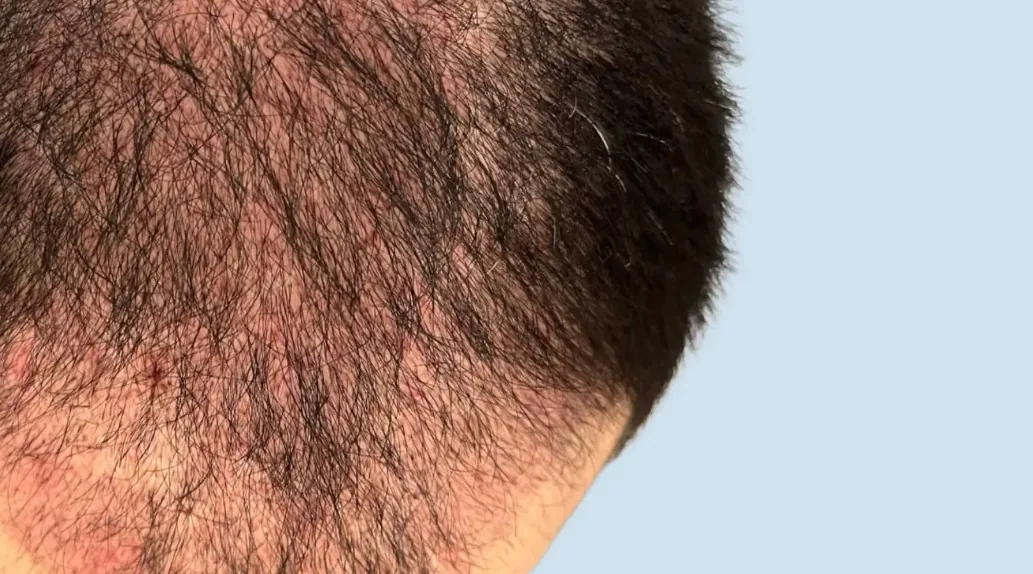
The scabs are long gone and in most people the pinkness has clearly faded; in people with fair skin a slight difference in colour can remain for a while longer. Most of the transplanted hairs have fallen out. The area can look short, sparse and sometimes thinner than before the operation. This look does not show the result; it shows that the roots are in their resting phase.
The donor area
At the back and sides of the head, where the grafts were taken, the hair has grown longer and the extraction points are usually hard to notice. With a very short haircut or on close inspection small dots can be seen; these fade further over time.
What you may feel
Pain has usually gone completely. Numbness, tingling, tenderness to the touch or occasional itching in the transplant and donor areas can continue into the second month; they ease as the nerves recover. For details, see our articles on numbness after a hair transplant and itching after a hair transplant.
Why does the area look like it did before the operation in month 2?
After the transplanted hair roots are moved to their new place, they enter a resting phase for a while. During this time the hair shaft falls out while the root stays under the skin. This is called shock loss and it usually happens between weeks 3 and 8. The second month falls at the end of this window; in most people the shedding is over and the area looks at its plainest.
Some people also notice temporary thinning of their own hair around the transplant area. This is usually part of the same temporary process and recovers in the following months. We explain the topic in detail in our articles on shock loss after a hair transplant and why hair looks thin in the first months.
Are pimples and itching normal 2 months after a hair transplant?
Usually, yes. As new hairs make their way to the surface, small red bumps or pimples can appear around the hair follicles; this is usually seen in the first 1-3 months. Mild itching can also occur in the same period. Do not squeeze, scratch or pick at them with your nails. If they increase in number, get bigger or become painful, send photos to your clinic. We separate what is normal from what is not in our article on ingrown hairs and pimples.
What can you do 2 months after a hair transplant?
If your recovery is going smoothly, by the second month you are back to almost all of your daily life. Even so, take each step according to the instructions your doctor has given you.
- Sun: Sunbathing and long exposure that could lead to sunburn are avoided for the first 2 months. This period ends at the close of month two; after that, protecting your head is still a good habit if you will be in the sun for a long time. Details are in our article on sun exposure after a hair transplant.
- Hats and beanies: Day 10 for hats and day 40 for beanies and tight headwear are behind you; your doctor decides which headwear you can wear, depending on how it is made.
- Washing: You are back to normal washing. A gentle massage with your fingertips is enough instead of hard rubbing. For the method, see our guide on how to wash your hair after a hair transplant.
- Exercise: Your doctor tells you at what intensity you can return to training. The stages are in our guide to exercising again after a hair transplant.
- Pool and sea: Get your doctor’s approval before going into the water. We cover this in our article on swimming after a hair transplant.
- Haircut and dye: Trimming the ends with scissors is not the same as using clippers or a razor on the transplant area. Get your doctor’s approval for haircuts, hair dye and styling products.
- Medication: If your doctor considers it suitable, finasteride can be started 10 days after the operation. Your doctor decides when to start minoxidil; the options are in our article on finasteride and minoxidil.
When should you write to your clinic?
Worrying signs are rare in the second month, but if any of the following applies, contact your clinic without waiting:
- Redness that spreads, feels warm to the touch or keeps getting darker,
- Discharge, yellow crusts or a bad smell,
- Pimples that do not go away, get bigger or become painful,
- Pain or tenderness that increases instead of decreasing,
- Fast and widespread shedding of your own hair outside the transplant area,
- Fever or feeling generally unwell.
Hairpol patients can send their photos to their VIP patient managers 24/7 during this period. For 12 months after the operation, they are followed up with monthly photos via the mobile app; the photo from month two is a good starting point for comparing progress in the months that follow.
What comes after month 2?
New hairs usually start to grow in months 3-4; the first hairs can be fine, light in colour and scattered, and they thicken over time. Most people see a visible change in months 5-6, and the final result settles at 12-18 months. We cover the next stages in our articles on 4 months after a hair transplant and 5 months after a hair transplant, and the full timeline in our article on the hair transplant timeline from day 1 to 12 months. For the earlier weeks, see our articles on 10 days after a hair transplant, 2 weeks after a hair transplant, 3 weeks after a hair transplant and 6 weeks after a hair transplant.
At Hairpol, growth of the transplanted hairs in the transplant area is covered by a guarantee certificate. You can read what the certificate covers in our article on the hair transplant guarantee certificate. To get to know our polyclinic’s physician, see the Dr. Barış Duman page.
Frequently asked questions
Is it normal for no hair to have grown 2 months after a hair transplant?
Yes. In the second month the roots are in their resting phase. New hairs usually start to grow in months 3-4, and density increases over the months.
Hair is still falling out at 2 months. Are the grafts falling out?
No. The grafts are secure by days 10-14. Shock loss usually happens between weeks 3 and 8; what falls out is the hair shaft, while the root stays under the skin.
Can pimples appear 2 months after a hair transplant?
They can. Small pimples are usually seen in the first 1-3 months as new hairs make their way to the surface. Do not squeeze them; if they get bigger or become painful, send photos to your clinic.
Can you go out in the sun 2 months after a hair transplant?
Sunbathing and long exposure that could lead to sunburn are avoided for the first 2 months. This period ends at the close of month two; if you will be in the sun for a long time, keep protecting your head.
Is tenderness in the transplant area normal at 2 months?
Numbness, tingling and tenderness to the touch can still be felt in this period and ease as the nerves recover. If the tenderness increases or comes with redness, write to your clinic.
Free photo analysis
If you are planning a hair transplant and want to know the recovery process from the start, send us your photos; we will share the plan and process that suit you free of charge.
Message us on WhatsApp or see which photos to send.
Find this helpful? Add Hairpol as a preferred source on Google.
Free hair analysis
Planning a hair transplant? Start with a free analysis
Tell us about your hair and our medical team prepares a plan specific to you.
- Transplant carried out by a specialist team under doctor supervision
- Guarantee certificate, valid for 18 months
- All-inclusive package: hotel, VIP transfer, aftercare kit
Free of charge, no obligation to book.
