
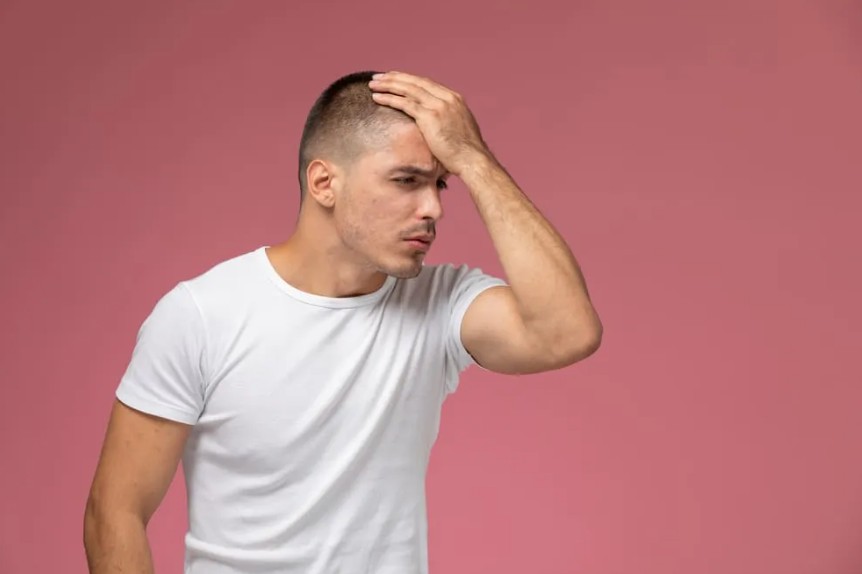
Nobody warns you about this part. You spend weeks reading about grafts, density and shedding, you brace yourself for the swelling and the awkward third week, and then one morning you run your hand over the top of your head and it feels like touching someone else’s scalp. The pressure is there. The sensation isn’t. It doesn’t hurt, and that’s exactly what makes it unsettling — pain you can explain to yourself, but a patch of your own head that has quietly gone offline feels like something went wrong.
It almost certainly didn’t. Numbness is one of the most common and least discussed parts of recovering from a hair transplant, and for the overwhelming majority of patients it is temporary, harmless, and a predictable consequence of how the surgery works. But “common” is not the same as “explained,” and most people are sent home with a bag of medication and a washing schedule while nobody mentions that half their scalp will feel strange for months.
At Hairpol, we’d rather tell you this before it happens than field the anxious message on week six. Here’s what’s actually going on under the skin, how long it typically lasts, and where the honest limits of the reassurance are.
What Numbness Actually Feels Like
Patients describe it in remarkably similar ways, which is itself reassuring. The most common description is “like the dentist,” except it lingers for weeks rather than hours. You can feel pressure — press firmly and you know your hand is there — but the fine detail is missing. Light touch, temperature, the drag of a fingertip across the skin: those are muted or absent.
Some people describe it as wearing a swim cap they can’t take off. Others say the top of their head feels thick, or padded, or slightly detached from the rest of them. A smaller group notices it mostly when washing: water hits the recipient area and registers as pressure without warmth or coolness.
The numbness is rarely total. It’s usually patchy — a numb zone with normal islands inside it, edges that fade gradually rather than stopping at a line. It’s often more pronounced in the donor area at the back and sides than in the recipient zone up top, though plenty of patients report both. And it very frequently doesn’t announce itself on day one. The first week is busy with swelling, tightness and scabs, and numbness only becomes noticeable once that noise dies down and you finally start paying attention to how your head feels.
Why It Happens: The Nerves You Can’t Avoid
Your scalp is densely wired. Sensation is carried by a network of small sensory nerve branches that run in the fatty layer just beneath the skin, fanning upward and forward from the back and sides of the head — the occipital nerves at the back, the auriculotemporal branches at the sides, the supraorbital and supratrochlear nerves feeding the front.
Here’s the geometry problem: those nerve branches run through exactly the tissue layer a surgeon has to work in. Extracting follicles from the donor area means passing a punch through skin and into the fat where those fibres sit. Creating recipient sites means making thousands of small incisions in the same plane up top. Injecting local anaesthetic means distending that layer with fluid. Even the most careful surgeon working with the best technique cannot harvest thousands of grafts without interrupting some of the tiny terminal branches of that network.
And critically — they don’t need to be cut to stop working. Nerves are far more easily stunned than severed. Stretching from the fluid volume of anaesthetic, compression from swelling, and the general inflammatory chaos of healing tissue are all enough to make a nerve stop transmitting temporarily while remaining structurally intact. This is the mechanism behind most post-transplant numbness, and it’s also why it resolves: the fibre isn’t destroyed, it’s interrupted.
Numbness Is Not the Same as Nerve Damage
This distinction matters more than almost anything else in this article, because it’s the one people get wrong when they panic.
What most patients experience is neurapraxia — a temporary conduction block. The nerve’s insulation and structure are essentially intact; the signal is just not getting through while the tissue is inflamed, swollen and rebuilding. Once the local environment calms down, conduction returns. No regrowth is required, which is why this type recovers relatively fast, usually within weeks to a few months.
A smaller share of numbness comes from actual division of tiny terminal branches during extraction or site creation. Those nerves do have to regrow, and nerve regeneration is slow — the widely cited figure is roughly a millimetre per day, which for the small distances involved on a scalp means a matter of months. This is the type that takes longer, and it’s why a stubborn patch at month five isn’t automatically a bad sign.
What almost never happens is meaningful, permanent loss of sensation across a wide area. The scalp’s nerve supply is heavily overlapping and redundant — neighbouring branches supply overlapping territory, so when one small branch is out, its neighbours partially cover the ground. That redundancy is the reason a procedure that unavoidably interrupts hundreds of nerve fibres leaves most patients with a completely normal scalp a year later.
The Realistic Timeline
Every scalp is its own project, so treat this as a map rather than a schedule.
Weeks 1 to 2: numbness is present but usually buried under everything else. Swelling, tightness and tenderness dominate. Many patients don’t consciously register the numbness until this phase ends.
Weeks 3 to 8: this is when it becomes the main event. Scabs are gone, swelling has resolved, and what’s left is a head that feels foreign. This is also when the majority of anxious messages arrive, and when the numbness is most likely to be misread as a complication.
Months 2 to 4: the shift usually starts. It’s rarely a switch flipping. Instead the numb territory shrinks from the edges inward, islands of normal sensation appear inside it, and the whole thing becomes patchier and less defined. Progress in this phase is easier to notice looking back a month than day to day.
Months 4 to 8: most patients are largely back to normal, often with one or two residual patches — commonly a small zone in the donor area or near the crown — that are noticeable only if you go looking for them.
Months 8 to 12+: the long tail. Slow, quiet resolution of the last areas. Some patients report a final change well past the one-year mark, which is entirely consistent with how slowly nerves regenerate.
If you’re somewhere in the middle of this and it feels like nothing is changing, that’s the normal experience, not a warning. Sensory recovery is one of the least perceptible processes in the body precisely because you only notice sensation when it’s absent.
Numbness at a glance: week 1 to month 12
Most numbness messages we get come from one of two people. One writes on day 22: “the top still feels like rubber, is that okay?” The other writes at month eight and asks whether it is ever going away. Both are usually on schedule. Numbness is most noticeable between weeks 3 and 8, shrinks from month 2, and is largely gone for most people between months 4 and 8; a small patch can take 12 months or longer. The table puts the timeline above on one screen.
| Period | What you will likely feel | What to do, and when to call |
|---|---|---|
| Weeks 1 to 2 | Numbness is there but buried under swelling, tightness and tenderness. Many people barely register it yet. | Follow your aftercare. Call if pain is escalating instead of settling, or if you see redness, heat, discharge or fever. |
| Weeks 3 to 8 | Numbness becomes the main event: scabs gone, swelling down, a head that feels foreign. Itching usually peaks here. | Don’t scratch, moisturise as your clinic directs, and protect numb skin from hot water, hairdryers and sun. Call if the numb area is expanding after the first two weeks. |
| Months 2 to 4 | The numb zone shrinks from the edges inward and islands of normal feeling appear. Tingling and brief zaps are common. | Compare month to month, not day to day. Tingling is a recovery sign. Avoid smoking, which slows nerve recovery. |
| Months 4 to 8 | Most people are largely back to normal, often with one or two residual patches, commonly in the donor area or near the crown. | A small, painless patch needs nothing. Call if a large area is still densely numb with zero change by month six. |
| Months 8 to 12+ | The long tail: the last areas resolve slowly and quietly. Some people notice a final change after the first year. | Keep sun protection on anything that still feels muted. Ask for a look if the skin is shiny, tight, discoloured or not healing. |
If your week count and symptoms match the first two columns, you are on the usual track. Unsure? Send a photo of the area over WhatsApp with the number of weeks since surgery; at Hairpol we answer these every week. If the itch is what keeps you awake, our guide to itchy scalp after a hair transplant covers what actually helps.
The Tingling, Itching and Electric Zaps Phase
Here’s the part almost nobody prepares patients for, and it produces a second wave of worry right when the first one should be ending.
Recovering nerves are not quiet. As fibres come back online, they misfire. Patients report tingling, pins and needles, crawling sensations, sudden brief electric zaps, hypersensitivity where a light touch feels disproportionately sharp, and deep itching that no amount of scratching satisfies because it isn’t coming from the skin at all — it’s the nerve itself generating the signal.
These symptoms feel like something is going wrong. They are, in fact, the clearest evidence that something is going right. A nerve that’s regenerating is a nerve that’s transmitting again, imprecisely at first. Silence is the absence of signal; static is the return of one.
The practical problem is the itching, because scratching a healing scalp is genuinely counterproductive. The urge peaks somewhere around weeks three to eight for most people. Keeping the scalp moisturised as your clinic directs helps, since dry healing skin amplifies it. Cool water helps. Antihistamines help some patients. What doesn’t help is attacking it with your fingernails — and if the itch is severe enough that you’re losing sleep over it, message your clinic rather than improvising. At Hairpol, we’d far rather answer that message than see the damage from a week of scratching. If you’re trying to work out what “back to normal” should feel like, our piece on when hair feels normal again after a transplant covers the wider sensory picture.
Donor Area vs Recipient Area
These two zones behave differently, and understanding why explains a lot of the pattern you’ll experience.
The donor area at the back and sides is usually where numbness is most pronounced and most persistent. This is where the greater and lesser occipital nerves and their branches distribute, and it’s where thousands of punches have passed through the exact tissue plane those branches occupy. Extraction is more mechanically disruptive to that layer than site creation is. Donor numbness also tends to be the last to fully resolve — the residual patch that lingers into month eight or ten is more often at the back than the front.
The recipient area up top is a different situation. The incisions are smaller and shallower, and the nerve supply arriving there is already fanned into fine terminal branches rather than trunk-sized ones. Recipient numbness is common but tends to be milder and to resolve faster.
Technique plays a real role too. With DHI, implantation and channel creation happen in a single controlled motion, and with Sapphire FUE, the smoother blade geometry creates cleaner incisions with less collateral trauma to the surrounding tissue. Neither eliminates numbness, because nothing does. But less tissue trauma broadly means less inflammatory disruption of the nerve environment, and that’s not nothing.
What Makes Numbness Last Longer
Some of the variation is out of anyone’s hands, and some of it isn’t.
Session size matters most. A 4,000-graft session covers far more territory and disrupts far more of the nerve network than a 1,800-graft one, and the numb zone and its duration scale accordingly. Large sessions in one sitting are one of the most consistent predictors of prolonged numbness.
Punch size and extraction discipline matter. Larger punches and aggressive, high-speed harvesting damage more surrounding tissue per graft than careful work with appropriately sized instruments. So does depth control — going deeper than necessary puts the punch straight into the nerve layer.
Anaesthetic technique matters. The volume of fluid injected and how it’s distributed affects how much the tissue is stretched, and heavy-handed tumescence contributes to the early phase.
Second procedures matter. If you’ve had a previous transplant, the tissue is already scarred, the nerve network has already been rearranged once, and numbness after a revision tends to be more pronounced and slower to resolve.
And then there’s you. Age, smoking, diabetes, and general vascular health all influence how fast nerves regenerate. Smokers heal slower across the board, and nerve recovery is no exception.
You’ll notice something about that list: most of it is decided in the operating room, by whoever plans and performs your surgery. This is a large part of why the “maximum grafts, single mega-session, fastest possible extraction” approach that some high-volume clinics sell as value has a cost that doesn’t show up in the price list.
Where Turkey Fits Into This
A lot of the people reading this had their procedure abroad, and a lot of them are considering it. The reason hair transplant Turkey searches dominate this space isn’t mysterious — the concentration of experience here is real, the surgical volume is enormous, and the results at the good end of the market are genuinely world-class at a fraction of European or American pricing.
But the market is wide. The same city contains clinics where a board-certified surgeon plans your extraction pattern personally and clinics where you’re a slot in a conveyor belt, harvested as fast as possible by whoever is available. The second kind produces more numbness, more prolonged numbness, and more of the donor-area problems that take a year to sort themselves out. When people say the difference between a good and bad hair transplant Turkey experience isn’t the country, it’s the clinic, this is one of the concrete things they mean.
If you’re already numb and worried, or you’re weighing up a procedure and want a straight answer rather than a sales pitch, send us a message. A photo of your donor area over WhatsApp and a description of what you’re feeling is usually enough for us to tell you whether you’re on a normal track or whether something warrants a proper look. We answer these constantly and we don’t charge for the reassurance.
When Numbness Is Actually a Warning Sign
Almost never. But “almost never” isn’t “never,” and you deserve the honest version rather than blanket reassurance.
Numbness accompanied by significant pain is worth a call. Uncomplicated numbness doesn’t hurt. Numbness plus escalating pain, especially if it’s worsening rather than settling after the first week, can point to infection or a healing problem that has nothing to do with nerves.
Numbness accompanied by redness, heat, discharge or fever is an infection question, not a nerve question, and needs attention promptly.
Numbness that is genuinely getting worse after the first fortnight is unusual. The normal pattern is stable then slowly improving. Expanding numbness deserves a conversation.
Total, dense, unchanging numbness across a large area with zero change by month six is the rare presentation that warrants a real assessment. Even then, the outcome is usually continued slow recovery rather than anything permanent — but it should be looked at rather than waited out indefinitely.
And numbness that comes with visible skin changes — areas that look shiny, tight, discoloured or aren’t healing — is a tissue question that needs eyes on it.
Outside those situations, a numb scalp at week five with no pain and no other symptoms is the single most normal thing in post-transplant recovery.
What You Can Actually Do About It
Honestly? Less than you’d like, and that’s frustrating.
There’s no proven intervention that meaningfully accelerates sensory nerve recovery in the scalp. Anyone selling you one is selling you something. What you can do is avoid making it slower and avoid making it worse.
- Don’t smoke. This is the single most impactful thing on the list. Nicotine constricts the small vessels that supply healing nerves.
- Protect the numb area. Numb skin can’t warn you. You won’t feel a hairdryer that’s too hot, water that’s scalding, or sun that’s burning you. Sunburn on a numb scalp is a genuinely common and completely avoidable injury in the first year.
- Be gentle for as long as instructed. Rough handling of healing tissue prolongs the inflammatory phase that’s suppressing your nerves in the first place.
- Don’t scratch. The itch is coming from the nerve, not the skin. Scratching won’t reach it and might cost you grafts.
- Keep the scalp moisturised per your clinic’s guidance. It won’t speed nerve recovery but it reduces the dryness that makes the itch unbearable.
- Sleep, eat properly, manage stress. Unglamorous, but nerve regeneration is a repair process and repair processes run on the same fuel as everything else.
Some patients ask about supportive scalp treatments during recovery. Those have real value for the health of the follicles and the tissue environment — that’s what they’re for. Nobody should promise you they’ll restore sensation faster.
The Psychological Part Nobody Mentions
Numbness bothers people out of proportion to its medical significance, and it’s worth naming why rather than telling patients they’re overreacting.
You’ve just made a significant decision about your appearance, spent real money, and possibly travelled to another country for it. You’re already primed to scan for evidence that you made a mistake. Then a part of your body stops responding normally, and the scanning has something to grab onto. It doesn’t hurt, so you can’t dismiss it as ordinary post-surgical pain. It doesn’t visibly change, so you can’t track progress. And it sits right on top of your head, so you’re reminded of it every time you touch your hair — which, in month two of a transplant, is constantly.
That’s a recipe for rumination, and it lands during the exact window when the results also look their worst. Shed hair, patchy regrowth, a scalp that doesn’t feel like yours. Plenty of the people who describe regretting their transplant are describing month three, and month three is a liar.
Hairpol patients hear the same thing from us at every stage of this: the discomfort of the middle months is not information about the final result. It’s just the middle. If you’re in it and it’s getting to you, message us. Talking to someone who has watched a few thousand people through this exact phase is worth more than another midnight forum thread.
How the Right Planning Reduces It
The most effective intervention for numbness happens before you’re numb — in the planning.
Splitting a large case into two sessions rather than forcing 4,500 grafts through in a single day means less territory disrupted at once and a nerve network that only has to recover from half as much at a time. Whether that’s the right call depends on your donor supply, your pattern and your timeline, but it should be an actual conversation and not a default answer determined by what’s most convenient to sell.
Appropriate punch sizing and disciplined depth control mean fewer nerve branches interrupted per graft harvested. Distributed extraction rather than stripping one dense zone spreads the disruption. Precise anaesthetic technique limits the tissue stretch.
None of this is exotic. It’s ordinary careful surgery, and it’s largely invisible to patients comparing quotes, which is precisely why it’s the first thing cut when a clinic competes purely on price and graft count. At Hairpol, this is where the argument for a properly planned procedure actually lives — not in the marketing photos, but in the parts of your recovery you’d never think to ask about.
Sensation, Density, and What Normal Means
One last reframe that helps people.
Your scalp before surgery was not a uniform sensory field either. Sensitivity varies naturally across the head, and most people have never paid enough attention to notice. After a transplant, you’re suddenly monitoring your scalp with an attention you’ve never applied to it in your life, and some of what you’re noticing at month nine isn’t a deficit at all — it’s the baseline you never registered.
The genuinely useful benchmark isn’t “does every square centimetre feel identical.” It’s whether the numbness is shrinking over time, whether it’s painless, and whether it interferes with your life. For nearly everyone the answers are yes, yes, and no — and the numbness becomes something you eventually realise you stopped thinking about, without being able to say exactly when.
That’s how sensory recovery ends for most people. Not with a moment. With forgetting.
The Short Version
Numbness after a transplant is normal, expected, and a direct mechanical consequence of surgery on a densely innervated area. It’s usually a temporary conduction block rather than nerve damage. It’s typically worst in the donor area, most noticeable between weeks three and eight, improving from month two onward, and largely resolved between months four and twelve. The tingling and itching that follow are signs of recovery, not deterioration. Permanent meaningful loss is rare because your scalp’s nerve supply is redundant by design.
What you can control is who does the surgery and how it’s planned — because session size, extraction technique and instrument discipline are the factors that actually move the needle.
If you’re in the middle of it, worried, and tired of contradictory forum answers, send us a message. Send a photo of the area over WhatsApp, tell us how many weeks out you are and what you’re feeling, and we’ll tell you honestly whether it looks routine. If you’re still deciding and want to understand how we plan a case to minimise exactly this kind of disruption, our hair transplantation page covers the approach, and our before and after gallery shows what it produces. Either way, you shouldn’t be sitting alone at week six wondering if your head is broken. It isn’t.
Frequently Asked Questions (FAQ)
Is numbness after a hair transplant normal?
Yes. It is one of the most common parts of recovery and affects most patients to some degree. The surgery unavoidably interrupts small sensory nerve branches in the scalp, so a numb or padded feeling in the donor or recipient area is expected rather than a sign that something went wrong.
How long does numbness after a hair transplant last?
Most patients notice it most between weeks three and eight, see clear improvement from month two onward, and are largely back to normal between months four and eight. A few residual patches can take twelve months or longer to fully resolve, which is still within the normal range.
Can numbness after a hair transplant be permanent?
Permanent, meaningful loss of sensation across a wide area is rare. The scalp's nerve supply overlaps heavily, so neighbouring branches cover territory when one is interrupted. A very small patch of reduced sensitivity can persist long term, but it typically does not affect daily life.
Why is the donor area more numb than the top of my head?
Extraction passes thousands of punches through the exact tissue layer where the occipital nerve branches run, which is more mechanically disruptive than the shallower incisions made in the recipient area. Donor numbness is usually more pronounced and takes longer to resolve.
Is the tingling and itching a bad sign?
No, it is usually the opposite. Tingling, pins and needles, brief electric zaps and deep itching are typical signs of nerve fibres coming back online and misfiring as they recover. The itch often comes from the nerve rather than the skin, which is why scratching does not relieve it.
When should I contact my clinic about numbness?
Contact your clinic if numbness comes with significant or worsening pain, redness, heat, discharge or fever, if it is expanding after the first two weeks, if there is zero change by month six, or if the skin looks shiny, tight or is not healing. Painless numbness with no other symptoms is routine.
Does the technique used affect how numb I will be?
Somewhat. Less tissue trauma generally means less disruption to the nerve environment, so careful technique with appropriately sized punches and controlled depth helps. But the biggest factors are session size and extraction discipline, not the brand name of the method.
Can I speed up the return of sensation?
There is no proven treatment that meaningfully accelerates sensory nerve recovery in the scalp. What you can do is avoid slowing it down: do not smoke, protect the numb area from heat and sun since you cannot feel a burn, avoid scratching, and follow your aftercare instructions.
It's been 6 weeks and my scalp still feels numb. Is that normal?
Yes. Weeks 3 to 8 are when numbness is usually most noticeable, because the swelling and scabs that masked it are gone. Painless numbness that is stable or slowly shrinking is routine at six weeks. Contact your clinic if it is spreading after the first two weeks, painful, or comes with redness, heat, discharge or fever.
Why is my scalp still numb at 6 months?
Most people are largely back to normal between months 4 and 8, but one or two residual patches, often in the donor area or near the crown, are common. These are usually tiny nerve branches that have to regrow, which is slow, and some patches take 12 months or longer. A small patch that is shrinking is normal; a large area with no change at all by month six deserves an assessment.
Find this helpful? Add Hairpol as a preferred source on Google.
Get a Free Consultation
Answer a few questions and the medical team will review your situation.
