
 Deutsch
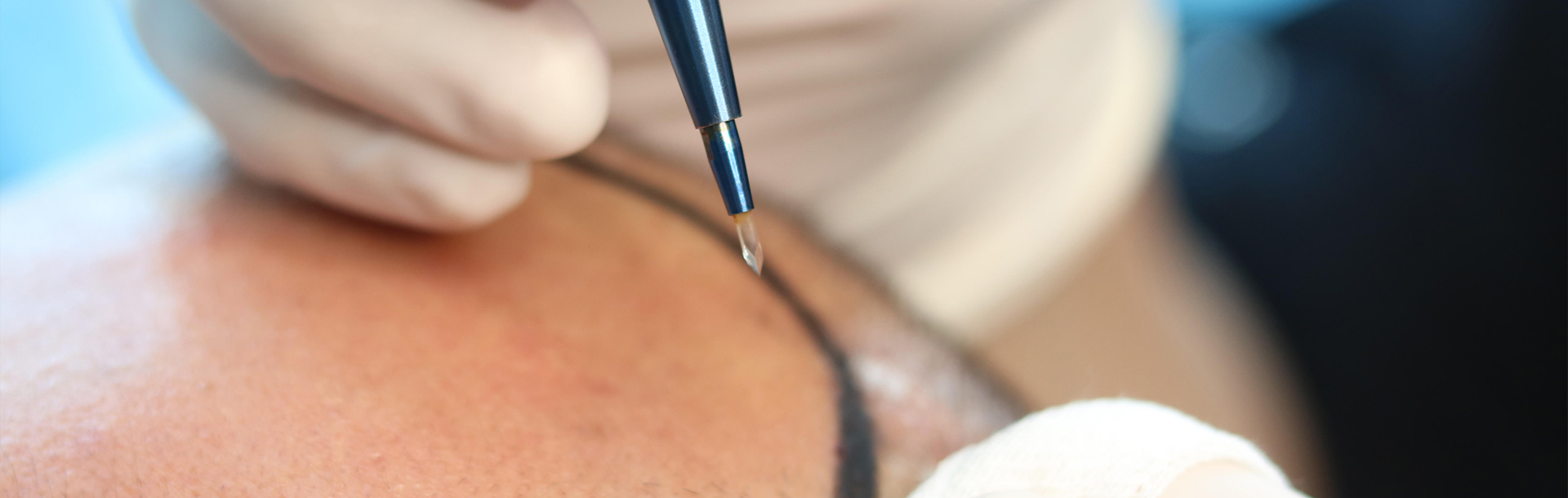
Short answer: All three are forms of FUE. The grafts are taken out the same way, one by one from the back of your head. What differs is how they are put back: classic FUE and Sapphire FUE open small channels first (with steel or sapphire blades) and then place the grafts, while DHI uses an implanter pen that opens the channel and places the graft in one movement. None of them is the best for everyone; the right choice depends on the area you want treated, how many grafts you need and whether you want to avoid shaving.
If you have been reading clinic websites, you have probably seen each technique presented as the most advanced. That makes the decision feel harder than it is. This guide sets out what each one actually does, where each has a real advantage, and the questions that matter more than the name of the technique.
The part all three have in common
Every one of these techniques starts with follicular unit extraction. Under local anaesthesia, individual follicular units (small groups of one to four hairs) are taken from the donor area at the back and sides of your head using a micro punch. This leaves tiny dot-shaped marks rather than the linear scar of the older strip method (FUT). If you want that comparison, see FUT vs FUE.
This matters because extraction is where a lot of the outcome is decided. A graft that is damaged on the way out will not grow well, whichever tool is used to place it. So when you compare clinics, the quality of extraction and graft handling is at least as important as the placement technique.
Classic FUE, Sapphire FUE and DHI explained
Classic FUE
After extraction, the surgeon opens tiny channels (incisions) in the recipient area with fine steel blades or needles. The angle, depth and direction of each channel decide how the hair will grow. Grafts are then placed into the channels with fine forceps.
Sapphire FUE
The same process, but the channels are opened with blades made of sapphire instead of steel. Sapphire blades can be made very fine and sharp, which allows small, precise channels. Because the channels are all opened before placement, the surgeon can plan the whole pattern (angle, direction, spacing) across the area first. That is useful for large areas and an even, natural distribution of density. For more on what the blade itself changes, read Sapphire FUE vs classic FUE.
DHI (Direct Hair Implantation)
Grafts are loaded into a pen-like implanter (often called a Choi pen). The pen creates the channel and places the graft in a single movement, one graft at a time. The angle and direction are set at the moment each graft goes in. Because no channels are opened in advance, DHI can be used to add grafts between existing hairs, and partial or unshaven procedures are possible in some cases. DHI is slower per graft than channel-based placement. See why it is often chosen for the front: DHI for the hairline.
Side-by-side comparison
| Classic FUE | Sapphire FUE | DHI | |
|---|---|---|---|
| Extraction | Micro punch, one by one | Same | Same |
| How channels are made | Steel blade or needle, before placement | Sapphire blade, before placement | Implanter pen, at the moment of placement |
| Placement | Forceps into ready channels | Forceps into ready channels | Pen places the graft directly |
| Planning the pattern | Whole area planned when channels are opened | Same, with very fine channels | Graft by graft |
| Speed per graft | Faster | Faster | Slower |
| Typical strength | Larger areas | Larger areas, even density | Hairline detail, adding density between existing hair |
| Shaving | Recipient area usually shaved | Usually shaved | Partial or unshaven options possible in some cases |
| Donor area | Same in all three | Same | Same |
Which technique suits which situation
These are common patterns, not rules. Your own plan is made after looking at your donor area and photos.
| Your situation | Often considered | Why |
|---|---|---|
| Receding hairline or temples, early stage (e.g. Norwood 2–3) | DHI | Fine control over angle and direction at the front, can work between existing hair |
| Large area: front, mid-scalp and crown (e.g. Norwood 4–6) | Sapphire FUE | Many grafts in one session, even distribution over a large area |
| Crown only | Sapphire FUE or DHI | Depends on how much native hair is left in the crown and the swirl pattern |
| Thinning but not bald, you want to keep your length | DHI, sometimes unshaven | Grafts can be placed between existing hairs; see unshaven FUE |
| Women with diffuse thinning or a widening part | Often DHI | Existing hair can be preserved; see hair transplantation for women |
| Afro-textured or tightly curled hair | Decided case by case | Extraction of curved follicles is the critical step; see our afro hair transplant guide |
| Second procedure to add density | Often DHI | Placement between hairs from the first procedure |
Some plans combine techniques, for example channel-based placement for the larger area behind the hairline and DHI for the front row. Whether a combined plan makes sense for you is decided in the assessment.
Recovery: is one easier than the others?
The recovery is very similar for all three, because the extraction (and so the donor area healing) is the same. The typical course:
| Time after the procedure | What usually happens |
|---|---|
| Days 1–3 | Some tightness and possible swelling of the forehead. You sleep with your head raised. |
| Days 7–10 | Small scabs come off with gentle washing. Most people feel fine to return to desk work around this time. |
| Weeks 2–8 | Most transplanted hairs shed. This is normal. |
| Months 3–4 | New growth begins. |
| Month 12 | Most of the result is visible. The crown can take up to 18 months. |
Some patients notice differences in early redness, but individual healing varies more than technique does. If you had partial or unshaven DHI, the work is less visible in the first two weeks because your existing hair covers it.
For the full month-by-month picture, see our recovery timeline from day 1 to month 12.
Myths worth ignoring
“DHI leaves no scars.” All three techniques extract grafts in the same way, so the donor area heals with the same small dot marks. DHI changes the placement, not the extraction.
“Sapphire FUE gives better results.” The blade allows fine, precise channels. The result still depends on planning, graft handling and the people doing the work.
“DHI gives more density.” DHI allows grafts to be placed close together, but density is limited by your donor supply and by what the scalp’s blood supply can support. More tightly packed is not automatically better; the plan has to respect what your donor area and scalp can support.
“Robotic is the most advanced.” Robot-assisted extraction exists, but a technique label tells you less about your result than who plans and performs your procedure.
“More grafts is always better.” Your donor area is limited and does not regenerate. A good plan uses grafts where they make the most visible difference and keeps a reserve for the future. Read why hairline design matters more than graft count.
What matters more than the technique
When patients choose a clinic mainly by technique name, they often skip the questions that decide the result:
- Who performs the procedure? At Hairpol, the transplantation is performed directly by the doctor, and our professional technicians work under the doctor’s supervision. Ask every clinic the same question: doctor or technician: who does your hair transplant?
- How are grafts handled between extraction and placement? Time out of the body and how the grafts are stored affect survival. See graft survival rate explained.
- Is the plan built from your own donor area? A graft number promised before anyone has assessed your donor area is a sales number.
- What happens after you fly home? The result takes 12 months. Ask how follow-up works and how long it lasts.
- Can you see results at month 12, with graft count and technique? For example, our 3,500-graft DHI result at month 12 and 4,000-graft FUE crown and mid-scalp result. More in our before and after gallery.
Cost
Our all-inclusive hair transplant packages for international patients start from these prices:
| Package (from) | Cash | Credit card |
|---|---|---|
| Hair transplant | $2,500£1,900€2,250CA$3,500 | $2,800£2,100€2,500CA$3,950 |
| Hair transplant + stem cell | $3,250£2,450€2,900CA$4,550 | $3,500£2,650€3,150CA$4,900 |
Payment is upfront, in cash or by credit card; we do not offer instalment plans. The package includes a guarantee certificate securing your planned result, 2–3 nights in a 4–5-star central Istanbul hotel, VIP Mercedes V-Class transfers with a private driver, an aftercare set with all prescribed medications, a 24/7 multilingual VIP patient manager, monthly follow-up for 12 months and complication insurance for your procedure. Your final quote, with the technique and graft plan for your case, is confirmed in writing after a free photo assessment.
More in our cost guide and on the technique pages for Sapphire FUE and DHI.
Frequently Asked Questions (FAQ)
What is the difference between FUE, Sapphire FUE and DHI?
All three extract grafts the same way. Classic FUE opens channels with steel blades, Sapphire FUE with sapphire blades, and both then place grafts into those channels. DHI uses an implanter pen that opens the channel and places the graft in one movement.
Which is better, DHI or Sapphire FUE?
Neither is better for everyone. Sapphire FUE is often chosen for large areas and even density; DHI for hairline detail and adding density between existing hair. The right choice depends on your hair loss pattern and donor area.
Is DHI more natural looking than FUE?
Not by itself. A natural result comes from hairline design, correct angles and sensible density. Both techniques can produce natural results in experienced hands.
Can I have a hair transplant without shaving?
Sometimes. DHI makes partial or unshaven procedures possible in some cases, usually for smaller areas. The donor area usually still needs some shaving for extraction. Whether it works for you depends on the number of grafts needed.
Does Sapphire FUE heal faster?
Not in any way that matters much. Overall recovery is very similar across techniques because the extraction is the same, and individual healing varies more than technique does.
Which technique is best for the crown?
Both Sapphire FUE and DHI are used for the crown. The choice depends on how much native hair remains and how large the area is.
Can DHI and Sapphire FUE be combined?
Some plans combine them, for example Sapphire FUE for the larger area and DHI for the hairline. Whether that suits your case is decided in your assessment.
How do I know which technique I need?
Send us photos of your hairline, top, crown and back of your head. We recommend a technique based on your donor area and the area to treat, and explain why.
Not sure which technique fits you?
Send four photos (front, top, crown and back, in daylight) on WhatsApp or through our contact form. We reply with the technique we recommend for your case, an estimated graft range and your quote. Free and without obligation.
Get your free photo assessment on WhatsApp →
Written by the Hairpol team. Medically reviewed by Dr. Barış Duman · 28 October 2026
Find this helpful? Add Hairpol as a preferred source on Google.
Get a Free Consultation
Answer a few questions and the medical team will review your situation.
