
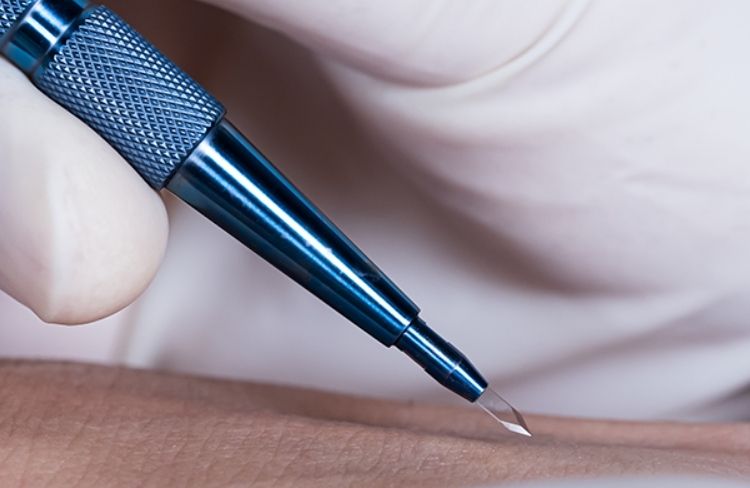
Somewhere in the last few years, a gemstone got attached to a surgical technique, and the marketing has never quite recovered. Sapphire. It sounds expensive. It sounds precise. It sounds like something you would pay more for without asking too many questions, which is exactly why so many clinic websites lead with it and explain almost nothing after.
Here is the thing worth understanding before you spend a single euro: the sapphire in Sapphire FUE is not a different operation. It is a different blade. That single fact explains most of what confuses people shopping for a hair transplant Turkey clinic online, where the word is used as a grade rather than a description. That blade opens the channels your grafts will sit in, and channel-making is one of the most consequential steps in the entire procedure — but it is one step, not the whole story. Understanding precisely what changes when you swap steel for crystallised aluminium oxide, and what stubbornly does not change, is the difference between choosing a technique and being sold one.
At Hairpol, we use sapphire blades for most cases. We also do not pretend they rescue a bad plan. Both of those statements are true at once, and this article is our attempt to explain why.
The Step Everyone Skips Over: Channel Opening
A follicular unit extraction procedure has three acts. You harvest grafts from the donor area at the back and sides of the head. You open recipient sites — tiny incisions in the bald or thinning zone. You place the grafts into those sites. Classic FUE and sapphire FUE are identical in act one and act three. They differ only in act two, in the instrument used to make the incision.
That middle act, though, decides an enormous amount. The angle of each channel dictates the direction your hair will grow for the rest of your life. The depth dictates whether the graft sits flush with the skin or buried too deep or perched too high. The density of channels per square centimetre dictates how full the result looks. And the shape of the wound — how much tissue it displaces, how cleanly the edges meet afterwards — dictates how fast you heal and how much trauma the surrounding blood supply absorbs.
Classic FUE has traditionally used steel slit blades, often cut to custom widths from a larger blade, or occasionally hypodermic needles. These work. They have worked for two decades. Millions of successful transplants have been performed with plain steel, and anyone telling you steel produces bad results is selling something. But steel has physical limits, and those limits are where the sapphire conversation actually begins.
What Sapphire Actually Is
The blades are made from synthetic corundum — aluminium oxide grown into a crystal and then ground to a cutting edge. It is the same material family as the sapphire crystal on a good watch face. On the Mohs hardness scale it sits at 9, just below diamond at 10 and far above surgical steel, which lands somewhere around 5 to 6.
Hardness matters for one reason above all: an edge that hard can be ground finer and, more importantly, it stays that way. A steel blade begins dulling from the first pass through tissue. Across two, three, four thousand channels in a single session, that edge degrades measurably. The last channel of the day is not being cut by the same instrument that cut the first. A sapphire edge, by contrast, is essentially unchanged from channel one to channel four thousand. Consistency, not sharpness, is the real headline.
The second difference is geometry, and this is where it gets genuinely interesting.
Flat Slit vs V-Shaped Channel: The Geometry Argument
A steel slit blade makes a flat, rectangular cut. Think of a paper cut — two parallel walls of tissue with a gap between them. To fit a graft in, that gap has to be wide enough to accommodate the widest part of the follicular unit, which means the top of the wound is as wide as the bottom.
Sapphire blades are typically ground to a V-shaped or conical tip. The incision they make is wider at the surface and tapers to a point at depth. This matters because a follicular unit is itself roughly cone-shaped — bulbous at the bulb, narrowing along the shaft. The V-channel mirrors the shape of the thing going into it.
The practical consequence is that a V-shaped channel displaces less total tissue for the same graft. Less tissue displacement means a smaller wound volume, less disruption of the microvasculature that has to feed the graft, and edges that fall back together more readily once the blade is withdrawn. It is a subtle mechanical advantage, but repeated across thousands of sites in one afternoon, subtle advantages compound.
The Healing Difference — Real, but Measured in Days
This is where honest expectations matter. Patients frequently arrive at consultation believing sapphire means healing in half the time. It does not.
What we observe, and what the clinical literature broadly supports, is that sapphire recipient sites tend to show less initial oedema, crusts that are smaller and lift a few days sooner, and less erythema through weeks two and three. In practical terms, a patient healed with sapphire channels might look socially presentable at day ten to twelve instead of day fourteen to sixteen. That is a genuine, noticeable difference. It is not a transformation of the timeline.
Everything downstream is unchanged. Shock loss still happens around weeks three to six. Regrowth still starts around month three or four. Real density still arrives between months eight and twelve, with the crown often lagging into month fifteen. No blade material accelerates a follicle’s biological cycle. Anyone implying otherwise is guessing, or worse.
Scarring: The Argument That Actually Holds Up
The stronger case for sapphire is not speed — it is what the recipient area looks like at a microscopic level a year later.
Every incision leaves something behind. In the recipient zone these marks are individually invisible to the naked eye, but they are not nothing. Thousands of tiny wounds in a small area create cumulative fibrosis, and fibrotic tissue behaves differently from healthy scalp. It is stiffer. It holds less blood. And crucially, it is harder to work in later.
Smaller, more precisely shaped wounds produce less fibrosis. For a patient who will only ever have one procedure, this is largely academic. For the patient who may need a second pass in eight years — and given that androgenetic alopecia is progressive, that is a lot of patients — the condition of the recipient bed is a genuine asset. We think about the second operation while doing the first. If you want the fuller picture on how scarring behaves in both the donor and recipient zones, our guide to hair transplant scars and what to expect covers it in more depth.
Density: Where the Blade Buys You Something Real
Here is the argument that carries the most practical weight, and the one clinics rarely explain properly.
Density is limited by blood supply. You cannot pack channels infinitely close together, because at some point the tissue between them can no longer nourish what you have planted, and grafts fail. Every surgeon works against this ceiling.
Because a V-shaped sapphire channel removes less tissue and preserves more of the vascular network between sites, it lets you place sites slightly closer together before hitting that ceiling. In the frontal third — the hairline and the zone immediately behind it, where the eye judges fullness most harshly — a modest gain in achievable density per square centimetre translates into a visibly different result. Not a doubling. A refinement. But that refinement is exactly what separates a transplant that reads as natural from one that reads as thin.
If you are weighing this against implanter-pen approaches, where channel and placement happen in one motion, our comparison of sapphire FUE and DHI on natural density takes that question head-on, and DHI vs FUE: which technique is right for you maps out the broader decision.
What the Blade Does Not Change
Let us be blunt about the ceiling, because this is where most disappointment is manufactured.
Sapphire does not increase your donor supply. You have a finite number of DHT-resistant follicles on the back and sides of your head, and that number was set by genetics long before you booked a consultation. A better blade does not add a single graft to it.
Sapphire does not design your hairline. The angle, the shape, the deliberate irregularity that stops a hairline looking drawn with a ruler, the decision about how aggressive to go for a twenty-six-year-old whose loss is still moving — that is judgement. A crystal edge has no opinion about your face.
Sapphire does not stop your native hair from thinning. If you are not addressing the underlying process, you will get an excellent transplant sitting in a field that keeps receding around it, and in five years the result will look strange for reasons that have nothing to do with the surgery. Medical hair treatments exist for that reason.
Sapphire does not protect grafts outside the body. Grafts die from time out of the scalp, from drying, from being crushed by careless forceps. That is technician discipline, not tooling.
The Team Behind the Blade
Which brings us to the thing that actually determines your outcome, and it is uncomfortable for everyone selling technique names.
A sapphire blade in an inexperienced hand produces a worse result than steel in an expert one. Every time. The blade does not choose the angle. It does not decide that this zone needs single-hair grafts and that zone can take triples. It does not notice at hour four that the technician placing grafts is getting tired and the depth is drifting.
At Hairpol this is why we talk about surgeon-led planning before we talk about instruments. The sapphire blade is standard equipment for us in the same way a good camera is standard for a photographer. Necessary, not sufficient. When you are comparing clinics — and especially when you are comparing prices for a hair transplant Turkey package against numbers you have seen at home — the question that predicts your result is not which blade. It is who is holding it, how many operations they run in a day, and whether the person designing your hairline is the same person present when it is cut.
If you are unsure how to read a clinic’s answers to those questions, send us a photo through WhatsApp and ask us directly. We would rather spend twenty minutes telling you what to look for — even at a clinic that is not ours — than have you find out afterwards.
Does Sapphire Cost More?
Slightly, at the level of consumables. A sapphire blade costs meaningfully more than a steel one, and it is single-patient use. But it is a small line item inside a procedure whose real costs are surgeon time, a full theatre team for eight hours, anaesthesia, facility, and follow-up.
When a clinic quotes a large premium for “sapphire upgrade,” that gap is usually not covering the blade. It is covering positioning. In the hair transplant Turkey market specifically, where competition is brutal and packaging is aggressive, sapphire has become a tier label more than a technical disclosure. At Hairpol it is not an upsell tier — it is what we use, because we think the geometry argument is sound.
The corollary matters too. If a package is priced far below everything around it and still advertises sapphire, ask what was cut to make the arithmetic work. It is rarely the blade. It is usually the hours, the supervision, or the number of patients sharing one surgeon that day.
When Steel Is Still a Perfectly Good Answer
Because the honest position is not that sapphire wins everywhere.
For thick, coarse hair with large follicular units, the width of the channel is dictated by the graft, and the geometric advantage narrows. For very small sessions — a modest temple restoration, a scar camouflage of a few hundred grafts — the compounding effect of thousands of marginally better wounds simply does not compound. For some Afro-textured hair cases, where the follicle curls beneath the skin and the priority is avoiding transection rather than optimising channel shape, the blade debate is genuinely secondary to how the graft is harvested and read.
And a surgeon who has cut ten thousand cases with steel and knows precisely how that instrument behaves in tissue may do better work with it than with a tool they adopted last quarter. Familiarity is a real clinical variable. It just never appears in a brochure.
How This Decision Actually Gets Made at Hairpol
In a real consultation, nobody opens with blades. We look at your donor density under magnification. We map your loss pattern and try to predict where it is heading, because designing for today’s hairline on a twenty-eight-year-old is how you build a problem for thirty-five. We talk about hair calibre and curl, because coarse wavy hair delivers more visual coverage per graft than fine straight hair and that changes the graft maths entirely.
Only then does instrumentation come up, and by that point it is usually a short conversation, because the plan has already made the choice obvious. That order is deliberate. When a clinic leads with technology names, it is often because the assessment underneath is thin. Our Sapphire FUE page lays out how we run it, and the before and after gallery is a more useful document than any spec sheet — look at hairlines under harsh light, at the crown, at twelve months rather than at day three.
Questions Worth Asking Any Clinic
Take these to whoever you are considering, including us.
- Who opens the channels — the surgeon, or a technician? Ask plainly. In many high-volume clinics the answer is not the person in the marketing photograph.
- How many patients does that person operate on in a day? Concentration is a consumable too, and it depletes.
- What density are you planning per square centimetre in the frontal zone, and what is the reasoning?
- What happens to my native hair over the next decade, and what is the plan for it?
- If I need a second procedure in eight years, does today’s plan leave room for it?
If the answers to those are vague but the answer about blade material is enthusiastic and rehearsed, you have learned something important about that clinic’s priorities.
So Which Should You Choose?
If a clinic offers sapphire and their planning, their team, and their honesty about limits all hold up, take it. The geometry is better, the consistency across a long session is better, the recipient bed is left in better condition for the future, and the healing is a little gentler. These are real advantages. They are just modest ones stacked on top of each other, not a different category of surgery.
If a clinic offers only steel but the surgeon is excellent, the plan is sober, and the design work is careful, take that too, and do not lose sleep over the blade. You will get a good result.
What you should not do is choose a clinic because of the word sapphire. That is choosing a consumable and hoping the rest comes attached. It usually does not. The blade is a good instrument in the hands of someone who has already made all the decisions that matter — and it is a very expensive way to make the wrong plan slightly tidier.
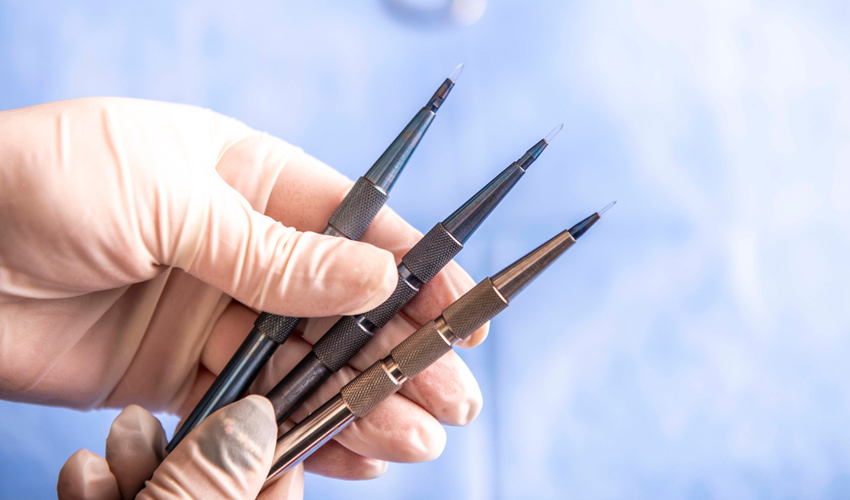
At Hairpol, we would rather you arrive with hard questions than with a preference for a material you read about on a comparison page. Send us a message on WhatsApp with a few clear photos of the front, top and back of your scalp in daylight, and we will tell you what we actually see — including if we think you should wait, or treat rather than operate. If you want to understand our approach first, start with our hair transplantation department, or just get in touch and ask the awkward one: who, exactly, will be opening my channels?
Find this helpful? Add Hairpol as a preferred source on Google.
Get a Free Consultation
Answer a few questions and the medical team will review your situation.
