
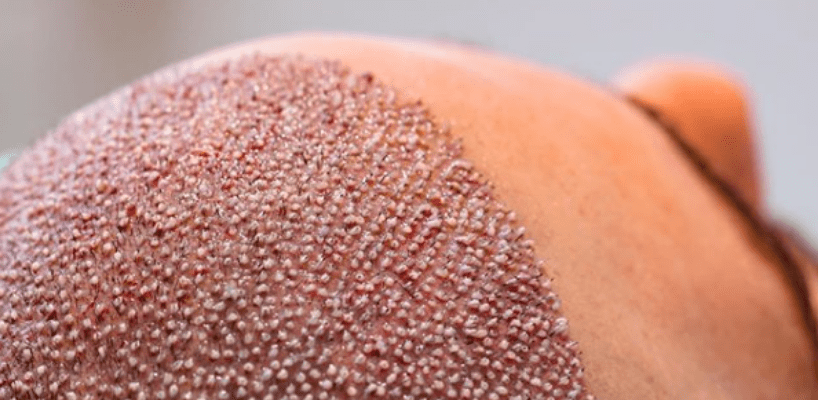
You can move four thousand grafts into a balding scalp and still end up with a thin, patchy result. The number of grafts a clinic quotes is the headline figure everyone fixates on, but it is not the one that decides how your hair looks a year later. The figure that actually matters is rarely advertised, rarely guaranteed in writing, and almost never explained clearly. It is the percentage of those grafts that survive.
This is the quiet variable behind most disappointing results. Two patients can receive the same graft count from two different clinics and walk away with visibly different density, because one clinic kept ninety-five percent of those follicles alive and the other lost a third of them. Understanding graft survival rate is the single most useful thing you can do before choosing where to have your procedure, and at Hairpol it is the metric we obsess over most.
What Graft Survival Rate Actually Means
A graft is a follicular unit, a tiny cluster of one to four hairs taken from your donor area. When that unit is extracted, kept outside the body, and reimplanted, some of those follicles take root and grow, and some do not. The graft survival rate is simply the proportion that survives the journey and produces living, growing hair in its new location.
In a well-run procedure, survival sits somewhere around ninety to ninety-five percent or higher. In a poorly run one, it can drop to seventy percent or worse without the patient ever being told. The difference does not show up on procedure day. It shows up at month nine and twelve, when the density that should have arrived simply is not there, and there is no easy way to prove what went wrong after the fact.
Why You Cannot See Survival Until Much Later
Here is what makes this metric so slippery. Transplanted hairs shed within the first few weeks, then regrow gradually over the following year. So in the early months, every transplant looks roughly the same regardless of how well the grafts were handled. A clinic that lost a quarter of your follicles and a clinic that saved them all produce identical photos at week three.
The gap only opens up later, once regrowth is supposed to fill in. By then you have paid, traveled home, and moved on. This delayed feedback is exactly why corner-cutting clinics get away with poor survival rates. The damage is invisible at the moment of sale, and by the time it is visible, it is months too late to do anything but consider a second procedure.
The Out-of-Body Time Problem
The biggest enemy of graft survival is time spent outside the body. A follicle is living tissue. The moment it is extracted, it is cut off from its blood supply, and a clock starts. The longer it waits before being reimplanted, the more its cells deteriorate and the lower its odds of taking root. Beyond a certain window, survival drops sharply.
This is why a clinic that rushes extraction to harvest a huge graft count, then leaves those grafts sitting for hours, can quietly sabotage a result while appearing efficient. At Hairpol, the workflow is built to keep that out-of-body window as short as possible, with extraction and implantation paced so grafts are not stockpiled and forgotten. Speed for its own sake is not the goal; minimizing the time each individual follicle spends waiting is.
Holding Solution and Temperature
While grafts wait, they sit in a holding solution, and what they sit in matters enormously. A basic saline solution at room temperature keeps follicles alive far less effectively than a chilled, specialized preservation solution designed to slow cellular metabolism and protect tissue. Cooling the grafts buys time and protects survival, almost like slowing the clock that started at extraction.
This is one of those invisible details that separates a serious clinic from a cheap one. You will never see the holding solution in a marketing photo, and patients rarely ask about it, but it has a direct, measurable effect on how many follicles ultimately grow. The grafts that produce your final density are kept alive in a small dish for hours, and the quality of that dish is not a place to economize.
Extraction Technique and Graft Trauma
Survival begins at the moment of extraction. A graft pulled out roughly, with the follicle transected or stripped of its protective surrounding tissue, is damaged before it ever reaches the recipient site. The punch size, the angle, the sharpness of the instrument, and the skill of the hand all determine how intact each graft comes out.
This is where technique like Sapphire FUE and the precision it allows become more than marketing terms. Cleaner extraction means less trauma, and less trauma means higher survival. A high transection rate, where follicles are accidentally cut during removal, directly lowers the number of viable grafts no matter how many were technically harvested.
Implantation: Depth, Angle, and Handling
The way a graft is placed is just as important as how it is removed. Implanted too deep, and it can become buried or starved of oxygen. Too shallow, and it can pop out or fail to anchor. Crushed by clumsy forceps during placement, and the follicle is traumatized. Each of these handling errors costs survival, and they accumulate across thousands of grafts.
Techniques like DHI, which uses an implanter pen to place each graft at a controlled depth and angle with minimal touching, are partly designed to reduce this handling trauma. The less a graft is gripped, squeezed, and repositioned, the better its chances. Gentle, precise placement is not a luxury; it is survival insurance for every follicle you paid to move.
How Graft Count and Survival Interact
Patients tend to think more grafts always means more hair, but the two interact in ways that can backfire. Packing grafts too densely into a recipient area can outstrip the local blood supply, so the tissue cannot nourish every follicle, and survival drops even though more were planted. There is a point where adding grafts stops adding hair and starts wasting donor.
A skilled surgeon balances density against blood supply, placing grafts close enough to look full but not so close that they compete and die. This is why a clinic that promises an enormous graft count at a suspiciously low price should make you cautious. Quoting a big number is easy. Keeping a big number alive is the hard, expensive part that does not fit on a price list.
The Patient’s Own Role in Survival
Survival is not entirely in the clinic’s hands. The first ten to fourteen days after surgery are when newly placed grafts are most vulnerable, before they anchor into their blood supply. Knocking them, scratching them, sleeping face-down, picking at scabs, or exposing the scalp to heavy sweat and friction can all dislodge or damage grafts that were placed perfectly.
This is why aftercare instructions are not optional suggestions. Following the washing routine, sleeping elevated, avoiding the gym, and keeping your hands off your scalp directly protect the survival rate the clinic worked to achieve. A flawless procedure can still be undermined by a careless first two weeks. At Hairpol, we are deliberately specific about aftercare for exactly this reason, because the last stretch of survival is yours to protect.
Why No Honest Clinic Guarantees 100 Percent
If a clinic promises a perfect, guaranteed survival rate, treat it as a red flag rather than reassurance. Biology does not work in absolutes. Even with flawless technique, a small percentage of grafts will not take, and an honest clinic tells you that. What a good clinic can promise is a process built to push survival as high as it realistically goes, not a number it cannot control.
Realistic expectations protect you from disappointment and from being misled. A result that lands around ninety percent survival looks dense and natural; chasing a marketing fantasy of one hundred percent only sets you up to feel cheated by normal biology. The honest framing is the trustworthy one, and it is the one we use.
How to Judge a Clinic on Survival Before You Book
You cannot measure survival in advance, but you can read the signals. Ask how grafts are stored and at what temperature. Ask how the out-of-body time is managed for large sessions. Ask whether very large cases are split across two days to protect quality. Look at twelve-month results, not three-month ones, because density only proves itself late. Ask about the team’s transection rate and how implantation handling is controlled.
A clinic confident in its survival rate answers these questions directly and without defensiveness. One that deflects to graft numbers and price is telling you where its priorities sit. The whole point of a hair transplant is permanent, natural density, and that outcome lives or dies on survival, not on the headline figure printed on your quote.
The Role of the Patient’s Own Biology
Not every factor in survival is something a clinic or a patient controls. Your own physiology plays a part too. Blood supply to the scalp, the quality and elasticity of your skin, whether you smoke, how well your body heals, and underlying conditions like poorly managed diabetes all influence how readily transplanted follicles take root. Smoking in particular constricts blood vessels and reduces oxygen delivery to healing tissue, which is one of the clearest, most avoidable threats to survival.
This is why a good clinic asks about your health and habits before surgery and gives honest advice about what to change. Being told to stop smoking for a few weeks before and after is not a formality; it directly protects the grafts you are about to pay for. The same goes for managing blood sugar, staying hydrated, and eating well in the recovery window. None of this guarantees a perfect outcome, but it stacks the odds in favor of the follicles, and small advantages across thousands of grafts add up to a visibly fuller result.
Why Cheap Clinics Quietly Sacrifice Survival
It helps to understand the economics, because they explain why survival is so often the corner that gets cut. A clinic that runs several patients in a single day, with technicians rather than a surgeon doing much of the work, can advertise a very low price. But volume is the enemy of survival. When grafts from multiple patients are being processed at once, out-of-body times stretch, handling becomes rushed, and the careful pacing that protects follicles disappears.
The result still photographs fine in the first weeks, the patient flies home, and the survival shortfall only surfaces months later in another country. The business model depends on that delay. This is not a reason to fear all affordable care, but it is a reason to ask hard questions about how a low price is achieved. If the answer is volume and speed, your follicles are the ones quietly paying for the discount. A clinic that protects survival cannot run an unlimited assembly line, and its pricing reflects the real cost of doing the work properly.
The Difference Between Grafts Harvested and Grafts That Grow
It is worth separating two numbers that often get blurred together. The first is how many grafts were harvested, the figure printed on your invoice. The second is how many of those grafts actually grow into living hair, which is what you see in the mirror a year later. These are not the same number, and the gap between them is the survival rate in disguise.
A clinic can truthfully say it harvested four thousand grafts while only two thousand eight hundred of them survive and grow. On paper you got a large procedure. In reality you got a medium one, at a large procedure’s price, with a donor area depleted to no benefit. This is the most expensive way to lose money on a transplant, because the lost grafts come straight out of a finite donor reserve you can never get back. Protecting survival is therefore not just about density today; it is about preserving the donor capacity you might need for a future session.
Why Survival Matters Even More on a Second Procedure
For anyone considering a revision or a second session, survival becomes even more critical. The donor area is a limited bank, and every graft that fails to survive is withdrawn from that bank for nothing. A first procedure with poor survival does double damage: it gives you a thin result and it spends donor reserve that could have been used to fix it. By the time someone arrives needing a corrective procedure, there is often less donor left to work with, which makes high survival on every remaining graft non-negotiable.
This is why the quiet, careful clinics tend to be the ones that keep patients out of the revision cycle altogether. A procedure done once, with survival pushed as high as biology allows, often means you never need a second. The cheapest transplant is frequently the one you only have to pay for once, and survival is what makes that possible.
How Hairpol Builds Survival Into the Whole Workflow
At Hairpol, survival is not a single step you can point to; it is a thread that runs through the entire day. It starts with careful donor assessment so the area is harvested at a sustainable density rather than stripped. It continues with controlled extraction to minimize transection, immediate placement of grafts into chilled preservation solution, and a paced workflow that keeps out-of-body time short even on larger cases. Implantation is handled gently, with attention to depth and angle on every graft, and very large sessions are split when that protects quality.
None of this shows up in a glossy before-and-after, which is precisely the point. The work that protects survival is invisible by nature, and that is why it is so easy for cheaper operations to skip. When you choose a clinic, you are not really buying a graft count. You are buying the dozens of small, unglamorous decisions that determine whether those grafts live. That is the standard a serious clinic holds itself to, and it is the one worth paying for.

So when you compare clinics, look past the graft count. The grafts you can count on paper mean nothing until they survive and grow. The clinics worth trusting are the ones that treat each of those tiny follicles as something to keep alive, hour by hour, from the moment it leaves your donor area to the day it finally grows back as your own permanent hair.
If you remember only one idea from all of this, let it be that density is not bought with graft numbers; it is earned with survival. The figure on your quote is a promise of effort, not a guarantee of result. What turns that promise into the hair you actually see is everything that happens in the hours between extraction and growth, and it is worth choosing a clinic that takes those hours as seriously as you do. When you are ready to ask the right questions, that conversation is the real beginning of a good result.
Find this helpful? Add Hairpol as a preferred source on Google.
Graft Range Calculator
Answer three questions to see the typical graft range for your situation — based on our published clinical guides.
This is a preliminary estimate, not a medical assessment. The exact number can only be determined by a doctor after examining your donor area and hair characteristics.
Get a Free Consultation
Answer a few questions and the medical team will review your situation.
