If you’ve spent any time researching hair transplants, you’ve almost certainly encountered the terms FUT and FUE — the two primary surgical approaches to hair restoration. Most clinic websites describe them in broad terms: FUT leaves a linear scar, FUE leaves small dots, FUE has a faster recovery. These summaries are accurate as far as they go, but they leave out the clinical nuances that matter for making a genuinely informed decision about which approach is appropriate for a given patient’s situation.
This guide covers both techniques in full — the surgical mechanics, the scar profiles, the recovery experiences, the graft yield implications, the donor area management considerations, and the specific patient situations where each technique has genuine clinical advantages. The goal is not to declare a winner, but to give you the information needed to understand what the technique choice actually means for your procedure and your long-term options.
The Fundamental Difference: How Follicles Are Extracted
The distinction between FUT and FUE is fundamentally a distinction in how follicular units are extracted from the donor area — everything else follows from this difference.
In FUT — follicular unit transplantation, also called the strip method — a linear strip of scalp skin is surgically excised from the donor area, typically from the mid-portion of the back of the scalp. This strip, typically two to three centimeters wide and ten to thirty centimeters long depending on the graft count required, contains the follicular units that will be transplanted. After excision, the wound is closed, usually with a trichophytic closure technique designed to minimize scar visibility. The strip is then taken to a dissection table where technicians use microscopes to carefully dissect it into individual follicular units — single-hair, double-hair, and multi-hair grafts — which are then implanted into the recipient area.
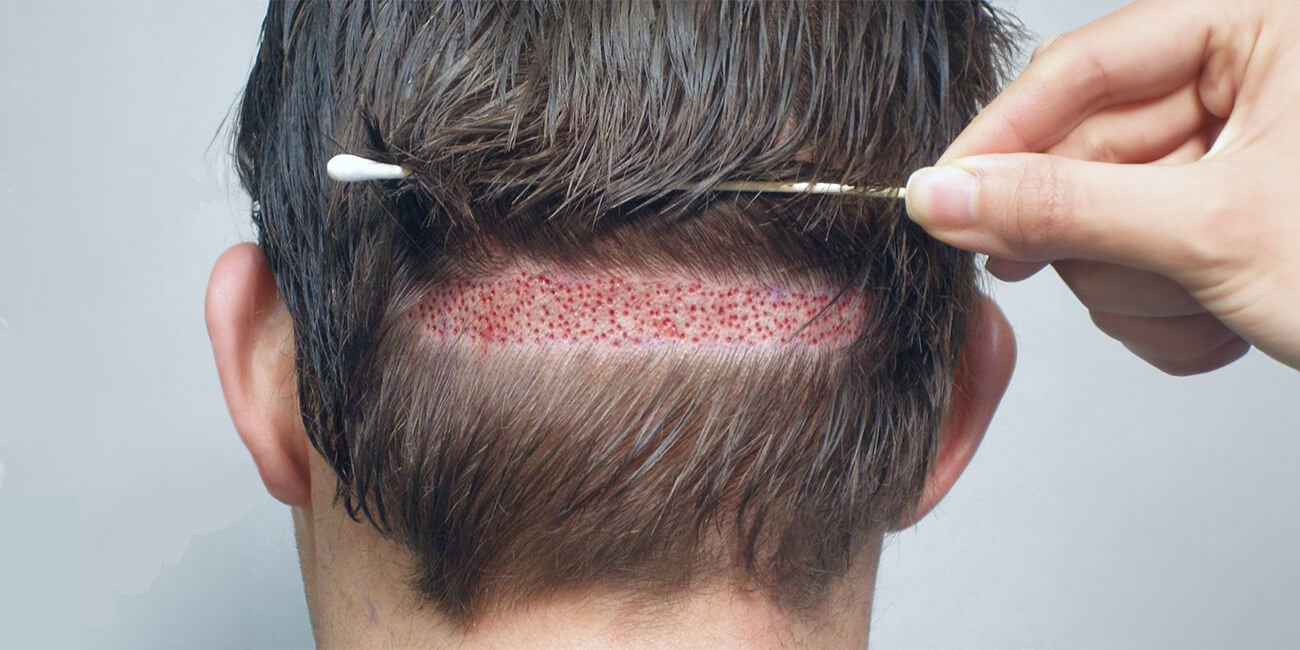
In FUE — follicular unit extraction — individual follicular units are extracted one by one directly from the donor area using a small circular punch instrument, typically 0.7 to 1.0 millimeters in diameter. Each punch creates a tiny circular incision around the target follicular unit, which is then extracted and placed in a preservation solution awaiting implantation. There is no strip excision, no linear wound, and no suture closure. The extraction sites heal as small circular wounds that leave tiny round scars rather than a linear one.
This extraction difference has cascading implications for scar profile, recovery, donor area management, the range of patients who can be treated, and the long-term options available after the first procedure — all of which are worth understanding specifically.
The Scar Profile: Linear vs. Dots
The most immediately apparent difference between FUT and FUE is the scar each technique leaves in the donor area, and this difference is clinically significant in ways that go beyond simple aesthetics.
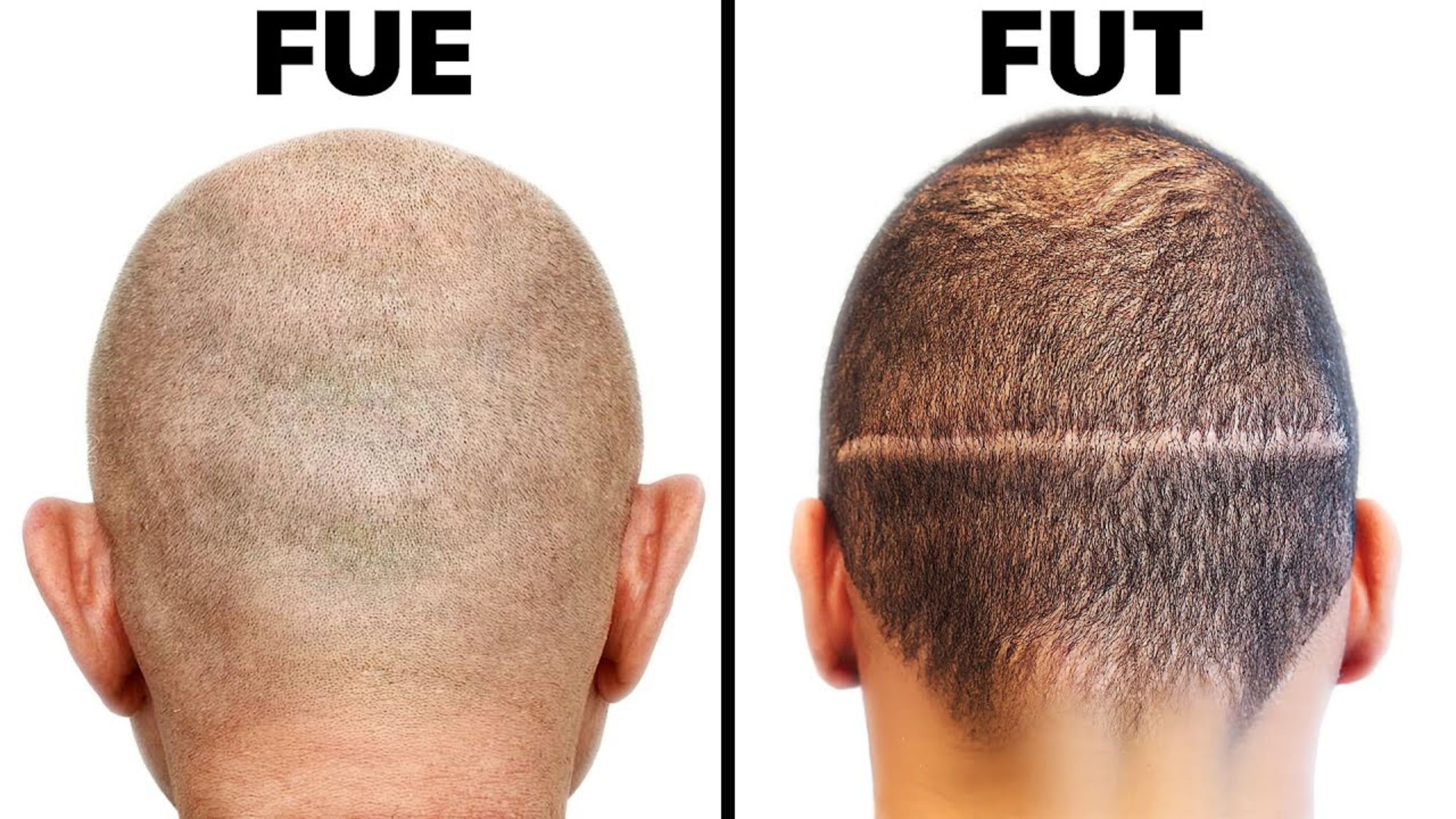
FUT leaves a linear scar across the back of the scalp — typically running from one side to the other in the central donor zone. The width of this scar, once healed, varies from a few millimeters to a centimeter or more depending on the patient’s scalp laxity, healing characteristics, and the skill of the closure technique. With the trichophytic closure method — where one wound edge is beveled to allow hair to grow through the scar — the linear scar can be largely concealed by overlying hair when worn at normal lengths. However, when hair is cut very short — at a grade two or below — the linear scar becomes visible. At a buzz cut length or shorter, it may be clearly apparent.
This has a direct practical implication: patients who have had FUT and want to wear their hair very short have a permanent styling constraint. The scar cannot be removed; it can only be concealed by sufficient hair length. This constraint affects not just aesthetic preferences but also what is possible in revision procedures and in subsequent sessions — if significant additional harvesting is needed from the donor area, the original FUT scar must be accounted for in the planning.
FUE leaves small circular extraction site scars — typically described as white dots — approximately 0.5 to 1.0 millimeters in diameter, distributed across the donor area. At normal hair lengths, these dots are covered by surrounding hair and essentially invisible. At very short hair lengths — grade one or shorter — they may be faintly visible under close inspection in good lighting, but for most patients with typical skin and hair they are not apparent in normal social interaction at any length the patient would actually wear.
The practical implication is that FUE patients have significantly more styling freedom than FUT patients — they can wear their hair short without the scar constraint that FUT imposes. For patients who prefer short hairstyles or whose lifestyle involves close-cropped hair — athletes, military, certain professions — this styling freedom is a genuine and significant quality-of-life consideration.
Recovery: What Each Technique Involves
The recovery experiences of FUT and FUE differ in ways that are practically significant for patients planning around work, social obligations, and physical activity.
FUT recovery involves healing a linear incision wound in addition to the recipient area implantation sites. The sutured wound at the back of the scalp requires suture removal at approximately ten to fourteen days, during which the wound area is tender and the presence of sutures creates a specific management period. The tension of the wound closure — necessary to bring the wound edges together after strip removal — can produce a feeling of tightness in the donor area that some patients find uncomfortable for days to weeks. The healing scar itself remains sensitive for weeks to months as it matures.
The recovery from FUT is generally more involved than from FUE in terms of the donor area specifically. The linear wound requires more careful management than the small circular FUE extraction sites, the suture removal appointment is a required step, and the overall healing process at the donor area is longer. Most patients return to desk work within one to two weeks of FUT, though physical activity restrictions are similar to those following FUE.
FUE recovery is generally faster and less uncomfortable in the donor area than FUT. Without a linear wound and sutures, the donor area healing is characterized by multiple small round wounds that close and heal quickly — typically looking largely normal within two weeks without the suture management and wound tension of FUT. Most patients find the donor area recovery after FUE noticeably less uncomfortable than after FUT, and the absence of sutures eliminates the management step and appointment that FUT requires.
The recipient area recovery — the scalp where grafts are implanted — is essentially the same for both techniques, since the implantation phase is identical regardless of how the grafts were extracted. The scabbing, shock loss, and growth timeline follow the same biological sequence in both cases.
Graft Yield and Quality: A Nuanced Comparison
One of the more important and less well-understood comparisons between FUT and FUE concerns the quality and quantity of grafts that each technique can deliver — and this comparison is more nuanced than simple rankings suggest.
FUT’s primary advantage in terms of graft yield is the preservation of perifollicular tissue. When a strip is excised and dissected under microscopic guidance, each follicular unit is separated from its neighbors while retaining the surrounding tissue that protects the follicle. This careful microscopic dissection, done in controlled conditions by skilled technicians, can produce follicular units with very high integrity — the follicle structure is well-preserved, the surrounding protective tissue is intact, and the grafts arrive at the implantation table in good condition.
FUT also allows very high graft counts from a single session. Because the strip can be sized to yield the needed number of grafts without the time constraints of individual punch extraction, sessions of 3,000 to 5,000 grafts are more consistently achievable in a single day with FUT than with FUE, where very high graft counts require very long extraction sessions that create their own quality challenges.
FUE’s primary disadvantage in traditional comparisons has been transection rate — the rate at which follicles are damaged or transected during the punch extraction process. Punch extraction requires aligning the punch instrument precisely with each follicle’s exit angle from the scalp. When alignment is imperfect, the punch can cut through the follicle rather than around it, damaging or destroying it. In less experienced hands or with less refined technique, FUE transection rates can be meaningfully higher than the graft damage rates in FUT microscopic dissection, which translates directly to lower functional graft counts from the same donor supply.
This transection disadvantage has diminished significantly as FUE technique and instrumentation have improved. Experienced FUE surgeons and teams with high case volumes and refined technique achieve transection rates comparable to FUT in skilled hands. The quality comparison between FUT and FUE is therefore team-dependent rather than technique-inherent — in experienced hands, both techniques can produce high-quality grafts consistently. In less experienced hands, FUE is more vulnerable to quality degradation through elevated transection than FUT performed by a skilled strip surgeon.
Donor Area Management: The Long-Term Strategic Consideration
For patients who may need multiple sessions across their lifetime — particularly those with progressive hair loss or extensive patterns — the donor area management implications of FUT versus FUE are strategically significant and deserve specific attention.
FUT and the strip approach allows multiple sessions by excising successive strips in the same region — each subsequent strip removes a new section of scalp that incorporates the previous scar, essentially trading one scar for a new one at the same location. This can be done two to three times in many patients, each session yielding a high graft count from the central safe donor zone. However, as sessions accumulate, the remaining scalp laxity decreases — each strip removal takes some scalp skin, and the ability to close the wound without excessive tension depends on sufficient remaining laxity. After multiple FUT sessions, the scalp tension may become too high for further strip excision, limiting options for additional FUT sessions.
At this point, a patient who has had multiple FUT sessions is not necessarily out of surgical options — FUE can be performed on the remaining donor hair not affected by the linear scar region. But the scar itself is permanent, and patients who might have used FUE from the outset have preserved more donor area flexibility.
FUE’s donor management approach distributes extractions as individual dots across the donor area rather than concentrating the harvest in a linear strip. This distribution can be managed strategically to harvest from different zones across multiple sessions, maintaining the appearance of the donor area while extracting from the available supply. The flexibility of where extraction occurs in each session gives the surgeon more control over long-term donor density management.
FUE also allows extraction from areas outside the typical scalp donor zone — beard hair, chest hair, and body hair can be harvested using FUE technique in patients who need additional graft supply beyond what the scalp donor area provides. This body hair FUE is not possible with strip excision, giving FUE an additional donor supply advantage in patients with limited scalp donor availability.
Who Is the Better Candidate for FUT?
Despite FUE’s emergence as the dominant technique in modern hair restoration, FUT retains genuine clinical advantages for specific patient situations where its characteristics represent real benefits rather than historical convention.
Patients who need very high graft counts in a single session — particularly those with extensive loss at higher Norwood types who want comprehensive coverage — are candidates for whom FUT’s ability to reliably yield high graft counts in a single day has practical value. While large FUE sessions are achievable, they require very long procedure days and the quality maintenance challenges that come with extended extraction sessions.
Patients with lower scalp laxity — where punch extraction from a tight scalp is more technically challenging — may yield better results from FUT, where scalp laxity affects wound closure rather than extraction quality. The punch extraction in FUE on a tight scalp requires more precise technique to avoid elevated transection rates; FUT’s strip excision is less directly affected by scalp laxity in terms of graft quality.
Patients who have already had FUE sessions and want to maximize their donor supply across a subsequent procedure may benefit from FUT if their donor density has been reduced by previous FUE harvesting in ways that make further FUE harvesting from the central zone less productive.
Patients for whom cost is a primary consideration should note that FUT is generally less expensive than FUE per graft — the extraction process is less labor-intensive than individual punch extraction — which may make it accessible for patients who would not otherwise be able to afford the graft count their situation requires.
Who Is the Better Candidate for FUE?
For the majority of patients presenting at modern hair transplant clinics, FUE represents the appropriate primary choice — not because it is universally superior in every technical dimension, but because its combination of characteristics best serves the most common patient presentations and priorities.
Patients who want to wear their hair short are unambiguously better served by FUE. The dot scar profile of FUE is compatible with short hairstyles that the FUT linear scar is not. For any patient whose preferred hairstyle involves short sides or whose lifestyle might include close-cropped hair in the future, FUE eliminates a permanent styling constraint that FUT would impose.
Younger patients whose hair loss pattern is still developing and who will almost certainly need multiple sessions over the coming decades benefit from FUE’s more flexible donor area management. Preserving long-term donor options — including the ability to harvest from different zones across sessions without the scar constraints of FUT — serves their multi-decade hair management picture better.
Patients who want faster donor area recovery — those with work or social commitments that make a longer recovery period impractical — generally find FUE’s more rapid donor healing preferable.
Patients interested in beard or body hair supplementation — those whose scalp donor supply is insufficient for their needs — can only access these additional sources through FUE technique, making it the necessary choice for this specific situation.
Patients with naturally low scalp laxity — whose tight scalp makes strip excision wound closure under high tension and potentially problematic scar widening more likely — are better served by FUE’s extraction approach, which is independent of scalp laxity in terms of wound closure.
Sapphire FUE and DHI: Modern Refinements of the FUE Approach
Within the FUE category, two specific technique refinements have become prominent in modern hair restoration practice and deserve specific mention in any comprehensive technique comparison.
Sapphire FUE uses sapphire-tipped blades rather than standard steel blades for the creation of recipient channels — the incisions into which grafts are implanted. The sapphire surface is harder and smoother than steel, producing cleaner incision edges with less surrounding tissue trauma. This reduced tissue trauma translates into less recipient area redness, less crusting during healing, and faster resolution of the visible signs of the healing process. Sapphire blades also allow more precise control of incision depth and angle, which supports more accurate directional implantation — particularly relevant for the hairline zone where precise angles determine naturalness.
DHI — direct hair implantation — uses the Choi implanter pen to simultaneously create the recipient channel and deposit the graft in a single motion, eliminating the separate channel-creation phase of standard FUE. This single-step approach reduces the time grafts spend outside the body after channel creation, which may support graft viability. It also allows implantation without shaving the recipient area in some cases — an advantage for patients who want to keep existing hair during the procedure. DHI’s precision is particularly suited to high-density work in specific zones and to facial hair applications like beard and eyebrow transplants where very shallow implantation angles are required.
Neither Sapphire FUE nor DHI represents a fundamental departure from the FUE extraction approach — both use the same punch extraction method from the donor area. They are refinements in the recipient site creation and graft placement phases that affect the healing quality and precision of the implantation rather than the extraction itself.
The Honest Summary: How to Think About the Technique Choice
The decision between FUT and FUE should be driven by the clinical specifics of each patient’s situation rather than by marketing preferences or generic claims of one technique’s superiority over another.
For most patients in most modern clinical contexts, FUE represents the appropriate primary choice. Its compatibility with short hairstyles, faster donor recovery, more flexible long-term donor management, and the elimination of a permanent linear scar address the priorities of the majority of patients seeking hair restoration today. The technical quality that FUE can achieve in experienced hands — with low transection rates, high graft integrity, and precise implantation — matches what FUT can deliver at its best.
FUT retains genuine clinical advantages for specific situations: very high graft count requirements in a single session, patients for whom cost per graft is the primary constraint, patients who have already maximized FUE extraction from their available donor area, and occasionally patients whose specific scalp or donor characteristics make strip excision the more practical approach.
The most important consideration in either case is not the technique label but the expertise of the team executing it. A highly experienced FUE team with refined technique and high case volumes will produce better outcomes than a less experienced team performing FUT — and vice versa. The technique provides the framework; the team’s skill and judgment determine what is actually achieved within that framework.
At Hairpol, FUE — including Sapphire FUE and DHI — is the primary approach, reflecting both the clinical advantages of the technique for the majority of patients and the team’s specialized experience and refinement with FUE execution. Every consultation includes an honest assessment of which approach best serves the individual patient’s situation, donor characteristics, and long-term goals — because the right technique for any patient is the one that best serves their specific clinical picture, not the one that is most prominent in marketing materials.
Frequently Asked Questions (FAQ)
What is the main difference between FUT and FUE hair transplants?
The fundamental difference between FUT and FUE is how follicles are extracted from the donor area. In FUT — follicular unit transplantation — a linear strip of scalp skin is surgically excised from the back of the head, then dissected under microscopes into individual follicular units for implantation. This leaves a linear scar across the donor area. In FUE — follicular unit extraction — individual follicular units are extracted one by one using a small circular punch instrument, leaving tiny round scars rather than a linear one. The implantation phase is identical in both techniques — extracted follicular units are placed into the recipient area in the same way regardless of how they were harvested. Everything else that differs between FUT and FUE — the scar profile, the recovery experience, the donor area management implications, and the range of appropriate candidates — follows from this extraction difference. At Hairpol, Sapphire FUE and DHI represent the primary modern approaches, offering the benefits of FUE with additional refinements in the recipient site creation phase.
Does FUT or FUE leave more visible scarring?
FUT leaves a linear scar across the back of the scalp — typically several centimeters to over ten centimeters long depending on the graft count required. When hair is worn at normal lengths, overlying hair conceals this scar. When hair is cut very short — at a grade two or shorter — the linear scar becomes visible and may be clearly apparent. This represents a permanent styling constraint for FUT patients. FUE leaves small circular extraction site scars — typically 0.5 to 1.0 millimeters in diameter — distributed across the donor area. At normal hair lengths, these are covered by surrounding hair and essentially invisible. At very short lengths they may be faintly detectable under close inspection, but are not apparent to others in normal social interaction. For patients who want to wear their hair short — athletes, those who prefer close-cropped styles, or anyone who might want short hair in the future — FUE's dot scar profile represents a meaningful and permanent quality-of-life advantage over FUT's linear scar. Hair transplant consultations should explicitly address hairstyle preferences and how the scar profile of each technique aligns with them.
Which technique — FUT or FUE — produces better graft quality?
The graft quality comparison between FUT and FUE is more nuanced than simple rankings suggest — it depends significantly on the experience and skill of the team performing the procedure rather than being an inherent property of the technique. FUT's primary quality advantage is the preservation of perifollicular tissue through microscopic strip dissection, which can produce follicular units with very high structural integrity. FUE's historical quality disadvantage has been elevated transection rates — the rate at which the punch instrument damages or cuts through follicles during extraction — which in less experienced hands can meaningfully reduce the functional graft count from the same donor supply. However, experienced FUE surgeons and teams with high case volumes and refined technique achieve transection rates comparable to skilled FUT. The quality comparison is therefore team-dependent: in experienced hands, both Sapphire FUE and FUT produce consistently high-quality grafts. In less experienced hands, FUE is more vulnerable to quality degradation than FUT. This makes the choice and evaluation of the surgical team more important than the technique designation itself.
Is FUE recovery faster than FUT recovery?
Yes — FUE recovery is generally faster and less uncomfortable in the donor area than FUT recovery. Without a linear wound and sutures, FUE donor area healing involves multiple small round extraction sites that close and look largely normal within approximately two weeks, without the wound tension and suture management that FUT requires. FUT recovery involves healing a sutured linear wound, suture removal at ten to fourteen days, and a period of wound-area tenderness and tightness that some patients find uncomfortable for days to weeks. Most patients find FUE donor area recovery noticeably less demanding than FUT, and the absence of sutures eliminates the removal appointment that FUT requires. The recipient area recovery — covering the hair transplant timeline of scabbing, shock loss, and growth — follows the same biological sequence in both techniques, since the implantation phase is identical regardless of extraction method. DHI and Sapphire FUE both typically produce faster recipient area healing than standard FUE due to reduced tissue trauma in the channel creation phase.
Can you have FUE after having FUT?
Yes — FUE can be performed after FUT, and this combination is a common approach for patients who want to maximize their lifetime donor supply across multiple sessions. After one or more FUT procedures, the remaining donor area outside the linear scar region still contains viable follicles accessible by FUE punch extraction. FUE can harvest from areas above, below, and lateral to the FUT scar without being limited by it — since FUE extracts individual follicles rather than requiring strip excision from the same region. This allows patients to continue accessing donor supply after FUT's strip excision capacity is exhausted or when scalp laxity no longer supports further strip removal. The scar itself can occasionally be addressed — camouflage through scalp micropigmentation or, in some cases, scar revision — but the more practical approach is using FUE to access remaining donor supply in adjacent zones. Patients who anticipate multiple future sessions — particularly younger patients with progressive loss — benefit from understanding this sequencing possibility when planning their first hair transplant, as starting with FUE preserves more flexibility than beginning with FUT.
What is the difference between FUE, Sapphire FUE, and DHI?
All three are variants of the FUE approach — they all extract individual follicular units from the donor area using punch instruments — but they differ in the recipient site creation and graft placement phases. Standard FUE creates recipient channels using steel blades, then places grafts into those channels as a separate step. Sapphire FUE uses sapphire-tipped blades rather than steel for channel creation. The sapphire surface is harder and smoother, producing cleaner incision edges with less surrounding tissue trauma — which translates into less recipient area redness, less crusting, and faster healing. Sapphire blades also support more precise angle control, which is particularly relevant for the natural-looking hairline zone. DHI uses the Choi implanter pen to simultaneously create the recipient channel and deposit the graft in a single motion, eliminating the separate channel-creation phase. This reduces the time grafts spend outside the body after extraction, may support graft viability, and allows implantation without shaving the recipient area in some cases. DHI's precision is particularly suited to high-density work and facial hair applications. None of these represent a fundamental departure from FUE extraction — they are refinements in the implantation phase that affect healing quality and precision.
How do I know if FUT or FUE is right for me?
The appropriate technique for any individual patient depends on several specific clinical factors rather than a general preference for one technique over another. FUE is typically the better choice for: patients who want styling freedom including short hair without scar visibility; younger patients with progressive loss who need long-term donor area flexibility across multiple sessions; patients interested in beard or body hair supplementation as additional donor supply; and patients who want faster donor area recovery. FUT retains genuine advantages for: patients who need very high graft counts in a single session — typically above 3,500 to 4,000 grafts; patients for whom cost per graft is the primary constraint, since FUT is generally less expensive; patients who have already used much of their available FUE donor supply and want to access the strip zone; and occasionally patients with donor characteristics that make strip excision more practical than punch extraction. A thorough consultation that assesses your specific hair loss pattern, donor characteristics, hairstyle preferences, progression trajectory, and long-term needs will identify which approach best serves your situation. At Hairpol, this assessment is part of every consultation — the technique recommendation follows the clinical picture rather than preceding it.
Is FUT still performed or has FUE replaced it?
FUT is still performed and retains a place in modern hair restoration practice, though it has been substantially replaced by FUE as the dominant technique in most leading clinics globally. The shift toward FUE reflects the genuine clinical advantages of the technique for the majority of patients — particularly the scar profile, styling freedom, and donor area flexibility that FUE provides — combined with the significant improvement in FUE technique and outcomes as the method has matured. Most patients presenting at modern hair transplant clinics are better served by FUE, and most clinics that have developed strong FUE expertise no longer routinely perform FUT except for specific clinical indications where its characteristics remain advantageous. FUT's persistence in some practices reflects both its genuine remaining advantages — reliable high graft yield, lower cost per graft, and preserved validity for specific patient situations — and the expertise investments of surgeons who developed their practice around the strip method. Neither technique has become obsolete: FUT remains a legitimate surgical approach with specific clinical applications, and FUE continues to advance with refinements like Sapphire FUE and DHI that address its earlier limitations.
Find this helpful? Add Hairpol as a preferred source on Google.