

Nobody books a flight to Istanbul hoping to come home with a hairline that looks drawn on. Yet that is the complaint that fills forums: a line that starts too low, runs dead straight from temple to temple, fills every corner with uniform hair and, from across a room, looks as if it was set with a ruler. The internet has given it a name, the Turkish hairline.
The label is unfair to a country that also produces some of the most natural work anywhere. The look behind it is real, though, and it is almost entirely a design problem, which means it can be prevented before the first graft is taken.
The short version: a “Turkish hairline” is a transplanted hairline that is too low, too straight and too uniform, with the temples closed in and dense multi-hair grafts in the front row. It comes from drawing the line to a template or a teenage photo rather than to your face, age and future loss. You avoid it by agreeing a mature, irregular hairline design before surgery.
What is a Turkish hairline, exactly?
There is no medical definition, which is part of the problem. The phrase started on forums and social media as shorthand for a recognisable look, and it is worth being precise about what that look is, because each feature points to a different design decision.
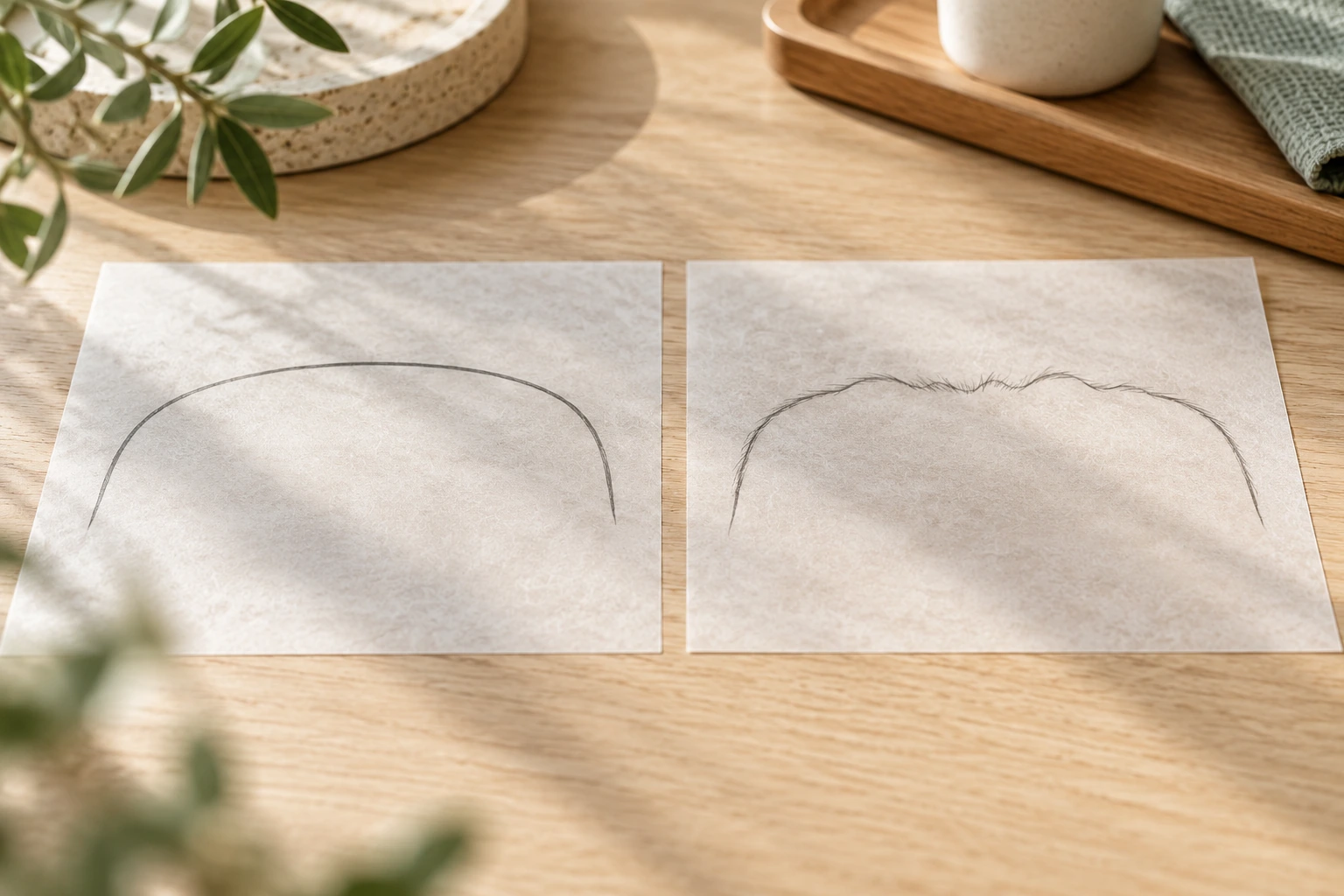
First, the line itself is low. It often sits where the patient’s hair was at seventeen, or lower, instead of where a man in his thirties or forties would naturally have it. Second, it is straight or gently curved like the brim of a cap, without the small peaks, notches and soft scatter that every natural hairline has. Third, the temples are filled in completely, so the forehead looks like a rectangle framed by hair. Fourth, the front edge is dense from the very first row, often with two- and three-hair grafts placed right at the margin.
Any one of these on its own can look acceptable. All four together produce the helmet effect that people recognise instantly, even if they could not explain why.
Why does the Turkish hairline happen?
It is tempting to blame a single bad surgeon, but the pattern is too common for that. The Turkish hairline is mostly a product of three pressures that push in the same direction.
The first is patient demand. Many people arrive with a photograph of themselves at eighteen and ask for that hairline back. The request is understandable; a good consultation explains why a teenage line rarely suits an adult face, even when saying so is less comfortable than agreeing.
The second is time. A standard shape is quick to draw and quick to follow. Irregularity, temple angles and single-hair transition zones take time and thought at the design stage, and they only appear when someone gives them that time.
The third is the graft count itself. A lower, fuller, more rectangular hairline uses more grafts, and when a quote is read mainly as a number, a bigger number can look like better value. None of these pressures is unique to Turkey; they exist wherever hair transplants are planned in a hurry.
The four design errors behind it, and when a low line is fine
When we look at a hairline that reads as unnatural, it almost always comes down to the same short list:
- Height: the line is placed too far down the forehead for the patient’s age and facial proportions.
- Shape: a straight or evenly curved edge with no micro-irregularity, peaks or notches.
- Temples: the frontotemporal angles are closed completely instead of keeping a natural recession.
- Front row: multi-hair grafts at the margin instead of a soft zone of single hairs that thickens gradually.
Notice that none of these is about technique in the sense of FUE versus DHI. They are design decisions, made with a marker pen before a single graft is extracted. That is good news, because it means they can be discussed, questioned and changed while you are still sitting in the consultation chair.
Height is the error people argue about most. Is a low hairline always a mistake?
No. Some people genuinely suit a lower line, and some had one naturally for most of their adult life. A man in his late twenties with stable loss, a small forehead and strong donor hair may look entirely natural with a hairline only slightly above his original one.
The problem is not lowness in itself. It is a line that is lower than the face, the age and the future can support. A hairline that looks right at twenty-eight can look strange at forty-five if the hair behind it continues to thin and the transplanted strip ends up isolated at the front. That is the scenario that worries surgeons most, and it is why a conservative line is usually the safer bet for younger patients.
How high should a natural hairline sit?
Surgeons often use the face itself as the ruler. A classic starting point divides the face into thirds: hairline to brow, brow to the base of the nose, nose to chin. In an adult man, the mid-frontal point of the hairline commonly sits somewhere around 7 to 9 cm above the brows, adjusted for forehead slope, face length and the patient’s own history.
Just as important is the idea of a mature hairline. Teenage hairlines sit low and straight. Adult male hairlines rise slightly at the temples and develop a gentle recession, even in men who never go bald. Designing to that adult pattern is what makes a transplant look like hair you grew rather than hair you bought.
Where would a sensible line sit on your own face? That drawing can happen before any booking: send a few photos and ask for a proposed hairline marked on your photos. The image comes back with the height and temple angles explained, so the first conversation is about your face rather than a template.
Temples, graft angle and the front row: the details that give it away
If you look at a convincing transplant and an unconvincing one side by side, the temples are often the clearest difference. Natural male temples recede slightly into a soft angle, and the temporal points, the small triangles of hair in front of the ears, frame the face from the side.
Closing the frontotemporal angles completely is one of the fastest ways to make a hairline look artificial. It flattens the shape of the face and creates that rectangular frame people describe as “too perfect”. Restoring the temporal points, on the other hand, can make a modest hairline look surprisingly complete. Our article on temple point restoration explains why this small area does so much work.
Even with the temples right, the front row can still give the game away.
Natural hair at the front of the scalp exits at a very shallow angle, often only 15 to 20 degrees, pointing forwards. Grafts placed more upright stand out from the skin, catch the light and look tufted, even when the line itself is drawn well.
The first few millimetres of the hairline should be made almost entirely of single-hair grafts, scattered irregularly, with doubles and triples introduced gradually behind them. This transition zone is what the eye reads as soft. Skip it and put dense multi-hair units at the very edge, and you get the abrupt, wall-like front that defines the Turkish hairline.
This is also why more grafts do not automatically mean a better result. A hairline built with 1,800 carefully angled grafts usually looks more natural than one built with 3,000 placed quickly. We have written about why some hair transplants look fake in more detail.
Peaks, notches and the irregularity the eye expects
Look closely at any natural hairline and you will find it is never a clean line. It has a central point that may be a gentle peak or a slight dip, small clusters of hairs that step forward, gaps that step back, and isolated fine hairs sitting a few millimetres ahead of the main edge. Our eyes read this micro-irregularity as normal without consciously noticing it. Remove it, and the line suddenly looks manufactured.
Recreating this pattern is slow work. It means placing single grafts deliberately out of line, varying the spacing, and building a zig-zag rather than a curve. It also means resisting the urge to make both sides perfectly symmetrical, because no face is. A good design is symmetrical enough to look balanced and irregular enough to look real.
A pronounced widow’s peak is a separate question. Some men had one and want it back; others never did and would look odd with one. It should be a deliberate choice discussed during design, not a default shape applied to everyone. The same goes for the overall curve: a broad, rounded line suits some faces, a slightly squarer one with soft corners suits others. The point is that each of these is decided for your face, rather than copied from a standard shape.
Is the Turkish hairline a Turkey problem?
Not really. The look comes from design choices, not a passport. The same errors appear in transplanted hairlines from many countries, and so does careful, natural work. Because so many people travel to Turkey for the procedure, more photographs of every kind of result circulate online.
What is true is that price alone tells you very little about how a hairline will be designed. Our page on getting a hair transplant in Turkey covers how to compare clinics on the things that actually determine the result: who designs the hairline, who places the grafts, and how many twelve-month results they can show you.
How to avoid a Turkish hairline: what to ask before you book
The most useful protection is a set of direct questions, asked before you pay a deposit:
- Who draws my hairline, and can I see a proposed design on my own photos first?
- Where will the mid-frontal point sit, and why that height for my age?
- Will my temples keep some recession, and will the temporal points be addressed?
- How wide is the single-hair transition zone at the front?
- How is the plan adjusted for the hair I am likely to lose in the next ten years?
A clinic that answers these clearly, and is willing to tell you when your request is too low, is usually a clinic that designs carefully. A clinic that agrees to everything without discussion is telling you something too.
People often ask whether the technique itself is the safeguard.
Technique matters less than the design and the hands behind it, but it is not irrelevant. DHI hair transplantation places each graft with a pen-shaped implanter, which gives fine control over angle and direction and is often chosen for the front edge. Channel-based FUE can produce an equally natural hairline when the channels are opened at the correct angle.
Neither technique will rescue a hairline that was drawn too low or too straight. If the design is wrong, the most precise placement in the world simply produces a precisely wrong result.
Planning for the hair you have not lost yet
Hair loss rarely stops because you had a transplant. The native hair behind the new hairline may continue to thin, especially in men who start losing hair early. A hairline that ignores this can look excellent for five years and isolated after ten.
Good planning works on two fronts. The design keeps the line at a height the donor area can support if loss progresses, and grafts are held in reserve rather than spent on maximum density today. Medical therapy, where appropriate and always prescribed and monitored by a physician, can help slow further loss, which is why it is often discussed alongside surgery.
A practical way to test a design against the future is to imagine the native hair behind it gone. If the transplanted edge would then sit alone, like a fringe on a bare scalp, the line is too low or too dense for your donor reserve. A responsible plan for a man in his twenties often looks almost modest on the first day for exactly that reason: it is built so that a second session, if one is ever needed, has somewhere sensible to go.
How hair colour, calibre and curl change the design
The same hairline drawing can look natural on one man and harsh on another, because hair itself changes how a line reads. Dark, coarse hair against pale skin creates strong contrast, so every graft at the edge is visible and the transition zone needs to be wider and softer. Fine, light or grey hair against fair skin is more forgiving at the edge but needs more grafts to create a sense of density further back.
Curly and wavy hair covers more scalp per graft and hides the edge more easily, but the curl continues below the skin, which affects how grafts are extracted and how channels are angled. Very straight, thick hair is the least forgiving of all: if the angle is too steep or the front row too dense, it stands up and shows immediately.
This is one reason a hairline cannot be designed from a reference photo of someone else. A line that looks perfect on a celebrity with dense wavy hair may look unnatural on you. Our article on what a hairline design consultation should cover explains how these factors are assessed before the marker touches your skin.
Can a Turkish hairline be fixed, and how do you spot one early?
Often it can be improved, though rarely erased completely. Raising a hairline that is too low usually means removing grafts from the front edge, either by extracting and relocating them or by other methods chosen case by case. Softening a harsh line can involve adding single-hair grafts in front of and between existing ones to create the missing transition zone, and rebuilding temple angles that were closed off.
Repair work is slower and more constrained than a first procedure, because donor hair has already been used and scar tissue changes how grafts behave. That is why the best fix is prevention. If you are already living with a hairline you are unhappy with, our article on when a second hair transplant makes sense is a realistic place to start, and Hairpol does assess revision and second-session cases.
Prevention also starts with how you read other people’s results.
When you look at a clinic’s results, look past the density. Look at the edge. Is it slightly irregular, with fine single hairs at the front? Do the temples keep a natural angle? Is the hairline photographed from the side and from above as well as straight on, and at twelve months rather than four?
Photos taken with wet hair combed forward, at an angle that hides the temples or in harsh overhead light, tell you less than they seem to. You can browse our before and after gallery with those questions in mind and judge the hairlines rather than the headline numbers.
The one test to run on any hairline proposal
Ask the clinic to show you the line as it would look at fifty, not just next summer. A good designer can explain where your native hair is likely to retreat, how the transplanted edge will sit once it does, and why the temples were left the way they were. If the answer is a shrug or a promise of “maximum density”, you have learned what you needed to know.
At Hairpol we would rather argue for a slightly higher, softer line that still looks right in twenty years than agree to one that pleases for a season. That reasoning runs through everything we do in hair transplantation, and the drawing itself needs nothing more than a few clear photos of your face.
Find this helpful? Add Hairpol as a preferred source on Google.
Get a Free Consultation
Answer a few questions and the medical team will review your situation.
