For a lot of people, the single biggest thing standing between them and a hair transplant isn’t the surgery itself. It’s the shave. The idea of walking out of a clinic with a buzzed head, then spending weeks explaining the scabs and the obvious new growth to colleagues, friends, or clients, is enough to make them keep putting it off. That’s exactly the gap the unshaven hair transplant was designed to close, and it’s worth understanding properly before you assume it’s the obvious choice.
The unshaven approach, often labelled U-FUE, lets you keep your existing hair length through the procedure, so the change is far less visible to the outside world. It sounds like a clear win, and for the right person it is. But it comes with real trade-offs that an honest clinic will walk you through rather than gloss over. At Hairpol, we offer it where it genuinely fits, and we’re equally honest about when it doesn’t.
What an Unshaven Hair Transplant Actually Means
The term covers a few related approaches, so it helps to be precise. In a fully unshaven hair transplant, neither the recipient area nor the donor area is shaved. Your hair stays at its normal length throughout, and grafts are taken and placed in between the existing strands. This is the most discreet version and the most technically demanding.
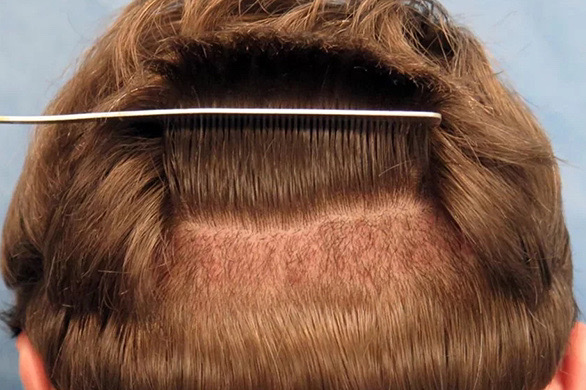
More common is a partial-shave approach, where a hidden strip of the donor area is trimmed, but it sits under longer hair above it, so once you comb over it the trimmed zone is invisible. The recipient area, the part everyone sees, stays unshaven. You get most of the discretion of a fully unshaven procedure with fewer of the technical limits, which is why many “unshaven” cases are actually partial-shave in practice.
The key thing to hold onto is that “unshaven” describes how your hair is managed, not a different surgery. The grafts are still extracted with FUE and usually placed with implanter pens. It’s the same biology and the same core technique, adapted so you don’t have to lose your length.
How It’s Actually Done
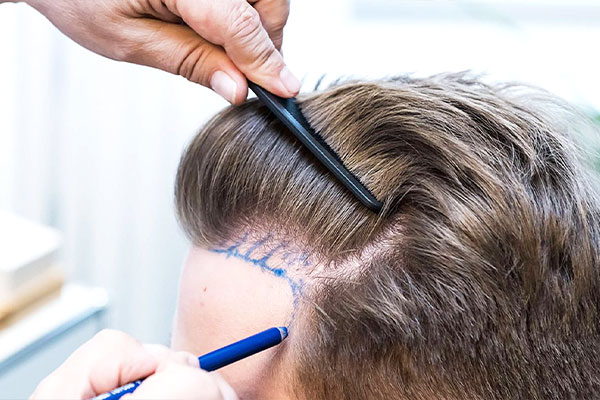
Because the recipient area isn’t shaved, the surgeon is working amongst your existing hair, threading new grafts between strands that are already there. That demands precision, because every placement has to respect the angle and direction of the surrounding hair without damaging the follicles already growing. This is why U-FUE is almost always done with DHI implanter pens, which give the control needed to place grafts cleanly into an unshaven field.
On the donor side, individual follicles are extracted from amongst the existing hair, or from a discreetly trimmed hidden zone, again one by one. The work is slower and more meticulous than a shaved procedure, because the surgeon can’t see the whole field as clearly and has to navigate around the hair that’s staying put. Done well, the result is that you leave looking much as you arrived, just with new grafts settling in quietly.
The Real Advantages
The headline benefit is discretion, and it’s a genuine one. You can have the procedure and return to work or social life without an obvious sign that anything was done. There’s no grow-out phase where your head is buzzed and the transplanted area is conspicuous against bare scalp. For people in public-facing roles, or anyone who simply doesn’t want to announce their hair transplant to the world, that’s a real quality-of-life difference.
It’s also a strong fit for many women, who often can’t or won’t shave their heads, and for whom the existing hair length is non-negotiable. An unshaven hair transplant lets them add density or restore a receding area without sacrificing the hair they already have. The same applies to anyone topping up an earlier procedure or filling a localised patch, where shaving the whole head for a small job would feel wildly disproportionate.
And because the surrounding hair stays in place, some people find the early healing period easier to camouflage, since the existing strands help screen the recipient area while the tiny scabs resolve.
The Trade-Offs No One Should Hide
Here’s where honesty matters. The unshaven approach has real limits, and a clinic that pretends otherwise isn’t doing you any favours.
The first is the number of grafts. Working amongst existing hair is slower and more fiddly, so the realistic graft count per session is usually lower than in a shaved procedure. For someone needing a small-to-moderate amount of work, that’s fine. For someone needing several thousand grafts to cover a large area, the unshaven route can mean it simply isn’t practical in one go, or that more sessions are required.
The second is cost. Because it’s more time-consuming and technically demanding, U-FUE typically costs more than an equivalent shaved procedure. You’re paying for the extra skill and time the discretion requires.
The third is the demand it places on the team. Placing grafts accurately in an unshaven field, without harming existing follicles, is genuinely harder. In skilled hands it’s excellent; in inexperienced hands the risk of damaging the hair you already have, or of lower graft survival, rises. This is not a technique to hand to a junior team.
Who It Genuinely Suits
Putting the trade-offs together, a clear profile emerges. The unshaven approach suits people who need a small-to-moderate number of grafts, who place a high value on discretion, and who have enough existing hair to work amongst. Think of someone refining a hairline, restoring a modestly receded area, adding density to thinning zones, or topping up a previous transplant.
It suits women restoring density or addressing a widening part, where shaving is off the table. It suits public-facing professionals who can’t take visible downtime. And it suits anyone whose job or social situation makes a buzzed head genuinely problematic rather than merely inconvenient.
Who It Doesn’t Suit
Equally, it’s honest to say who shouldn’t expect the unshaven route to be ideal. Someone with extensive baldness needing a very high graft count across a large area is usually better served by a conventional shaved procedure, which can place more grafts efficiently in a single session. Trying to force a huge case into an unshaven format can mean compromised density, multiple sessions, or a higher bill for a result that a shaved approach would have delivered more straightforwardly.
If maximum density over a big zone is your priority and a short grow-out period isn’t a dealbreaker, the standard approach may simply give you more for your money. The right answer depends on weighing how much discretion is worth to you against how much area you need covered.
The Partial-Shave Middle Ground
For many people, the best answer isn’t fully unshaven or fully shaved, but the partial-shave compromise. Here the donor is trimmed in a hidden band beneath longer hair, which makes extraction faster and allows a higher graft count, while the visible recipient area stays unshaven so your appearance barely changes. You get a meaningful chunk of the discretion without paying the full price in graft numbers.
This middle path is often the sweet spot, and it’s worth asking any clinic whether it’s an option for your case. It can deliver more grafts than a fully unshaven procedure while still letting you return to normal life without a visibly shaved head. At Hairpol, we’ll tell you honestly whether full unshaven, partial-shave, or a conventional approach gives you the best result for what you actually need.
How Clinic Skill Changes the Outcome
More than almost any other variation, the unshaven approach lives or dies on the skill of the team. Because the surgeon is working blind to some degree, navigating around hair that’s staying in place, the margin for error is smaller and the consequences of inexperience are larger. A skilled team protects your existing follicles and places new ones precisely; a careless one can damage what you came in with.
This is why choosing the clinic matters even more here than usual. You want a team with genuine, demonstrable experience in unshaven work specifically, not one that offers it as an afterthought. Ask to see unshaven cases they’ve personally done. The technique can produce beautiful, invisible results, but only when the hands doing it know exactly what they’re navigating. To understand how we place grafts with implanter-pen precision, you can read more on our DHI hair transplant page.
Recovery With an Unshaven Procedure
Recovery follows the same broad path as any FUE procedure, with one practical advantage: your existing hair helps screen the recipient area while the tiny scabs form and fall away over the first week to ten days. You’ll still need to follow the same aftercare, the same careful washing, and the same patience through the shedding and regrowth cycle over the following months, with the final result arriving around the twelve-month mark.
The discretion of the early weeks is the main day-to-day difference, and for many people it’s the whole point. Just remember that the underlying biology is identical: the grafts still go through shock loss and regrowth on the normal timeline. The unshaven format changes how visible the process is, not how it heals. For a fuller picture of those first days, our guide on the first 7 days after a hair transplant walks through what to expect.
How It Compares to a Standard FUE Day
If you’ve read about a conventional procedure, it helps to see where the unshaven version diverges. In a standard shaved FUE, the surgeon has a clean, fully visible field and can work quickly, extracting and placing high volumes of grafts with the whole canvas in view. The unshaven version trades that speed and visibility for discretion: the same steps happen, but slower, threaded between the hair you’ve kept.
Everything else, the local anaesthetic, the basic experience of the day, the aftercare, is broadly the same. What you’re really choosing between is a faster, higher-volume day that leaves a visible buzzed phase, versus a slower, more painstaking day that lets you walk out looking almost unchanged. Neither is objectively superior; they answer different priorities.
The Donor Area in Unshaven Work
People often focus on the recipient area, but the donor area deserves attention too. In a fully unshaven case, follicles are harvested from amongst your existing donor hair, which is slow and limits how many can be taken cleanly. In the partial-shave version, a hidden band is trimmed so the surgeon has a clearer field to extract from, then longer hair above is combed down to cover it.
This is why the partial-shave compromise so often makes sense: it protects the discretion you want while giving the donor extraction enough room to yield a workable graft count. A good clinic will assess your donor density and your hair length and tell you honestly which donor strategy gives the best balance for your case.
Managing Expectations About Coverage
One honest conversation worth having upfront is about coverage. Because the unshaven route typically yields fewer grafts per session, the realistic coverage from a single procedure may be more modest than what a shaved session could achieve. For a hairline refinement or a localised area, that’s no limitation at all. For someone hoping to rebuild a large, advanced area of loss in one go, it’s important to understand that the unshaven format may not deliver that in a single sitting.
Setting this expectation early prevents disappointment later. At Hairpol, we’d rather tell you plainly what one unshaven session can realistically cover than let you arrive expecting more than the approach can give. Sometimes the honest answer is a partial-shave plan, or staging the work, or accepting a short grow-out for a fuller single-session result.
Combining Discretion With Good Planning
The best unshaven results come from good planning as much as good technique. Because graft numbers are more limited, every follicle has to count, which makes thoughtful design even more important. Prioritising the most visible zones, respecting your natural hair direction, and being realistic about what one session achieves all matter more when you’re working within a tighter graft budget.
This is where an experienced clinic earns its place. Anyone can promise to keep your hair long; far fewer can plan an unshaven case so the limited grafts deliver the most natural, satisfying result. The discretion is only worth having if the underlying plan is sound, which is why the consultation matters as much as the technique itself.
Is Unshaven the Same as DHI?
It’s a common point of confusion, so worth clearing up. DHI and unshaven are not the same thing, though they often go together. DHI is an implantation method using a Choi pen; unshaven describes keeping your hair length. Because placing grafts into an unshaven field needs the precise control of an implanter pen, most U-FUE procedures use DHI, which is why the terms get tangled.
But you can have DHI on a shaved head, and the unshaven concept is really about hair management rather than the pen itself. Understanding the distinction helps you ask sharper questions in a consultation: you’re choosing both how grafts are placed and whether your hair stays long, and a good clinic will explain both decisions clearly rather than blurring them into one buzzword.
What to Ask at Your Consultation
A few targeted questions will tell you whether a clinic is the right place for unshaven work. Ask how many fully unshaven and partial-shave cases they perform, and ask to see photographs of both. Ask who places the grafts and how experienced they are at working amongst existing hair. Ask, honestly, whether your case is better suited to unshaven, partial-shave, or a conventional approach, and listen for whether the answer is reasoned around your scalp or simply tells you what you want to hear.
A clinic confident in unshaven work will answer all of this easily and may even talk you out of it if your case calls for something else. That willingness to steer you toward the right approach, rather than the one you walked in asking for, is the clearest sign you’re in good hands.
Is It Worth It?
Whether an unshaven hair transplant is worth it comes down to a single honest question: how much is discretion worth to you, and how much area do you need covered? If you need a small-to-moderate amount of work and the thought of a shaved head genuinely troubles you, the unshaven route can be transformative, letting you make the change quietly and on your own terms. If you need a large reconstruction, the maths may point you back toward a conventional approach, or a partial-shave compromise.
There’s no universally right answer, only the right answer for your hair, your goals, and your life. At Hairpol, we’ll give you a straight assessment of which approach actually serves you, rather than upselling the option that sounds most impressive.
If keeping your hair length through the process matters to you, the unshaven approach may be exactly right, but only a proper consultation can confirm it fits your case. To find out whether full unshaven, partial-shave, or a conventional procedure will give you the best result, the hair transplantation team at Hairpol is ready to assess your hair and talk you through your options honestly.
Find this helpful? Add Hairpol as a preferred source on Google.
Get a Free Consultation
Answer a few questions and the medical team will review your situation.
