
Nobody studies the back of your head in a lift. People look at your face, and at the frame around it. That frame is the first four or five centimetres of hair above your forehead, and it is the part of a hair transplant that gets judged in daylight, in phone cameras, in wedding photos, from half a metre away. Everything else on the scalp can be good enough. The front zone has to be right.
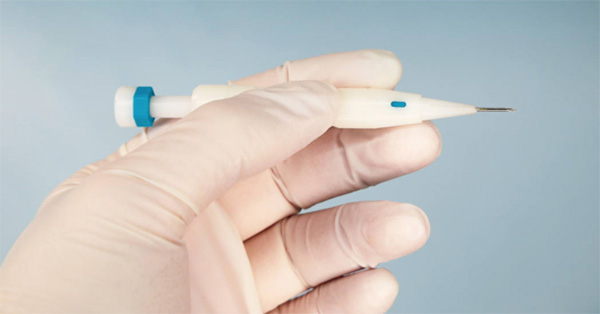
That single fact explains why so much surgical attention, and so much marketing noise, collects around one instrument: the Choi implanter pen. At Hairpol, we use it deliberately and selectively, not as a slogan. What follows is what the pen actually does in the front zone, why its mechanics suit that specific piece of scalp, and where its usefulness genuinely runs out.
What the Choi Pen Actually Does in the Surgeon’s Hand
Picture a fine hollow needle with a bevelled tip, mounted inside a slim barrel with a plunger. A loaded graft sits inside the channel of that needle, follicle first, the hair shaft trailing out of the slot. The operator holds the pen almost flat against the scalp, presses the tip through the skin to a set depth, and pushes the plunger. The needle withdraws and the graft stays behind, seated in the space the needle just made.
Two things happen at the same moment. The incision is created and the graft is placed in one continuous action. That is the whole idea behind DHI, or direct hair implantation, and it is why the technique is sometimes described as implantation without pre-opened channels. In classic FUE, one instrument opens the recipient sites and a different pair of hands, minutes or hours later, inserts grafts into them. With the Choi pen, those two steps collapse into one.
The pens come in graded needle diameters, usually somewhere between 0.6 and 1.0 millimetres. A skilled team keeps several calibres on the tray at once and matches the needle to the graft: the thinnest pens for the fine single-hair grafts that build a hairline, wider ones for the chunkier three-hair units that go further back. That matching is not a detail. It is most of the reason the front zone can look soft rather than planted. You can read more about how we plan the procedure itself on our DHI hair transplantation page.
Why the Front Zone Is the Hardest Real Estate on the Scalp
The hairline is unforgiving for reasons that have nothing to do with technology. It sits on skin that is thin and mobile. It has no surrounding hair to hide behind, which means every graft is visible on its own merits. And it is the only region where the eye has a lifetime of reference material: you know what a natural hairline looks like even if you could not describe one, because you have seen thousands of them.
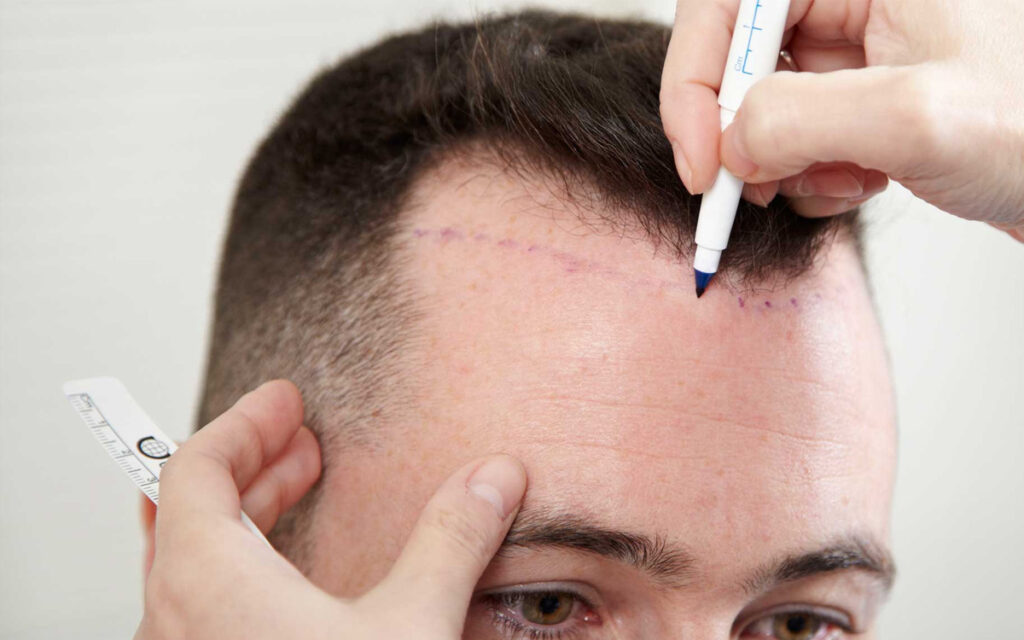
That instinctive recognition works on details most patients never consciously name. Natural hairlines are not lines. They are zones, two to three millimetres deep at the front edge, made of scattered single hairs of varying calibre, with small irregularities, gentle asymmetry, and hairs that lie almost parallel to the skin rather than standing up from it. Break any one of those and the result reads as artificial even when the coverage is technically good.
So the front zone demands control over variables that matter far less elsewhere. Angle. Direction. Depth. Spacing. Graft selection. A crown can tolerate approximation because whorl patterns are chaotic anyway and the viewing angle is rarely straight on. The hairline cannot. This is the context in which the Choi pen earns its place, and it is also why we treat a hairline design consultation as a separate piece of work from the surgery itself.
Angle: Working Almost Flat Against the Skin
Hair at the frontal hairline exits the scalp at a strikingly acute angle, often between fifteen and twenty-five degrees. It grows forward and lies down. Further back on the mid-scalp that angle steepens, and at the crown it can approach ninety degrees. If you implant a hairline at forty-five degrees, the hair will stand up like bristles no matter how good the graft quality is. It will never fall into a natural fringe, and no styling product will fully compensate.
The Choi pen holds an acute angle unusually well, because the operator is aiming a rigid needle rather than trying to insert a soft, foldable graft into a slit that was made earlier. Getting a graft into a shallow, oblique channel with forceps is genuinely difficult; the tissue tends to push the graft back towards vertical, and the more the technician struggles, the more the follicle gets handled. The pen simply travels along the angle it is pointed at and delivers the graft along the same vector.
At Hairpol, this is one of the reasons we favour DHI for the hairline even when the rest of the case is planned differently. The flattest angles on the head are exactly where the instrument’s geometry helps most. Consistency matters more than any single graft: two hundred grafts placed at a shared acute angle read as a fringe, while the same two hundred at scattered angles read as noise.
Direction: The Fan, the Temples and the Whorl
Angle is only half of the orientation problem. Direction is where the hair points when viewed from above, and it changes constantly across the front zone. In the central forelock, hairs run forward and slightly outward. Moving laterally towards the temples they swing to point down and back, sometimes almost horizontally. At the temporal points the transition can be sharp, and getting it wrong produces one of the most obvious tells in the industry: a temple region whose hair fights the natural sweep of everything around it.
Because the pen creates the site and fills it in one move, direction is decided at the moment of placement rather than inherited from a channel opened earlier by someone else. The operator rotates the pen a few degrees between grafts to follow the fan. Over a few thousand placements those small corrections accumulate into a front zone that moves as one piece when you run a hand through it.
There is a second benefit that shows up months later. Hair that all points the same way clumps. Hair that follows a natural fan separates, catches light differently along its length, and looks fuller than the graft count suggests. That is the honest mechanism behind most of the density claims made about DHI hair transplant results, and it has more to do with orientation than with quantity.
Depth: The Axis Everyone Forgets
Depth is the quietest of the three variables and the one that punishes mistakes most. Place a graft too deep and the skin can dimple or pit around it, sometimes with a small inclusion cyst or a patch of folliculitis in the healing phase. Place it too shallow and the follicle sits proud, healing with a raised bump, or it simply fails to survive because the bulb is not properly bedded in vascular tissue.
Choi pens have adjustable depth stops, so the same operator can move from a 4.5 millimetre setting in one region to a shallower setting in another without changing instruments or guessing. Scalp thickness is not uniform. The skin at the frontal hairline is often thinner than the skin behind it, and the depth that works perfectly at the mid-scalp will bury a graft at the front edge. Matching depth to the tissue in front of you is exactly the kind of adjustment the pen makes routine.
Patients almost never ask about depth. They ask about graft numbers and technique names. Yet in our experience, the difference between a hairline that heals invisibly and one that leaves a faint cobblestone texture in strong light is very often a depth story, not a technique story. The instrument helps, but only in hands that are actively watching the tissue rather than working on autopilot.
No Pre-Opened Channels: What That Changes and What It Doesn’t
The phrase channel-free gets used loosely, so it is worth being precise. DHI does not avoid making holes in the scalp. Every graft still needs a recipient site. What DHI avoids is the interval between opening a site and filling it, and the separate handling that interval requires.
Practically, this means a graft spends less time sitting out of the body waiting for a slot, and it is manipulated less between the moment it leaves the holding solution and the moment it is seated. Grafts are fragile. Repeated grasping with forceps, crush injury at the bulb, and drying at the surface are the real enemies of survival rates, and each transfer is an opportunity for all three. Fewer transfers, fewer opportunities.
It also means bleeding behaves differently. When channels are opened in advance across a whole region, the field oozes while grafts are inserted one by one, and visibility drops. With the pen, each site is occupied almost immediately, so the surgical field stays cleaner and the operator can see the previous row while placing the next one. In the front zone, where spacing is judged by eye against neighbouring grafts, that visibility is worth more than it sounds.
What it does not change: DHI is not automatically gentler on the scalp overall, and it does not remove the need for a well-planned donor extraction. A pen cannot rescue a case built on poor graft harvesting.
Single Grafts and the Irregular First Row
Every credible hairline is built from single-hair grafts at the leading edge. Not two-hair units trimmed down, not three-hair units placed sparsely: genuine one-hair follicular units, ideally the finer ones, sorted under magnification during the preparation stage. The first row or two is where naturalness is decided, and a single misplaced multi-hair graft at the front edge can be visible for years.
The thinnest Choi needles suit exactly this graft type. A 0.6 or 0.7 millimetre pen makes a site proportionate to a single fine follicle, which keeps the wound small and reduces the risk of the graft sitting loosely. It also lets the team place grafts closer together than a wider instrument would allow, without sites merging into one another and compromising blood supply.
Then comes irregularity, which is a design decision rather than an instrument capability. A natural front edge wanders. It has micro-irregularities, sentinel hairs sitting slightly ahead of the main line, small clusters, and gaps. Hairpol’s approach is to build that variation deliberately, because a perfectly even row is the single most recognisable sign of a transplanted hairline. We wrote about this design logic in more depth in why hairline design matters more than graft count.
Density in the Transition Zone
Behind the leading edge sits the transition zone, a band a centimetre or two deep where single grafts gradually give way to doubles and then to triples. This band carries most of the visual weight of a hairline. Too abrupt and there is a visible line where density jumps. Too gradual and the front looks thin no matter how many grafts went in behind it.
DHI helps here in a specific, limited way. Because the pen makes and fills each site in one action, the operator can place grafts relatively densely without the risk of accidentally re-entering or tearing an adjacent site that was opened earlier and is still empty. In a pre-opened field, sites sit open and can be damaged by subsequent instrument passes. That risk sets a practical ceiling on how tightly channels can be spaced.
We should be careful with the word density, though. Blood supply, not instrument choice, ultimately limits how many grafts a square centimetre of scalp can support. Pushing beyond roughly forty to fifty grafts per square centimetre in a single session is a gamble with survival, regardless of technique. What DHI offers is a cleaner path to sensible density, not permission to exceed biology.
Graft Handling, Time Out of Body and Survival
Follicular grafts are living tissue with no blood supply from the moment they leave the donor area until the recipient site revascularises. Everything in between is a race against dehydration and mechanical trauma. The commonly cited protective factors are cold storage, an appropriate holding solution, minimal handling, and short time out of body.
DHI addresses two of those directly. Handling drops because the graft is loaded once into the pen and released once into the scalp. Time out of body can shorten because implantation begins as soon as the first grafts are ready, rather than after an entire recipient field has been prepared. In a well-run theatre, extraction and implantation overlap, and grafts move from donor to recipient in a steady flow.
It is worth saying plainly that loading pens is itself a skilled, slow task, and a poorly trained team can spend so long loading that the theoretical advantage evaporates. This is why the technique is only as good as the number of experienced hands in the room. At Hairpol, the loading team is a fixed part of the DHI workflow rather than an afterthought, because the pen protects grafts only if it is fed correctly.
Unshaven DHI: Genuinely Useful, Frequently Oversold
One of the most requested features of the Choi pen is that it can be used through existing hair. Because the pen delivers the graft directly, an operator can work between standing hairs without needing a clear surgical field of shaved skin, which makes unshaven DHI feasible for selected patients.
This is a real advantage for people who cannot take visible downtime: someone whose job is public-facing, or who wants to return to an office in a week without explanations. Existing hair covers the healing recipient area, and if the donor is harvested through a hidden strip or a partially shaved window, the whole procedure can be close to invisible to a casual observer within days.
The limits are equally real. Working through hair is slower, so the achievable graft count in a session drops, sometimes considerably. It usually costs more. It suits patients with mild to moderate recession who still have reasonable native coverage in and around the recipient zone, and it suits smaller sessions better than large ones. Someone needing four thousand grafts across a bare front and mid-scalp is not a good unshaven candidate, and we will say so rather than sell the convenience.
Where the Choi Pen Stops Being the Obvious Answer
The honest limitations of DHI are almost all about scale. Loading a pen takes time; placing a graft takes time; and unlike channel opening, none of it can be batched. A large session covering the entire front and mid-scalp becomes a long day, sometimes spread over two days, with a bigger team and a higher price. For many patients that is a poor trade for a benefit which is concentrated in the first few centimetres of scalp.
Wide recipient areas with existing thin hair also raise a specific hazard: the needle can transect surviving native follicles on the way in. In a bare front zone that risk is negligible. In a diffusely thinning mid-scalp with a lot of miniaturised but living hair, it is not, and careful angle discipline matters even more.
This is where Sapphire FUE often makes more sense for the regions behind the hairline. Sapphire blades create fine, smooth recipient channels quickly and allow high-volume coverage in a reasonable session length. Many of our cases are hybrids for exactly this reason: pen at the front, blades behind it, one plan.
Why the Crown Is Not Automatically a DHI Case
Patients often assume that if a technique is good for the hardest area, it must be best everywhere. The crown argues otherwise. Crown hair grows in a spiral whorl, the scalp there is convex and often thicker, and coverage over a curved surface consumes grafts at a rate that surprises people. Crowns are usually about volume and the direction of the swirl rather than about a razor-fine leading edge.
Using DHI across a large crown is possible and sometimes appropriate, particularly for reconstructing a convincing whorl centre where angle changes rapidly over a small area. But applying it to an entire balding vertex is frequently an expensive way to buy precision that the region does not reward. Volume, sensible planning for future loss, and honest expectations matter more there.
At Hairpol we would rather spend a patient’s graft budget on a well-designed front and a stable mid-scalp than exhaust the donor area chasing a fully dense crown with the most time-consuming technique available. That conversation happens before surgery, not after.
How We Decide: Pen at the Front, Blades Behind
In practice, the decision tree is short. We look at where the hair loss is, how much donor supply exists, how the patient’s hair behaves in terms of calibre and curl, whether native hair remains in the recipient area, how many grafts the plan realistically needs, and how much downtime the patient can absorb.
From that, a typical Hairpol plan for a Norwood III or IV patient with a strong donor might use the Choi pen for the first two to three centimetres, including the temporal points and the transition zone, and Sapphire FUE channels for the mid-scalp behind it. The patient gets precision where it is visible and efficiency where it is not, in a single session at a sensible cost.
Sometimes the answer is full DHI, particularly for smaller unshaven cases, hairline refinement after a previous surgery, or repair work where existing hair must be preserved. Sometimes it is no DHI at all. The instrument is a means, not a philosophy, and any clinic that offers only one technique will inevitably find that every patient needs it.
What to Ask Before You Book
You do not need to be a surgeon to test whether a clinic’s DHI offer is substantial. Ask which parts of your scalp will actually be done with the pen and which will not, and why. A confident team answers with regions, not adjectives. Ask what needle diameters they keep on the tray, and whether single-hair grafts are sorted separately under magnification for the first rows.
Ask who is holding the pens. In most clinics the surgeon designs the hairline and makes the critical decisions while trained technicians place a proportion of the grafts, which is normal internationally. What matters is that the surgeon is present, that the team is stable, and that the person deciding your angles has seen thousands of hairlines rather than dozens.
Ask about the design before you ask about the count. A hairline drawn too low or too straight will look worse at forty than a slightly conservative one, whatever pen placed it. And ask what happens to the areas you are not treating now, because a good plan accounts for hair you have not lost yet.
The Realistic Timeline After a DHI Hairline
The first ten days look busier than people expect. Small crusts form at each implanted site and clear with careful washing. Because sites in the front zone are numerous and close together, the area can appear pink for a couple of weeks, particularly on fair skin, and slightly longer if you were treated unshaven and the redness sits between existing hairs.
Then comes shedding. Most implanted hairs fall out between weeks two and six, which is normal and not a failure of the technique. The follicle stays; the shaft is discarded. Regrowth typically starts around month three or four, becomes convincing at month six to eight, and reaches its final character somewhere between twelve and eighteen months as the new hairs thicken and take on their permanent calibre.
Judging a hairline before month twelve is a reliable way to make yourself miserable. Early growth is often finer, sometimes slightly wiry, and density looks patchy while different follicles wake at different times. At Hairpol we schedule reviews along that curve precisely so that patients measure progress against the right expectations rather than against a photo taken at month four.
If you are weighing up techniques for your own front zone, the useful question is not which acronym is superior in the abstract. It is which instrument suits the specific centimetres of scalp that will frame your face, and whether the team holding it has designed enough hairlines to make the small decisions well. Our clinicians in Ataşehir will assess your donor area, map your recession, and give you a plan that says exactly what happens where. You can start with our hair transplantation page, or book a consultation and bring your questions with you.
Find this helpful? Add Hairpol as a preferred source on Google.
Get a Free Consultation
Answer a few questions and the medical team will review your situation.
