

There is a particular unfairness in the combination that brings women to us with PCOS. Hair disappearing from the top of the head while appearing on the chin and upper lip. The same hormone driving both, in opposite directions, on the same body.
And the advice is usually the wrong shape. Either it is entirely gynaecological and never mentions your hair, or it is entirely cosmetic and never mentions the hormones.
The short answer: PCOS hair loss is androgenetic — raised androgen activity gradually miniaturises follicles at the crown and along the parting while sparing the back and sides. Because the follicles are shrinking rather than dying, medical treatment can genuinely improve density, and it should always be tried first. Expect 6 to 12 months before any treatment shows a visible result. A hair transplant only makes sense once hormones are controlled, shedding has stabilised for at least a year, and the donor area is confirmed strong enough.
Why the same hormone thins your scalp and thickens your chin
Androgens act on hair follicles, but the response depends entirely on where the follicle sits. On the face, chest and abdomen, androgens push fine vellus hairs to become thick terminal hairs. On the scalp of a genetically susceptible person, the same signal does the reverse — each growth cycle produces a slightly finer, shorter hair until the follicle no longer produces anything visible.
That is why hirsutism and scalp thinning so often travel together in PCOS, and why treating one usually helps the other. It also explains the frustration of patients who are told their hair loss is “just genetic” — the genetics decide which follicles are sensitive, and the hormonal environment decides how fast that sensitivity plays out.
The mechanism itself is the same one that drives male pattern loss, described in what DHT is and why it causes hair loss. What differs in women with PCOS is the pattern it produces and the fact that the hormonal driver is often modifiable.
What PCOS hair loss actually looks like
Women rarely go bald in the male sense. The typical presentation is a widening parting that develops over years, reduced ponytail thickness, and thinning that is worst over the crown and mid-scalp while the frontal hairline stays largely intact.
Look at your parting in a mirror with the hair pushed to one side. If the gap is noticeably wider at the front of the parting than at the back, forming a shape sometimes described as a Christmas tree, that is the classic female pattern distribution.
The back and sides being spared matters enormously, and not only for diagnosis. That preserved zone is the donor area, and its density is what determines whether surgery is ever an option. It is also why PCOS-related loss looks different from the diffuse whole-scalp shedding of telogen effluvium, where the sides thin too.
Getting the diagnosis right
Plenty of women with thinning hair and irregular cycles have never had a proper hormonal workup, and plenty who have been diagnosed with PCOS have never had their hair assessed by anyone.
Diagnosis rests on a combination of irregular or absent ovulation, clinical or biochemical evidence of raised androgens, and ovarian appearance on ultrasound, with other causes excluded. That exclusion step matters — thyroid disease, elevated prolactin and adrenal conditions can imitate parts of the picture, which is why an endocrinologist or gynaecologist should lead the diagnosis rather than a hair clinic.
From a hair perspective, ask for the panel that overlaps: ferritin, thyroid function and vitamin D alongside the hormonal tests, because deficiencies are extremely common in this group and make everything worse. Which values matter and how to read them is set out in the blood tests for hair loss.
Insulin resistance is the part nobody explains
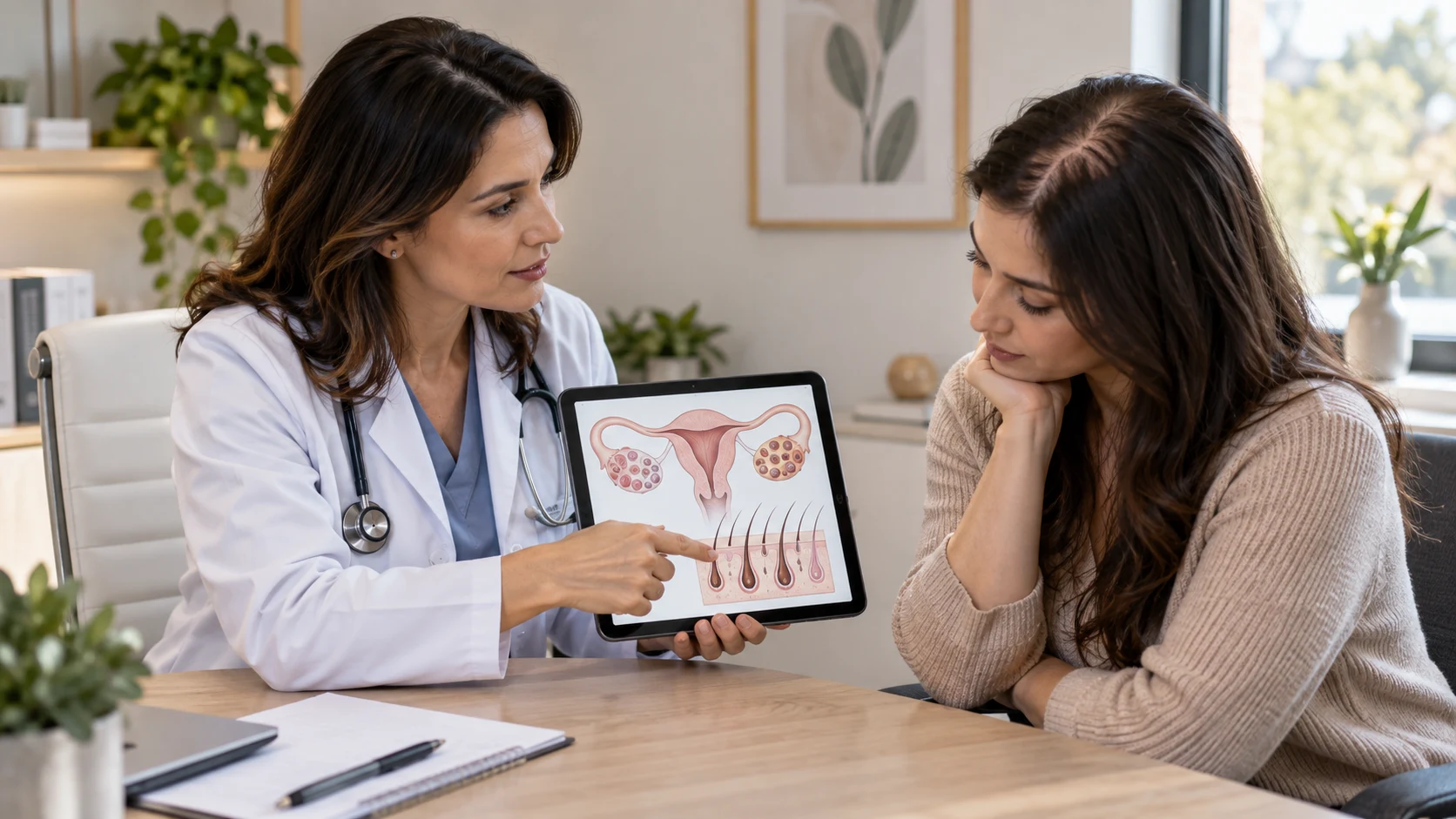
Insulin resistance sits underneath a large proportion of PCOS cases and drives the hormonal picture more than most patients are told. Higher circulating insulin encourages the ovaries to produce more androgens and lowers the protein that binds them in the blood, so more free androgen reaches the follicle.
This is why weight, diet and activity come up in every PCOS consultation, and why it feels dismissive when it is delivered badly. The point is not appearance. It is that improving insulin sensitivity lowers androgen exposure at the follicle, and that is one of the few levers that affects the underlying cause rather than the symptom.
One caution that belongs here: rapid, aggressive weight loss can trigger a separate shedding episode two to four months later, on top of the pattern loss you already have. Gradual change with adequate protein is genuinely better for hair than a crash approach, whatever the scales say.
What medical treatment does for the hair
Several medications are used in PCOS with an effect on hair, and every one of them requires a doctor’s prescription, assessment and monitoring. None of this is a self-directed project.
Anti-androgen medication is the most directly relevant, reducing androgen activity at the follicle and often improving both scalp density and unwanted facial hair. Combined hormonal contraception is frequently used to regulate cycles and reduce free androgen levels. Insulin-sensitising medication addresses the metabolic driver. Topical minoxidil is used to prolong the growth phase and is one of the few treatments with direct evidence in female pattern hair loss.
Two safety points that are not optional. Several of these treatments are contraindicated in pregnancy or require reliable contraception during use, which has to be discussed before starting. And each carries its own monitoring requirements. The right combination depends on your full clinical picture, your plans regarding pregnancy and your tolerance of side effects — decisions for your prescribing doctor, not for a hair clinic and not for a forum.
How long before you see anything
Hair answers slowly, and this is where most women lose faith in a treatment that was actually working.
Shedding usually settles first, often within 3 to 4 months of hormonal control being achieved. Visible improvement in density takes far longer — realistically 6 to 12 months, and the change is gradual enough that you will not notice it day to day. Some treatments also produce a temporary increase in shedding in the first weeks as follicles resynchronise, which is expected and not a reason to stop.
The only reliable way to see progress is photographs: same window light, same parting, same angle, once a month. Women who track properly are far less likely to abandon a treatment at month four, which is exactly when it looks like nothing is happening.
Iron, thyroid and the overlap nobody separates
PCOS does not protect you from everything else. In practice, many women arrive with two or three processes stacked on top of each other, and unpicking them changes the plan completely.
Low ferritin is very common, especially in women with heavy or irregular bleeding. Thyroid disease is more common in women generally and produces diffuse thinning that looks similar. Rapid weight change, a course of illness, or a recent pregnancy each add a temporary shedding layer over the underlying pattern.
The practical consequence is that some of what you are seeing may be reversible even if the PCOS pattern is not. That is genuinely good news, and it is a strong argument for correcting the correctable before making any decision about surgery.
How PCOS loss differs from postpartum and menopausal loss
These get confused constantly, and the distinction changes what you should do.
Postpartum shedding is a temporary effluvium: heavy, alarming, diffuse, and usually resolving within six to twelve months without treatment. Menopausal thinning is a pattern process driven by falling oestrogen leaving androgen influence relatively unopposed, and it tends to begin later in life. PCOS loss is a pattern process too, but it typically starts earlier — often in the twenties or thirties — and it comes with a hormonal driver that can frequently be modified.
That last point is the important one. A woman with PCOS often has more room to change the trajectory medically than a woman whose loss began at menopause, which we discuss separately in menopause and female hair loss. Starting treatment early in PCOS protects follicles that would otherwise be gone by forty.
Where PRP and in-clinic treatments fit
Non-surgical treatments have a supporting role in female pattern hair loss, and they work best on a scalp whose hormonal and nutritional situation has already been addressed.
Sequencing is everything. Running a course of PRP while androgens are uncontrolled and ferritin is at the floor is working against the current, and the disappointing result gets blamed on the treatment rather than the timing. Once hormones are managed, the same treatment has a much better chance of producing a visible change.
Realistic framing helps too. These treatments support existing follicles and can improve calibre and shedding rate; they do not create new follicles or reverse advanced miniaturisation. Our approach and what we offer is set out under hair treatments, and we would rather talk you out of a badly timed course than sell you one.
Is a hair transplant possible with PCOS?
Yes, for the right patient at the right time, and no for a surprising number of women who ask.
The conditions are specific. Hormones should be controlled and stable. Shedding should have been stable for at least a year, ideally documented in photographs. The donor area at the back and sides must have genuine density — in diffuse female patterns it is not always spared as much as it first appears, and transplanting from a donor zone that is itself thinning produces a result that fades. And medical treatment should be ongoing, because surgery moves hair, it does not stop the underlying process.
That last point is the one most often skipped in consultations. Transplanted follicles come from an androgen-resistant zone and keep growing, but your native hair in the recipient area continues to respond to hormones. Without ongoing medical management, you can end up with transplanted hair surrounded by continued thinning, which is the same trap described for diffuse thinning candidacy.
The donor question in women
Assessing the donor properly is the single most important part of a female consultation, and it is the part most often rushed.
Female pattern loss can be more diffuse than it looks. A parting that is obviously thin draws attention, while a donor zone that has quietly lost twenty per cent of its density does not. Measuring hairs per square centimetre in the donor area, rather than glancing at it, is what separates a plan that will work from one that will not.
Where the donor is borderline, the honest answer is to treat medically, wait, and reassess in a year. Where it is genuinely strong, a well-planned procedure can add meaningful density to the parting and mid-scalp. How female surgery differs technically from male cases is covered in how female hair transplants differ.
What surgery can and cannot do for a diffuse pattern
Surgery is a redistribution, not a cure. It moves a finite number of follicles from a zone that is not affected into a zone that is, and in diffuse female patterns the amount available is often smaller than patients hope.
What it does well: widening the appearance of the parting, improving density at the front and mid-scalp, restoring a hairline that has receded, and thickening temples. What it does not do: restore youthful density across the entire scalp, stop future loss, or replace medical treatment.
Expectations set properly in advance are the difference between a patient who is pleased at month twelve and one who is not, even with identical surgical results. If you want a straight answer about your own scalp before committing to anything, you can send photographs for an assessment — including one of the back of your head, which is the photograph that actually decides the question.
The emotional side, which is not a side issue
Women with PCOS often carry a stack of appearance-related symptoms at once — hair loss, facial hair, acne, weight that will not shift despite genuine effort — and each one is commonly dismissed individually by someone who does not see the whole picture.
Hair loss in women is also socially harder than it is for men. There is no accepted version of it, no equivalent to shaving your head, and the compensating behaviours are exhausting: styling around a parting, avoiding certain lighting, dreading wind.
At Hairpol we take that seriously in the consultation rather than treating it as background noise, because it changes what a good outcome looks like. A patient who wants to stop worrying about her parting in a restaurant needs a different plan from one focused on a number of grafts, and it is worth saying out loud which one you are.
What to do about the facial hair while you treat the scalp
Almost every consultation reaches this question, usually late and slightly apologetically, and it deserves a straight answer rather than a redirection.
The same anti-androgen treatment that helps scalp density usually reduces facial hair growth as well, but it works slowly and it does not remove hair that is already there. Expect it to reduce how fast and how coarsely new hair grows rather than to clear anything.
Removal is a separate track. Laser treatment works on the hairs that exist and does nothing about the hormonal driver, which is why women who treat only with laser often find new areas appearing over the following years. Combining medical control with removal is more effective than either alone, and the sequence matters less here than it does for the scalp.
Two practical notes. Laser works best on dark hair against lighter skin and is much less effective on fine, pale or grey hair. And plucking facial hair for years can irritate the follicle in a way that makes later treatment harder, which is worth knowing before it becomes a decade-long habit.
Pregnancy plans change the entire treatment order
This is the single most important thing to raise at the start of a consultation, and it is frequently left until the end.
Several of the treatments used in PCOS hair loss cannot be used during pregnancy or while trying to conceive, and some require reliable contraception throughout treatment. That is not a reason to avoid treatment; it is a reason to plan the order deliberately with your doctor rather than starting something you will have to stop in eight months.
Pregnancy itself also changes the hair picture temporarily in both directions — many women shed less during pregnancy and then experience a heavy postpartum shed that has nothing to do with the PCOS pattern underneath. Knowing that in advance prevents a great deal of unnecessary alarm at month four after delivery.
If a procedure is under consideration, this is decisive. We do not plan surgery around an active or imminent pregnancy, because the hormonal environment, the medication schedule and the healing period all argue for waiting until things are settled.
What to do next if you have PCOS and are losing hair
Start with the diagnosis rather than the solution. If you have not had a full hormonal and metabolic assessment, that is the first appointment, with an endocrinologist or gynaecologist rather than a hair clinic.
Ask for ferritin, thyroid function and vitamin D alongside the hormonal panel, and correct what is low under medical supervision. Discuss medical treatment for the hair specifically, including contraception requirements if any of it is contraindicated in pregnancy. Then start photographing your parting monthly in the same light, and give it a year.
If after that year your hormones are controlled, your bloods are corrected and the parting is still visibly thin, that is the point at which a surgical conversation is reasonable rather than premature. You can reach us through our contact page, read the practical detail in our frequently asked questions, and see how we assess candidacy on our hair transplantation for women page. And if the honest answer is that medicine will do more for you than surgery, we will tell you that instead — it is a better outcome, even though it is a worse sales pitch.
Find this helpful? Add Hairpol as a preferred source on Google.
Graft Range Calculator
Answer three questions to see the typical graft range for your situation — based on our published clinical guides.
This is a preliminary estimate, not a medical assessment. The exact number can only be determined by a doctor after examining your donor area and hair characteristics.
Get a Free Consultation
Answer a few questions and the medical team will review your situation.
