

Some people book a hair transplant because they want to look like nothing was ever missing. Others book one for a more specific and more emotional reason: they want the hair they had at twenty-two. The length they used to tie back before a job interview. The version of themselves that existed before clippers became a coping strategy rather than a haircut.
That second group asks a question most clinics answer far too quickly. Can you grow long hair after a hair transplant? The reflex answer is yes, and the reflex answer happens to be correct, but it skips everything that actually matters: how long the wait really is, what happens to the look of density once hair gets heavy, and the single styling habit that can quietly undo a good surgical result over the following five years.
The short answer: Yes. Transplanted follicles keep their own genetic programming, cycle normally, and grow to whatever length your hair naturally reaches — there is no built-in ceiling. Scalp hair grows roughly 1 to 1.5 cm per month, so expect your first proper haircut around month 3 to 4, roughly 10 to 15 cm of new length by month 12, and shoulder-length hair somewhere between year two and year three. Length is almost never the problem. Density at length is.
Can You Actually Grow Long Hair After a Hair Transplant?
The follicles moved during surgery come from the back and sides of your head, a zone that is largely insensitive to the hormone that drives pattern loss. When a surgeon lifts a follicular unit out of that region and places it into a thinning area, the follicle carries its programming with it. It does not adopt the habits of its new neighbourhood. It keeps cycling on its own schedule, growing for years at a stretch before resting and being replaced by the next hair from the same follicle.
That one fact settles the length question. A hair that stays in its growth phase for four to six years at about a centimetre a month has a natural terminal length somewhere between fifty and seventy centimetres. Nothing about the surgery shortens that window. Transplanted hair grows long for exactly the same reason the hair on the back of your head grows long — because the follicle producing it was built that way.
What people are really asking, once you unpack the question, is whether it will look right at length. That is a completely different question, and answering it honestly involves density, angle and planning rather than biology. We will get there.
The Shedding Month That Makes People Think They Cannot
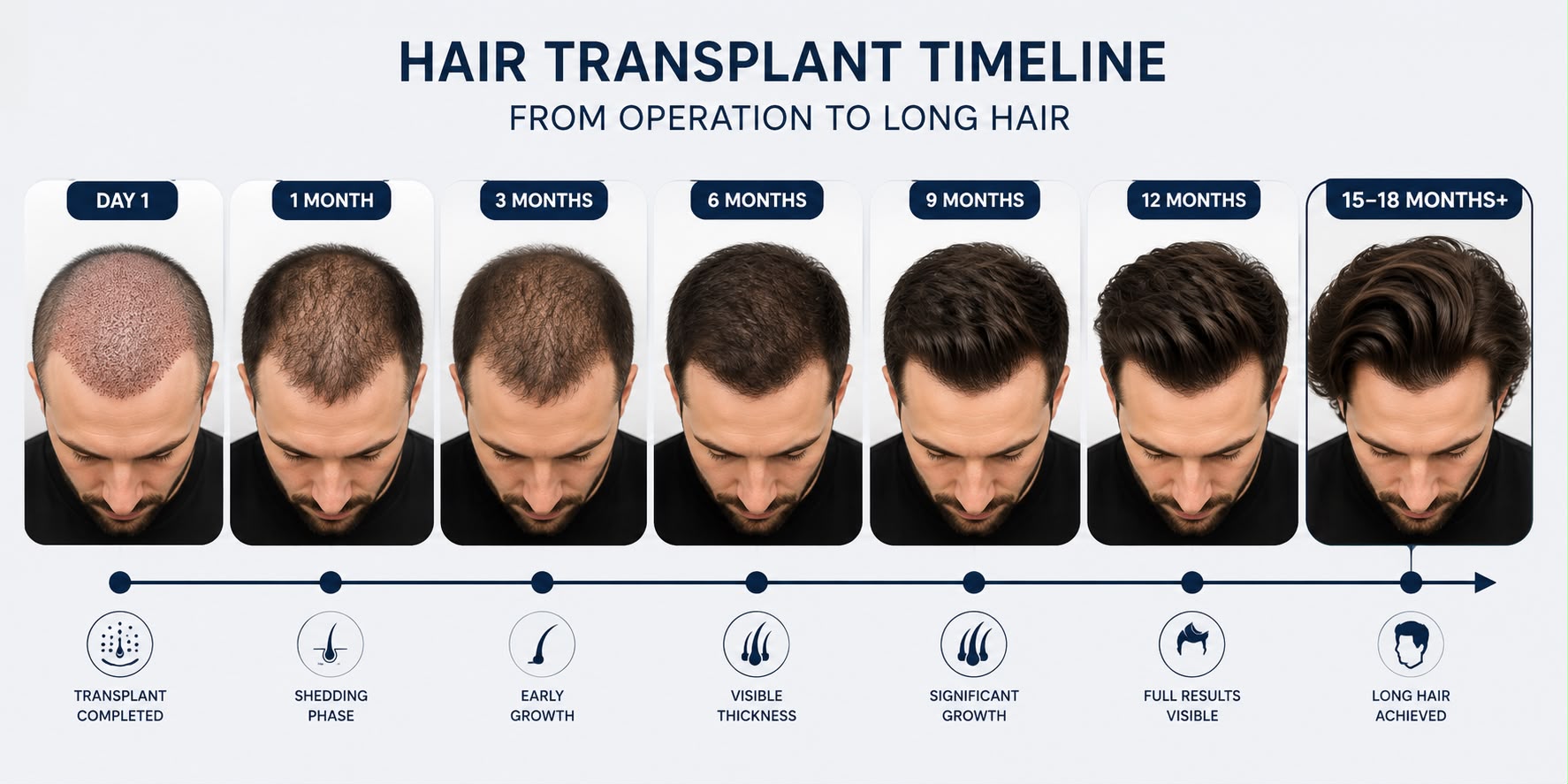
Between roughly week two and week six, most of the transplanted hairs fall out. The shafts leave. The follicles stay exactly where they were placed. This happens because the trauma of extraction and implantation pushes the follicle into a resting phase, and the hair it was carrying at the time has no reason to hold on through that.
Nobody enjoys this stage, and the patients planning for long hair take it hardest. They came in with a picture on their phone of the length they wanted, they left with a shaved head, and now even the new hair is disappearing down the shower drain. At Hairpol this is the month we get the most anxious messages, and the answer is always the same: the loss is the shaft, not the graft.
Regrowth typically restarts somewhere between month three and month four, unevenly, a few hairs at a time. This matters for anyone counting toward a length target, because your growth clock does not start on surgery day. It starts about a hundred days later. Every timeline in this article is measured from that restart, not from the operating table, and that offset alone accounts for most of the disappointment we see in month six.
When Can You Cut Your Hair for the First Time?
The donor area and the recipient area are on completely different schedules, and treating them as one is how people get into trouble at the barber.
The donor zone heals fast. The extraction points close over within days and the skin is generally settled by the end of the second week. Trimming there with scissors or a guarded clipper from around week three or four is usually uneventful, though it is worth waiting until any residual redness has faded so you are not asking a barber to work over irritated skin.
The recipient zone needs more patience. Scissors held above the scalp, cutting only the length of hair without touching skin, are generally reasonable from around week six to eight if you badly need tidying. Clippers with a guard over the transplanted area are usually fine from month three onward. A bare blade, a razor, or anything that drags across the surface should wait considerably longer — six months is a sensible line, and there is nothing to gain by testing it earlier.
Tell your barber what has happened. Not for sympathy, but because the instinct to comb hard, tug a section straight and hold tension while cutting is exactly what you want avoided in the first half of the year. If you want the full version of that conversation, we covered it in detail in our guide on how to style and cut your hair after a transplant without damage.
How Long Does It Take to Get Shoulder-Length Hair?
Do the arithmetic honestly and the answer stops being vague. Scalp hair grows around 1 to 1.5 cm per month, which is 12 to 18 cm in a year. Regrowth begins around month three to four. So at the twelve-month mark, when most people are being told to “judge the final result”, the transplanted hair is genuinely only eight or nine months old and sits somewhere around 8 to 13 cm.
That is a decent crop. It is not long hair.
Shoulder length from the crown of an average adult head requires somewhere in the region of 30 to 35 cm of hair, and the front sections need more than that because they start higher and have further to fall. At a realistic growth rate, and accounting for the months of nothing at the start, you are looking at roughly two and a half to three years from surgery before the transplanted zone genuinely reaches the shoulder. Longer if you trim along the way, which most people do because the intermediate stages are difficult to live with.
None of this is a reason to avoid surgery if long hair is the goal. It is a reason to start the clock sooner rather than waiting another two years to decide.
Does Long Hair Hide Thin Areas or Expose Them?
This is the part where honesty costs clinics bookings, so it tends to get skipped. The truthful answer is that long hair does both, and which one dominates depends on your hair calibre, your density, and how you wear it.
The argument for length is real. Coverage is partly a function of how much scalp each individual strand shades, and a long strand lying flat across the scalp shades far more surface than a short one standing upright. Grow the top out and you can lay hair across a thin zone, overlap it, and produce apparent coverage that a two-centimetre crop simply cannot deliver from the same number of follicles.
The argument against length is equally real. Long hair is heavier, and weight makes it separate under its own load rather than sitting as a mass. It clumps when it is oily and it clumps dramatically when it is wet, and clumped hair means visible channels of scalp between the clumps. It also creates a parting line, and a parting line is the single most unforgiving view of density on the human head. Fine long hair behaves worse here than coarse medium-length hair, every time.
The practical summary from years of watching patients try both: a short crop distributes any scalp show evenly across the whole head so the eye reads it as a hairstyle. Long hair concentrates scalp show at the part line and the crown whorl, so the eye reads it as thinning. If your density is genuinely good, length flatters it. If your density is borderline, length audits it.
If long hair is your actual goal, the number that matters is not the graft figure someone quotes you over a messaging app. It is whether your donor supply can fund enough density in the zones that will carry the weight and form the part. A photo set — hair pushed back, hair parted, and one shot with the hair wet — usually tells us that within a day, and you can send those photos for an assessment before you commit to anything.
What Long Hair Does to the Look of Your Donor Area
Here the news is good, and it is one of the few places where the long-hair plan has a clear structural advantage.
Modern extraction leaves small round marks in the donor zone, typically under a millimetre across, slightly paler than the surrounding skin. At a number one buzz they can be visible under direct light, particularly if the extraction was aggressive or poorly distributed. At two centimetres of hair they are functionally invisible. At the kind of length someone growing their hair out will be carrying, nobody is ever going to see them, including you.
There is one exception, and it catches people out. The classic long-on-top, short-at-the-sides undercut fades the sides and back down to skin — and the region it fades hardest is precisely where grafts were harvested. Growing the top long does nothing to protect a donor zone you are deliberately shaving. If that is your intended style, say so at consultation, because it changes how the extraction should be distributed. We wrote about this in more depth in our piece on how visible hair transplant scars really are.
Is It Normal That My New Hair Grows at Different Lengths?
Yes, and it is one of the most common reasons people message us at month eight convinced something has gone wrong.
Transplanted follicles do not restart in unison. Some wake at month three, some at month five, a stubborn minority not until month eight or nine. By the time you are approaching a year, you are carrying hairs that started growing at five or six different points in time, which means you are carrying hairs of five or six different lengths in the same square centimetre. Under a mirror this reads as feathery, wispy, faintly patchy, and nothing like the smooth result you were promised.
It resolves on its own. Most of that unevenness has evened out by month fourteen to eighteen, as the late starters catch up and the whole area drifts into a more uniform range. The mistake we see is people trying to fix it by cutting everything back to the shortest hairs, which sacrifices a year of growth to solve a problem that was about to solve itself.
The other thing worth knowing: your native hair around the transplanted zone is on its own cycle and is not resetting, so during that first year the grafted patch will always be shorter than the hair around it. That contrast is temporary and it is not a sign of failure.
Texture, Calibre and the Grafts That Behave Differently
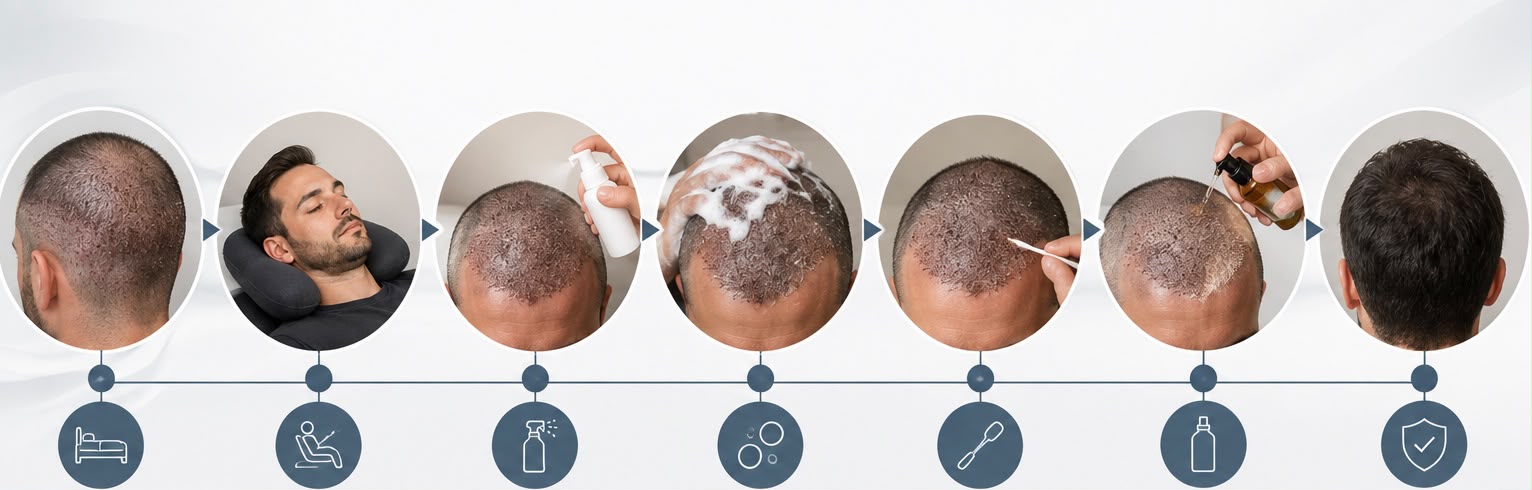
The first hair a transplanted follicle produces is often not representative. It tends to emerge finer than the follicle’s eventual output, and it is frequently curlier, wavier or more wiry than the rest of your hair, sometimes noticeably so. This settles over the first one to two cycles as the follicle recovers its normal calibre, which in practice means the texture you have at month eighteen is a much better indicator than the texture you have at month seven.
Where this becomes genuinely important for a long-hair plan is with grafts taken from outside the scalp. Beard and body hair follicles keep their original programming too, and their original programming includes a much shorter growth phase. A beard follicle placed on the scalp will grow, but it will stop and shed at a length dictated by its own cycle — commonly somewhere in the range of a few centimetres — rather than following the scalp hair around it to thirty.
In a short or medium style this is invisible and the extra coverage is a genuine gain. In a long style, those grafts will always sit as a shorter under-layer that never reaches the rest. If you know long hair is the endpoint, that is a conversation to have before body grafts are planned into the visible zones rather than after.
If You Do Not Want to Lose Your Length in the First Place
For patients who already have long hair, the shave is often the hardest part of the whole proposition. Losing two or three years of growth in twenty minutes to gain a result that will take another three years to catch up is a genuinely unattractive trade, and it is the reason a lot of people with long hair postpone surgery indefinitely.
The unshaven route exists for exactly this. Grafts are extracted between the existing long hairs and placed without shaving the recipient zone, so you leave with your length essentially intact. It works, and for the right patient it is an excellent option. It also has real limits: the achievable graft numbers are lower than a shaved session, the surgery takes longer, extraction is technically harder and therefore more expensive than a shaved session of the same size, and very large sessions are generally off the table. There is also a partial-shave middle ground, where a strip of donor is shaved underneath a curtain of longer hair that hides it completely.
Which of those fits you depends on how many grafts you actually need, and that is a question of pattern rather than preference. Our full breakdown is in the article on unshaven U-FUE hair transplants, who they suit and their limits.
Styling Long Hair Without Pulling On It
This section matters more than any other in the article, and it is the one nobody reads until it is too late.
Transplanted follicles inherit resistance to hormonal loss. They inherit no resistance whatsoever to mechanical loss. Sustained tension on a follicle — a tight bun worn daily, a ponytail pulled back hard, tight braids, a hair tie in the same spot for years — causes traction alopecia in transplanted hair exactly as it does in native hair. The follicle is pulled, it inflames, it miniaturises, and eventually it scars down and does not come back. You cannot transplant your way out of a habit that is still running.
The rule of thumb we give patients is straightforward: if you can see the skin tenting at the hairline when the hair is tied, it is too tight. If you have a headache after an hour, it is too tight. If there is a permanent dent where the tie sits, it is too tight. Wear it loose, use fabric ties rather than thin elastics with metal joints, move the parting and the tie position around rather than loading the same line every day, and never sleep in a tied style.
We are emphatic about this because we treat the consequences. Our article on hair transplants for women with traction alopecia exists because tension damage is one of the few forms of hair loss that is entirely preventable and routinely ignored until the hairline has already receded a centimetre.

Heat, Dye and Chemical Processing on Grown-Out Grafts
The hair shaft is dead protein. Nothing you do to it with a straightener or a bottle of dye reaches down and harms the living follicle, which is why the timing rules around colouring are about scalp healing rather than graft survival. Once the scalp is fully settled — commonly around the six-month mark, and worth confirming with your clinic rather than guessing — chemical processing is not a threat to your result.
Breakage is. If you are trying to reach a length that takes three years to achieve, every centimetre lost to snapping mid-shaft is a centimetre you have to grow twice. People chasing long hair after a transplant tend to over-manage it: daily heat styling, aggressive brushing when wet, tight elastics, frequent bleaching. The follicle survives all of it. The length does not.
Low heat, wide-tooth comb, detangle from the ends upward, and accept that hair grown for length needs to be handled less rather than more.
Long Hairstyles That Work While You Are in the Middle
Months six to eighteen are the awkward stretch. Too long to read as a deliberate crop, too short to tie back, and uneven in length because of the desynchronised regrowth described earlier. This is where most people give up and shave it, which resets everything.
A few things genuinely help through that window:
- A soft side sweep rather than a slicked-back style — anything pulled straight back puts the hairline under maximum scrutiny at the exact moment it is least dense.
- Texture over shine. Matte products and sea-salt style sprays separate hair into apparent volume, while gels and pomades clump strands together and expose the scalp beneath.
- Delay the centre parting. A hard central part is the harshest possible test of density and is best saved for after month eighteen, when the late-starting follicles have caught up.
At Hairpol we tend to suggest a light shaping cut every ten to twelve weeks through this phase rather than growing it out untouched. You lose a little length and you gain a style that does not look accidental, which is usually the difference between someone who makes it to the finish line and someone who buzzes it at month nine.
When You Reach the Length You Wanted and It Still Looks Thin
Sometimes the plan works and the result at length is still not what you pictured. It is worth saying plainly rather than pretending it never happens.
The first thing to check is timing, because a surprising number of these conversations happen too early. Density continues to build well past the twelve-month mark as calibre thickens and late follicles arrive, and a result at month eighteen is often noticeably fuller than the same head at month twelve, which is why our before and after gallery is labelled by month rather than shown as a single image. Judging long hair before that point is judging an unfinished picture.
If the timing is right and the density is genuinely short of the goal, the options are honest and limited. A second session can add density to the part line and the areas carrying weight, and donor supply permitting, this is often the cleanest answer. Medical hair treatment — which needs a doctor’s assessment before you start anything, including the products sold without prescription — protects the native hair that is doing half the work in a long style. Scalp micropigmentation can shade the background so that gaps between strands stop reading as bare skin. And sometimes the right answer, unglamorous as it sounds, is a shorter cut that distributes what you have evenly instead of asking it to cover more scalp than it can.
What we will not do is take money for a second procedure that cannot deliver what the donor area does not contain. That conversation is uncomfortable once and useful for a decade.
Planning the Surgery When Long Hair Is the Goal
If you already know that long hair is where you want to end up, say it in the first ten minutes of your consultation rather than at the end. It changes the plan in ways that are difficult to retrofit.
Angle and direction matter more, because long hair has to fall somewhere and grafts placed at an angle that fights your natural fall will never sit right no matter how well they grow, which is one reason DHI implantation, where angle and depth are set in a single step, suits patients planning for length. The intended part line deserves priority density, since that is the strip that will be examined every day. Body and beard grafts, if they are part of the plan, belong in zones where a shorter under-layer will not show. Donor extraction should account for whether the sides will be worn short or grown out. And if the pattern is still progressing, a staged plan makes more sense than a single large session that leaves you with a dense front and an evolving gap behind it.
At Hairpol, growing your hair long afterwards is not an unusual request and it is not one we discourage — it simply needs to be part of the design rather than an afterthought. If that is your goal, bring the photograph of the length you have in mind to your hair transplantation consultation and let it shape the plan from the beginning. Three years is a long wait for hair. It is a much shorter wait when the surgery was built for it.
Find this helpful? Add Hairpol as a preferred source on Google.
Get a Free Consultation
Answer a few questions and the medical team will review your situation.
