

The question almost never arrives at the start of the consultation. It arrives at the end, quietly, once the graft numbers have been discussed and the patient has decided they want to go ahead. “One more thing. I’m on blood thinners. Is that a problem?”
It is not a small footnote, and the fact that patients save it for last tells you how many clinics have made them feel it might disqualify them. Most of the time it does not. What it does is change the sequence: your medical history has to be assessed and cleared before anyone books a surgical date, and the person who signs off on your medication is your own doctor, not a hair clinic.
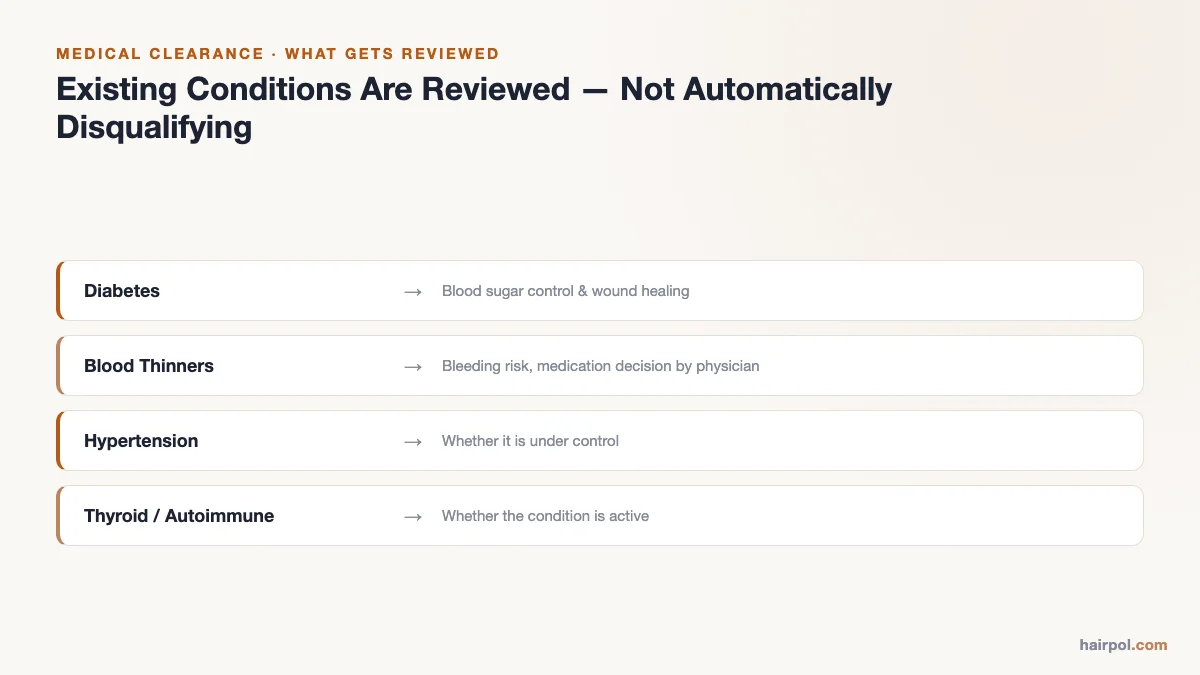
The short answer: a hair transplant is a minor surgical procedure under local anaesthesia, so most people with well-controlled diabetes, treated hypertension or stable thyroid disease can be cleared. Blood thinners require a documented decision from the prescribing physician, never from the clinic. Uncontrolled disease, recent cardiac events and active autoimmune flares are reasons to postpone, and a small number of situations are genuine contraindications.
Why the question matters more than patients expect
A hair transplant involves thousands of small wounds. Each extraction punch and each recipient incision is tiny, and there are between two thousand and five thousand of them, spread across two areas of a well-vascularised scalp. The individual injuries are trivial. The cumulative demand on wound healing, clotting and infection control is not.
That is the whole reason systemic conditions matter here. Anything that slows healing, raises bleeding risk, suppresses immunity or destabilises blood pressure during a long procedure changes the risk profile of an operation that is otherwise remarkably safe. It rarely rules you out. It usually changes preparation, timing and monitoring.
At Hairpol we ask for the full picture in writing before a date is offered: diagnoses, current medications with doses, recent test results and the name of the physician managing each condition. Patients occasionally find that excessive for what they were told is “a simple day procedure”. It is a day procedure. It is still surgery, and the honest risk discussion is covered in is a hair transplant safe and what the real risks are.
Diabetes: controlled and uncontrolled are different operations
Diabetes is the condition patients worry about most and the one that most often ends in clearance. The distinction that matters is not whether you have it but how well managed it has been.
Well-controlled diabetes, with stable readings and regular review by the physician managing it, is compatible with hair transplantation in most cases. Poorly controlled or newly diagnosed diabetes is a different situation, because sustained high blood glucose impairs the small-vessel circulation and the immune response that wound healing depends on. Grafts need reliable blood supply in the first days. Donor and recipient wounds need to close without infection.
Your surgeon will usually want a recent HbA1c result, because it describes control over the preceding months rather than on the morning of the appointment. There is no single universal number that clears or blocks every patient; the interpretation belongs to your physician and the operating surgeon together, alongside how long you have had the condition and whether there are existing complications such as neuropathy or poor peripheral circulation.
Practical points also change. Fasting instructions, timing of insulin or oral medication, meal breaks during a long day and glucose monitoring in theatre all have to be planned in advance with your treating doctor, not improvised on the day.
Blood thinners: the one decision that is never the clinic’s
This is the most important paragraph in this article. If you take an anticoagulant or an antiplatelet medication, the decision about whether it is paused, adjusted or continued around surgery belongs exclusively to the doctor who prescribed it. Not to us, not to a coordinator, and not to a forum.
The reason is that these medications are prescribed for a reason with its own risk. Someone taking an anticoagulant after a cardiac valve procedure, a clot or an arrhythmia faces a genuine thrombotic risk if the medication is interrupted, and that risk can be far more serious than a bleeding complication during hair surgery. Balancing those two risks requires knowing why you are on the drug, which no hair clinic can determine.
What a responsible clinic does is straightforward: ask for the drug and dose in writing, ask you to obtain a written opinion from your prescriber, and plan around whatever that opinion says. Sometimes that means proceeding with no change and accepting more oozing during extraction and placement, with a longer day and careful haemostasis. Sometimes it means a temporary adjustment agreed by your own physician. Sometimes it means the procedure waits.
Aspirin, other anti-inflammatory painkillers, fish oil, high-dose vitamin E and several herbal supplements can also affect bleeding, which is why the pre-operative questionnaire asks about supplements and not only prescriptions. Bring the actual boxes to your consultation if you are unsure what you take.
High blood pressure: common, manageable, and worth taking seriously
Hypertension is the condition we see most often, and in treated, stable patients it very rarely changes the plan. Uncontrolled hypertension is a different matter, for two practical reasons.
The first is bleeding. Elevated pressure during a procedure involving thousands of incisions produces more oozing, which obscures the surgical field, slows placement and can affect graft handling time. The second is safety during a long day. Sitting or lying for many hours with anxiety, local anaesthetic containing adrenaline and pre-existing hypertension is a combination that needs monitoring rather than assumption.
Most clinics will check your blood pressure on arrival and will postpone if readings are significantly above your usual controlled range. That is not bureaucracy; it protects both the result and you. If your readings have been unstable recently, see the doctor managing your treatment before you book flights rather than after, and read who should delay a hair transplant for the wider list of reasons a date gets moved.
Thyroid disease and the hair loss underneath it
Thyroid disorders raise two separate questions, and clinics often answer only the first.
The surgical question is simple: a patient with stable, treated thyroid function is generally a candidate, and untreated or unstable thyroid disease should be settled before elective surgery.
The second question is more interesting for your result. Both underactive and overactive thyroid function can cause diffuse hair shedding that has nothing to do with genetics. Transplanting into a scalp where part of the thinning is driven by an untreated endocrine condition means the underlying loss continues after surgery and the result underperforms. If thyroid disease is in the picture and the shedding pattern is diffuse rather than patterned, we want an endocrinology assessment first. The candidacy logic is the same one set out in does a hair transplant work for everyone.
Autoimmune conditions and immunosuppressive treatment
Rheumatoid arthritis, lupus, inflammatory bowel disease, psoriasis and similar conditions come up regularly, and the assessment depends on two things: whether the disease is active and what medication you take for it.
A quiet, well-managed autoimmune condition is often compatible with surgery. An active flare is a reason to wait, because inflammation and healing are competing for the same biological resources, and because a flare often coincides with a change in medication.
Immunosuppressive and biologic therapies raise infection risk and can affect healing, and the timing of surgery relative to your dosing cycle may matter. That timing decision belongs to your rheumatologist or dermatologist. We ask for it in writing, and we plan around it. Some scalp conditions, notably lichen planopilaris and discoid lupus affecting the scalp, are scarring processes where transplantation is generally not appropriate at all while the process is active, and sometimes not afterwards either.
Heart conditions, stents and the anaesthesia question
Patients with cardiac history often assume a hair transplant is out of reach because they associate surgery with general anaesthesia. Hair transplantation is performed under local anaesthesia, usually with mild oral sedation at most, which removes a large part of the cardiac risk associated with major operations.
That does not make it risk-free. Local anaesthetic solutions typically contain adrenaline to reduce bleeding, which has cardiovascular effects. The procedure is long. Patients with significant arrhythmia, recent myocardial infarction, recent stent placement, unstable angina or heart failure need a cardiology opinion before an elective cosmetic procedure, and in the months immediately after a cardiac event the usual answer is to wait.
If you have a pacemaker or implanted defibrillator, tell the clinic early. Certain instruments used in theatre require specific precautions, and knowing in advance is very different from discovering it on the day. Our approach to this kind of preparation, and to who is in the room, is described on our about Hairpol page.
Which tests are usually requested before surgery?
Requirements vary by clinic and by patient, but a typical pre-operative panel covers a small number of predictable areas.
A full blood count looks at haemoglobin and platelets. Coagulation tests describe how your blood clots. Blood glucose and HbA1c matter for anyone with diabetes or suspected of it. Blood-borne infection screening is standard in most surgical settings for the protection of staff and other patients. Depending on age and history, an ECG and a basic biochemistry panel including kidney and liver function may be added.
Two things about these tests are worth knowing. They should be recent, usually within a few weeks, because a result from last year describes a person who no longer exists. And someone should actually read them. A clinic that collects your results and never mentions them again has performed an administrative ritual, not a clinical assessment.
If your results show something unexpected, the correct outcome is a referral, not a rescheduled sales call. Anyone comparing clinics should ask what happens if a test comes back abnormal, and our list of questions to ask before you commit includes several worth raising in writing.
Who gets asked to postpone?
Postponement is not rejection, and in our experience it is the outcome patients resent at the time and appreciate a year later.
We ask patients to wait when diabetes control has recently deteriorated, when blood pressure is unstable, when there has been a cardiac event or major surgery in recent months, when an autoimmune condition is flaring, when there is an active scalp infection or inflammatory scalp disease, when a patient is on a short course of medication that affects clotting or immunity, or when a required specialist opinion has not yet been obtained.
Pregnancy and breastfeeding are also reasons to wait, both because elective surgery is deferred as a matter of routine and because postpartum hair changes can resolve on their own. That question comes up frequently in our hair transplantation for women department, and the answer is almost always to reassess after hormonal changes settle.
In every one of these cases the plan is not cancelled. It is dated differently, and the graft plan is usually better for the delay.
Who is genuinely not a candidate?
The list is short, and honest clinics keep it short rather than expanding it or pretending it does not exist.
Severe uncontrolled systemic disease that has not responded to management, significant bleeding disorders that cannot be safely managed around surgery, active scarring alopecias of the scalp, and unrealistic expectations combined with body dysmorphic features are the main categories. Insufficient donor supply is a separate and much more common reason, and it has nothing to do with your general health.
Being told no is not a pleasant experience, and we understand why patients then look for a clinic that will say yes. Someone usually will. That is precisely the problem, because the risk did not disappear when the second clinic accepted the booking; it simply moved to a place with less scrutiny.
If you want a straight answer about your own situation, send your diagnoses, medication list and recent results with your photographs through the Hairpol assessment form, and we will tell you whether the next step is a surgical date, a specialist referral or a longer wait.
Smoking, alcohol and the risks you can actually change
Chronic conditions are largely outside your control. These are not, and they influence healing more than most patients believe.
Nicotine constricts small blood vessels, which is exactly the circulation newly placed grafts depend on in the first days. Smoking is associated with slower wound healing and higher complication rates across surgical specialties, and it is the single modifiable factor we raise most often. Most surgeons ask patients to stop for a period before and after the procedure. The detail is covered in how smoking affects graft survival.
Alcohol thins the blood, raises bleeding during extraction and interacts with several medications, so a defined abstinence window before and after surgery is standard advice. Uncontrolled weight, poor nutrition and untreated sleep apnoea also sit in this category of things that quietly change outcomes.
None of this is moralising. It is the same argument as graft handling and team size: everything that improves circulation and healing improves the percentage of grafts that survive, which is the number your result actually depends on, as explained in what graft survival rate means.
Travelling abroad for surgery with a chronic condition
If you are flying for treatment, a chronic condition adds logistics that are easy to underestimate.
Carry enough medication for longer than your planned stay, in original packaging, with a copy of your prescription. Bring a summary of your medical history and your specialist’s contact details in a language the clinic can read. Tell the clinic about your condition when you enquire, not when you land, so that any additional testing or specialist input can be arranged in advance rather than compressed into the day before surgery.
Flight timing also deserves thought. Long-haul travel shortly after any procedure carries its own considerations for patients with cardiovascular conditions or clotting risk, and the appropriate interval is a question for your own physician. Patients planning a trip can see how we structure the practical side on our hair transplant in Turkey page, including what is arranged before you travel.
The clinics that handle this well ask you medical questions before they quote a price. The ones that quote first and ask later are telling you where their priorities sit.
What to bring to your Hairpol consultation
Preparation turns a vague conversation into a decision, and it takes about twenty minutes to assemble.
Bring a complete list of medications and supplements with doses, including anything taken occasionally. Bring recent test results if you have them, with dates. Bring the names and contact details of the physicians managing each condition. Bring a short written history of any surgery, cardiac events, clotting problems, allergies or reactions to local anaesthetic. And bring photographs of your scalp in ordinary light if you are enquiring remotely.
What we do with that is the same for everyone: assess whether your conditions are stable, identify which specialist opinions are needed, request any missing tests, and only then discuss graft numbers and dates. Where a condition contributes to your hair loss rather than only affecting surgery, we may also suggest that our hair treatment programmes or a medical plan come first, always alongside the doctor who prescribes for you.
If you are ready for that conversation, book through our hair transplantation department and bring the paperwork. The clinics worth trusting are the ones that want to read it.
Find this helpful? Add Hairpol as a preferred source on Google.
Get a Free Consultation
Answer a few questions and the medical team will review your situation.
