

Most women who ask us about traction alopecia don’t open with the phrase. They open with a photo on their phone, usually taken at an awkward angle, showing the strip of bare scalp where their edges used to be. Then comes the timeline: the years of tight braids, the ponytail that was the only style that looked professional, the weave that was installed a little too snugly, the scarf tied a fraction further back each month to hide what the last style had taken.
That’s the honest starting point. Traction alopecia isn’t a mystery diagnosis. You usually know what caused it, and quite often you knew while it was happening — because it hurt. The harder question, the one that brings you to a clinic, is different: how much of this can be given back, and what does surgery actually fix?
At Hairpol, this is one of the consultations where we say “not yet” more than almost any other — and also one where, when the timing is right, the result changes how a woman photographs herself for the rest of her life. Both things are true at the same time.
What Repeated Pulling Actually Does to a Follicle
A hair follicle sits in the scalp at an angle, anchored by connective tissue and fed by a small cluster of vessels. It tolerates a surprising amount of daily handling. What it does not tolerate is sustained mechanical tension — the same directional pull, held for hours, repeated for years.
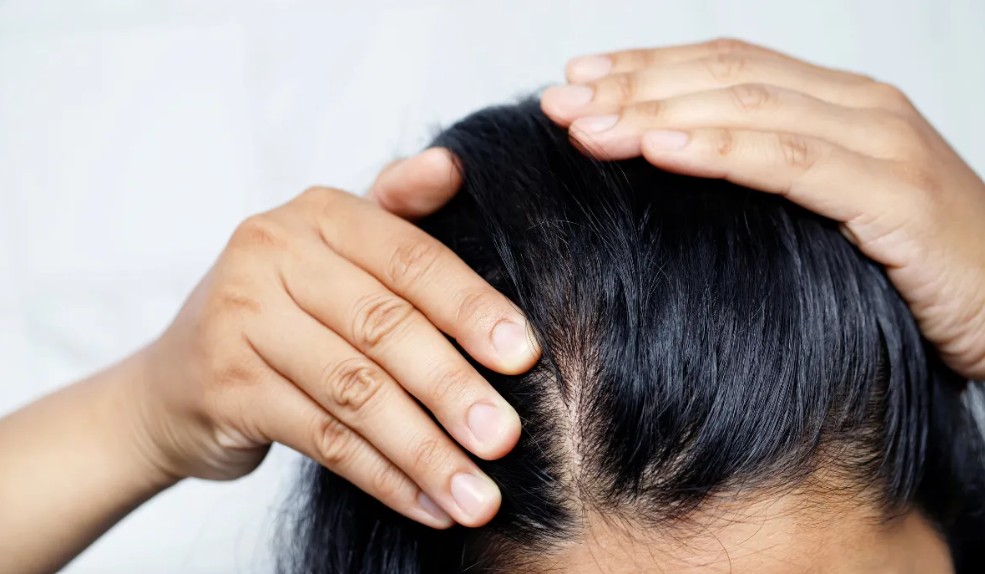
Early on the follicle responds the way any stressed tissue does. It becomes inflamed. The hairs it produces get finer and shorter, the growth phase shortens, and shedding increases. If you were to look closely at the affected border during this stage, you’d often see tiny inflammatory bumps around the openings, sometimes a few short broken hairs, and a scattering of surviving hairs marooned in front of the receding line — the so-called fringe sign that separates traction from a receding pattern of genetic loss.
Push past that stage and the biology changes character. Chronic inflammation is eventually replaced by fibrous tissue. The follicular opening closes over, the stem cell reservoir in the upper follicle is lost, and the scalp in that zone becomes smooth and slightly shiny. At that point you’re no longer dealing with a stressed follicle. You’re dealing with an absent one, and no shampoo, serum, oil or supplement brings back a structure that isn’t there anymore.
Why the Damage Shows Up at the Hairline and Temples First
The frontal hairline and the temples take the load in almost every high-tension style. When hair is gathered back into a bun, a ponytail or cornrows, the tension vector runs from the front of the scalp backwards. The hairs closest to the anchor point of the style — the ones at the very edge — carry the most force per follicle.
They’re also the wrong hairs for the job. Frontal and temporal hairs are naturally the finest on the head. Their shafts are thinner, they often grow as single-hair follicular units rather than groups of two or three, and their roots sit slightly shallower. A hair that is structurally delicate, positioned exactly where the mechanical load is highest, is the first thing to fail.
That’s why traction loss has such a recognisable geography: a widened gap between the natural hairline and the start of dense hair, temples that have retreated into bare triangles above the ears, and sometimes a band of thinning that follows exactly where a scarf edge or a wig band has sat for years. The crown and the mid-scalp are usually untouched. When a woman tells us her overall hair volume is fine but her edges are gone, the pattern itself is doing most of the diagnostic work.
The Early Stage Is Reversible, and That Window Matters
Here’s the part that gets lost in the rush toward surgery. Traction alopecia caught in its inflammatory phase often recovers on its own. Not always to the last hair, but substantially — enough that women who were quoted a graft number end up not needing one.
Recovery requires one thing above all: the tension has to stop. Not soften, not alternate with the occasional loose style. Stop. That usually means moving away from braids, weaves and extensions that pull at the border, retiring the tight daily ponytail, choosing looser wraps or lined scarves that don’t grip the front, and being honest about the styles you wear for work, for family occasions, or under a helmet.
Alongside that, topical minoxidil, in-office treatments and a period of simply leaving the area alone can shorten the recovery curve. We usually ask for six to twelve months of observation with standardised photographs. It feels slow when you’ve already been waiting years. But regrowth that happens on its own costs nothing, carries no risk, and preserves donor hair for a future you can’t fully predict. Recommending a transplant to someone whose follicles were about to recover would be, in a very literal sense, harvesting hair she didn’t need to spend. If you want the broader picture of how female cases are assessed, our page on hair transplantation for women walks through the diagnostic side in more detail.
How You Can Tell the Loss Has Become Permanent
There’s no single test that draws a clean line, but several signals point strongly toward scarring.
- The affected skin looks smooth and slightly shiny, with no visible follicular openings under magnification.
- Nothing has changed in that zone for well over a year despite a genuine end to tension.
- There’s no inflammation left — no bumps, no tenderness, no itching. The area has gone quiet.
- Trichoscopy shows an absence of follicular ostia rather than miniaturised hairs.
Where the picture is genuinely unclear — some inflammation, unusual distribution, loss beyond the tension zones — a scalp biopsy is worth doing. Traction alopecia can coexist with, or be confused for, central centrifugal cicatricial alopecia and frontal fibrosing alopecia, and those conditions are active scarring processes. Transplanting into an unstable scarring alopecia is one of the fastest ways to lose grafts, because the same process that destroyed the original follicles goes on to destroy the transplanted ones. At Hairpol we would rather send you for a biopsy and lose three months than build a hairline on ground that’s still moving.
The Preconditions We Insist On Before Surgery
Three conditions have to be met before we’ll plan a procedure, and we don’t treat them as negotiable.
The tension habit has genuinely stopped. Not “mostly”, not “except for special occasions”. If the styling that caused the loss is still part of your routine, transplanted follicles will fail exactly the same way native ones did — and they’ll fail faster, because a newly implanted graft spends its first months with a weaker anchor than a follicle that grew there naturally.
The loss is stable. We want photographic evidence, ideally over a year, that the border isn’t still retreating. A stable border tells us where to design. A moving one guarantees that whatever we build gets stranded ahead of a receding line.
The scalp is quiet and the donor area is adequate. No active inflammation, no pustules, no tenderness. And enough healthy donor hair at the back and sides — which, in women with long-standing tension styling, is not automatic, since the donor zone in some cases has also carried load from braids or a wig band.
Meet all three and you become a genuinely good candidate. Miss one and the honest answer is a treatment plan first, surgery later.
Transplanting Into Scarred Tissue: The Honest Version
This is where marketing tends to go quiet, so we’ll be direct.
Scarred scalp is not the same recipient bed as healthy scalp. Fibrous tissue has a poorer blood supply, it’s stiffer, and it holds grafts differently. A follicle placed into a well-vascularised, elastic scalp has a survival rate in the region of ninety to ninety-five per cent in experienced hands. A follicle placed into fibrotic tissue does not. Depending on how dense the scarring is, survival can fall well below that — and in badly scarred zones it can be low enough that a single pass simply doesn’t produce a convincing result.
That’s not a reason to refuse surgery. It’s a reason to plan differently. We work at a more conservative implantation density in scarred areas, because packing grafts tightly into tissue with limited blood flow makes competition for oxygen worse, not better. We often plan two sessions from the outset, with the second placed a year later into a bed that the first session has already improved — transplanted follicles bring their own micro-circulation, and scarred skin genuinely becomes more receptive after it has been worked once. In selected cases we’ll precondition the area with treatments that improve tissue quality before a blade ever touches it.
What you should take from this is simple: a woman with traction alopecia should expect her plan to look different from a standard hairline case, and should be suspicious of any clinic that quotes her the same density and the same single-session promise it gives everyone else.
Why This Affects Afro-Textured Hair Disproportionately
Traction alopecia is far more common in women with tightly coiled hair, and the reasons are structural rather than anything to do with hair being weak.
An afro-textured hair shaft is elliptical in cross-section and curves as it grows, which creates natural points of torsion along its length. It’s also the hair type most often worn in protective styles — braids, locs, cornrows, weaves and sew-ins — precisely because those styles reduce daily manipulation and breakage. The irony is real: styles adopted to protect the hair become the leading cause of a permanent, scarring form of loss when they’re installed too tightly or worn continuously without breaks.
Surgically, curly hair changes the operation itself. The follicle curves beneath the skin, so punch angle and depth have to follow that curve or the graft gets transected during extraction. The technical detail behind that is covered in our article on why curl pattern changes the surgical plan, and the procedure page for afro hair transplant sets out how we approach it.
There is one genuine advantage. Coiled hair covers scalp far better per follicle than straight hair, because each shaft occupies more visual space. A woman with afro-textured hair often reaches an acceptable appearance of density at a graft count that would look thin on someone with fine, straight hair. In a scarred field where we can’t be aggressive with density, that property does a lot of quiet work in your favour.
Rebuilding Temples: The Hardest Part of the Job
Ask any surgeon which area of a woman’s scalp is most technically demanding, and a good number will say the temples.
Temporal hair is the finest on the head, it lies almost flat against the skin, and it grows at an acute angle that sweeps downward and backward. It also frames the face in a way that is instantly readable. Get the angle wrong by fifteen degrees and the hair stands off the scalp instead of lying along it. Get the direction wrong and the sweep runs the wrong way, which the eye catches immediately even if the observer can’t name what’s off.
So temporal work is slow. It’s built almost entirely from single-hair grafts, chosen deliberately for their fineness, placed at very shallow angles with high graft counts relative to the small surface area involved. Recreating a temporal point — that small triangular projection of hair in front of the ear — requires reproducing a specific shape that varies from face to face and shouldn’t be copied from a template.
The upside is that temples respond well to modest numbers. Restoring both temples might take somewhere between eight hundred and fifteen hundred grafts, but because the area is small and framed by existing hair, the visual change is disproportionate to the graft count. Women who’ve spent years angling away from cameras often describe the temples as the part that gave them back a normal photograph.
Designing a Hairline That Belongs to Your Face
Female hairline design follows different rules from male design, and traction cases add a layer on top.
A woman’s natural hairline is generally lower, rounder and less defined than a man’s, with a soft transition zone rather than a sharp edge. It’s usually asymmetric in small ways, and it often contains a subtle widow’s peak or a slight lateral irregularity. Reconstructing that means deliberately building in imperfection: varied single-hair grafts along the leading edge, irregular macro and micro-irregularity, no straight lines anywhere.
Traction cases bring an extra decision. The original hairline was often lower than where the current border sits, and the temptation is to restore it exactly. But dropping a hairline several centimetres across a wide front means committing an enormous number of grafts to a scarred bed with reduced survival, and that donor hair is finite. In many cases the better outcome is a hairline set slightly higher than the original, restored to a convincing density, rather than an ambitious low line that ends up sparse. A dense, believable hairline at a moderate height reads as natural. A thin one at the “correct” height reads as a transplant.
The broader differences in how female procedures are planned — donor management, no full shave, and hairline philosophy — are set out in our piece on how women’s hair transplants differ from men’s.
Realistic Density: What the Numbers Look Like
Native scalp carries roughly eighty to one hundred follicular units per square centimetre. No transplant reproduces that, in anyone, anywhere. Standard restoration into healthy tissue typically achieves thirty-five to forty-five units per square centimetre, and that’s enough to look full because hair is a visual medium and the eye is easily satisfied once scalp stops showing through.
In scarred traction zones we usually plan lower — often twenty-five to thirty-five units per square centimetre in a first pass. Sometimes lower still where the fibrosis is dense. That decision isn’t caution for its own sake; it’s the density at which grafts actually survive in tissue with compromised blood supply.
What does that mean in practice? For a moderate frontal and temporal traction pattern, a realistic plan might involve one thousand five hundred to two thousand five hundred grafts, delivering a visible, natural border that holds up in daylight and under normal styling, though not the density you had at nineteen. For extensive loss across the entire frontal and temporal rim, two staged sessions are often the honest answer.
Hairpol would rather commit to a number we can deliver than a number that sounds impressive in a consultation and disappoints at month twelve.
Staging: Why Two Smaller Sessions Often Beat One Large One
Staging isn’t upselling. In scarred tissue it’s frequently the technically superior approach.
The first session does two jobs. It places grafts, and it improves the recipient bed. Every surviving follicle arrives with its own blood supply and, over the following year, the surrounding fibrous tissue softens and vascularises. A second session placed into that improved bed enjoys better survival than the first did. The scalp has, in effect, been rehabilitated by the surgery itself.
Waiting also gives you information you can’t get any other way. At twelve months you can see exactly which zones took well and which underperformed, and the second session can be targeted accordingly rather than distributed on a guess. That’s a far better use of finite donor hair than committing everything on day one.
The cost is patience. Two sessions a year apart means the full result lands somewhere around twenty-four months from your first procedure. For women who’ve already lived with this for a decade, that timeline is usually acceptable once the reasoning is explained. What isn’t acceptable is spending your donor reserve on a single aggressive pass that under-delivers, leaving nothing meaningful in the bank for a correction.
Medical Treatment Around the Surgery
Surgery restores hair to areas where follicles are gone. It does nothing for the follicles you still have, and in traction cases there are usually plenty of miniaturised but living follicles bordering the scarred zone.
Topical minoxidil is the mainstay for those. It won’t resurrect a scarred follicle, but it can thicken struggling ones at the margin, and a stronger transition zone makes the transplanted area blend far better. In-office options such as PRP and mesotherapy have a supporting role, particularly in the months before surgery when we’re trying to improve tissue quality in a fibrotic bed.
It’s also worth checking the rest of the picture. Iron deficiency, thyroid dysfunction and low vitamin D are common in women with hair loss and frequently untreated. Correcting them won’t reverse traction alopecia, but leaving them uncorrected undermines everything else you do. We ask for bloodwork as a routine part of female assessment for exactly that reason — surgery is one lever among several, and the others are cheaper.
Life After Surgery: The Styles You Can’t Go Back To
This is the section that decides whether the money was well spent.
Transplanted follicles are not tension-proof. They come from the back of the scalp, which is genetically resistant to hormonal loss, but nothing in that biology protects against mechanical force. Pull them hard enough for long enough and they’ll scar over and disappear, just like the originals.
Immediately after the procedure, grafts are fragile for around two weeks and need to be left completely alone. But the long-term rules matter more. That means no tight braids or cornrows at the restored border, no sew-ins or bonded extensions anchored to the front, no daily high ponytail pulled tight, no wig or lace band gripping the new hairline, no scarf tied hard at the front edge. Looser versions of most of these are workable, and the practical test is straightforward: if it hurts, if it tingles, or if you get small bumps along the line afterwards, it’s too tight.
We say this plainly at consultation because the alternative is worse. A woman who returns to the same styling routine will be back in five years with the same complaint, a smaller donor area and fewer options. Surgery buys you a restored hairline. Only a change in habit keeps it.
When Surgery Isn’t the Right Answer
Not everyone who books a consultation for traction alopecia should have an operation, and we’d rather tell you that at the start.
If the loss is recent or still inflammatory, the answer is treatment and time. If the tension styles are non-negotiable for cultural, professional or personal reasons, the answer is honesty — and possibly scalp micropigmentation or a well-fitted hair system that doesn’t rely on tension anchoring. If there’s an active scarring alopecia in play, dermatological control comes first and surgery is only considered after a long quiet period. If the donor area is already compromised, expectations have to be recalibrated before anything else.
And in some cases the arithmetic simply doesn’t work: extensive scarring, limited donor supply, and the desire for a low, dense hairline are three things that can’t all be satisfied at once. Saying so in a consultation costs a clinic a booking. Not saying so costs the patient far more.
What a Good Consultation Should Feel Like
A proper assessment for traction alopecia takes time. It should involve a close look at the scalp under magnification, not a glance from across a desk. It should include questions about your styling history going back years, about what you wear now, and about what you’re genuinely prepared to change. It should involve measuring donor density rather than eyeballing it, and it should produce a graft number derived from surface area and achievable density rather than a round figure that matches a price bracket.
It should also involve a frank conversation about scarring. If nobody mentions that graft survival in fibrotic tissue is lower than in healthy scalp, you’re not being told the whole story. And if you’re offered a same-week procedure without any period of documented stability, that’s a commercial decision rather than a clinical one.
At Hairpol, a meaningful number of women who come to us about their edges leave with a treatment plan and a review date rather than a surgery slot. That isn’t a rejection. It’s the same judgement we’d apply to our own families — and for the women who do go ahead, it’s the reason the results hold.
Traction alopecia sits in an unusual place: it’s one of the few causes of permanent hair loss that is entirely preventable, and one of the few where surgery, correctly timed, can restore something close to what was lost. The two facts depend on each other. Stop the tension and the loss stops. Wait until things are stable, plan conservatively, and a hair transplant can rebuild a hairline and temples that look like they were always yours.
If you’re weighing that decision, bring your photographs, your styling history and your questions. Our team will tell you whether you’re ready, and if you’re not, what to do for the next six months. You can read more about our approach on the hair transplantation page, or book a consultation and let us look properly.
Find this helpful? Add Hairpol as a preferred source on Google.
Get a Free Consultation
Answer a few questions and the medical team will review your situation.
