
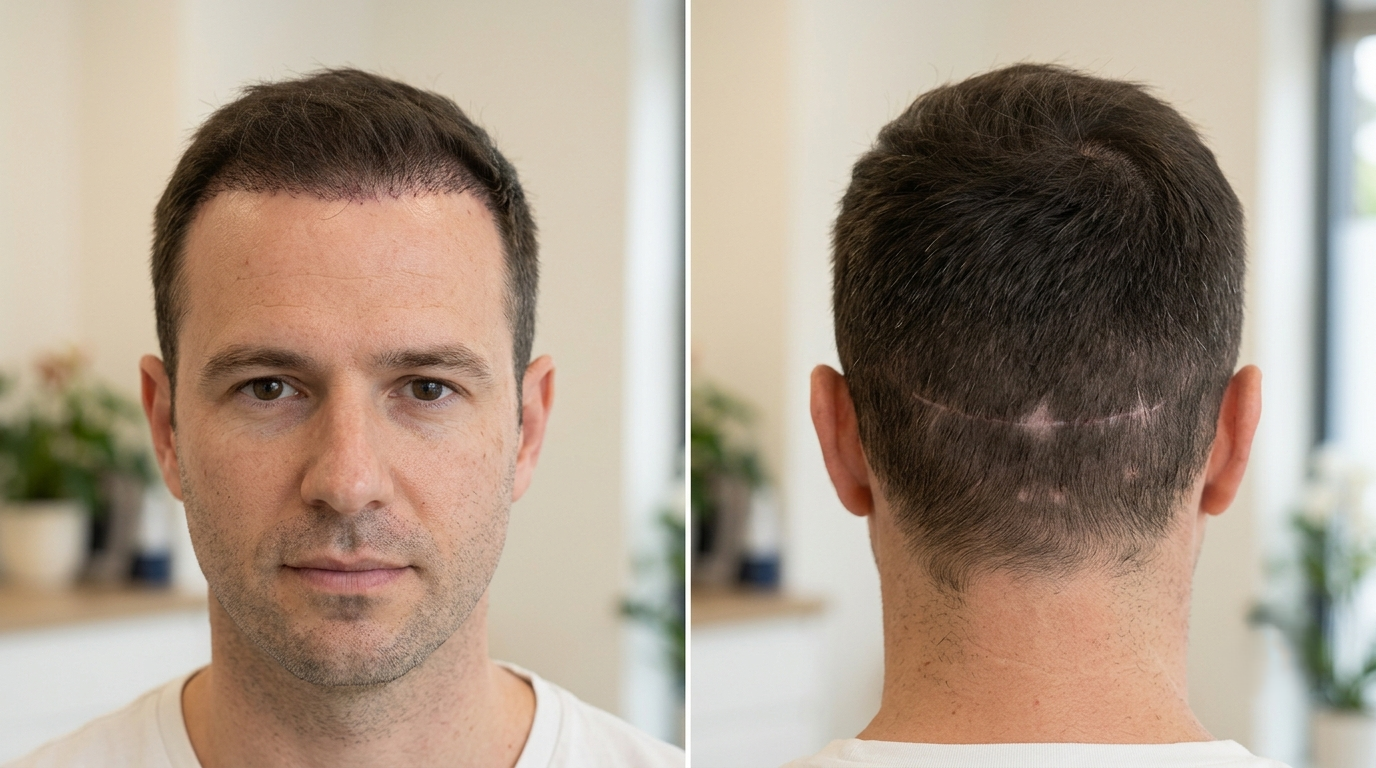
The photo that sells the surgery almost never shows the back of the head. You see the restored hairline, the thicker crown, the confident before-and-after grin, and the whole story lands as if hair simply reappeared out of nowhere. What the marketing shot quietly leaves out is that every graft in that new hairline came from somewhere, and that somewhere carries a mark. If you are worrying about hair transplant scars before you have even booked a consultation, you are not being paranoid. You are asking the question the glossy version skips.
So let us give it a straight answer. Yes, a transplant leaves scarring, always, in every technique, on every scalp. The honest question is not whether scars exist but how visible they actually are, what makes them worse, and how well they can be hidden. At Hairpol, we would rather you understand that fully before surgery than discover it in a mirror afterward, because the difference between a scar you notice and one nobody ever sees is mostly a matter of technique, planning, and how you wear your hair.
The truth nobody puts in the brochure: scarring is never zero
Let us clear up the biggest myth first. There is no such thing as a scarless hair transplant. Any time a follicle is removed from the donor area, the skin heals over that spot, and healed skin is scar tissue by definition. What has changed over the last two decades is not the elimination of scarring but its scale. Modern methods reduced a single long line down to hundreds of pinpoint marks, which is a genuinely different experience, but it is not the same thing as leaving no trace.
This matters because clinics that promise a completely invisible, scar-free result are either being loose with language or hoping you will not look too closely. The realistic promise, the one we make at Hairpol, is that your hair transplant scars can be made small, well distributed, and easy to conceal, so that in normal life nobody notices them. That is achievable. Zero scarring is not. Knowing the difference protects you from both false hope and needless fear.
What FUE dot scars actually look like
With follicular unit extraction, follicles are harvested one at a time using a tiny circular punch, usually well under a millimetre across. Each extraction leaves a correspondingly tiny round scar, and when it heals it looks like a small pale or slightly lighter dot. Spread a few thousand of these across the back and sides of the scalp and, individually, they are almost nothing.
The reason FUE scarring is so forgiving is distribution. Instead of one concentrated wound, you have many microscopic ones scattered over a wide area, so the surrounding hair only has to cover a little at each point. Under hair of even modest length, these dots disappear completely. The catch, and it is an important one, is that they do not vanish. Shave the area down and you will see faint stippling, a subtle change in texture where the density was harvested. For most people, most of the time, that is a non-issue. For someone who wants to shave to the skin, it is the whole conversation.
What an FUT strip scar actually looks like
Follicular unit transplantation, the older strip method, works differently and scars differently. Instead of individual punches, a thin strip of skin is removed from the back of the head and the edges are stitched together. That leaves a single linear scar running side to side across the donor zone. When it is done well and heals well, it can be a thin, fine white line. When it heals poorly, or is stretched, or the surgeon closed it under tension, it can be wider and more obvious.
The trade-off is real and worth understanding rather than dismissing. A well-executed FUT scar hides easily under hair of a couple of centimetres or more, because a single line only needs one length of hair falling over it to disappear. But that line is fixed and continuous, so if you ever want very short hair it becomes the limiting factor. Our detailed comparison of the difference between FUT and FUE walks through how each method behaves, but for the scar question the summary is simple: FUE scatters, FUT concentrates.
FUE dots versus an FUT line: which is easier to hide?
Put the two side by side and the answer depends entirely on how short you plan to go. At medium or long hair length, both are effectively invisible. Nobody at arm’s length, in an office, on a date, or in a photograph, is going to spot either one when there is hair covering the donor zone. In that sense the anxiety many people carry is out of proportion to daily reality.
The difference reveals itself at the extremes. If you want to buzz your hair very short or run a clipper without a guard, scattered FUE dots tend to blend into the natural variation of a short-cut scalp far better than a single continuous line, which can still catch the light as a visible stripe. This is exactly why most modern patients, and Hairpol, favour FUE-based approaches such as Sapphire FUE when short hairstyles matter to the patient. Neither is truly invisible bald, but FUE gives you more room to go short before scarring shows.
How visibility changes with hair length
Hair length is the single biggest variable in whether your scarring is seen, more than technique, more than anything you can do afterward. This is the part people underestimate. The same donor area that looks flawless under a number four clipper guard can start to reveal faint marks under a number one, and can show clearly if you take it down to bare skin with a razor. The scars did not change. The coverage over them did.
Think of it as a sliding scale. At longer lengths you have complete camouflage for free, from your own hair. As you go shorter, the margin narrows, until at a true skin fade or a shaved head the underlying pattern becomes potentially visible. This is why any honest conversation about hair transplant scars has to start with a question the patient rarely expects: how short do you actually like to wear your hair, now and realistically in the future? Everything about scar planning flows from that answer.
Buzz cuts, skin fades, and the shaved-head test
The people who care most about scarring are usually the ones who like very short hair, and that is not a coincidence. A skin fade tapers the sides down to almost nothing, and a fully shaved head hides nothing at all. These are the styles that put donor scarring to the test, so if this is you, it needs to be on the table from the first consultation, not discovered later.
The honest position is this. A skilled FUE harvest, with extractions spread thoughtfully and not over-harvested in any one patch, can often survive a skin fade with only the most subtle stippling that a barber can work around. A shaved-to-the-skin head is the harder test, and no one should promise you a completely undetectable result at that extreme. At Hairpol, if you tell us you want the freedom to shave down, we plan the harvest around that goal from the start, because scarring you can hide is a decision made before surgery, not a rescue attempted after.
The factors that make scars worse
Not all scarring is equal, and much of what separates an invisible result from a visible one is within a surgeon’s control, or yours. Over-harvesting is the biggest offender: take too many grafts from too small an area and the donor thins out, the dots crowd together, and the whole zone looks moth-eaten under short hair. A disciplined, evenly distributed harvest is the single most important defence against obvious scarring.
Other factors stack on top. Punch size matters, since larger punches leave larger marks. Closing an FUT strip under tension widens the line. And your own biology plays a part: some people are simply more prone to raised or stretched scars, and a small number develop keloids. Poor aftercare, infection, or picking at healing skin can all worsen the final look. Many of the ugliest hair transplant scars we are asked to repair did not come from bad luck but from an aggressive harvest by a high-volume clinic chasing graft numbers. Technique is not a detail here. It is the whole game.
The recipient area scars people forget about
Almost all the worry goes to the donor zone, but the recipient area, where the new hair is implanted, also heals with micro-scarring. Each implanted graft sits in a tiny incision, and that incision heals just like any other. The difference is that recipient scarring is usually far less of a concern, because the whole point of that area is that it fills with growing hair that covers it.
Where recipient scarring can show is when something goes wrong: incisions made too large, placed too densely, or angled poorly, which can leave a subtly pitted or shiny look between the new hairs. Done well, with fine instruments and correct angling, the recipient site heals invisibly under the transplanted hair. This is another reason technique and planning matter more than the raw number of grafts, and it is covered further in our companion guide on what to expect on the donor and recipient area, which maps out the healing of both zones in detail.
The concealment toolkit: your own hair comes first
Before any procedure or product, the most powerful concealment tool you own is the hair already on your head. Understanding your minimum safe hair length, the shortest you can go before scarring starts to show, is the foundation of everything else. For most well-executed FUE patients that length is short, often just a few millimetres, and for FUT it is usually a bit longer because a line needs more cover than scattered dots.
Knowing that number changes how you live with the result. It lets you choose hairstyles with confidence instead of anxiety, and it means you are never caught out by a barber taking the sides shorter than you expected. At Hairpol, part of the aftercare conversation is being honest with you about where that line sits for your specific donor area, so you are managing your hair with real information rather than guessing and hoping. Your own hair, kept at a sensible length, hides the vast majority of scarring for the vast majority of people, at no extra cost and no extra procedure.
Scalp micropigmentation into the scar
When you do want to go shorter than your hair alone allows, scalp micropigmentation is the most effective concealment tool available. SMP deposits tiny pigment dots into the skin that mimic the look of short hair follicles. Applied over a donor scar, it breaks up the visual contrast between the pale scar tissue and the surrounding shadowed follicles, so the eye stops picking out the scar as a separate feature.
For an FUT line, SMP can transform a visible white stripe into something that reads as ordinary short hair from normal viewing distance. For faint FUE stippling under a skin fade, a light scattering of pigment can even out the tone so the harvested area matches the rest. It is not literally hair and it will not stand up to being shaved perfectly smooth under bright light at close range, but for the everyday reality of short haircuts it is remarkably convincing. Many patients who thought their only option was to keep their hair long find SMP gives them back the freedom to buzz it down.
Scar revision and reduction surgery
Sometimes the scar itself needs treating rather than just concealing, and this is where scar revision comes in. A wide or stretched FUT scar can sometimes be surgically excised and re-closed with better technique and less tension, producing a thinner line the second time around. It is not guaranteed to shrink dramatically, and it trades one scar for a hopefully better one rather than erasing anything, but for a genuinely wide strip scar it can be worthwhile.
Another approach is to transplant follicles directly into the scar tissue. Grafts placed into a scar have a lower survival rate than in normal scalp, because scar tissue has a poorer blood supply, but even partial growth adds hair that breaks up the line and helps camouflage it. These are more involved options reserved for scarring that genuinely bothers the patient, and they are usually a second step rather than a first resort. The honest framing is that revision improves difficult hair transplant scars; it rarely makes them vanish.
Density around the scar and letting hair do the work
One of the quieter but most effective strategies is simply ensuring there is enough surrounding density to drape over the scarred zone. A scar is only visible when the hair around it is too sparse to cover it. Preserving good donor density during harvest, by not over-extracting, means the remaining hair naturally falls over and conceals the extraction points far better than an over-thinned donor ever could.
This is why a conservative, well-planned harvest pays off twice: it gives you the grafts you need and it leaves behind a donor area that camouflages its own scarring. In some cases, careful placement of a small number of grafts into or around a visible line adds just enough density to tip a scar from noticeable to hidden. The theme running through all of this is consistent: the best concealment is designed in from the beginning, through restraint and planning, not bolted on afterward to fix a donor area that was pushed too hard.
Tattooing and cosmetic camouflage
Beyond medical SMP, there are simpler cosmetic options for masking scarring day to day, and they have their place. Cosmetic scalp tattooing overlaps with SMP but is sometimes done in a more decorative, less follicle-realistic way, so quality varies enormously and it is worth choosing a specialist who understands scalp work specifically. Done poorly, a flat or wrongly toned tattoo can look worse than the scar it covers, so this is not a corner to cut.
For temporary cover there are also topical products: fibre powders that cling to existing hair to boost apparent density, and tinted concealers that darken pale scar tissue to match the scalp. These wash out and need reapplying, but for an event or a photo they are quick and effective and commit you to nothing. The sensible way to think about the whole toolkit is as a ladder: start with your own hair length, add SMP if you want to go shorter, and reserve revision surgery for the minority of scars that genuinely warrant it.
How Hairpol works to keep scarring hidden from the start
Everything above points to the same conclusion: the best time to deal with hair transplant scars is before the first graft is taken. A harvest that is spread wide, kept within safe density limits, uses appropriately small punches, and is planned around how short you actually want to wear your hair will scar far less visibly than one optimised only for graft count. Concealment techniques are excellent, but they are easier when there is less to conceal.
At Hairpol, that philosophy shapes the whole approach. We would rather harvest conservatively and protect your donor area than push for a headline graft number that leaves you with a thinned, stippled donor you spend years hiding. We talk to you about your hairstyle, your future plans, and your tolerance for short hair before we plan the extraction, because scar management is a design decision, not an afterthought. Honest expectations plus disciplined technique is how a scar becomes something only you know is there.
If you are weighing up surgery and the question of scarring is on your mind, that is exactly the conversation worth having out loud rather than worrying about alone. Come and talk to us about your donor area, your preferred hairstyles, and what a realistic, well-hidden result looks like for you. Explore our approach to hair transplantation, where minimising and concealing scarring is treated as part of the plan from the very first consultation.
Frequently Asked Questions (FAQ)
Is there such a thing as a scarless hair transplant?
No. Any time a follicle is removed from the donor area, the skin heals over that spot and healed skin is scar tissue. Modern methods make scarring tiny and well distributed so it is easy to hide, but a completely scar-free result does not exist. Realistic clinics promise well-hidden scars, not zero scarring.
How visible are FUE dot scars?
Individually they are tiny round marks, usually well under a millimetre, scattered across the donor zone. Under hair of even modest length they disappear completely. They only become visible as faint stippling if you shave the area down to very short or bare skin.
How visible is an FUT strip scar?
FUT leaves a single linear scar across the back of the head. Done and healed well it can be a thin white line that hides easily under a couple of centimetres of hair. If closed under tension or healed poorly it can be wider and more obvious, and it limits how short you can go.
Which is easier to hide, FUE or FUT scarring?
At medium or long hair length both are effectively invisible. The difference shows at very short lengths: scattered FUE dots blend into a short-cut scalp better than a single continuous FUT line, so FUE gives more freedom to buzz your hair short before scarring shows.
What makes hair transplant scars worse?
Over-harvesting from too small an area is the biggest cause, along with large punch sizes, closing an FUT strip under tension, and individual tendencies toward raised or keloid scars. Poor aftercare, infection, or picking at healing skin can also worsen the final look. Disciplined technique matters most.
Can scalp micropigmentation hide a transplant scar?
Yes, SMP is the most effective concealment tool for going shorter. It deposits pigment dots that mimic short follicles, breaking up the contrast between pale scar tissue and surrounding hair. It can make an FUT line read as ordinary short hair, though it will not withstand a perfectly smooth shave under bright light.
What is the shortest I can cut my hair after a transplant?
It depends on your minimum safe hair length, which varies by technique and how you healed. Many well-executed FUE patients can go down to just a few millimetres, while FUT usually needs a bit more length. Your clinic can tell you where that line sits for your specific donor area.
Can a bad transplant scar be repaired?
Sometimes. A wide FUT scar can be surgically revised into a thinner line, and follicles can be transplanted into scar tissue to break it up, though survival there is lower. SMP is often the simplest fix. Revision improves difficult scars but rarely makes them vanish completely.
Find this helpful? Add Hairpol as a preferred source on Google.
Get a Free Consultation
Answer a few questions and the medical team will review your situation.
Related articles
- Itchy Scalp After a Hair Transplant: Why It Happens and How to Cope
- Swelling After a Hair Transplant: Why Your Forehead Puffs Up and How to Reduce It
- Crown Hair Transplant Before and After: What Results Really Look Like at 6, 8, and 12 Months
- Beard-to-Scalp Grafts: When Facial Hair Becomes a Donor Source
