
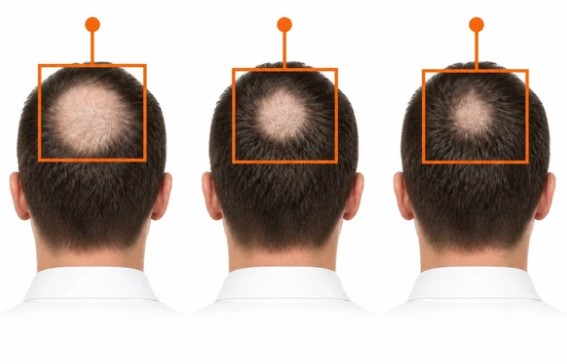
Most people book a crown procedure expecting one operation and a finished head of hair. A large share of them end up having a conversation about a second session eighteen months later, and almost none of them were told at the start that this was even a possibility.
That gap usually is not dishonesty. It is the crown behaving the way the crown always behaves. It swallows grafts. It shows scalp through a density the hairline would carry without complaint. And it keeps widening underneath a result that was perfectly accurate on the day it was planned. At Hairpol we would rather say the awkward part out loud in the first consultation than let someone discover it alone in front of a bathroom mirror in month fourteen.
The short answer: The crown requires a second session more often than any other zone of the scalp. A crown of a given size typically needs 1.5 to 2 times the grafts of an equivalent frontal area to read as covered, which means many patients are staged from the beginning even when nobody says so. A second crown session is normally performed 12 to 18 months after the first, once the initial growth has fully matured, and usually adds 1,000 to 2,000 grafts. It is planning, not failure.
Why the crown behaves differently from every other zone
The crown is not a flat patch of scalp with hair on it. It is a spiral. Hair leaves the whorl in a radiating pattern, curving outward in every direction from a single point, and each hair exits the skin at a shallower angle than hair at the front does. That geometry is why the crown photographs badly under overhead lighting and why it looks thinner in a lift photo than it feels to the touch.
Every one of those features works against a surgeon. At the hairline you plant hairs travelling in broadly one direction, forward and slightly down, and neighbouring hairs shelter each other. In the whorl the directions fan apart. Hairs that point away from each other cannot lean on each other for visual cover, so light passes between them and reaches the scalp underneath. The eye reads that reflected scalp as baldness even when the graft count on paper looks respectable.
The curvature adds a second problem. The crown sits on the most convex part of the skull, so you are looking down at it rather than across it. A frontal zone is seen edge-on, where hair shafts overlap in the line of sight; a crown is seen face-on, where they do not. Two zones can hold identical follicle counts per square centimetre and look completely different, which is the single most useful thing to understand before you start comparing graft numbers between clinics.
If you're weighing a second procedure, see how a second hair transplant compares before deciding.
Why the crown requires more grafts than the frontal zone
Put numbers on it and the staging logic becomes obvious. A frontal zone of around 50 square centimetres often reaches a convincing result with 2,000 to 2,500 grafts. A crown of the same measured area frequently needs 3,000 to 4,000 to reach a comparable visual impression, and that is before anyone talks about matching the native density of the hair around it.
Nobody plants a crown at native density. Native scalp carries somewhere in the region of 80 to 100 follicular units per square centimetre. A transplant places roughly 30 to 45 in the crown, sometimes a little more in a small, tightly bounded area with excellent donor supply. That is a deliberate limit, not a shortcut. Pack grafts too close and you compete for blood supply, and poor survival in a zone that already needs every graft it gets is the worst possible outcome.
So the arithmetic runs into a wall. A large crown that would need 4,500 grafts to look closed cannot safely receive 4,500 grafts in one sitting, and even if it could, spending that much donor hair on a single zone in a single day is rarely the right lifetime decision. The honest resolution is to plant a solid, safe layer now and revisit the areas that still read thin after everything has grown. We explain the underlying limits of the zone in more detail in do hair transplants work on the crown.
The coverage threshold: why the crown looks empty until it suddenly does not
Density in the crown does not translate into appearance in a straight line. It works like a threshold. Below a certain point, adding grafts changes the photograph very little, because there is still enough gap between hairs for light to hit scalp. Cross the threshold and the same increment produces a dramatic change, because the hairs finally begin to overlap and shade the skin.
This is why two patients with crown results 8 grafts per square centimetre apart can have completely different opinions about their surgery. One landed just under the threshold and sees a patch that is better but still visible. The other landed just over it and sees a crown that closed.
It also explains a second session that seems small on paper. Going from 32 to 45 grafts per square centimetre sounds like a modest addition. In the crown it is frequently the difference between an area you still arrange your hair to hide and an area you stop thinking about. Hair calibre matters here as much as count: a patient with coarse hair can cross the threshold at a lower density than a patient with fine hair, which is why two people with identical graft numbers can need different plans.
The moving target: crown loss keeps expanding after surgery
The other reason the crown so often needs a second session has nothing to do with technique. It is that androgenetic alopecia does not stop at the edge of the treated area.
A crown patch measured at 35 years old is not the crown you will have at 42. The transplanted hairs are taken from the permanent donor zone at the back and sides and they behave accordingly. The native hairs sitting around them and between them do not. Those hairs keep miniaturising on their own schedule, and as they thin, the treated zone appears to shrink while the untreated rim widens around it.
Patients describe this as the transplant failing. Usually it is not. The grafts are still there and still growing; the frame around them has receded. You can see it clearly in photographs where the transplanted core looks stable while the border has softened and blurred outward over three or four years. Our before and after gallery shows the same comparison across matched time points.
This is the strongest argument for medical maintenance under a doctor’s supervision after crown surgery, and the reason we are cautious about operating on a young man whose crown is thinning quickly and who has no interest in medication. Surgery treats the patch in front of you. It does not treat the process that created it, and in the crown that process is often still accelerating.
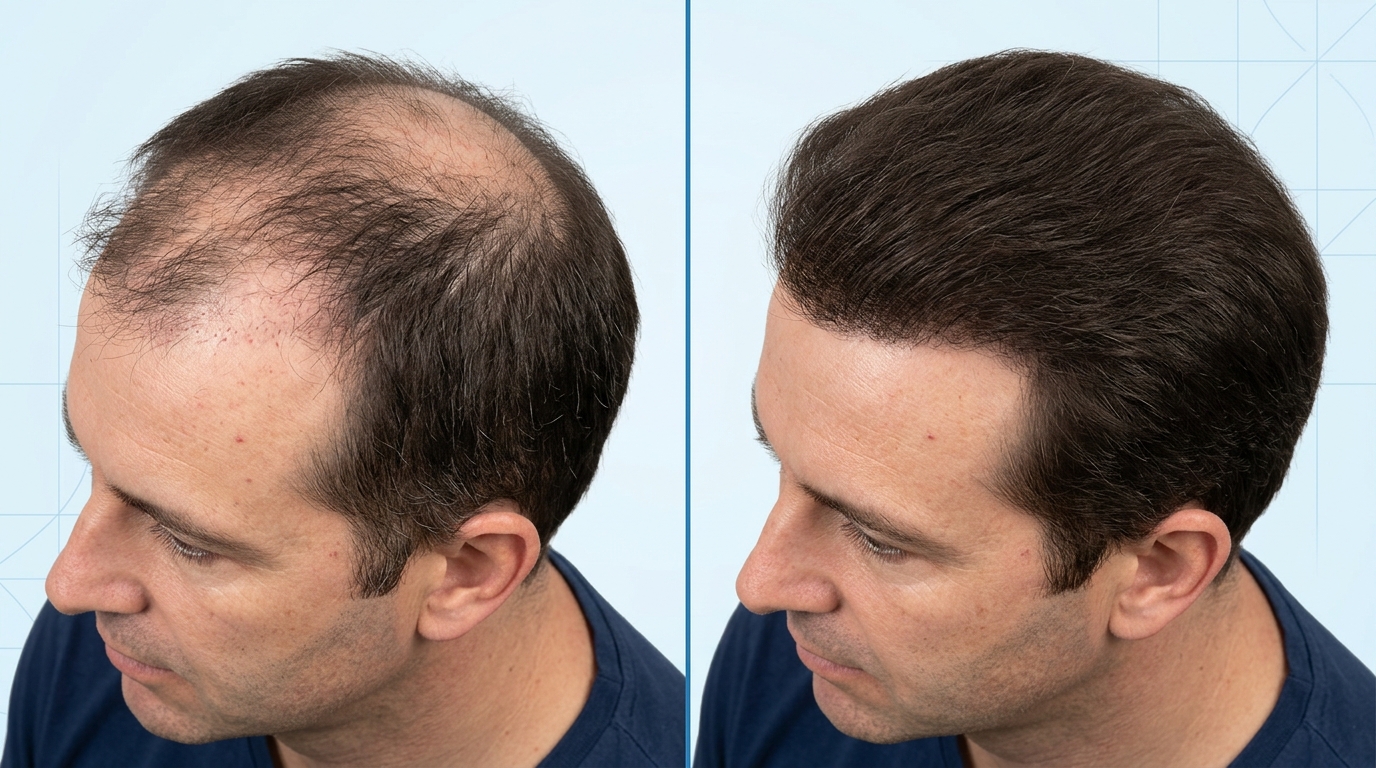
What honest first-session planning sounds like
The phrase to be suspicious of is a flat promise that one session will finish it. In the crown, that sentence is either a guess or a sales line, and the person who pays for it is the patient who plans their entire timeline around a single trip.
A more useful consultation sounds different. It gives you a measured area, a graft number for this session, a stated density target, and a candid sentence about what happens if the result lands below the coverage threshold. It tells you before you book whether your case is likely to be a one-stage or a two-stage plan. It tells you what part of your donor supply is being spent today and what is being held back on purpose.
There is nothing wrong with a staged plan. Staging is often the better surgical decision, because it lets the surgeon see real grown results before committing more donor hair, rather than guessing at coverage on the day. What is wrong is discovering the staging after the fact. A patient who is told at the start that a second session is likely tends to treat month twelve as a checkpoint. A patient who was promised one session treats the same month as a disaster, and books an emergency revision consult somewhere else in month five, long before there is anything to judge.
How long should you wait before a second crown session?
Twelve months at the absolute earliest. Twelve to eighteen months in practice, and eighteen is the number we prefer for the crown specifically.
The reason is that crown growth is slow and finishes late. Transplanted hair sheds in the first weeks, sits dormant for roughly three months, starts emerging between months four and six, and thickens through the rest of the first year. The crown consistently lags the frontal zone by two to three months at every one of those milestones. Judging a crown at month eight is judging an unfinished result, and thickening continues in many patients into months fifteen and sixteen as individual shafts gain calibre.
There is a surgical reason too. Scalp tissue that has been operated on needs time for blood supply to normalise and scar tissue to soften. Going back into a recipient area too early means planting into tissue that is still remodelling, with a real risk to grafts placed in the first session. Waiting also lets the donor area recover so it can be assessed accurately rather than optimistically.
The practical checkpoint is month twelve: a set of standardised photographs under the same lighting, compared against the pre-operative set. If the crown still reads thin at twelve months, book the assessment then and schedule the surgery for somewhere between fifteen and eighteen months. That way the decision is based on a mature result rather than an anxious one.
If you are looking at your crown at month twelve and genuinely cannot tell whether it needs another 1,200 grafts or simply more time, a photo assessment settles it in a day rather than another six months of checking the mirror. Send standardised photos through our appointment form and we will tell you which of the two it is, including when the answer is that you should wait.
What a second crown session actually adds
A second crown session usually places 1,000 to 2,000 grafts, occasionally up to 2,500 if the donor area is generous and the untreated rim has widened noticeably. That typically raises density in the treated area from somewhere around 30 to 35 grafts per square centimetre into the low to mid forties, and extends coverage outward across the border that has thinned since the first operation.
Expect a different kind of change from the first time. The first session takes a visible bald patch and turns it into a covered but see-through zone, which is a large visual jump. The second session takes a see-through zone and closes it, which is a smaller jump in photographs but often a bigger one in daily life, because it is the point where you stop managing the area with hair length and styling.
Some of the second session is not about density at all. It is about direction. First operations sometimes place the whorl centre imprecisely, or fan the angles too uniformly, and the result reads as slightly artificial when the hair is longer. A second pass can add grafts at corrected angles around the spiral to break that uniformity, which does more for the natural look than raw graft count does.
Does a second session damage the grafts from the first one?
This is the question that stops most people from booking, and it deserves a direct answer: the risk is real but small, and it is mostly under the surgeon’s control.
Existing grafts in a healed recipient area are anchored in tissue and sit at established angles. A surgeon opening new channels between them has to work around them rather than through them, which means slower work, careful angling, and accepting a lower packing density than a virgin area would allow. It is also part of why some teams prefer the implanter-pen placement of DHI hair transplantation when working inside a field that has already been grafted. Done properly, damage to previously transplanted follicles is uncommon. Done in a hurry by someone treating the area as if it were untouched, it is not.
Scar tissue is the second consideration. Every recipient site heals with a small amount of fibrosis, and an area that has been operated on once has slightly reduced elasticity and slightly altered blood supply. That is not a barrier, but it is a reason survival rates in second sessions run marginally lower than in first ones, and a reason the second session should be planned around what the tissue can support rather than what the patient hopes for. We covered this specific worry across all zones in can a second hair transplant damage the first one.
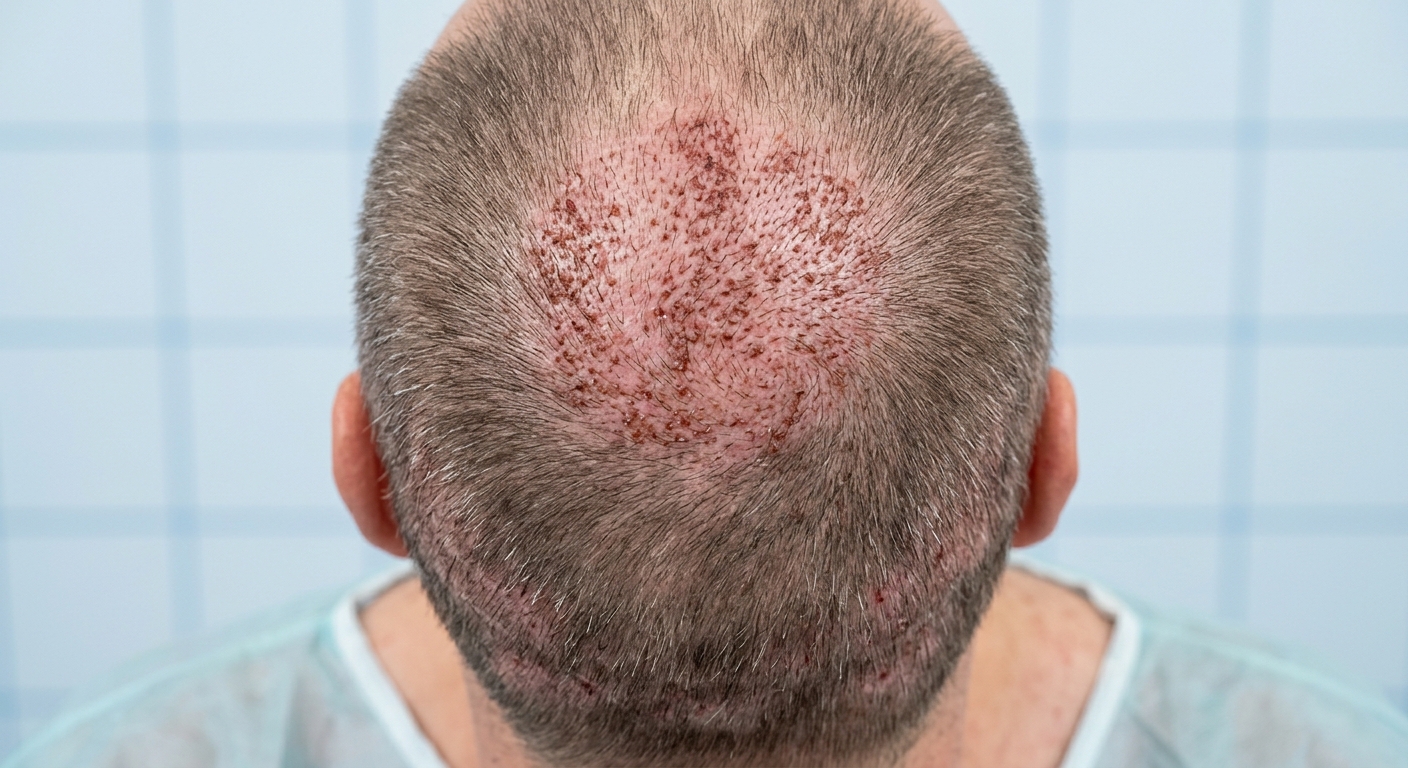
The donor budget question nobody asks early enough
You have a finite number of grafts available across your entire life. Most people can safely give up somewhere between 5,000 and 8,000 over all sessions combined, with the range depending on donor density, scalp laxity, and how much loss is still ahead of them.
The crown is the most expensive zone to buy with that budget. It takes the most grafts per unit of visible improvement, and it is the zone most likely to keep expanding and ask for more later. Spend 4,000 grafts on the crown in your thirties and you may find yourself, at fifty, with a mid-scalp that has thinned and no donor supply left to address it.
This is the calculation behind the standard advice to treat the front first when both zones are affected. The frontal third frames the face, it is visible in every photograph and every conversation, and it delivers far more perceived improvement per graft. The crown is visible mainly to people standing behind you. Neither zone is trivial, but if the budget only stretches to one, the arithmetic is not close. We compared the two zones directly in crown vs hairline transplant: which should you do first.
A second crown session is worth its cost when the first result is close to the threshold and a moderate addition will cross it. It is a poor use of donor hair when the crown is large, the loss is progressing quickly, and the same grafts would be needed elsewhere within a few years. What a staged plan includes and how it is priced is set out on our hair transplant cost page.
When medication is the better second step than surgery
Not every thin crown at month twelve needs another operation. The crown is the zone that responds best to medical treatment, which makes the medical route a genuine alternative rather than a consolation prize.
Minoxidil and finasteride, used only under a doctor’s supervision and after a proper assessment of your medical history, have their strongest documented effect on vertex thinning. They will not regrow a bald crown, and nobody should promise you that. What they can do is thicken the miniaturising native hairs still present between and around the grafts, and that surviving native hair sits in exactly the gaps that make a transplanted crown look see-through. Results vary considerably from patient to patient, and the effect depends on continued use.
Supportive treatments such as PRP and mesotherapy are sometimes added alongside, again as maintenance for existing hair rather than as a substitute for grafts. You can read what these treatments involve on our hair treatments page.
The practical rule we use: if a meaningful amount of native hair remains in the crown, try medical support under supervision for six to twelve months before committing more donor grafts. If the crown is genuinely bare and the surrounding hair is already gone, medication has little left to work with and surgery is the honest answer.
Who should not have a second crown session
Some patients are better served by a clear no, and it is worth knowing where you sit before you travel for a consultation.
- Anyone under about 25 with an aggressive vertex pattern and no interest in medical maintenance — the loss is moving faster than surgery can follow.
- Patients whose donor area is already thin, over-harvested, or showing visible density loss from the first procedure.
- Anyone still inside the first twelve months, where the result is not finished and cannot be judged.
- Patients whose real problem is a mid-scalp that is thinning quietly while attention stays on the crown.
- Anyone expecting the second session to produce the density they had at twenty, which no crown surgery delivers.
The last one is worth sitting with. A second session raises coverage into a range where the crown stops drawing the eye. It does not restore native density, and a surgeon who agrees that it will is not doing you a favour. The general version of this decision, across every zone rather than the crown alone, is set out in second hair transplant: when is it needed and when is it a mistake.
Working out a graft count is easier with a number in front of you. Our hair graft calculator turns your loss stage and the area you want covered into a typical graft range, so the figures above have something concrete to sit against before a surgeon looks at your case.
What to bring to a second-session assessment
The quality of the answer you get depends heavily on what you bring to the conversation, and most people arrive with almost nothing usable.
Bring your pre-operative photographs, if you still have them, along with photographs from around months six and twelve. Take a fresh set the same way: overhead light, dry hair, crown photographed from directly above and from behind, no filters and no flattering angle. Consistency across the set matters more than image quality, because the whole point is comparison.
Bring the operative note from your first surgery if you can obtain it, including the graft count and which zones received them. Bring an honest account of any medication you have used, the dose, and how consistently you actually took it, since inconsistent use is the most common reason a crown looks worse than it should at month twelve. And bring your own account of what bothers you, because it is often more specific than the photographs suggest — a patient who only notices the crown under office lighting needs a different conversation from one whose scalp is visible in every daylight photo.
At Hairpol we assess crown cases with the donor area, the untreated rim and the patient’s age all on the table at once, and a fair number of those assessments end with a recommendation to wait or to treat medically rather than to operate. If you want a second opinion on a crown result that has not turned out the way you were promised, or a first-session plan that tells you upfront whether staging is likely, our hair transplantation team will give you the measured version rather than the encouraging one.
Find this helpful? Add Hairpol as a preferred source on Google.
Graft Range Calculator
Answer three questions to see the typical graft range for your situation — based on our published clinical guides.
This is a preliminary estimate, not a medical assessment. The exact number can only be determined by a doctor after examining your donor area and hair characteristics.
Get a Free Consultation
Answer a few questions and the medical team will review your situation.
