
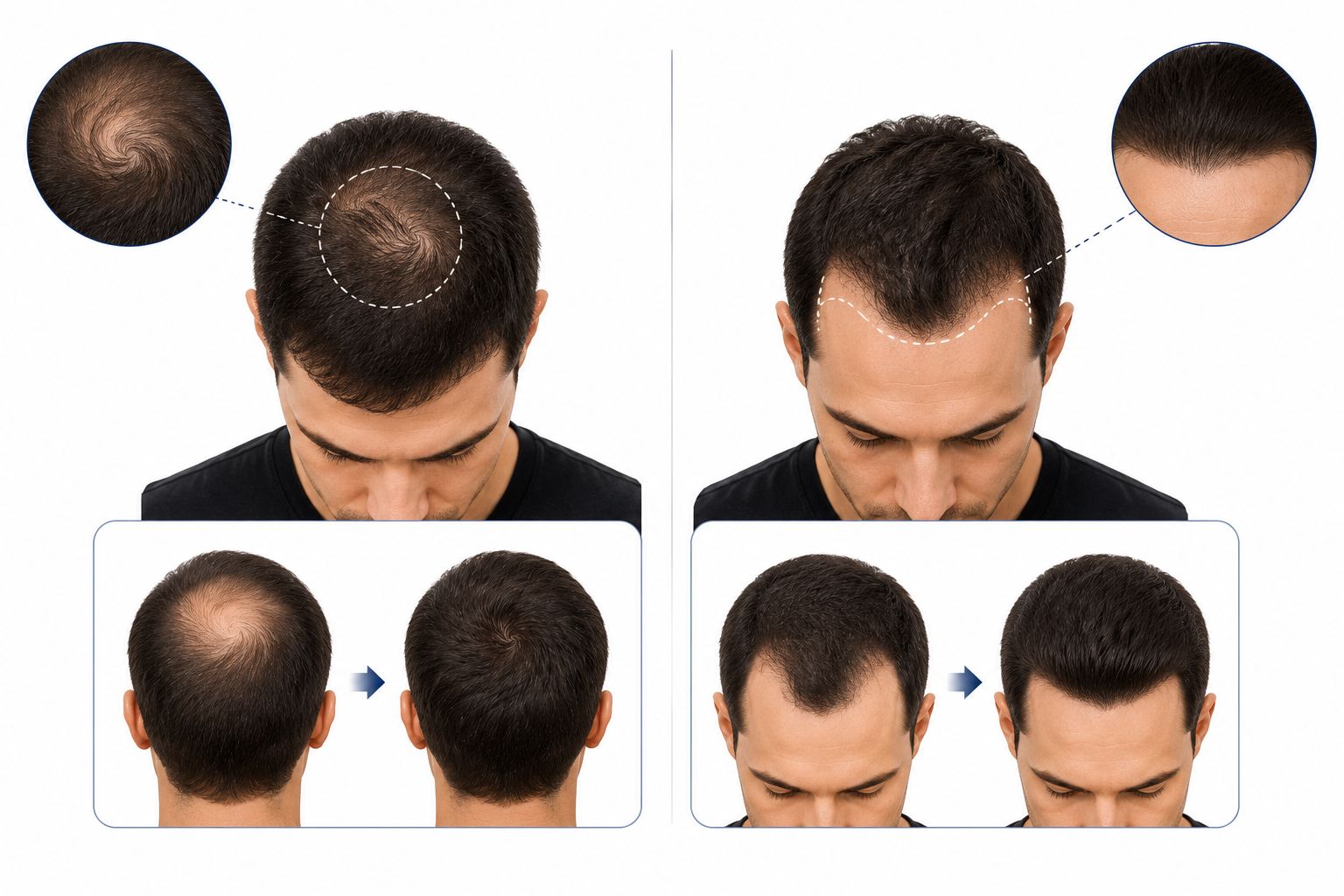
For patients dealing with both crown thinning and a receding hairline, the question of which area to address first is one of the most consequential decisions in the entire planning process. It affects how the result looks at twelve months, how it ages over the following decade, how much donor supply remains for future needs, and how satisfied the patient is likely to be with the overall outcome.
It’s also one of the questions that gets the least thoughtful attention in many consultations. The default tendency is to either treat both areas in the same procedure regardless of circumstances, or to default to whichever area the patient is most visually bothered by without considering how that choice plays out over years. Neither approach is wrong in every case, but neither is right in every case either. The actual answer depends on factors that vary meaningfully patient to patient.
This guide works through the decision framework specifically. Why the hairline is usually addressed first, what circumstances change that, when combined procedures make sense versus when staging is better, and how to think about your specific situation in terms of what produces the best result over time rather than what produces the most dramatic before-and-after photo at twelve months.
The General Rule: Hairline First, Most of the Time
In most planning scenarios involving both crown and hairline work, the hairline takes priority. This isn’t arbitrary preference — it’s a clinical default that reflects several converging considerations.
The hairline has greater impact on facial appearance. The hairline frames the face. It defines how a person looks in mirrors, photographs, and direct social interaction. Crown loss is largely invisible to the person experiencing it and only becomes apparent from specific angles or in photos taken from behind. For most patients, restoring the hairline produces a more noticeable and immediate improvement in how they see themselves and how others see them than addressing the crown does.
The hairline produces visible results faster. The frontal zone has a meaningfully shorter recovery timeline than the crown. Visible growth typically emerges by months three to five for the hairline, while the crown often takes five to seven months before meaningful growth becomes visible. For patients who want to see progress sooner rather than later, the hairline delivers on that desire more reliably than the crown.
The hairline is more predictable. Hairline restoration in the hands of an experienced surgical team produces consistently good results when the patient is an appropriate candidate. Crown work is more variable — the spiral growth pattern, the larger area requiring coverage, and the higher graft counts involved all create more opportunities for outcomes to fall short of expectations. Starting with the more reliably successful procedure gives patients confidence and a positive experience to build on.
The hairline is structurally simpler to plan. Designing a hairline involves significant aesthetic decisions — position, shape, temple recession angles, transition zone density — but those decisions can be made and executed in a single procedure. Crown planning involves an additional layer of complexity around the whorl design and the spiral angle distribution that doesn’t translate directly from frontal experience.
When the Crown Should Be Addressed First Instead
The hairline-first default isn’t universal. Several specific situations argue for prioritizing the crown, and recognizing these situations is part of what distinguishes thoughtful planning from default planning.
- The crown is the patient’s primary concern. Some patients are genuinely more bothered by their crown loss than their hairline. If the crown is the source of psychological distress and the hairline is something the patient barely notices, addressing the crown first matches the procedure to what actually matters to the patient. The aesthetic theory about facial framing matters less when the patient’s own experience tells them their crown is what they want fixed.
- Crown loss is severe while hairline loss is mild. A patient with a fully bald crown and only minor temple recession has a different planning calculus than one with significant frontal loss and moderate crown thinning. When the size of the visible problem in the crown substantially exceeds the visible problem in the hairline, treating the crown first reflects the proportions of what actually needs work.
- The patient has already addressed their hairline. Some patients come to a crown discussion having already had successful hairline work, either at the same clinic or elsewhere. In these cases the question isn’t crown first or hairline first — it’s whether the existing hairline result is mature and well-established enough to support adding crown work, and whether the donor supply allows for it.
- The patient is older and the hairline pattern is mature. Older patients whose hairline has reached a stable mature appearance may not be candidates for aggressive hairline restoration — the appropriate hairline for a sixty-five-year-old is a mature one, and surgical intervention there may produce a result that looks artificially youthful. For these patients, addressing the crown — which causes a different kind of visible concern — may be the more relevant procedure.

The Combined Procedure Option
Combining both crown and hairline work in a single session is a third path that doesn’t get enough attention in many discussions. It’s appropriate in some cases and inappropriate in others, and the difference comes down to specific factors.
Combined procedures make sense when:
- The patient has adequate donor supply to cover both areas without over-harvesting any zone.
- The total graft count required is within what can be safely extracted and implanted in a single session.
- The patient has stable, well-established hair loss patterns in both areas rather than rapidly progressing loss.
- The patient prefers to address everything at once rather than commit to multiple procedures.
- The clinic’s surgical day length and staffing can support the longer procedure time required.
Combined procedures are inappropriate when:
- The total graft count needed exceeds what can be safely harvested from the donor area in a single session without over-harvesting.
- The patient is young and loss is actively progressing, making it likely that staged planning will produce a better long-term result.
- The crown is large and would absorb so much donor supply that the hairline work would have to be compromised, or vice versa.
- The patient hasn’t yet established medical management (finasteride and minoxidil) and the loss pattern isn’t stable.
A combined procedure that fits within the patient’s donor supply and addresses stable loss in both areas can produce excellent results in a single recovery cycle. A combined procedure that stretches the donor supply too thin or treats unstable loss can produce a result that looks okay at twelve months but creates problems for future planning when ongoing loss requires additional work.
The Donor Supply Question Drives Everything
The factor that most influences whether to address the crown or hairline first — and whether to combine them — is donor supply. Donor supply is finite. The follicles available for extraction from the back and sides of the scalp represent a fixed resource that needs to be managed across the patient’s lifetime rather than spent without consideration of future needs.
A patient with a substantial donor reserve and limited overall hair loss has more flexibility than a patient with marginal donor supply and extensive loss across multiple areas. The donor supply assessment should be part of the conversation before the crown-vs-hairline decision is finalized, because it determines what’s actually possible rather than what’s theoretically ideal.
Practical donor supply scenarios:
- Abundant supply, limited loss: The patient can address both areas in a combined procedure or in close succession without donor concerns. The decision becomes about preference and timing rather than constraint.
- Adequate supply, moderate loss: The patient can address both areas, but staging is generally preferable to allow for better-targeted second-procedure planning based on how the first procedure matures.
- Limited supply, significant loss: The patient cannot address both areas to the degree they might prefer. Prioritization becomes essential, and decisions about what to address and to what density require explicit acknowledgment of the tradeoffs.
- Marginal supply, extensive loss: The patient may not be able to address both areas at all without compromising the result quality of the area they do address. This is a difficult conversation but an important one. Honest assessment of what’s actually achievable serves the patient better than promising more than can be delivered.
The Age Factor
Patient age changes the crown-vs-hairline calculation in several specific ways that are worth understanding.
Younger patients face greater uncertainty about their final loss pattern. A twenty-six-year-old with early crown thinning and mild hairline recession may stabilize at Norwood 3 or progress to Norwood 6 over the following two decades. Treating their crown aggressively at twenty-six uses donor supply that may be needed for much more extensive future coverage. For younger patients, the prudent approach is often hairline-first with a relatively conservative graft count, combined with aggressive medical management to slow ongoing progression — and a deferral of crown work until the loss pattern is clearer.
Patients in their thirties and forties typically have clearer information about how their loss is progressing. Family history, the rate of change over the past several years, and the patient’s current Norwood stage all contribute to a more reliable picture of likely future need. Planning for this group can be more committed to addressing both areas if the donor supply supports it.
Older patients have the clearest picture of their final loss pattern but also have different aesthetic considerations. A mature hairline is appropriate for a mature face — aggressive hairline restoration in a sixty-year-old can look artificially youthful in ways that don’t serve the patient’s overall appearance. For older patients, modest hairline work combined with addressing the crown may produce a more natural-looking result than aggressive frontal restoration alone.
The Sequencing Strategy: How to Stage Two Procedures
For patients who will address both areas but stage them across two procedures rather than combining them, the sequencing decision affects both the short-term experience and the long-term result.
If the hairline is addressed first, the typical sequence looks like this:
- Hairline procedure performed with a graft count appropriate to the area being treated and the patient’s overall pattern.
- Twelve to eighteen month recovery and maturation period before any second procedure.
- Reassessment of the crown area at the twelve-to-eighteen month mark — has loss progressed, how is medical management performing, what does remaining donor supply look like?
- Crown procedure planned based on the actual situation at the time of the second procedure rather than what was projected during the first consultation.
If the crown is addressed first, the sequence works similarly but in reverse:
- Crown procedure performed addressing the more pressing or visible loss.
- Extended recovery period — the crown’s longer timeline means waiting closer to eighteen months before the result is genuinely mature.
- Hairline procedure planned with updated information about how the crown matured and what donor supply remains.
The key insight in either sequence is that the second procedure isn’t planned at the time of the first — it’s planned at the time of the second, with the benefit of seeing how the first procedure matured. This produces better-targeted second procedures than committing to a two-procedure plan in detail at the start.
Medical Management: Why It Matters Before Either Procedure
One thing that should happen before crown-vs-hairline decisions are finalized — regardless of which area gets prioritized — is establishing medical management. Patients who aren’t on finasteride and aren’t using minoxidil have an actively progressing baseline that affects every subsequent planning decision.
The reason medication matters before surgical decisions:
- It stabilizes the loss pattern, which makes surgical planning more reliable.
- It protects the native hair that will contribute to the overall result alongside the transplanted grafts.
- It reduces the rate at which donor supply will be consumed by future progression.
- It provides information about how the patient responds to medical management, which is relevant to predicting their long-term trajectory.
Patients who establish medical management for at least six to twelve months before their first procedure have a more stable baseline to plan against and a better understanding of how their hair loss responds to intervention. This information makes the crown-vs-hairline decision sharper and the resulting plan more reliable.
How to Think About Your Specific Situation
Working through the crown-vs-hairline question for your own situation involves answering a few specific questions honestly.
- Which area bothers you more — when you think about your hair loss, which one comes to mind first?
- How extensive is your hairline loss relative to your crown loss — measured in visible scalp area, not in feeling?
- How old are you, and how stable has your loss pattern been over the past two to three years?
- Are you on finasteride? If not, why not, and is starting it something you’re willing to commit to?
- What does your donor supply look like — has it been assessed by a clinic specifically, or are you working from your own visual impression?
- What’s your timeline — are you trying to see a result before a specific date, or is the timeline flexible?
- Do you prefer one procedure or are you comfortable committing to two over time?
The answers to these questions don’t dictate a specific decision, but they do clarify what factors should weight the decision in your case. A patient whose primary distress is crown loss, who has stable loss, established medical management, and adequate donor supply is in a position to address the crown first. A patient whose primary distress is hairline recession, with progressing loss, no medical management, and limited donor supply is in a different position entirely.
At Hairpol, the crown-vs-hairline conversation is part of the consultation rather than an assumption made before the patient walks in. Different patients arrive at different appropriate answers based on their specific situation, and the planning process is designed to surface those differences rather than apply a default to everyone.
What Not to Do
A few patterns worth avoiding when working through this decision:
- Don’t decide based on what you’ve seen in before-and-after galleries. The dramatic frontal transformations that dominate marketing materials reflect what shows up well in photos, not what’s necessarily best for your situation.
- Don’t commit to combined procedures without explicit donor supply assessment. The temptation to address everything at once is strong, but combined procedures that stretch donor supply too thin create problems that compound over years.
- Don’t make this decision under time pressure. Hair transplant decisions are best made deliberately, not in response to clinic urgency or limited-time pricing offers. The procedure will still be available next month.
- Don’t ignore the long-term picture. A decision that produces the best twelve-month photograph isn’t necessarily the decision that produces the best result at five and ten years. Long-term thinking serves you better than short-term optimization.
- Don’t skip medical management because surgery seems like the more decisive solution. Surgery without medical management addresses the loss that has already occurred. Medical management addresses the loss that would otherwise continue. Both halves matter.
The crown-vs-hairline question doesn’t have a single right answer, but it has better and worse answers for any specific patient. Working through the question carefully, with honest assessment of your own situation and access to a clinic that engages with the planning rather than defaulting to a standard recommendation, is what produces the answer that serves you best over the long run.
Find this helpful? Add Hairpol as a preferred source on Google.
Graft Range Calculator
Answer three questions to see the typical graft range for your situation — based on our published clinical guides.
This is a preliminary estimate, not a medical assessment. The exact number can only be determined by a doctor after examining your donor area and hair characteristics.
Get a Free Consultation
Answer a few questions and the medical team will review your situation.
