

Most people notice it in a photograph rather than a mirror. The face looks flatter somehow, less defined, older in a way that has nothing to do with skin. Then you look properly and realise the outer half of both eyebrows has quietly disappeared.
Eyebrows do more structural work than almost any other feature, which is why losing them registers emotionally out of all proportion to the number of hairs involved. Two hundred hairs frame your entire face.
The short answer: the most common causes of eyebrow hair loss are years of over-plucking, thyroid disease (classically thinning the outer third), normal age-related change, alopecia areata, iron deficiency and inflammatory skin conditions. Brow hairs have a short growth cycle and regrow in 4 to 6 months if the follicle is intact — but plucked-out follicles that have been traumatised for a decade, and any area that has scarred, will not come back, and those are the cases where an eyebrow transplant is the only reliable option.
Over-plucking: the cause with a hidden deadline
Repeated plucking damages the follicle a little each time. For years, nothing seems to happen — you pluck, it grows back, you pluck again. Then at some point a hair does not return, and neither does the one next to it.
The pattern is usually recognisable: thinning that matches the shape someone was maintaining in their twenties, often thinnest exactly where the tweezers went most often. Women who followed the thin-brow fashion of the nineties and early two-thousands are the classic presentation, and many of them are now in their forties discovering that the follicles never recovered.
If you have been plucking and the hair still returns, stop now and give it a full six months untouched. That is the only way to find out how much of the follicle population is still alive. If you have already stopped for a year and the gaps have not filled, they are unlikely to fill on their own.
Thyroid and the outer third
There is a classic clinical sign here that is genuinely useful. Loss concentrated at the outer third of both eyebrows, symmetrical, in someone who also feels tired, cold or has had weight change, points toward hypothyroidism.
It is not a perfect rule — plenty of people with thyroid disease keep full brows, and plenty with thin outer brows have normal thyroid function — but it is a strong enough signal that it should always prompt a test rather than a cosmetic solution.
The good news is that this type of loss usually reverses once thyroid function is treated and stable, though the recovery lags treatment by several months. Which tests to request and how to read them is covered in the blood tests that matter in hair loss.
Age-related thinning is real and not a deficiency
Eyebrows change with age in a way nobody warns you about. Hairs become finer and less pigmented, the growth cycle shortens, and density falls gradually from the forties onwards. In men, paradoxically, individual brow hairs often become longer and coarser while overall density drops.
This is normal biology rather than a medical problem, and no supplement reverses it. What it does mean is that a woman in her fifties with thinning brows may have two things happening at once: decades of plucking damage plus age-related change, and the combined effect looks more dramatic than either alone.
It also affects surgical planning. Design for the face someone has now, not the brow shape they wore at twenty-five, because a heavy brow on an older face reads as artificial rather than youthful.
A round bald patch: alopecia areata of the brow
If a section of eyebrow disappeared over a few weeks, leaving completely smooth skin with a defined edge, that is a different condition entirely. Alopecia areata affects eyebrows relatively often, sometimes without touching the scalp at all.
It is autoimmune, it frequently resolves on its own or with dermatological treatment, and it is emphatically not a surgical problem while active. Grafts placed into an active patch can be attacked by the same immune process that removed the original hairs.
The distinction matters enormously because the treatment paths diverge completely. We set out the difference between this and pattern-driven loss in alopecia areata versus pattern hair loss. If your loss appeared quickly and has a clean circular border, see a dermatologist first.
Iron, vitamin D and rapid weight loss
Eyebrows are affected by the same systemic factors as scalp hair, and because brow hairs have a short cycle the effect can appear relatively quickly. Low ferritin, low vitamin D and severe caloric restriction all show up here.
Anyone who has lost a large amount of weight in a short period, whether through dieting, illness or appetite-suppressing medication, may notice brow thinning alongside general shedding. It usually recovers once intake normalises and stores are replenished.
The practical step is a blood panel before any cosmetic decision. Correcting a deficiency takes three to six months to show in hair, so there is no benefit in rushing a surgical plan while the numbers are still being fixed.
Skin conditions and inflammation
Eczema and seborrhoeic dermatitis both affect the brow area, producing flaking, redness and itch, and the resulting rubbing and scratching removes hair mechanically. Treat the skin and the hair usually returns.
The category that matters more is scarring inflammation. Certain conditions destroy the follicle permanently and replace it with fibrous tissue, and in those cases the hair cannot regrow no matter what is applied to the surface. Frontal fibrosing alopecia is the most relevant example — it commonly causes eyebrow loss, sometimes before the hairline recedes, and is particularly seen in postmenopausal women.
The clue is skin texture. If the skin where the hair used to be looks shiny, pale, smooth or slightly indented, and there are no visible pores, that suggests scarring and needs a dermatological diagnosis before anyone discusses transplantation. Grafts placed into a scarring process that is still active tend to be lost.
Medications, treatments and habits
Chemotherapy causes brow loss that usually recovers, though regrowth can differ in texture and colour. Some other medications, including certain retinoids, anticoagulants and drugs affecting thyroid function, can contribute — and none of these should be stopped or changed without the prescribing doctor’s involvement.
Repeated cosmetic trauma is its own category. Aggressive waxing, threading over many years, permanent tinting and repeated microblading passes all irritate the area, and heavily scarred microbladed skin can be harder to transplant into later.
Then there is trichotillomania, a compulsive pulling disorder in which eyebrows and eyelashes are common targets. It requires psychological support rather than surgery, and operating while pulling continues wastes grafts. Once the behaviour has stopped for a sustained period, restoration becomes reasonable.
Will eyebrows grow back on their own?
If the follicle is intact, yes — and faster than scalp hair, because the brow growth cycle is much shorter. Expect visible return in 4 to 6 months once the cause is removed, with full density taking closer to a year.
The follicle is usually intact after a temporary trigger: illness, a shedding episode, a corrected deficiency, treated thyroid disease, resolved dermatitis. It is usually not intact after decades of plucking, after a scarring condition, or in an area of burn or surgical scar.
The honest test is time. Six months untouched, no plucking, no waxing, no tinting, with monthly photographs in the same light. If nothing has moved in that period, the follicles in the empty areas are probably gone.
What helps before you consider surgery
Stopping the trauma is first and costs nothing. Correcting a proven deficiency is second, under medical supervision.
There is a prescription medication licensed for eyelash growth that is also used off-label on eyebrows, and some patients see thicker, darker hairs while using it. It requires a prescriber’s assessment, it must be applied carefully near the eyes, side effects include skin darkening and irritation, and the effect stops when the treatment stops. It is not a substitute for diagnosing why the brows thinned in the first place.
Cosmetic options — pencil, powder, tinted gels — are not a failure. Many patients use them for years happily, and a good makeup routine costs nothing surgically. Semi-permanent techniques are a personal choice, but it is worth knowing that heavily worked skin can complicate a future transplant, so discuss the order of operations before committing to either.
When an eyebrow transplant is the right answer
Three conditions again. The cause must be permanent rather than temporary. Any active condition — areata, dermatitis, a scarring process, ongoing pulling — must be settled and stable. And there must be adequate donor hair with a fine enough texture.
Under those conditions results are consistent and long-lasting, because transplanted follicles keep growing in their new location. The procedure itself is short compared with a scalp case, usually a few hundred grafts per brow, and it is done under local anaesthetic.
If you are unsure whether your brows are still recovering or genuinely finished, a photo assessment answers the timing question without any commitment. You can send photographs for an assessment and be told plainly whether to wait six months or plan a procedure. Our full explanation of the process is on the eyebrow transplantation page.
Who should not have one
Anyone with active alopecia areata, until a dermatologist confirms a long dormant period. Anyone with an undiagnosed scarring condition, where the priority is a skin biopsy rather than a graft plan. Anyone still pulling.
Also anyone whose thyroid or iron status has not been checked, because a treatable systemic cause should be corrected first — the brows may return without surgery at all, which is a far better outcome than an operation that was never needed.
And anyone expecting the transplant to behave like a tattoo. Transplanted brow hair grows continuously and needs regular trimming, which is a small commitment but a permanent one. If that sounds intolerable, it is better to know before rather than after.
How the design actually works
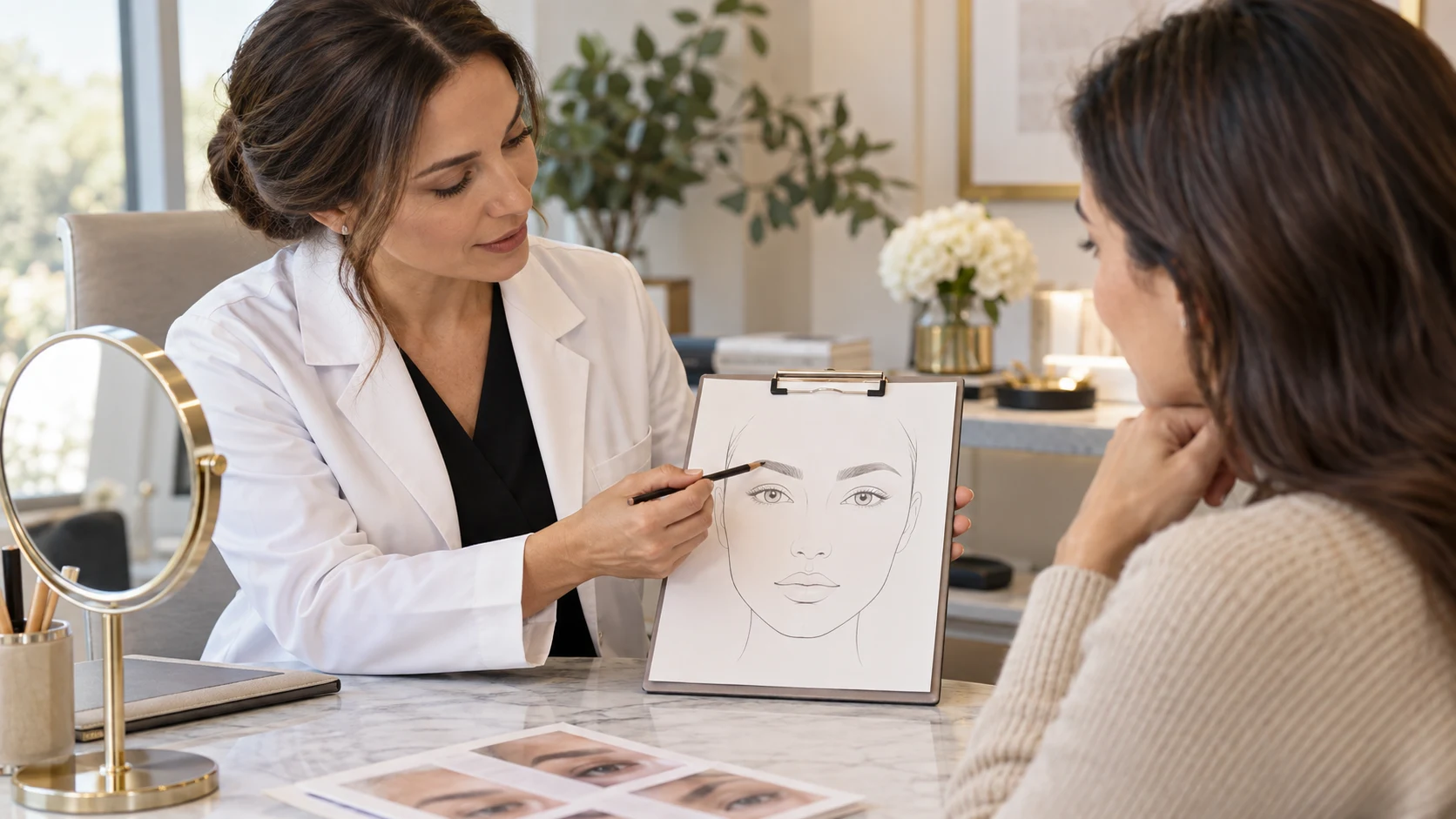
The technical difficulty of eyebrow work is not the number of grafts, it is the angle. Brow hairs lie almost flat against the skin, and their direction changes across the brow — upward at the inner end, gradually turning outward along the body, and downward-sloping at the tail. Grafts placed at the wrong angle stick out and look obviously artificial.
Single-hair grafts are used almost exclusively, and the typical case falls between 150 and 400 grafts per brow depending on how much needs rebuilding. The shape is drawn and agreed with the patient while sitting upright, because brows shift when you lie down.
Design has to suit the face and the age. We describe how natural shapes are planned in what to expect from an eyebrow transplant, and how facial cases are combined in beard and eyebrow restoration.
The first year and the trimming question
Healing is quick — small crusts for a few days, most social downtime measured in days rather than weeks. The transplanted hairs shed between weeks two and six, exactly as they do on the scalp, and this stage worries patients who were not warned.
Regrowth begins around month three, the shape is readable by month six, and final density and direction settle between months nine and twelve. Early growth can look coarse or stick out; hairs soften and lie down as they mature.
The permanent commitment is trimming. Because the grafts come from the scalp, they grow at scalp speed and need cutting every two to four weeks. Our guide to eyebrow aftercare and the first trim explains how to manage it, and results at twelve months are visible on our before and after page.
Women, hormones and the wider picture
Brow thinning in women very often arrives alongside other changes: a widening parting, increased shedding, a change in cycle or menopause. When those things travel together, the brow is a symptom rather than the problem.
In that situation the right sequence is medical assessment first — thyroid, ferritin, hormonal picture where indicated — then a decision about the brows once the systemic side is stable. Our approach to this is set out in the context of hair restoration for women.
At Hairpol we regularly tell women with recent brow loss to come back in six months. It is not the answer anyone wants, but a large proportion of them return with brows that have partly recovered on their own, and a smaller, better-defined problem to fix.
Men lose eyebrows too, and they ask about it later
Men rarely bring up their eyebrows first. It comes out at the end of a scalp consultation, almost as an afterthought, usually phrased as a joke about looking permanently surprised.
The pattern is different. Men more often lose density at the inner end and along the upper edge rather than the tail, and the classic male complaint is a brow that has gone sparse and wiry at the same time — fewer hairs overall, but the survivors longer and more unruly than they used to be.
Causes are the same list: thyroid, iron, skin disease, areata, ageing. What changes is the design brief. A restored male brow needs to stay flat, slightly heavier at the inner third, and never take on a defined arch, because the arch is what reads as female. Under-treating is far safer than over-treating here.
How to photograph and track your own brows
Almost every eyebrow decision is easier with three months of photographs behind it, and almost nobody arrives with them.
The method is simple. Stand facing a window in daylight, no artificial light, no makeup, brows completely untouched. Camera at eye level, roughly forty centimetres away, straight on and then one photo from each side. Neutral expression — raised eyebrows change everything. Same window, same time of day, once a month.
Compare only against your own previous photographs, never against a filtered image or a gallery. What you are looking for is not thickness but new short hairs appearing in the gaps, which is the earliest evidence that follicles are still alive.
Three or four of these images tell a surgeon more than an hour of description, and they occasionally save people an operation they did not need.
What to do if your brows have not recovered in a year
A full year with no plucking, corrected bloodwork, treated skin and no visible change means you are looking at permanent loss. That is the point at which a transplant stops being premature.
Take good photographs first: straight on, in daylight, without makeup, brows completely untouched. Add your blood results if you have them, and a rough history of when the loss started and whether it has changed since. That package answers most of the questions a surgeon needs to ask.
Send it through our contact page and ask for an honest assessment of whether surgery is warranted. Our frequently asked questions cover the practical side, and if the answer is that your brows are still coming back on their own, we will tell you that instead.
Find this helpful? Add Hairpol as a preferred source on Google.
Get a Free Consultation
Answer a few questions and the medical team will review your situation.
