
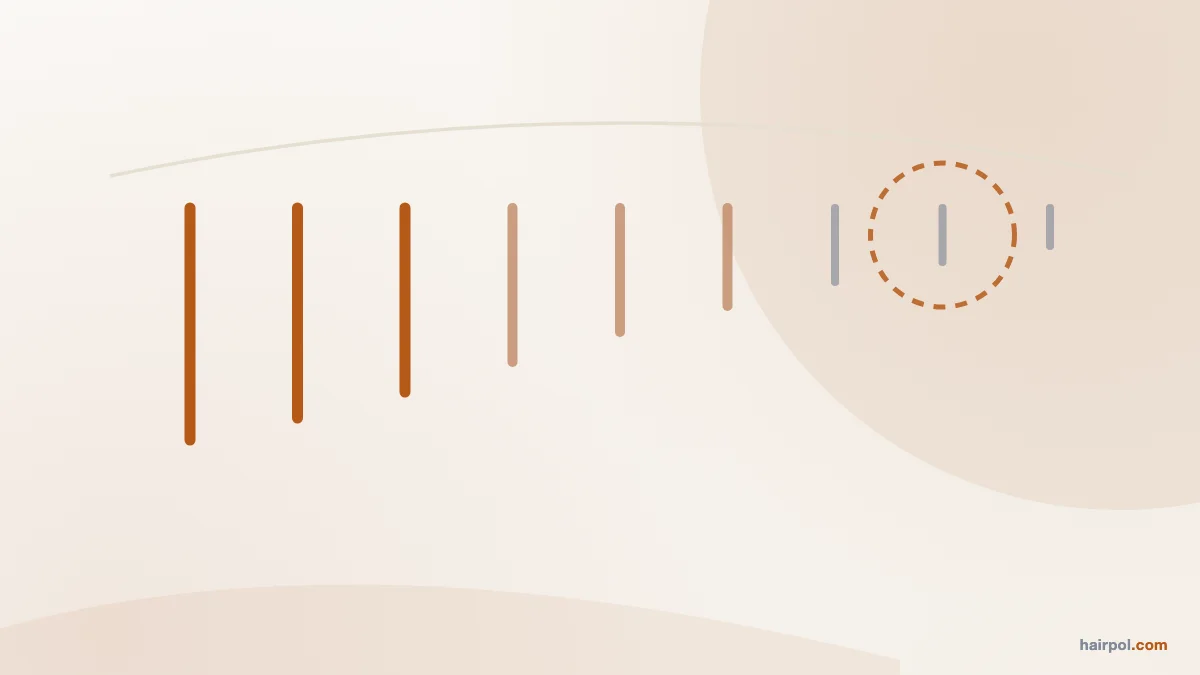
The clinic photos stop at month twelve. That is the whole problem.
Most men walk into a consultation carrying one hope they never say out loud: that surgery will end the slow retreat they have been tracking in bathroom mirrors for years. It does not. The operation relocates hair. It does not switch off the biology thinning the hair you still have, and the distance between those two facts is where almost every disappointing five-year result is born.
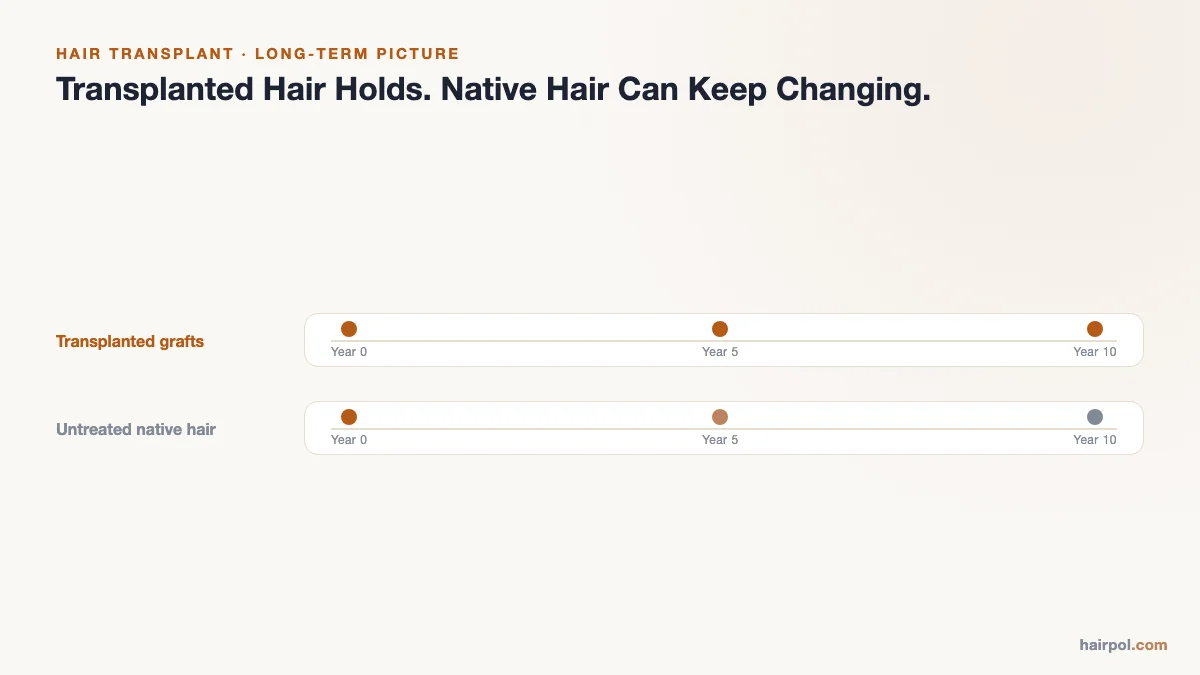
The short answer: a hair transplant does not stop hair loss. Follicles taken from the donor rim are largely resistant to DHT and tend to stay for life, but your native hair in and around the treated zone keeps miniaturising on its own schedule. Without medical maintenance, many men who operate in their twenties or early thirties see visible native thinning within 3 to 7 years of surgery. Planning for that is as important as the graft count.
What the surgery moves, and what it never treats
A transplant is a redistribution, not a cure. The surgeon harvests follicular units from the back and sides of the scalp, where hair is genetically programmed to ignore dihydrotestosterone, and places them into thinning or bald areas at the front, mid-scalp or crown. Those grafts carry their donor programming with them. That is the whole reason the technique works, and has worked since the 1950s.
What the surgery never touches is the hormonal process itself. Androgenetic alopecia is a progressive, genetically driven sensitivity of certain follicles to DHT. Nothing about harvesting 3,000 grafts changes the sensitivity of the 20,000 follicles you did not move. They carry on shrinking, cycle after cycle, producing shorter and finer shafts until they stop producing anything visible at all.
At Hairpol we say this in the first fifteen minutes of every consultation, because patients who understand it choose differently. They ask about staging instead of maximum density. They ask what their scalp looks like at forty rather than at month twelve. Understanding what DHT does to hair follicles is not academic here. It is the single fact that determines whether your result ages well or falls apart.
Why your native hair keeps miniaturising after surgery
Miniaturisation is gradual and it is sneaky. A follicle does not die in one dramatic moment; it produces a slightly thinner, slightly shorter hair each cycle, and each cycle lasts months to years. Over a decade a terminal hair becomes a vellus hair, and long before it disappears it stops contributing meaningful coverage. Because the change is incremental, you do not notice it happening. You notice the photograph.
Surgery does not slow any of this. If anything, patients become more aware of it, because the transplanted area now looks dense and the untreated area next to it does not. Contrast makes thinning obvious months earlier than it would otherwise be. The crown that was “a bit thin” before your hairline was rebuilt now reads as an open patch, purely because the front is full.
There is a second mechanism worth naming. Surgical trauma can push nearby weak native hairs into a resting phase, the well-documented shock loss phenomenon. Most of that returns within three to six months. Hairs that were already deep into miniaturisation, though, sometimes do not come back. They were on their way out; the operation simply moved the timeline forward.
Is it normal to keep losing hair after a hair transplant?
Yes, and clinics that pretend otherwise are setting you up. Continued native loss is the expected course of androgenetic alopecia, not a sign that your surgery failed. The two look completely different once you know where to check.
Transplanted hair sits in a defined pattern the surgeon drew. It grows out of a designed hairline or a designed crown whorl, it is consistent in calibre, and it holds. Native loss shows up around and behind that design: a widening part, temples creeping back beside a rebuilt frontal line, or the crown opening while the front stays solid. If your grafted zone is thinning uniformly instead, that is a different conversation entirely.
The practical test we use is time. Real graft failure declares itself in the first year. Native progression declares itself in year three, year five, year eight, long after your result stabilised. Patients who call at month fourteen worried about losing the transplant almost always have healthy grafts and a thinning zone sitting next to them.
The 5-to-10 year picture nobody photographs
Picture a 29-year-old at Norwood 3 who has 2,800 grafts placed into the hairline and temples. At month twelve the result is excellent. He takes no medication, because the clinic never raised the subject.
By year three his mid-scalp has thinned enough that the light catches his scalp under office ceilings. By year five the crown, which was faintly open at surgery, is a visible circle. The hairline is still perfect. That is exactly the trouble. A sharp, dense frontal band sitting above a thinning mid-scalp is one of the most recognisable signatures of a poorly planned transplant. It reads as artificial even though every graft grew.
Now the second procedure is not optional; it is remedial. He needs coverage behind the line he already spent his donor budget on, and his donor area is 2,800 grafts lighter than it was. This is why lifetime donor capacity is the number that should worry you more than the price of session one. You have a fixed supply. Spending it on a hairline before you know where the loss is heading is the most common expensive mistake in this field.
What the evidence actually says about medication after surgery
This is not a matter of clinic opinion. The International Society of Hair Restoration Surgery has long framed transplantation as one component of a long-term management plan for a progressive condition, alongside medical therapy and staged surgical planning, rather than as a standalone fix.
The most quoted piece of evidence is a controlled study led by Leavitt and colleagues, published in Dermatologic Surgery in 2005, which followed men undergoing hairline transplantation. Those who took finasteride 1 mg daily alongside surgery showed greater total hair counts in and around the treated region at the end of the follow-up period than those who had surgery alone. The mechanism is unremarkable once you accept the premise: the drug was protecting the native hair the surgery never addressed.
Two decades of clinical practice have not overturned that finding. What has changed is the honesty around side effects and the recognition that no medication suits everyone. Any decision about finasteride, topical or oral minoxidil, or any other agent belongs to you and a doctor who has taken your full history, never to a blog or a sales consultant. We go deeper into the trade-offs in whether finasteride improves transplant results, and into daily practicalities in our guide to building a maintenance routine that lasts.
Who is most at risk of a stranded result
Not everyone faces the same exposure. Four factors move you up the risk list, and they compound.
Age at surgery. A man operated at 24 has forty years of potential progression ahead of him. A man operated at 52 whose pattern has been stable for a decade has far less. Early loss is generally aggressive loss.
Pattern speed. If you moved from Norwood 2 to Norwood 4 in three years, your trajectory is steep, and your final pattern is probably several stages beyond where you are sitting today.
Family history on both sides. A father and a maternal grandfather who both reached Norwood 6 is meaningful information about your ceiling.
Diffuse thinning. This is the one that catches clinics out. Diffuse patterned loss thins the donor rim itself, which means the safe zone is not entirely safe, and grafts harvested from it may thin later. Anyone with diffuse features needs a careful candidacy assessment before anything else, which is the ground we cover in hair transplant for diffuse thinning.
What medical maintenance can hold, and what it cannot
Set expectations correctly and maintenance is one of the best decisions you will make. Set them wrongly and you will quit in month five.
What it does well: slow or stall further miniaturisation in follicles that are still producing hair, and in a proportion of men produce partial regrowth of recently miniaturised hair, most visibly in the crown and mid-scalp. Response varies by patient, and the effect is maintained only while treatment continues.
What it cannot do: regrow follicles that are gone. Once a follicle has fully involuted, nothing on the market brings it back. That is precisely the territory where surgery is the only answer, and why the two approaches are partners rather than alternatives.
Timing matters too. Starting medical treatment months before surgery gives you a clearer baseline and lets you see how your scalp responds before anyone commits donor hair. Our hair treatment programmes including mesotherapy and PRP sit in the same supporting role: useful adjuncts to a plan, never a substitute for one. Every drug and dose decision goes through a physician who has examined you.
If you are somewhere between “my hair is thinning” and “I should book something”, a single photo assessment of your donor rim and crown will tell you more than another six months of reading. Send images through the Hairpol assessment form and you will get a written opinion on staging before you commit to anything surgical.
How a good plan assumes you will keep losing hair
Once progression is treated as certain rather than possible, three decisions change shape.
Hairline position. A conservative, mature line with softly receded temples ages gracefully, and single-hair placement techniques such as DHI hair transplantation exist to make that front edge look grown rather than drawn. An aggressive juvenile line looks superb at 27 and absurd at 45, and it consumes grafts you will need behind it.
Density distribution. Concentrating maximum density in the frontal third and tapering backwards produces a result that stays coherent as native hair behind it fades. Even, uniform density across a large area looks better at month twelve and worse at year six.
Donor reserve. A responsible plan leaves grafts in the bank. If your realistic lifetime supply is 6,000 to 7,000 follicular units, spending 4,500 on session one at age 28 is a decision your 40-year-old self will have to live inside. We would rather do 2,500 now and hold the rest.
None of this is caution for its own sake. It is the difference between a result that improves with age and one that needs rescuing.
Crown or hairline first, when loss is still moving?
The honest answer depends on your trajectory, not your preference. The crown is a spiral with a whorl pattern, it swallows grafts, and it tends to keep expanding in men who lose hair early. Building a dense crown at 27 in a man heading for Norwood 6 is a well-known way to run out of donor supply at 38, with a bald mid-scalp sitting between two treated islands.
The frontal zone frames the face, is visible in every interaction, and behaves more predictably. For most younger patients with unfinished patterns we treat the front conservatively, hold the crown on medical management, and revisit it once the pattern has declared itself.
There is no universal rule here, and anyone who hands you one has not looked at your scalp. What we can say is that the sequence should be driven by where your loss is going, not by which area annoys you most this year.
Shock loss versus continued loss: telling them apart
In the first three months after surgery, patients often panic about hair falling from areas nobody touched. Two different processes can be at work and they need different responses.
Shock loss is a temporary shift of follicles into a resting phase triggered by local trauma, swelling and inflammation. It appears between weeks two and eight, affects native hairs adjacent to the recipient sites, and reverses in three to six months in the great majority of cases. It is unsettling and it is normal.
Continued androgenetic loss has no relationship to the surgery date. It appears months or years later, follows a pattern, and does not reverse on its own. If hair is still absent at month nine and the affected area matches your inherited pattern rather than the surgical field, you are watching progression, not a complication.
The practical response is the same in both cases: get photographed under consistent lighting, compare against your pre-operative images, and talk to your clinic rather than to a forum. The before and after gallery gives you a sense of what a stabilised twelve-month result looks like, which makes judging your own timeline much easier.
Will you need a second procedure? Probably, and that is fine
Roughly speaking, the younger and more aggressive the loss, the higher the chance of a second session at some point. That is not a failure of the first one. It is the arithmetic of operating on a moving target.
A planned second procedure is a very different thing from an emergency one. Planned means your surgeon reserved donor capacity, designed the first session to blend with a future one, and chose an area that will still make sense in ten years. Emergency means you spent everything on a hairline and now need coverage you cannot fund. The distinction is set on day one, in the plan, long before anyone touches a punch.
Cost sits inside this conversation whether or not clinics raise it. A staged plan across two sessions is not double the price of an over-aggressive single one, because the graft numbers are split rather than duplicated, and it is worth understanding what actually drives hair transplant cost before you compare quotes. Choosing the cheapest maximum-graft package at 26 is how people end up paying twice.
What we model at a Hairpol consultation
The assessment we run has four parts, and only one of them is about the operation.
We examine the donor rim under magnification for calibre variation, because a donor area with mixed shaft thicknesses is an early diffuse signal. We map your current Norwood stage and, more usefully, estimate the trajectory using your rate of change and family history. We discuss medical therapy openly, including the reasons you might reasonably decline it and what your plan looks like if you do. Then we design a surgical proposal that survives the projected pattern, not just the current one.
If that projection means we recommend fewer grafts than you hoped, or recommend waiting, we say so. Hairpol has turned down patients whose loss was moving too fast for surgery to be sensible yet, and we would rather do that than build something that needs repairing in five years. Reading who should delay a hair transplant will tell you whether you might be in that group.
If you already had surgery and your native hair is thinning now
You are not stuck, and you have more options than the internet suggests.
Start with an accurate picture. Photograph the crown, mid-scalp and temples in the same light every three months. Progression is far easier to argue about with images than with memory. If the pattern is clearly advancing, talk to a physician about medical management now rather than after another two years of loss, because protecting what remains is cheaper in every sense than transplanting into it later.
Then get a donor assessment. The question that determines your options is not how much you have lost but how much you have left to move. A patient with a strong donor rim and 3,500 grafts of remaining capacity has real choices. Someone who had 4,500 grafts harvested at 25 by a high-volume clinic may be looking at conservative coverage rather than restoration, sometimes combined with scalp micropigmentation for the illusion of density.
Either way, the next step is an examination rather than a purchase. Book a consultation through our hair transplantation department and we will tell you what your donor supply can realistically support over the next twenty years, including the answer you may not want, which is that maintenance alone is the better move right now.
Find this helpful? Add Hairpol as a preferred source on Google.
Graft Range Calculator
Answer three questions to see the typical graft range for your situation — based on our published clinical guides.
This is a preliminary estimate, not a medical assessment. The exact number can only be determined by a doctor after examining your donor area and hair characteristics.
Get a Free Consultation
Answer a few questions and the medical team will review your situation.
