
Nobody warns you about the handful. Everyone mentions the sleep, the feeding, the recovery, and then one morning around week ten you run your fingers through wet hair and come away with more strands than you thought a person could lose and still have hair.
It happens to a large proportion of women after childbirth, it looks alarming, and it almost always ends. That last part is worth saying clearly, because the internet is very good at turning a temporary event into a permanent fear.
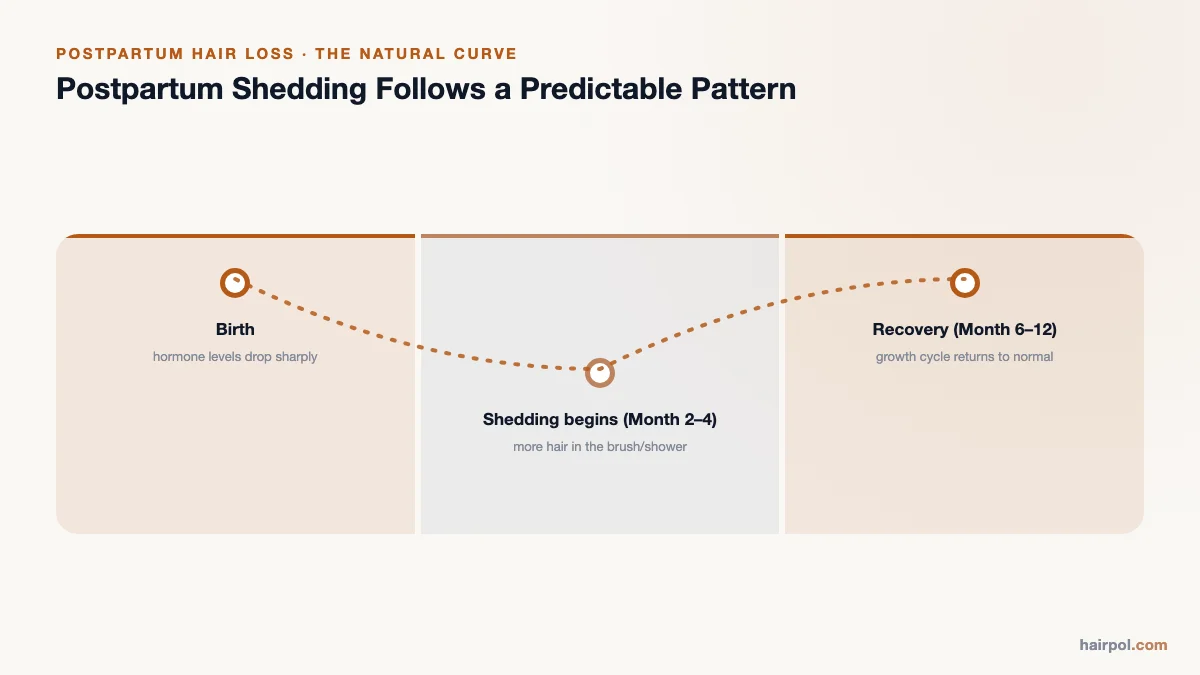
The short answer: postpartum hair loss usually begins around 2 to 4 months after delivery, peaks over about six weeks, and settles by month 6. Density typically returns between months 6 and 12, though the last of the regrowth can take up to fifteen months to reach full length. It is a shedding event, not balding — and it is not a reason for surgery. Shedding that is still heavy past twelve months, or that shows a defined pattern, deserves a medical assessment.
Why pregnancy made your hair look so good
During pregnancy, elevated oestrogen keeps a larger than usual share of follicles in the active growth phase and delays their exit into rest. Hairs that would normally have been shed over those nine months simply stay put.
That is why so many women describe the best hair of their life in the second and third trimesters. It is not extra hair growing; it is the normal amount of hair not falling.
After delivery, oestrogen drops sharply within days. The follicles that were held in growth all shift into the resting phase together, and roughly three months later they release their hairs at the same time. Nine months of postponed shedding arrives across a few weeks. Nothing has gone wrong — the account is simply being settled.
When does postpartum shedding start and peak?
Onset is usually 2 to 4 months after birth, which surprises people who expected it immediately. The delay is built into the hair cycle: the resting phase lasts around three months before the hair is released.
The peak tends to fall somewhere between months three and five, and it lasts about six weeks. During that window it is common to lose noticeably more than the usual 50 to 100 hairs a day, and washing or brushing concentrates the loss into moments that feel dramatic.
By month six most women report that shedding has clearly reduced. Not stopped — reduced. Complete normality often arrives closer to month eight, and the visible density lags behind that because the new hairs need length before they add volume.
The recovery timeline, month by month
Months 0 to 2 are quiet. Hair looks the way it did in pregnancy, sometimes better, and nothing suggests what is coming.
Months 2 to 4 bring the shed. This is the phase most women remember, and it usually coincides with the exact period of least sleep and most stress, which does not help the emotional experience. Months 4 to 6 are the taper: still shedding, but less each week.
Months 6 to 12 are the rebuild. Regrowth has been happening all along, but hair grows about a centimetre a month, so it takes half a year of growth to become visible thickness. By month twelve most women are close to their pre-pregnancy density, with a fringe of shorter hairs still catching up. Full recovery by month 12 to 15 is the normal expectation.
Those short hairs along your hairline
Around months eight to ten, many women notice a halo of short, fine, upright hairs along the front hairline and temples, and interpret it as breakage or new thinning.
It is usually the opposite. Those are the regrown hairs, all restarted at roughly the same time and therefore all the same length. They stand up because they are short and because they have not yet gained the weight to lie flat. A month later they are a centimetre longer and a month after that they blend in.
The tell is uniformity. Breakage produces hairs of many different lengths with damaged, split ends. Synchronised regrowth produces an even fringe with tapered, healthy tips. If you are unsure which you are looking at, photograph the same patch monthly — regrowth gets longer, breakage does not.
Does breastfeeding cause hair loss?
Breastfeeding does not cause postpartum shedding, and stopping does not reliably stop it. Women who breastfeed and women who do not both experience the shed, because the trigger is the hormonal shift of delivery rather than lactation.
What breastfeeding does do is increase your nutritional demand at a moment when eating regularly is difficult. That is a real factor, but it is a general health factor rather than a hair-specific one, and the answer is adequate intake rather than a hair supplement.
If you are breastfeeding, this matters for another reason: several hair loss medications are not appropriate during pregnancy or lactation, and that includes some commonly recommended online. Anything you take or apply while feeding must be cleared by your doctor first. This is one of the few areas where the usual “ask a professional” advice is not a formality.
Iron, thyroid and what to ask your doctor
Two conditions turn up often enough after pregnancy that they are worth raising directly with your doctor rather than waiting.
Iron deficiency is common after birth, particularly with significant blood loss during delivery or with a short interval between pregnancies. Ferritin can sit inside the laboratory reference range and still be low enough to matter for hair, which is why the interpretation belongs to a physician rather than to a printout.
Postpartum thyroiditis is the second, affecting a minority of women in the first year and often presenting with fatigue and hair changes that are easy to attribute to new motherhood. Both an underactive and an overactive thyroid can drive shedding. Both of these need blood tests and a doctor’s interpretation — we raise them in consultation, we do not diagnose or treat them.
Is it postpartum shedding or something else?
The pattern tells you a great deal. Postpartum shedding is diffuse: the whole scalp thins evenly, the hairline holds, and the donor area at the back and sides thins along with everything else.
What does not fit that picture: a hairline that is visibly moving backwards, thinning concentrated at the crown or along the parting while the rest holds, round patches with defined borders, or shedding that started before pregnancy and simply got worse.
Female pattern hair loss can be unmasked by a postpartum shed, and pregnancy is a common moment for it to become visible for the first time. If the parting is widening rather than the whole scalp thinning, our article on diffuse thinning and candidacy describes how that distinction is assessed, and what is and is not reversible covers the treatment side.
When should you actually worry?
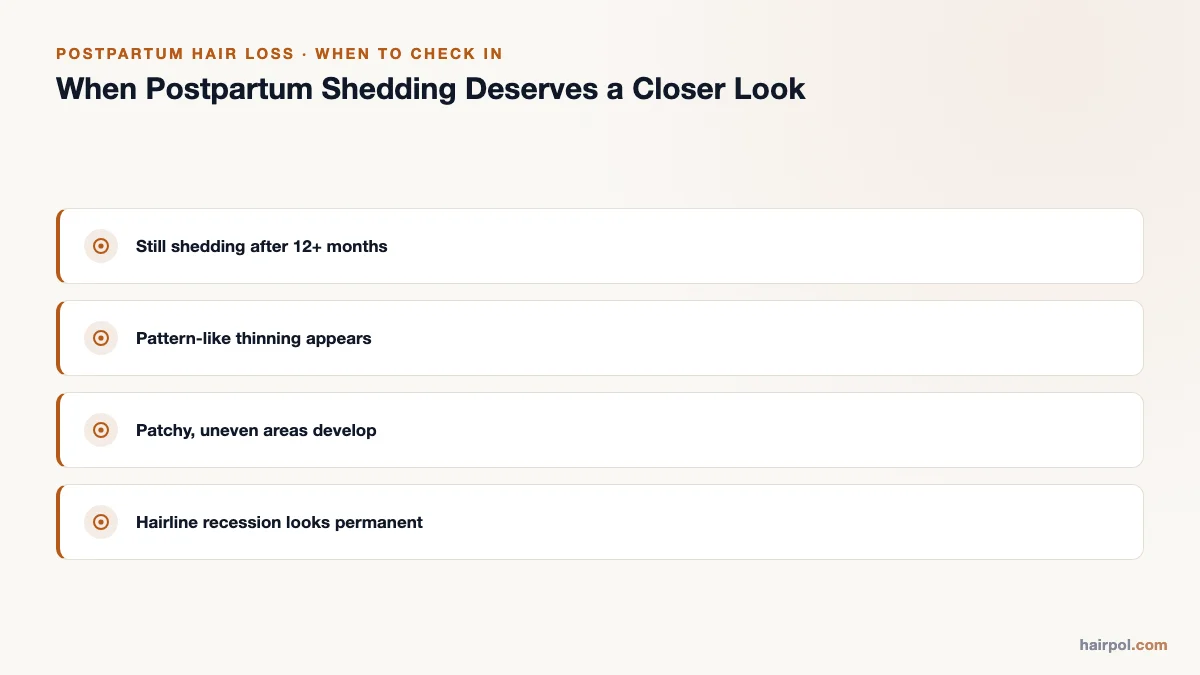
Book an assessment if shedding is still heavy at 12 months postpartum, if your hair has not recovered meaningful density by 15 months, if the loss is regional rather than diffuse, if you see round bald patches, or if the scalp is itchy, painful, red or scaling.
Also worth flagging: significant fatigue, unexplained weight change, or feeling persistently unwell alongside the hair loss. Those belong to your doctor as symptoms in their own right, not as hair questions.
Everything else — a frightening handful in the shower at month three, a wider parting at month five, short spiky hairs at month nine — is the normal shape of this event. At Hairpol we see a steady stream of women who arrive at month four convinced they need intervention, and the honest answer for most of them is a photograph diary and a follow-up conversation at month nine.
What actually helps in the meantime
Very little accelerates the biology, and anyone claiming otherwise is selling something. What you can influence is the visible impact and the risk of adding a second problem on top.
Eat enough. This sounds trivial and it is the most commonly skipped item on the list during the newborn months. Total calories and protein matter more than any targeted supplement, and supplements should follow blood work rather than replace it.
Protect the hair you have. Tight ponytails, tight buns and repeated tension on an already thinning hairline can convert a temporary shed into traction alopecia, which is permanent when it goes far enough. That risk is real and underestimated — our article on traction alopecia in women shows how much damage repeated tension can do over a few years.
Can you prevent postpartum hair loss?
Not really, and it is worth being direct about that, because a lot of money changes hands on the promise that you can. The shed is driven by a hormonal shift that is part of giving birth, and no shampoo, serum or prenatal formulation stops follicles that were held in growth from entering rest.
What you can influence is whether anything else gets stacked on top. Going into the postpartum period with adequate iron stores, a checked thyroid and reasonable nutrition means the shed you get is the one the hormones caused, rather than that plus a correctable deficiency. Women who lose a lot of blood at delivery and are not followed up afterwards often shed harder and recover more slowly, and that part is genuinely preventable with routine care.
The second lever is mechanical. If you know a shed is coming, the months either side of it are a poor time for tight braiding, extensions, or anything that pulls at the hairline. Hair that is shedding is also more fragile where it emerges, and tension damage during that window turns a temporary problem into a slower-healing one.
Beyond that, the honest advice is to expect it, photograph it and let it run its course. Trying to prevent a physiological event usually costs more than living through it, and the products marketed for exactly this purpose have very little behind them.
Is a hair transplant ever the answer after pregnancy?
Rarely, and never during the shed itself. This deserves stating plainly because postpartum hair loss is a period of high anxiety, and anxiety is when people book procedures they do not need.
Surgery moves hair from one place to another. It does not stop a shed, it does not speed regrowth, and operating on a scalp mid-shed makes the planning unreliable: the scalp looks thinner than it will be at month twelve, so any graft calculation is based on a temporary picture.
Where surgery does become a real conversation is when a woman has an established pattern that has been stable for at least a year, with adequate donor density, and where the postpartum shed simply revealed something that was already progressing. Our hair transplantation for women department handles those cases, and the differences from male surgery are set out in our piece on how female transplants differ.
What stabilisation means before any surgical plan
Stability is the word that decides everything here, and it has a specific meaning rather than a vague one.
We want at least 12 months since the shed settled, photographs across that period showing no further loss, hormonal and thyroid status reviewed by a doctor, and no plans for another pregnancy in the near term. That last point is practical rather than moral: another pregnancy means another shed, and building a surgical plan immediately before one is poor sequencing.
If you are unsure whether your pattern has stabilised or is still moving, a photo review is the fastest way to find out — you can send photographs for an assessment and get an honest answer, including the answer that you should wait another six months. Looking through before and after results is also more useful once you know which category you are in.
If you are planning another pregnancy
The practical advice is to sequence rather than to worry. Postpartum shedding repeats with each pregnancy in most women, and the severity varies rather than escalating predictably. A heavy shed after a first baby does not guarantee a heavy shed after a second.
What does change with each cycle is the visibility of any underlying pattern. If female pattern loss is present, each shed strips away the volume that was hiding it, and recovery brings back slightly less than the time before. That is the mechanism behind the common report of hair being “fine after the first, never the same after the second”.
Medical treatment decisions in this window are entirely your doctor’s. Several options are unsuitable during pregnancy or breastfeeding, some require a washout period before conception, and the timing is specific to the drug. Non-surgical support such as the programmes in our hair treatments department is discussed only once your doctor confirms what is appropriate for your situation.
The emotional side, which nobody schedules time for
It is worth saying that this shed lands during the least resourced period of many women’s lives. You are exhausted, your body has changed in several ways at once, and hair is the change that stares back at you in every mirror and every photograph.
Patients tell us they felt embarrassed for caring about hair at a time when they were supposed to be focused on a baby. That reaction is extremely common, and it is not vanity. Hair is bound up with identity, and losing a lot of it quickly while everything else is also in flux is genuinely hard.
What helps, practically: take a monthly photograph so you can see progress that daily mirror checks hide, avoid making permanent decisions in the middle of a temporary event, and get the medical basics checked so you are not carrying an untreated deficiency on top of everything else.
It also helps to tell one person. Partners and friends frequently have no idea this happens at all, and the isolation of quietly counting hairs in the shower makes the whole thing heavier than it needs to be. Several of our patients say the single most useful thing anyone did was to tell them, plainly, that it ends.
If your hair is still thin at eighteen months
At that point the postpartum explanation has run out, and the question changes from “when will this recover” to “what is actually going on”.
Three possibilities dominate. An unresolved medical contributor — iron, thyroid, another condition — that was never tested or was tested too early. A female pattern that the pregnancy unmasked and that is now progressing on its own timeline. Or traction damage from eighteen months of tying hair back, which behaves differently again and can become permanent.
Each of these has a different answer, and telling them apart needs the scalp examined rather than the timeline debated. If you have reached that point, our hair restoration team will look at donor density, distribution and miniaturisation together, and say plainly whether you are looking at something that will still recover, something that needs a medical plan, or something where surgery is worth discussing. Hormonal hair changes later in life follow a similar logic, which we cover in our article on menopause and female hair loss.
Find this helpful? Add Hairpol as a preferred source on Google.
Graft Range Calculator
Answer three questions to see the typical graft range for your situation — based on our published clinical guides.
This is a preliminary estimate, not a medical assessment. The exact number can only be determined by a doctor after examining your donor area and hair characteristics.
Get a Free Consultation
Answer a few questions and the medical team will review your situation.
