

A patient sends us three photographs and a single line: “I lost this in about six weeks, can you fix it with a transplant?”
Six weeks is the detail that matters. Pattern hair loss does not do anything in six weeks. When hair disappears from a defined area that quickly, and the skin underneath looks smooth and untroubled rather than gradually thinning, we are usually not looking at a surgical case at all. We are looking at something that belongs in a dermatology clinic first, and possibly only there.
The short answer: androgenetic alopecia is a transplant case; alopecia areata in an active phase is not. Pattern loss thins gradually over years in a predictable shape and leaves a DHT-resistant donor rim intact, which is what makes surgery work. Areata is an autoimmune condition that attacks follicles anywhere on the scalp, including the donor area, and it can regrow spontaneously. Transplanting into an unstable autoimmune process risks losing the grafts to the same immune activity that took the original hair.
Two conditions, one symptom, and a very common mix-up
From a patient’s chair, hair loss is hair loss. You notice more scalp, you photograph it, you search. What the search results rarely make clear is that the two most common causes behave in almost opposite ways, and only one of them is a candidate for surgery.
Pattern hair loss is a slow hormonal process that follows an inherited map. Areata is an immune process with no map at all: it can appear as a coin-sized patch above one ear, as several patches at once, as a band along the back of the head, or as diffuse shedding without any patch. It can resolve on its own within months. It can also return years later without warning.
At Hairpol we sort every consultation into one of those categories before we discuss grafts, techniques or dates. It is not a formality. Getting this wrong wastes donor hair on a condition that does not respond to surgery, and it delays a person from seeing the doctor who could actually help them. Nothing in this article is a diagnosis; it exists so that you know which door to knock on first.
What alopecia areata typically looks like
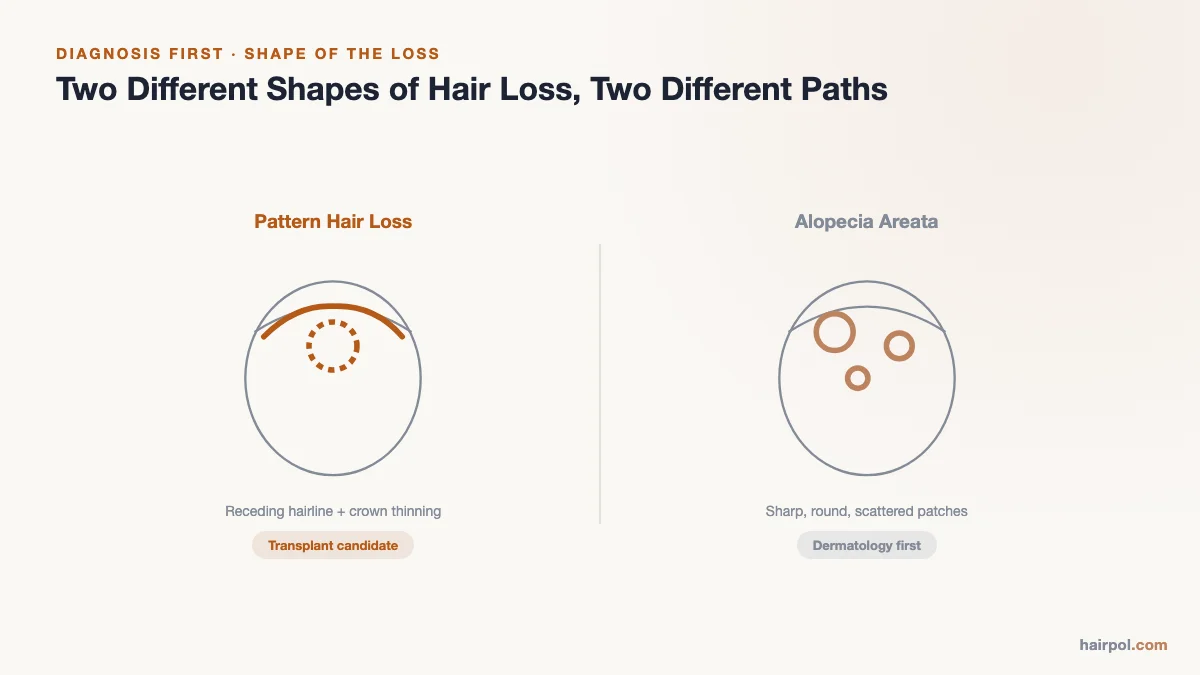
The classic presentation is abrupt and well defined. A round or oval patch of complete hair loss appears over days to weeks, and the exposed scalp looks normal: no scaling, no redness, no scarring, no visible follicle damage. Run a finger over it and the skin feels smooth rather than rough.
The patch has an edge. That is the key visual difference from pattern loss, which fades gradually from denser to thinner with no border anywhere. Areata patches have a border you could trace with a pen.
Other features are common but not universal. It can appear in the beard, eyebrows or eyelashes as easily as on the scalp. It can affect the fingernails, producing fine pitting or ridging. It often shows up in people with a personal or family history of other autoimmune conditions. And it can regrow on its own, sometimes with white or fine hair at first that later returns to normal colour.
None of these observations belongs to a blog reader with a phone camera. They belong to a dermatologist with a dermatoscope, and if any of them sound familiar, that is the appointment to make. Our guide on when to see a dermatologist about hair loss covers the referral logic in more detail.
What pattern hair loss typically looks like
Androgenetic alopecia is defined by its shape and its speed. In men it retreats from the temples and thins at the crown, following the well-documented Norwood stages. In women it usually widens the central part while the frontal hairline holds, following the Ludwig pattern. Neither version produces a hard edge.
The mechanism is miniaturisation, not sudden loss. Follicles sensitive to DHT produce progressively finer, shorter hairs over successive cycles. Under magnification a pattern-affected zone shows a mix of thick and thin shafts side by side, which is exactly the finding that separates it from an areata patch, where the affected area contains no hair at all.
Timeframe helps too. Pattern loss is measured in years. If you compare a photograph from three years ago with one from today and can see a difference, that is normal progression. If you compare a photograph from three months ago and the change is dramatic, something else is happening. Reading your own trajectory correctly is the point of the Norwood scale explained.
The findings a dermatologist actually checks
A hair clinic can tell you your Norwood stage. A dermatologist can tell you your diagnosis, and the examination is not the same.
Under a dermatoscope, active areata often shows short broken hairs that taper towards the scalp, yellow dots where follicular openings are empty, and black dots where hairs have broken at the surface. Pattern loss shows variability in shaft diameter across the affected area and follicular units that have dropped from three hairs to one. These are two different pictures, and a trained eye separates them in minutes.
Beyond the scope, a dermatologist may examine the nails, review your medical and family history, ask about recent illness, weight change, medication and stress, and in some cases order blood work or a scalp biopsy. Thyroid disease, iron deficiency, telogen effluvium and other conditions can all masquerade as, or coexist with, hair loss that looks straightforward from the outside.
We say this in every consultation where the presentation is not obviously androgenetic: we are surgeons, and we are not the right first stop for a diagnosis. A written dermatology opinion is worth more to your plan than any photograph we can assess.
Can you have both at the same time?
Yes, and it happens more often than patients expect. A man in his thirties with an inherited receding hairline can also develop an areata patch behind his ear. A woman with early Ludwig thinning can experience a diffuse autoimmune episode on top of it.
When both are present, the surgical question does not disappear; it gets postponed. The autoimmune component has to be assessed, treated where a dermatologist judges it appropriate, and shown to be quiet for a meaningful period before anyone discusses grafts. Operating while an immune process is active is how patients end up with grafts that grow for a year and then vanish in a patch, which is a devastating outcome to explain and an expensive one to have paid for.
The presence of both is also a reason to be conservative about the surgical plan even after clearance. If your scalp has demonstrated that it can attack its own follicles, the safest plan is a smaller, staged one with a clear understanding that a future flare could affect the transplanted area too. That kind of honesty belongs at the start, not at month fourteen. We take the same approach in whether a hair transplant works for everyone.
Why a transplant is not indicated in active alopecia areata
The logic is straightforward once you understand what the immune system is targeting. In areata, immune cells attack the hair follicle itself, specifically the structures around the growing bulb. That attack is not limited to a particular region of the scalp, and it does not distinguish between a follicle that has always been there and one a surgeon moved yesterday.
This is the crucial difference from pattern loss. In androgenetic alopecia the donor rim is genetically protected, so relocated follicles keep their resistance. In areata there is no equivalent protected zone. A graft harvested from the back of the head and placed in a patch carries no immunity with it; it can be attacked in its new location exactly as the original hair was.
There is a second problem. Areata frequently regrows without any intervention, sometimes within six to twelve months. Transplanting into a patch that would have refilled by itself spends irreplaceable donor grafts on an area that did not need them, and leaves the donor area permanently lighter for nothing.
For those two reasons, surgery in an active or recently active phase is not the standard of care anywhere. This is the same category of honest limit we set out in what a hair transplant cannot fix.
Is there any situation where surgery is considered?
There is a narrow one, and it comes with conditions rather than promises.
Some patients have a single patch that appeared years ago, never spread, never recurred, and has been stable for a long period under dermatological follow-up. In selected cases of long-standing, localised, quiescent disease, a dermatologist and a surgeon may together consider limited grafting, usually after a documented stable interval measured in years rather than months, and often with a small test session before any larger plan.
Even then the conversation includes a sentence patients rarely hear from clinics that want the booking: the disease can return, and if it does, the transplanted hair is not protected. Anyone who tells you otherwise is describing a mechanism that does not exist.
If you are trying to work out whether your own situation sits inside that narrow exception or well outside it, send your photographs and your dermatology report through the Hairpol assessment form and we will tell you plainly, including when the answer is that surgery is not the right tool for you.
What happens when someone transplants into active disease
We see the consequences as revision cases, and the pattern is consistent enough to be predictable.
The grafts often grow. Transplanted follicles have their own cycle, and the first six to twelve months can look like a success, which is precisely what makes the outcome so painful. Then a flare occurs, and hair disappears from the treated area in the same abrupt, edged way it disappeared originally. The patient has now lost donor grafts permanently and gained nothing.
Worse, the donor area itself can be affected. Areata is not confined to the recipient site, and a patient whose immune system targets follicles can develop a patch at the back of the head where extraction scars are already present, making the region harder to camouflage.
None of this is a reason for despair. It is a reason for sequencing: dermatology first, stability second, surgery third if and only if it still makes sense. Patients who follow that order rarely regret it. Those who skip it usually arrive in our clinic asking what can be salvaged, which is the conversation we cover in who should delay a hair transplant.
What the cost of a wrong diagnosis actually looks like
The financial loss is the smallest part of it. The real costs are counted in donor grafts and in years.
Donor supply is finite and non-renewable. Grafts spent on an autoimmune patch are grafts unavailable for the pattern loss that may develop later, and many patients with areata also have ordinary androgenetic thinning waiting in the background.
Time is the other loss. A person who spends a year and a half pursuing surgery is a person who has not been under dermatological care during the window when a clinician might have influenced the course of the condition. That window matters, and no surgeon can give it back.
There is an emotional cost too, and we would be dishonest to leave it out. Watching a result you paid for and waited a year for disappear in six weeks does something to a person that the second, correctly planned procedure cannot undo.
Treatment for areata belongs to dermatology, not to a hair clinic
We deliberately do not publish protocols for autoimmune hair loss, because prescribing decisions for an immune-mediated condition require examination, monitoring and follow-up that a surgical clinic is not the right setting for.
What we can say generally is that dermatology has more options than it did a decade ago, that response varies enormously between patients, and that every one of those decisions, including whether to treat at all, belongs to a physician who knows your full medical history. Do not start, stop or adjust any medication on the basis of an article, ours included.
Where we do have a role is in the supportive, non-prescription side of scalp health for patients whose diagnosis is settled, and in surgery once a case is genuinely stable. Our hair treatment department works alongside a dermatologist’s plan rather than in place of it, and we will say so directly if what you actually need is a referral instead of an appointment with us.
Eyebrows, beard and lashes: the same rule applies
Areata does not restrict itself to the scalp, and patients often arrive asking about an eyebrow that thinned on one side or a bald circle in the beard.
The assessment is identical. A sharply bordered, rapidly appearing gap in an eyebrow or a beard is not a design problem, and grafting into it before a dermatologist has looked at it risks the same loss as on the scalp. Facial areas are also more visible, which raises the cost of a failed result.
Once a diagnosis is settled and the condition is stable, restoration of eyebrows or beard can be planned like any other case, with the same conservative staging. You can see how we approach the design side in our eyebrow transplantation work, but the sequencing rule does not change: diagnosis first, then stability, then surgery.
Women, diffuse loss and the extra layer of difficulty
Female hair loss is where misdiagnosis is most common, because several conditions produce a similar diffuse picture and none of them has an obvious edge.
Diffuse alopecia areata can mimic telogen effluvium. Telogen effluvium after illness, childbirth, surgery, crash dieting or severe stress can mimic female pattern loss. Thyroid disorders and iron deficiency can contribute to all three. A woman who is offered surgery before those are excluded is being sold something rather than assessed.
Our position with female patients is unchanged and occasionally unpopular: bloodwork and a dermatology opinion before any surgical planning. When the diagnosis is genuinely female pattern loss with a stable donor area, results can be excellent, and our hair transplantation for women department plans those cases in detail. When it is not, we say so.
When to come to us and when to see a doctor first
Here is the practical filter, and it is short.
See a dermatologist first if the loss appeared suddenly, if it has a clearly defined edge, if the skin in the bald area looks completely smooth, if it involves eyebrows, beard or lashes, if your nails have changed, if there is redness, scaling, pain or itching, or if you have another autoimmune condition. Those features are not for a surgeon to interpret.
Come to us first if the change has been gradual over years, follows a recognisable pattern, and your donor rim is intact. That is the profile where a surgical conversation is genuinely useful, and where you can also read our comparison of diffuse thinning and pattern baldness to sharpen your own picture before the appointment.
If you are unsure which column you fall into, that uncertainty is itself the answer: start with the dermatologist. Nothing is lost by arriving at a surgical consultation with a diagnosis already in hand, and a great deal can be lost by arriving without one.
What a Hairpol candidacy assessment is looking for
Our assessment answers a candidacy question, not a diagnostic one, and we are explicit about that boundary.
We record the shape and borders of the affected area, the presence or absence of miniaturised hairs within it, donor density and calibre, and the history of how the loss developed. We ask when it started, whether it has ever regrown, whether anything similar has happened before, and whether anyone in your family has autoimmune disease. Where the picture does not fit ordinary pattern loss, we ask for a dermatology opinion before going further, and we will not schedule surgery without one.
Patients sometimes find that frustrating, especially when they have already booked flights. We would rather have that conversation than the one eighteen months later. If you want to know where you stand, bring your photographs and any medical reports to our hair transplantation department, and if you would like to see how we handle candidacy questions more broadly, our frequently asked questions page sets out the same standards in shorter form.
Find this helpful? Add Hairpol as a preferred source on Google.
Graft Range Calculator
Answer three questions to see the typical graft range for your situation — based on our published clinical guides.
This is a preliminary estimate, not a medical assessment. The exact number can only be determined by a doctor after examining your donor area and hair characteristics.
Get a Free Consultation
Answer a few questions and the medical team will review your situation.
