

You started training seriously about two years ago. Somewhere in the same window you also noticed the temples going. The internet has an opinion about which of those facts caused the other, and it delivers it with total confidence: it was the creatine.
It is one of the stickiest claims in men’s health, it rests on a much smaller body of evidence than most people assume, and dismissing it outright is just as unhelpful as repeating it. So here is what is actually known.
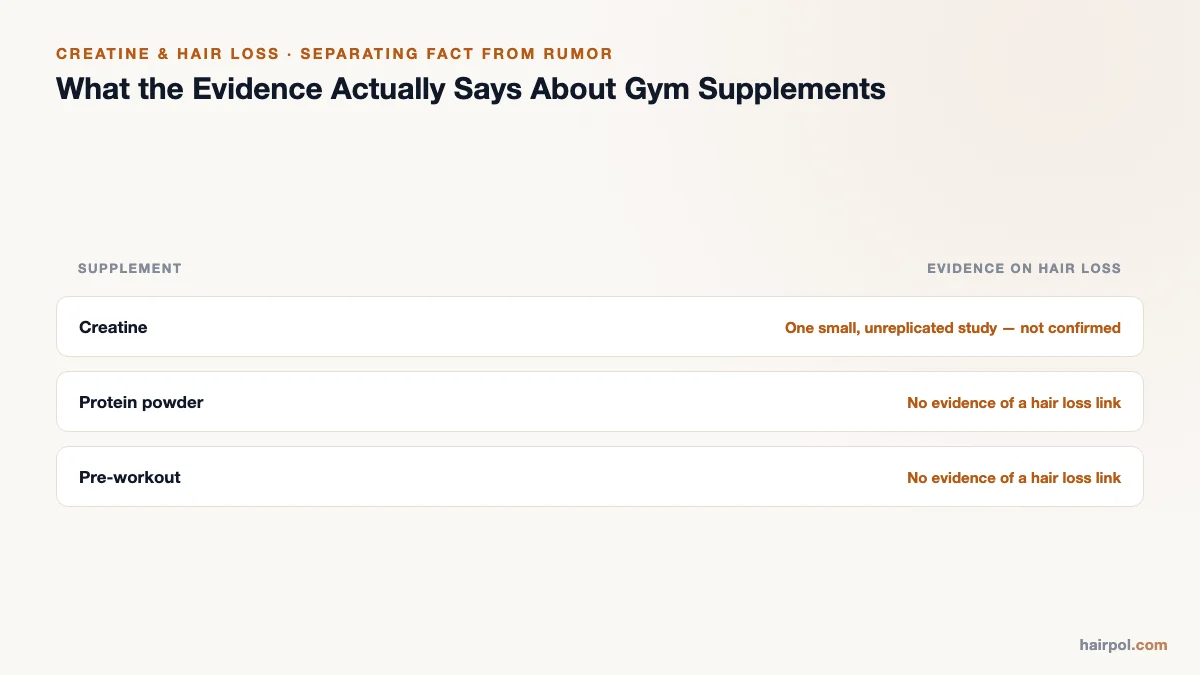
The short answer: the link between creatine and hair loss traces back to one small study from 2009 in college-aged rugby players, which measured a rise in DHT and did not measure hair at all. That finding has not been consistently reproduced, and no study has shown creatine causes hair loss. Protein powder does not cause it either. What does drive it, in gym-goers and everyone else, is genetic sensitivity to DHT — and, occasionally, aggressive cutting phases and anabolic steroid use.
Where the creatine rumour comes from
In 2009 a small trial gave creatine to a group of college-aged rugby players and measured hormone levels through a loading phase and a maintenance phase. Total testosterone did not change much. DHT rose substantially — reported around fifty percent above baseline after the loading week and staying roughly forty percent above baseline during maintenance.
DHT is the hormone that drives androgenetic hair loss in genetically susceptible people. Once that number was published, the inference wrote itself: creatine raises DHT, DHT causes baldness, therefore creatine causes baldness.
The problem is that the study had around twenty participants, ran for three weeks, and did not measure a single hair. It was a hormone study, not a hair study. Everything that followed was inference layered on top of a small measurement, and the inference has been repeated so often that it now gets quoted as if the hair outcome had been observed. It was not.
Has anyone repeated the finding?
Not convincingly, and that matters more than the original result.
Subsequent work looking at creatine and androgen levels has not reliably reproduced the same DHT rise. Reviews of the broader creatine literature have generally concluded that the evidence for a consistent effect on DHT is weak, and that no controlled study has demonstrated an effect on hair density or hair loss rates.
A single unreplicated finding is a reason to keep looking, not a reason to conclude. In clinical terms, an unreplicated result in twenty people over three weeks is a hypothesis. We say that plainly at Hairpol rather than picking whichever version of the story suits the consultation, because patients notice when a clinic is confident about things nobody actually knows.
Does more DHT automatically mean more hair loss?
No, and this is where the chain of reasoning breaks down even if you accept the original measurement.
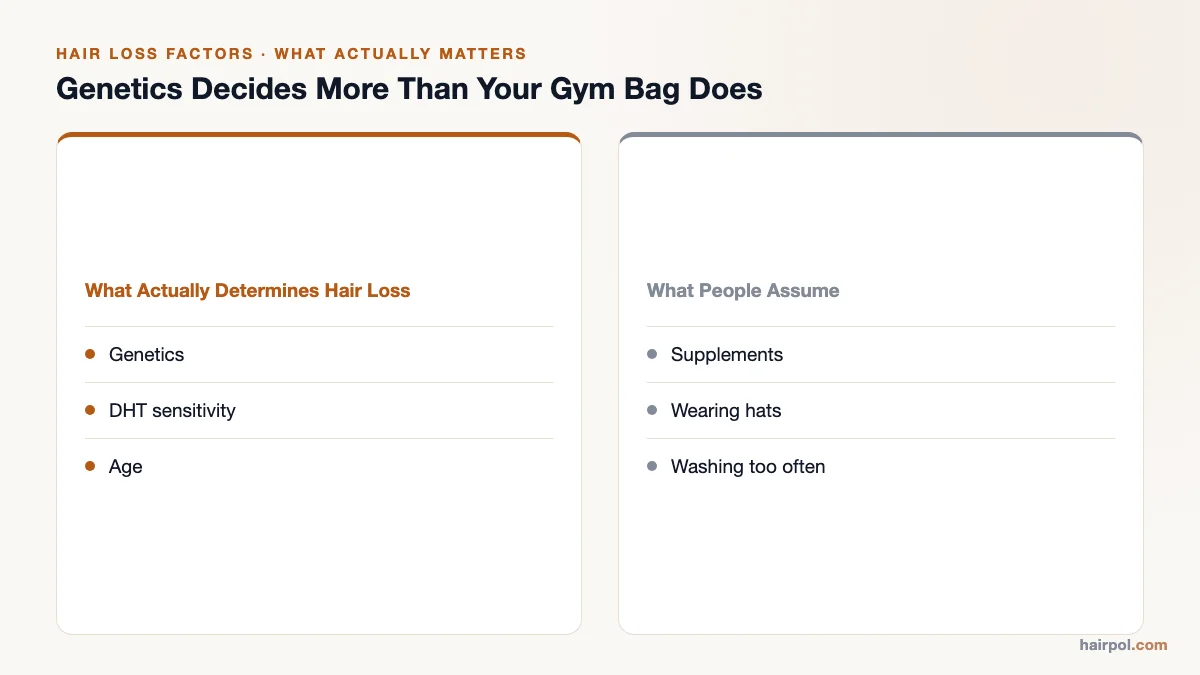
Androgenetic hair loss is not simply a function of how much DHT is circulating. It depends on how sensitive your follicles are to it, which is genetically determined and varies enormously between individuals. Two men with identical hormone levels can have completely different hairlines at forty.
That is why men with high DHT and no family history keep their hair, and why men with unremarkable hormone levels and a bald father lose theirs by thirty. The receptor sensitivity is the variable that matters. Our explainer on what DHT is and why it causes hair loss covers that mechanism in more detail, and it is the piece most gym-focused articles leave out.
Does protein powder cause hair loss?
There is no good evidence that whey, casein or plant protein powders cause hair loss. Protein is a building material for hair; a diet short of it is far more likely to cause problems than one containing extra.
Where the confusion comes from is that some mass-gainer and bodybuilding products contain more than protein. Added creatine, various herbal extracts, occasionally undeclared ingredients in poorly regulated products — the powder itself is rarely the interesting variable.
The other honest point is timing. Many men begin serious training in their twenties, which is exactly when androgenetic hair loss typically starts to become visible. The overlap is a coincidence of life stage, and it is the single most common false attribution we hear in consultation. If you want to know what genuine early pattern change looks like, our guide to Norwood stage 1 describes the first real signs.
What about pre-workout and stimulants?
Pre-workout formulas are mostly caffeine, beta-alanine, citrulline and flavouring. None of those has a demonstrated effect on hair.
The indirect route is more plausible than the direct one. Heavy stimulant use late in the day damages sleep, and chronic sleep deprivation is a genuine physiological stressor. It will not create androgenetic hair loss, but sustained stress can contribute to a diffuse shed — our article on how stress affects hair and recovery goes through that pathway.
The category worth actual caution is proprietary blends with undisclosed quantities, and anything sold as a “test booster” with a long herbal ingredient list. Not because those herbs are proven to cause hair loss, but because you do not know what you are taking, and neither does your doctor when you eventually ask.
The supplement that genuinely does matter
Anabolic steroids. This is the part of the conversation that usually gets skipped because it is uncomfortable, and it is the only part where the causal link is not in dispute.
Exogenous androgens can accelerate androgenetic hair loss substantially in genetically susceptible men, and the acceleration can compress a decade of gradual change into a couple of years. Men who would have reached a certain stage at forty reach it at twenty-eight.
We raise it in consultation because it changes the plan, not to lecture anyone. A patient on cycle has an unstable pattern, and operating on an unstable pattern produces a result that looks good at year one and disappointing at year four when the native hair around the grafts keeps retreating. If this applies to you, tell the surgeon. It is a clinical fact, not a confession, and it is exactly the kind of information that changes graft planning.
Cutting phases, crash diets and shedding
Here is a genuine, well-recognised gym-related cause of hair loss that almost nobody blames: aggressive dieting.
Rapid weight loss, very low calorie intake, or dropping a large share of body weight over a short period can push a large batch of follicles into their resting phase at once. The shedding shows up two to three months later, by which time the person has usually finished the cut and is looking elsewhere for an explanation.
This kind of shedding is diffuse, affects the whole scalp rather than a pattern, and resolves once eating normalises. It is also entirely avoidable with a less extreme deficit. The nutritional side of hair health is covered in our piece on how diet and nutrition affect hair, and the principles apply whether or not you have had surgery.
Should you stop creatine if you are worried?
That is your decision, and the honest framing is a risk-benefit one rather than a warning.
Creatine is among the most studied sports supplements there is, with a good safety record and well-documented performance benefits. Against that sits a single unreplicated hormone finding with no hair outcome attached. If you value the training benefit, the evidence does not currently justify stopping.
If you are genetically predisposed, already thinning, and would rather remove any variable you can control, stopping is a reasonable personal choice with very little downside beyond training performance. What it will not do is stop hair loss that is already underway. If you stop creatine and keep shedding, you have not learned much except that the creatine was probably not the cause.
What we ask gym-going patients in consultation
The supplement stack is one of the last things we ask about, not the first, and that ordering tells you something about how much weight it carries.
We start with family history on both sides, when you first noticed change, and whether the change is regional or diffuse. Then photographs from above, from the front, and of the crown. Then donor density at the back and sides, and whether there is miniaturisation — the mix of thick and fine hairs in the same area that signals a genetic process.
The supplements matter for two specific things: whether you are or have been on anabolic steroids, and whether you have been through an aggressive cut in the last six months. Those two answers change the interpretation. Whether you take five grams of creatine a day does not, on current evidence, change what we expect your scalp to do.
Training after a hair transplant: the real restrictions
This is where gym habits genuinely intersect with hair, and it has nothing to do with supplements.
After surgery, grafts spend the first ten to fourteen days anchoring. Heavy lifting raises blood pressure and intracranial pressure, sweat sits on healing skin, and gym equipment plus changing rooms are an unhelpful environment for a scalp with open micro-wounds. Most protocols keep patients away from resistance training for a period and reintroduce intensity in stages rather than all at once.
We have written the phase-by-phase version of this separately, because “when can I train again” is one of the most common questions we get: our guides on when you can exercise again and returning to full training intensity set out the timeline. The specific dates are your surgeon’s, not a blog’s.
Do caps, helmets and sweat make it worse?
This is the second most common gym-related worry after supplements, and it has a cleaner answer: no, a hat does not cause pattern hair loss. Follicles are supplied by blood vessels beneath the skin, not by air, and no amount of wearing a cap suffocates them.
What headwear can do is mechanical. A cap or helmet strap worn very tight, day after day, at the same point on an already receding hairline creates the same repeated tension that causes traction damage elsewhere. That is a real but uncommon problem, and it produces thinning along the strap line rather than the classic pattern.
Sweat is similarly overrated as a villain. Leaving sweat on the scalp for hours can contribute to irritation and, in people already prone to it, a flare of seborrheic dermatitis — which does increase shedding while it is active. Washing after training solves that, and washing daily is not damaging in the way gym forums often claim.
The one situation where we do give specific advice is the first weeks after surgery, when a tight cap over healing grafts is genuinely a problem and the clinic will tell you exactly what headwear is allowed and when. Outside that window, the honest answer is that your hat is not the reason your temples are moving, and looking for a cause in your kit bag delays the assessment that would actually tell you something.
Testing the theory on yourself without wasting a year
If you genuinely want to know whether a supplement is affecting your hair, treat it as an experiment rather than a worry.
Take standardised photographs first: same room, same light, same angles, hair dry and parted the same way. Do this monthly. Then change one variable at a time and give it at least four to six months, because anything shorter than that cannot show a hair cycle response.
Most people who do this discover their hair kept doing exactly what it was doing before, which is genuinely useful information — it moves the conversation from supplement anxiety to the actual question of what your pattern is doing and what your options are. If you would rather skip the year of self-experimentation, you can send photographs for an assessment and get a read on the pattern directly.
What actually works if you are thinning
Once you accept that the pattern is genetic rather than supplemental, the useful options narrow to a short and unglamorous list.
Medical treatment is the first line for anyone who is still in the miniaturisation phase rather than the bald-skin phase, and it belongs entirely to a doctor. Dose, formulation, side-effect monitoring and whether treatment is appropriate at all are prescribing decisions — our article on minoxidil timing and dose explains why supervision matters more than the specific product.
Clinic-based support such as the programmes in our hair treatments department can help the hair you still have. Surgery becomes relevant when there is an established pattern, a stable trajectory and adequate donor supply. None of those three depends on what is in your shaker.
One more thing about self-testing: change the variable, not the routine around it. People who quit creatine usually also change their training, start a new shampoo and buy a supplement on the same weekend, then have no idea which of the four did anything at month six. One change, six months, same photographs. That is the whole method.
The age overlap nobody mentions
It is worth returning to timing, because it explains more of these cases than any ingredient does.
Serious training usually starts somewhere between eighteen and twenty-five. Androgenetic hair loss usually becomes visible between twenty and thirty-five. Those two windows overlap almost perfectly, which means a very large number of men will start losing hair within a couple of years of starting to train regardless of what they take.
Correlation at that scale feels like causation, especially when a forum tells you it is. The way out is to look at the pattern rather than the timeline: pattern loss recedes at the temples and thins at the crown while the back and sides hold, and no supplement produces that geography. The questions we answer most often include a lot of variations on exactly this.
None of this is an argument for fatalism. Genetic does not mean untreatable; it means the lever is medical and surgical rather than nutritional, and that the clock matters more than the shopping list.
If you have already noticed thinning
The most expensive thing you can do is spend two years cycling supplements on and off while the pattern keeps moving. Hair lost to an untreated genetic process does not come back, and every year of delay narrows what any intervention can achieve.
The sequence that works is unremarkable. Establish what the pattern actually is, get medical advice on whether treatment is appropriate for you, hold what you have while you decide, and consider surgery only once the trajectory is understood. That order costs less and produces better ten-year outcomes than the reverse.
At Hairpol we see a lot of men in their late twenties who arrived convinced a supplement did this, and who leave with a realistic map of what is genetic, what is reversible and what is worth doing now rather than at thirty-five. If you want that map, our hair restoration team will look at donor density, miniaturisation and family history together and give you a straight answer — including the answer that you do not need surgery yet.
Find this helpful? Add Hairpol as a preferred source on Google.
Graft Range Calculator
Answer three questions to see the typical graft range for your situation — based on our published clinical guides.
This is a preliminary estimate, not a medical assessment. The exact number can only be determined by a doctor after examining your donor area and hair characteristics.
Get a Free Consultation
Answer a few questions and the medical team will review your situation.
