
 Türkçe
 Deutsch
 Français
Short answer: transplanted grafts start to anchor from the first days, but they are not yet secure in the first week. Grafts are usually considered settled in their new place around day 10, so the first ten days, and especially the first 3-4 days, are the most delicate period. A graft that is dislodged during this time is lost and cannot be put back.
Below you will find the rules for the first two weeks according to our official aftercare timeline, how to tell whether your grafts have taken, what puts grafts at risk and when the grafts that have taken start to grow hair. Your doctor will always give you the most accurate information for your own case.
When do grafts settle after a hair transplant?
A graft is a small piece of tissue taken from the donor area that contains one or a few hair follicles. From the moment it is placed in the channel opened in the recipient area, a thin layer forms around it and the graft holds in place through this layer. This early hold works, but it is not firm: hard friction, a knock or scratching can dislodge the graft.
Over the following days, new blood vessels grow from the surrounding tissue towards the grafts and the grafts begin to receive nourishment. As this process continues, the grafts settle in. Many doctors regard the first ten days as the critical period; for patients who get through the first ten days without problems, the grafts can be said to have taken. The exact time varies from person to person, and your doctor assesses your case at the first check-up.
Graft anchoring day by day: the first two weeks
| Period | What is happening to the grafts? | Rule to follow |
|---|---|---|
| Day of the procedure and days 1-2 | Grafts have just been placed; anchoring is just beginning | Do not touch the transplant area; the first wash is done at the clinic on day 1-2 |
| First 3-4 days | Grafts are at their most delicate | Do not bend your head forward; sleep with your head raised |
| First week | Anchoring is getting stronger but is not yet firm | Follow the washing routine, do not pick the scabs, avoid knocks and pressure |
| Around day 10 | Grafts are largely considered settled | A hat can be worn after day 10; your doctor decides based on the type of hat |
| First 14 days | Healing continues; itching may occur | Do not scratch; keep the transplant and donor areas out of direct sunlight |
We explain how to wash step by step in how to wash your hair after a hair transplant, and how to sleep in how to sleep without damaging grafts. For a day-by-day account of the first week, see the first 7 days after a hair transplant.
How can you tell that the grafts have taken?
It is hard to tell for certain by eye in the first weeks whether the grafts have taken; the real answer comes from the hair that grows over the following months. Still, some signs show that things are progressing normally:
- The scabs come off on their own with washing, without bleeding.
- Short hairs fall out together with the scabs, but no bleeding or open wound is left in the transplant area.
- Redness and mild swelling ease within days.
- After day 10, touching the transplant area lightly no longer causes discomfort.
Hairs that fall out with the scabs are usually not lost grafts. The follicle stays in place under the skin; only the hair shaft falls out, and the follicle produces new hair months later. We explain why in why transplanted hair falls out before it grows back.
If you notice bleeding, increasing redness, discharge, worsening pain or a fever in the transplant area, do not wait: contact your clinic straight away.
What puts grafts at risk?
- Scratching: Itching can be intense in the first two weeks, but you need to manage without scratching so as not to put graft anchoring at risk. You will find how to cope in itchy scalp after a hair transplant.
- Picking scabs: Scabs should come off on their own with washing. A scab pulled off by hand can take the graft with it.
- Knocks and pressure: Rubbing against a door frame, a car roof or a pillow can dislodge grafts in the first week.
- Sweat and exercising too early: Sweat creates conditions that raise the risk of infection. We explain when you can return to sport in exercise after a hair transplant.
- Wearing a hat too early: A hat can be worn after day 10 and a beanie after day 40. Details are in wearing hats after a hair transplant.
- Sun: For the first 14 days the transplant and donor areas are kept out of direct sunlight; for the first 2 months you avoid sunbathing and long periods in the sun.
When do the grafts that have taken start to grow hair?
Even after the grafts have settled, the transplant area may look thin for a while. According to our official timeline, shock loss may occur between weeks 3 and 8 and is a normal part of the process: the transplanted follicles shed their hairs and then enter a resting phase. New hairs then come through gradually, and the final result settles at 12-18 months.
We explain when shock loss starts and ends in shock loss after a hair transplant, and the first month day by day in hair transplant recovery day by day.
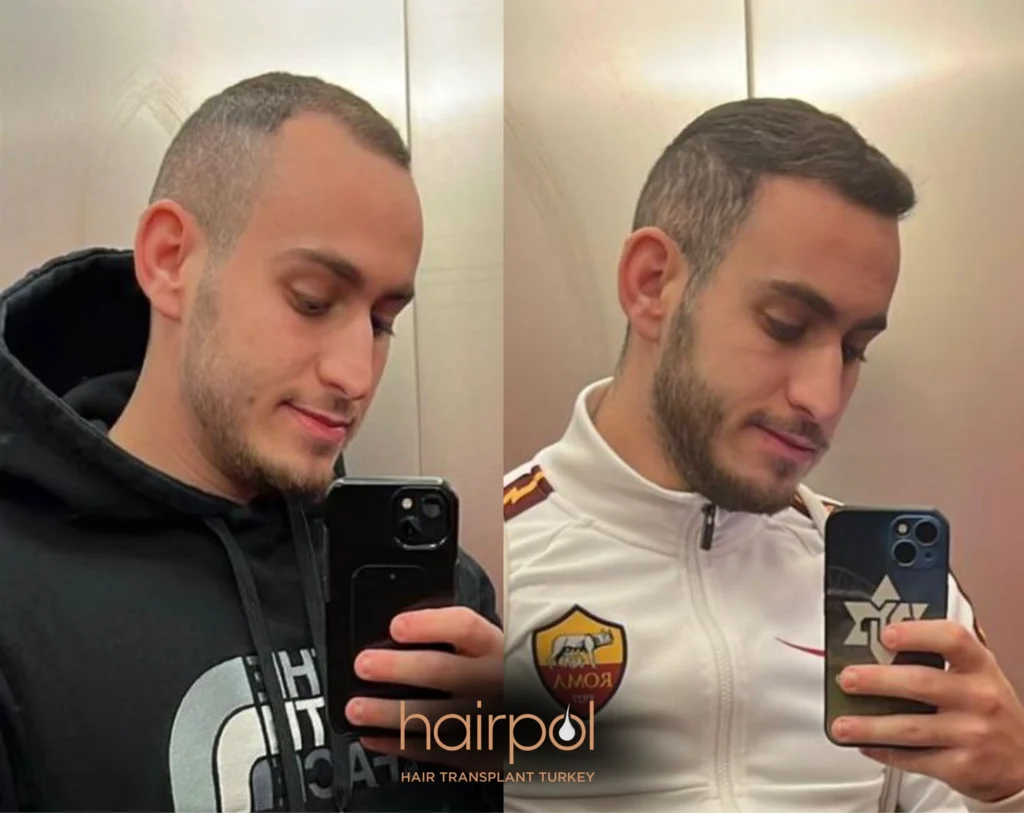
The photo shows one of our own patients and is shared with their permission. Results vary from person to person; the final look settles at 12-18 months.
What if the transplant does not take?
When the aftercare instructions are followed, most grafts anchor in place. Even so, some grafts may fail to take during healing; this is usually due to a knock in the first days, an infection or a general health condition. We explain the signs that suggest a transplant is failing and what to do in how to tell if your hair transplant is failing.
At Hairpol, the guarantee certificate guarantees that the transplanted hair grows in the transplant area and is valid for 18 months from the procedure. For the guarantee to apply, you need to share your photos and follow the aftercare instructions; see all the conditions here. Follow-up continues through our mobile app with monthly photos for 12 months, and you can message your 24/7 VIP patient manager whenever you have a question.
Planning and price
Hairpol performs Sapphire FUE, DHI and Manual Punch Long Hair FUE. The transplant may be carried out by the doctor or by the team under the doctor’s supervision. The price is set by the technique and the type of package, and you are never charged per graft. With cash payment, the all-inclusive package for patients travelling from abroad costs $2,500£1,900€2,250CA$3,500. Details are on our hair transplant cost page. To get to know our clinic’s physician, visit the Dr. Barış Duman page.
Frequently asked questions
How many days does it take for grafts to settle?
Grafts start to anchor from the first days, but they are not yet secure in the first week. They are usually considered settled around day 10. The most delicate period is the first 3-4 days, when you must not bend your head forward.
A hair came out with a scab. Have I lost the graft?
Usually not. If the scab came off on its own with washing and without bleeding, the follicle stays in place under the skin and only the hair shaft has fallen out. If there was bleeding or you picked the scab off by hand, send a photo to your clinic.
Can washing dislodge the grafts?
Not if you wash gently using the method you were shown. The first wash is done at the clinic on day 1-2; rubbing hard, scratching with your nails and picking scabs put grafts at risk in the first week.
When will I know for sure that the grafts have taken?
The hair that grows gives the definite answer. Shock loss may occur in weeks 3-8, new hair then comes through gradually and the final result settles at 12-18 months. During this time you can keep up your follow-up by sharing your photos monthly.
Free photo analysis
Send us your photos and we will share the right plan and price for you, free of charge.
Message us on WhatsApp or see which photos to send.
What the result looks like at month 3, and why that is normal, is covered in hair transplant 3 months after: signs of success.
Find this helpful? Add Hairpol as a preferred source on Google.
Graft Range Calculator
Answer three questions to see the typical graft range for your situation — based on our published clinical guides.
This is a preliminary estimate, not a medical assessment. The exact number can only be determined by a doctor after examining your donor area and hair characteristics.
Get a Free Consultation
Answer a few questions and the medical team will review your situation.
