
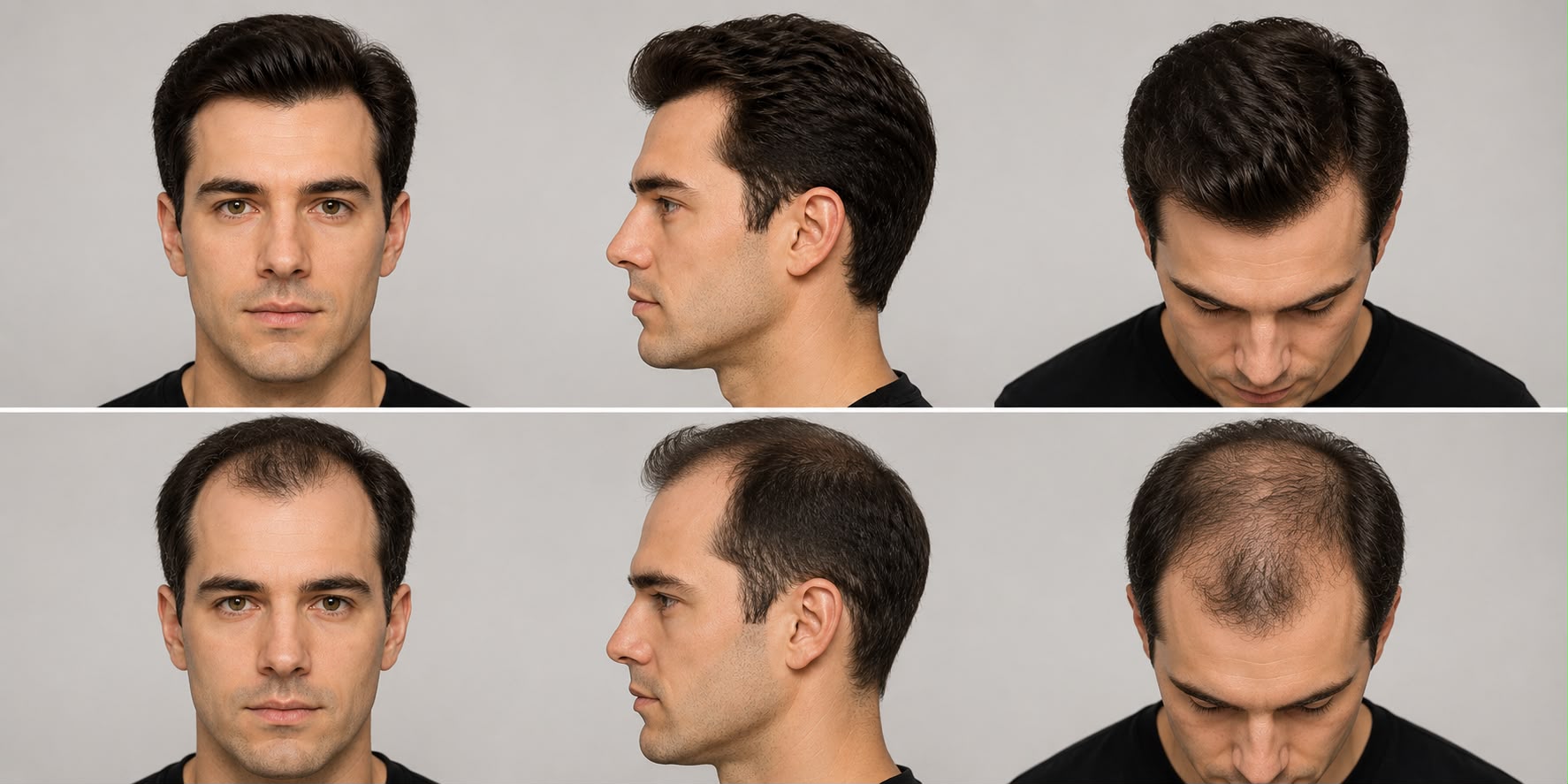
Most men who look up the Norwood scale at two in the morning are not really looking for a diagram. They are looking for permission to stop worrying.
You caught something in a bathroom mirror under bad overhead light — the corners of your hairline sitting further back than they do in a photograph from four years ago, a temple that suddenly seems to have a sharp edge to it. You found the seven-stage illustration, decided you were probably a 1, and then discovered you did not quite believe yourself. That doubt is why this article exists. Stage 1 is the only rung on the whole ladder where the honest clinical answer is frequently “nothing pathological is happening yet” — and where that answer is a finding, not a brush-off.
The short answer: Norwood 1 is the reference stage — a hairline with no significant recession, the baseline every later stage is measured against. Most men who think they have started losing hair are actually watching a mature hairline form: between roughly 17 and 30, the juvenile hairline normally moves back 1 to 1.5 cm fairly evenly, then stops. Norwood 2 starts when the temples recede in a triangular pattern beyond that, staying within about 2 cm in front of a line drawn between your ear canals. At Norwood 1, Hairpol does not recommend surgery. Photograph it for 12 months first.
If you want the full ladder — all seven stages, the A-variant, and what each one means for graft planning — we set that out in Norwood scale explained: how to read your hair loss pattern. This piece deliberately stays on the bottom rung, because that is where the most expensive mistakes get made in both directions: men who panic over a normal maturation and buy surgery they did not need, and men who dismiss a genuine early recession for three years because a forum told them everyone’s hairline moves.
What Norwood Stage 1 Actually Means
Norwood 1 is not a diagnosis of hair loss. It is the control group.
When Dr O’Tar Norwood published his revision of the Hamilton classification, he needed a starting frame — a head of hair that had not yet entered any recognisable pattern of androgenetic loss, so that the six stages after it had something to be compared against. That is Stage 1. The frontal hairline sits where it should for an adult male, the temples show no triangular indentation of any consequence, the crown is closed, and the density across the top of the scalp is even.
Which produces a strange situation. Thousands of men every month search for information about a stage that is, by definition, the absence of the thing they are afraid of. They are not searching because a doctor told them they are a Norwood 1. They are searching because they suspect they are about to stop being one.
At Hairpol, that suspicion is worth taking seriously — just not with a scalpel. A man who correctly identifies the first six months of a real recession has a genuinely different set of options from a man who arrives four years later at Norwood 3. What he needs is measurement, not surgery.
Where Norwood 1 Sits Among the Norwood Stages
The Norwood scale has seven main stages, and Norwood 1 is the only one that describes no pattern loss at all. Every stage after it adds recession at the temples, thinning at the crown, or both, until only a horseshoe of hair remains around the back and sides.
- Stage 1: no significant recession; the adult baseline.
- Stage 2: small triangular recession at the temples, within about 2 cm of the ear-canal line.
- Stage 3: deeper temple recession, usually the first stage regarded as clinical balding. A vertex variant adds early crown thinning.
- Stage 4: further frontal loss plus a thinning crown, still separated by a band of hair across the top.
- Stage 5: that band narrows and the front and crown zones move closer together.
- Stage 6: the band is gone and the front and crown join into one bald area.
- Stage 7: only a narrow horseshoe of hair remains at the back and sides.
There is also an A-variant, in which the hairline moves back across the whole front rather than forming two temple triangles. Men with that pattern are classified on a slightly different track from Stage 2 onward.
The reason this matters at Stage 1 is that the scale describes position, not speed. Being a Norwood 1 today says nothing about whether you will stay there, and the stage you eventually reach depends on genetics that a mirror cannot show you. The next rung is where most of the uncertainty lives, and we cover it in Norwood 2 hairline: do you need a transplant yet?
Mature Hairline vs Early Recession: The Distinction That Decides Everything
This is the section that matters more than the rest of the article combined, so read it slowly.
Nearly every man’s hairline moves backwards at some point between his late teens and his early thirties. This is not androgenetic alopecia. It is the normal transition from a juvenile hairline — the low, flat, rounded line of childhood — to a mature hairline, the slightly higher and gently arched adult version. It happens to men who will never lose a hair in their lives, and it happens to men who will be Norwood 5 by forty. On its own, it predicts nothing.
The differences that separate the two are consistent enough to work with. Maturation is even: the whole front edge lifts, with the temporal corners moving slightly more than the centre, producing a soft V or gentle arc rather than two sharp notches. Maturation is limited: it covers roughly 1 to 1.5 cm and then it stops, usually within two to four years of starting. Maturation keeps its density: the hairs behind the new line are the same thickness they always were.
Early androgenetic recession behaves differently on all three counts. It is uneven, favouring the temples aggressively while the central forelock stays put. It does not stop. And the hair immediately behind the receding edge gets thinner, finer and lighter over time — the border becomes wispy and see-through rather than crisply defined.
A hairline that has moved 1 cm and held that position for four years is almost certainly mature. A hairline that has moved 1 cm in eighteen months and is still moving is not.
What a Norwood 1 Hairline Looks Like Next to a Juvenile One
Part of the distress at this stage comes from a bad reference point. You are comparing your adult hairline against a photograph of yourself at sixteen, and no adult male hairline is supposed to look like that.
The juvenile hairline sits directly on top of the forehead with almost no gap. It runs flat across, its temporal corners rounded rather than angled, and it often carries fine downy hairs on its leading edge that make it look denser than it is. It is the hairline of a boy, and it belongs to a scalp that has not yet been exposed to years of circulating androgens.
The adult version sits higher and reads as more angular, which the brain interprets as loss even when the density is untouched. Look at photographs of men in their thirties whose hair everyone agrees is thick — actors, athletes, your own father at that age — and you will find temporal corners that would panic you if you saw them on yourself in a mirror. That is not reassurance dressed up as clinical language. It is the actual baseline for adult male hair.
How Do You Measure Your Own Hairline at Home?
You can get useful numbers with a mirror, a tape measure and four minutes.
Raise your eyebrows as high as they go. The topmost crease that forms across your forehead is your landmark — it is anatomically stable, unlike the hairline itself. Now measure from that highest crease straight up to where the hair starts at the centre of your forehead.
In most adult men with a matured but otherwise normal hairline, that gap falls somewhere around 1.5 to 2 cm — roughly one to two finger-widths. Anything sitting more or less on the crease is a juvenile line that has not matured yet. A central gap noticeably larger than two finger-widths, particularly with deeper measurements at the corners, has usually gone past maturation.
Then measure the corners. Take the same crease line out to each temple and measure the vertical distance to the hair. In maturation, the corner measurement exceeds the central one by a modest and roughly symmetrical margin. When one corner is materially deeper than the other, or when the corner measurement is running away from the centre by a centimetre or more, you are looking at a pattern rather than a transition.
Write both numbers down with the date. That single habit is worth more than any amount of forum reading, because six months from now you will have something objective to compare against instead of a memory.

Am I Norwood 1 or Norwood 2?
This is the question behind almost every search that lands here, and it has a more precise answer than most people expect.
The classification itself gives you a test. Norwood 2 is defined as triangular, usually symmetrical areas of recession at the frontotemporal hairline, where that recession does not extend more than about 2 cm in front of a coronal line drawn between the external ear canals. So: imagine a line running across the top of your head from one ear canal to the other. If your deepest point of recession is still comfortably forward of that line and there is no clear triangular notch, you are at or near Stage 1. If two distinct triangles have formed at the corners but stay within roughly 2 cm of it, that is Stage 2.
Two practical qualifiers. First, symmetry: maturation tends to be broadly symmetrical, while early pattern loss often runs a few months ahead on one side. Second, the quality of the edge. Put your face close to a mirror in daylight and look at the hairs forming the front line itself. In Stage 1 they are terminal hairs — full thickness, dark, sitting in a defined row. In early Stage 2 the front row starts to include shorter, finer, paler hairs that never reach full length. That thinning of individual hair calibre, not the position of the line, is the real signal.
What Actually Causes a Hairline to Change at Stage 1
Two entirely different mechanisms produce a hairline that has moved, and they call for opposite responses.
The first is androgenetic. Follicles in the frontal and temporal scalp carry a genetically inherited sensitivity to dihydrotestosterone. We explain that mechanism in what is DHT and why does it cause hair loss. Where that sensitivity exists, each growth cycle produces a slightly shorter, thinner, lighter hair than the one before, until the follicle produces only vellus hair or nothing at all. This is progressive, it is driven by an internal hormonal signal, and it does not resolve on its own. Maturation of the hairline can happen alongside it, which is exactly why the early months are so hard to read.
The second is everything else — and at Stage 1 it is more common than people assume. Iron deficiency, an under- or over-active thyroid, a crash diet, a recent illness with fever, a general anaesthetic three months ago, sustained sleep deprivation, and simple mechanical traction from a tight bun or a daily cap edge can all thin the frontal region temporarily. Telogen effluvium in particular tends to show up as diffuse shedding with a hairline that has not actually moved, which is why so many men at this stage describe hair “everywhere in the shower” while their photographs look unchanged.
The distinction is not academic. Non-androgenetic causes are frequently reversible once identified, which is one reason a blood panel is a reasonable first step at Stage 1 and a hair transplant is not.
The Signs You Are Moving From Norwood 1 to Norwood 2
Progression rarely announces itself. It gets noticed retrospectively, usually in a photograph someone else took.
The earliest reliable sign is the temporal notch — a small triangular indentation forming just above the outer end of each eyebrow, deepening while the central forelock holds its ground. Where maturation lifts the whole line together, this pulls the corners back independently, and the gap between corner and centre widens month by month.
The second sign is calibre change along the front edge. The line does not need to move for progression to be underway; the hairs holding that line get finer first. Under decent light you may notice the leading edge no longer blocks the scalp behind it, or that the front centimetre of hair looks paler and softer than the hair two centimetres back.
The third is shedding with a pattern. Everyone loses hair daily. What matters is whether what you find on the pillow includes short, fine, thin hairs alongside the full-length ones — miniaturised hairs shedding early is a different event from normal turnover.
The fourth is transparency at the temples in specific conditions: overhead light, wet hair, a photograph taken with flash from slightly above. If scalp shows through at the corners in those conditions and did not a year ago, the pattern is moving.
Photographing Your Hairline So the Comparison Means Something
Most men take hairline photographs that are useless within a month, because nothing about the conditions was controlled. Fix that once and you get a real dataset.
Use the same room and the same light each time — daylight from a window is more consistent than a bathroom fixture. Hair dry and pushed back off the forehead. Same distance, same head angle, eyebrows relaxed, no flash unless you use flash every single time. Take four frames: straight-on front, both temples in three-quarter profile, and one from above looking down at the crown. Date them.
Repeat every three to four months. Not weekly — the normal cycle produces enough variation to drive you slightly mad at that frequency, and no meaningful change occurs in six weeks anyway. Twelve months of quarterly photographs will tell you with reasonable confidence whether your hairline is stable or moving. Twenty-four months will tell you at what speed.
Patients who arrive at our clinic with a year of consistent photographs get a far better conversation than those who arrive with a story. The same standardised approach is what makes our before and after documentation comparable from case to case. The photographs answer questions that no examination on a single day can.
Why We Do Not Recommend a Hair Transplant at Norwood 1
We are a hair transplant clinic saying this, so it is worth being explicit about the reasoning rather than asking you to take it on trust.
Your donor area is finite. The safe zone at the back and sides holds a limited lifetime supply — commonly in the region of 4,000 to 7,000 grafts across all procedures for many patients, though it varies considerably with density, scalp laxity and hair calibre. Every graft spent is permanently gone from that budget. Spending part of it at Stage 1, on a pattern that has not declared where it is going, is the single most common way patients end up short of grafts in their forties when the loss they actually needed to cover finally arrives.
There is a second problem. Placing grafts into a dense native field carries a real risk of shock loss — the surrounding existing hairs shed in response to the trauma, and while most of that recovers, hairs already under androgenetic pressure sometimes do not come back. Surgery on a barely-changed hairline can therefore accelerate exactly what you were trying to prevent. That risk exists whichever placement method is used, including the implanter pens of DHI hair transplantation.
Third, aesthetics age. A hairline rebuilt at its juvenile position on a 24-year-old looks contrived on the same man at 45, when the rest of the pattern has moved and that low line sits marooned in front of thinning territory. Designing a hairline requires knowing where the loss is heading, and at Stage 1 nobody knows.
We have written about the wider version of this reasoning in who should delay a hair transplant and why, and it applies here in its strongest form.
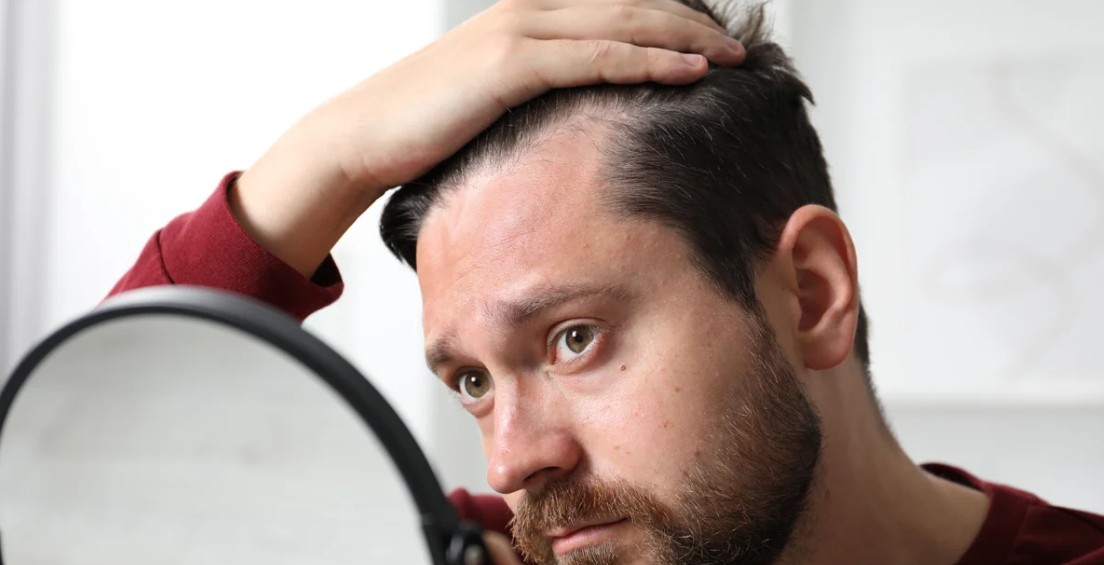
“I Still Want a Hair Transplant at Norwood 1” — The Honest Answer
Some readers will have got this far and remained entirely unmoved. That is fair, and you deserve a real answer rather than a polite deflection.
The honest answer is that a clinic willing to operate on a Norwood 1 hairline is telling you something about the clinic, not about your candidacy. There is nothing technically difficult about placing grafts into a hairline that has barely moved. The difficulty is entirely in the judgement — knowing that the operation you can perform today will make the operation you actually need in fifteen years harder, and saying so out loud while a paying patient sits in front of you.
There is a narrow set of genuine exceptions, and they are not androgenetic. A congenitally high hairline that has been there since childhood, a scar from an accident or previous surgery, traction damage at a defined and stabilised border, or a documented facial-harmony concern in a patient whose family history and trichoscopy both show no sign of pattern loss. Those are stable targets. A pattern that has not yet started is not.
What honest limits look like in general, across every stage, is something we set out in what a hair transplant cannot fix. Stage 1 is the earliest example of the same principle: surgery is very good at replacing hair that is gone, and very bad at guessing where hair is going.
When Should You Just Watch, and When Should You Book an Assessment?
Watching is appropriate when the picture is quiet: a hairline that has shifted a centimetre or so and then held still, symmetrical corners, no change in the thickness of the hairs along the front edge, no family history of early aggressive loss, and shedding that stays within normal daily range. Photograph it quarterly and get on with your life.
Book an assessment when any of the following is true. The line has kept moving over eighteen months. One side is clearly ahead of the other. The hair along the front edge is visibly finer than the hair behind it. You are shedding short, thin hairs rather than full-length ones. Your father or maternal grandfather was substantially bald before thirty-five. Or the shedding began suddenly and heavily, which points at a medical cause worth identifying quickly.
If you genuinely cannot tell whether your temples have moved, that is a solvable problem rather than a reason to keep guessing — trichoscopy measures hair calibre and density at fixed points in a single sitting, and a repeat at six months turns “I think it’s worse” into a number. Our team is happy to look at your baseline photographs and tell you honestly whether there is anything to act on; you can arrange an assessment here, and being told to do nothing for a year is a perfectly normal outcome of that appointment.
Protecting What You Have at Stage 1
If assessment does show early androgenetic change, the treatment conversation at Stage 1 is a medical one, and it should happen with a physician rather than a comment section.
Topical minoxidil and oral finasteride are the two agents with the longest track record in male pattern hair loss, and both are prescription-level decisions in practice, not lifestyle purchases. They work by different mechanisms, they take six to twelve months to show anything visible, results vary considerably between patients, and both require continuous use to hold whatever they achieve — stopping returns you to the trajectory you would have been on. Finasteride carries a side-effect profile that has to be discussed properly beforehand, including sexual side effects reported by a minority of users, and it is not appropriate for everyone. None of this is a reason to avoid the conversation. It is a reason to have it with a doctor who examines you first.
Around the medication question sits a set of supportive options — mesotherapy, PRP, low-level laser devices, correcting an iron or vitamin D deficiency, dropping the tight ponytail or the daily cap. These are adjuncts. They are worth doing where indicated and they will not, on their own, hold back an androgenetic pattern. Where they fit in a plan is something our hair treatments team maps out case by case, and at Stage 1 the honest version of that plan is usually short.
What a Scalp Assessment Actually Shows at Norwood 1
A good Stage 1 consultation is diagnostic rather than commercial, and it is reasonable to expect four things from it.
A magnified examination of the frontal and temporal scalp, comparing hair diameter in those zones against the occipital scalp at the back — because the back is not androgen-sensitive, it acts as your personal control. Meaningful variation in hair diameter within the frontal zone, when the back is uniform, is the earliest objective marker of pattern loss, and it appears well before anything is visible in a mirror.
A count of how many hairs are emerging per follicular unit, which drops as miniaturisation advances. A record of the hairline position measured against a fixed landmark rather than a subjective impression. And a conversation about family history on both sides, since inheritance patterns in male pattern loss are polygenic rather than the maternal-grandfather folklore most people are working from.
What you should not get is a graft quote. If a Stage 1 consultation ends with a number of grafts and a price before anything has been measured twice, you have been sold to rather than examined. The questions worth asking before any consultation are collected in our frequently asked questions.
If Your Hairline Has Not Moved in Two Years
Then it matured, and you are done. Adult hairlines are not supposed to look like teenage ones, and the corners you have been staring at are the corners you will keep.
If it has moved, you now have something far more valuable than reassurance: an early, documented, measured picture of a pattern in its first phase, which is precisely the situation where medical treatment has the most to preserve and where surgical planning — years from now, when the pattern has declared itself — will be built on real data instead of guesswork. The men who do best at forty are almost always the ones who started measuring at twenty-five and did nothing dramatic for a long time.
At Hairpol, our position on Stage 1 has not changed and is not a marketing posture: measure, treat medically if there is something to treat, and keep the donor area intact until the pattern earns the operation. When that point arrives, the plan will be better because you waited. If you want an honest read on where you actually sit — including being told that nothing needs doing — our surgical team assesses candidacy for hair transplantation with the same standard we would want applied to ourselves, and a no is a legitimate answer.
Find this helpful? Add Hairpol as a preferred source on Google.
Graft Range Calculator
Answer three questions to see the typical graft range for your situation — based on our published clinical guides.
This is a preliminary estimate, not a medical assessment. The exact number can only be determined by a doctor after examining your donor area and hair characteristics.
Get a Free Consultation
Answer a few questions and the medical team will review your situation.
