

Most of what you read about hair transplants in Turkey is written for men. The before-and-after photos show receding hairlines and bald crowns, the graft calculators assume a Norwood scale, and the packages are designed around a shaved head. If you are a woman with thinning hair, it is easy to come away thinking the whole industry was not built with you in mind.
That impression is partly right. Female hair loss is a different problem, and transplant surgery helps a narrower group of women than it does men. But for the women it does suit, the results can be excellent, and the procedure can usually be done without shaving the head. The hard part is working out honestly which group you are in before anyone books a flight.
Who it helps, in brief: a female hair transplant in Turkey suits women with a defined, stable area of loss and a strong donor zone, such as traction alopecia, temple loss, scars or patterned thinning that treatment has stabilised. Diffuse thinning, active shedding or an untreated medical cause usually call for treatment first. Most cases are unshaven or DHI, in one day. Hairpol prices them at typically $2,500–5,000; the exact figure follows a free hair analysis.
Why female hair loss is a different surgical question
In most men, pattern hair loss follows a predictable map. The front and crown thin, while the back and sides stay strong for life. That stable back-and-sides zone is what makes transplantation work: hair is moved from an area that will keep it to an area that has lost it.
Many women do not have that map. Female pattern hair loss usually shows as a widening part and general thinning over the top of the scalp, often with the front hairline intact. In some women, the hair at the back and sides thins too. When the donor zone itself is affected, moving hair from it is far less reliable, because transplanted hair keeps the behaviour of the place it came from.
This is why a responsible clinic spends more time on diagnosis with female patients than with male ones. It is not a sales hurdle. It is the step that decides whether surgery will help at all.
Who qualifies for a female hair transplant?
The women who do best with surgery tend to share two things: a clearly defined area to treat, and a donor zone that is dense and stable. Common examples include:
- Traction alopecia at the hairline or temples from years of tight braids, ponytails or extensions, once the pulling has stopped.
- Temple recession or an uneven hairline caused by hair loss, where the aim is to restore lost hair rather than to set the hairline lower than it has ever been.
- Scars from previous surgery, injury or a facelift, where hair no longer grows.
- Female pattern thinning that is stable on treatment and concentrated in a defined area, with a strong donor zone.
If you recognise yourself in that list, surgery may well be an option. If you are not sure, the answer usually starts with your part line and your donor area, and both show up clearly in photos: send a few to ask whether you are a surgical candidate, and you will hear whether surgery could help or whether treatment should come first.
Who is usually not a candidate yet, and why the cause comes first
Several situations make surgery a poor bet, at least for now. Diffuse thinning that affects the whole scalp, including the back and sides, leaves no stable donor hair to move. Active shedding, such as telogen effluvium after illness, childbirth, rapid weight loss or stress, needs time to settle, and much of that hair often returns on its own.
Hair loss driven by an untreated medical cause, such as thyroid disease, iron deficiency or a hormonal condition, needs that cause addressed first. Some forms of scarring or autoimmune hair loss can make transplanted hair fail if they are still active. None of these mean you can never have a transplant. They mean the order of steps matters.
Our article on hair transplants for diffuse thinning goes into this boundary in more detail, because it is where many women get mixed messages.
In women, hair loss is often the visible end of something else. Low ferritin, an underactive thyroid, low vitamin D, polycystic ovary syndrome, postpartum changes and certain medications can all thin the hair. Treating the cause can stabilise or partly reverse the loss, and a transplant done before that point may be undermined by continuing shedding around it.
That is why a sensible assessment for women often includes recent blood tests and a clear history: when the thinning started, whether it came on suddenly or gradually, what has changed in your health and medication. Bring that information to your consultation. It saves time and it changes the advice you get.
Traction alopecia and hairline work: often the clearest cases
Traction alopecia is one of the most common reasons women in their twenties and thirties consider a transplant, and it is often one of the most rewarding to treat. Years of tension from tight hairstyles damage the follicles along the hairline and temples, while the rest of the scalp, including the donor area, is usually healthy.
The key condition is that the traction has stopped. If the same styles continue, the new grafts will be pulled out just like the originals. Hair type matters too: tightly curled hair needs careful extraction because the follicle curves below the skin. Our article on hair transplants for women with traction alopecia sets out what is realistic in these cases.
Hairline and temple work follows similar logic, with a different design.
Some women have watched their temples recede or their hairline become uneven over time. Grafts can restore hair where it has been lost and soften the shape, keeping the curved, rounded outline typical of a female hairline rather than the sharper corners of a male one. A naturally high forehead is a different question: lowering it is surgical forehead reduction, which Hairpol does not perform, and a transplant here is planned only to restore hair that has actually been lost.
Female hairlines are designed differently. They tend to be rounder, with soft temple angles, fine single hairs at the edge and often a subtle widow’s peak. Getting that design right matters more than graft count. Our article on how female hair transplants differ from men’s explains the design differences in more detail.
Diffuse thinning and menopause: when surgery helps and when it does not
If your thinning is concentrated on the top of the scalp with a stable, dense donor area, a transplant can add density along the part line and crown. The aim is usually not to restore teenage thickness but to reduce how much scalp shows under light and along the part.
If the thinning extends into the back and sides, or if it is still progressing quickly, surgery is less predictable. In those cases, medical treatment and supportive therapies are usually the better first step, with surgery reconsidered once things are stable. An honest clinic will tell you which side of that line you are on.
Hormonal change around menopause adds its own layer to this question.
Hair often changes around menopause: it thins, loses volume and grows more slowly. Some women find that the loss stabilises after a period of change; others see it continue. A transplant can help when the loss has settled and the donor area is strong, but it does not stop hormonal thinning in the surrounding hair.
Our article on menopause and female hair loss covers this question in depth, including when treatment alone is the more sensible option.
The donor area, and how a female hair transplant is done
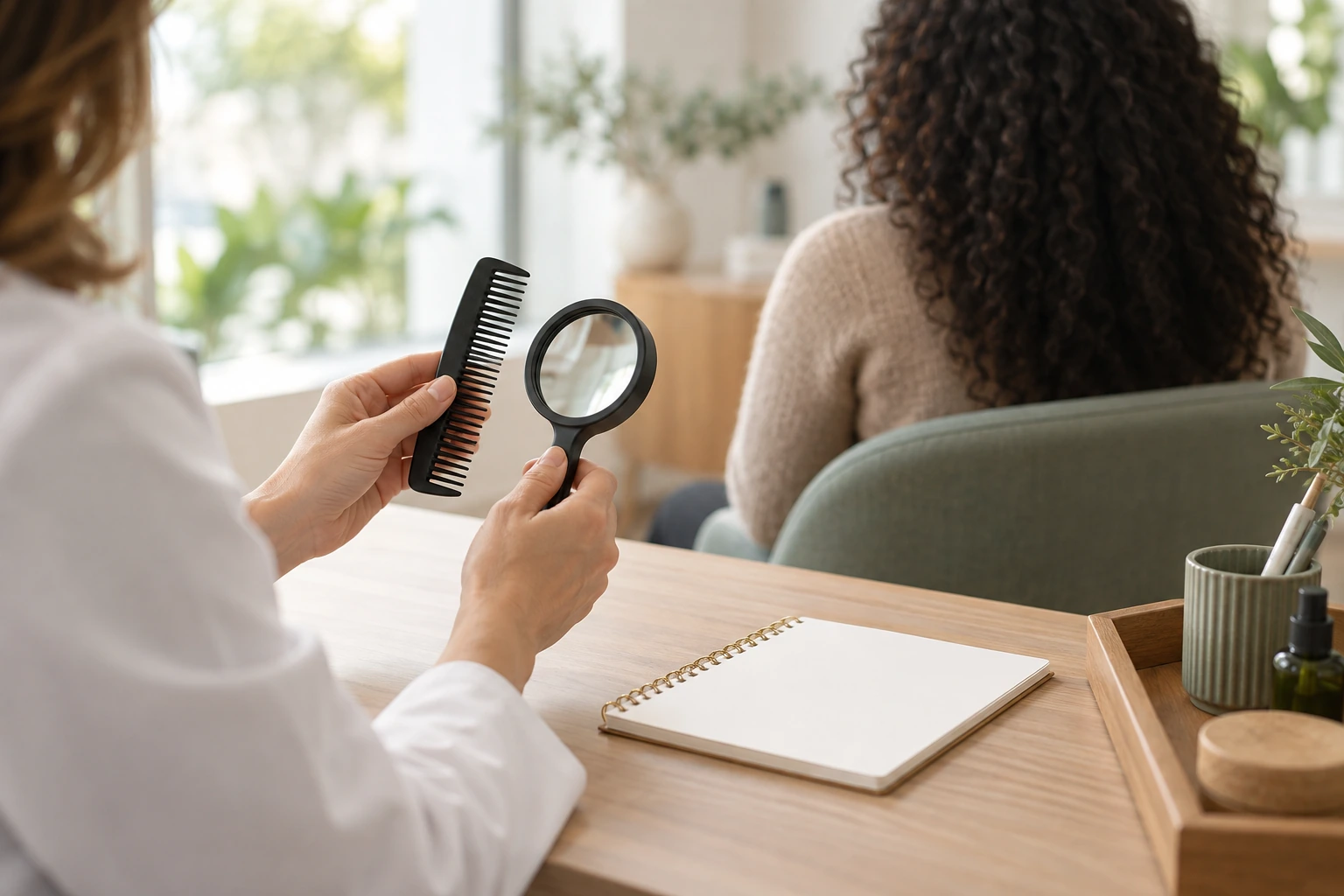
For women, the donor area assessment is often the single most important part of the consultation. Under magnification, the team looks at hair density, the thickness of individual hairs and whether there is any miniaturisation, which is the gradual thinning of hair shafts that signals the area is affected by pattern loss.
A donor zone with consistent, thick hairs and little miniaturisation is a good sign. A donor zone with many fine, miniaturised hairs is a warning that transplanted hair may thin over time. This is not something you can judge in the mirror, which is why photos are the start of an assessment rather than the end of it.
The day follows the same structure as any transplant: consultation and design, local anaesthesia, extraction, then placement. The main difference for most women is that the recipient area is not shaved. Grafts are placed between existing hairs, which calls for precise control over angle and depth.
That is why DHI hair transplantation is often chosen for female cases. The implanter pen places each graft directly at the chosen angle without opening a field of channels first, which works well in areas where native hair is still present. Session sizes are usually smaller than in men, often in the range of 1,000 to 2,500 grafts.
Without shaving, and how many grafts women usually need
In most cases, yes. The recipient area stays unshaven, and the donor area can often be prepared by shaving a narrow strip that is hidden when the hair above it falls down over it. With longer hair, most women can leave the clinic with the procedure barely visible from a normal distance.
Unshaven work is slower and limits how many grafts can be moved in a single day, so it suits the smaller, targeted sessions most women need. If you need a larger session, the team will talk you through the trade-offs between discretion and graft numbers.
As for numbers, female cases are usually smaller than male ones.
Rebuilding a traction-damaged hairline or temples often needs 800 to 1,800 grafts. Restoring temple points and an uneven hairline after hair loss usually sits in a similar range. Adding density along the part and top of the scalp varies widely with the area and the donor, and is often between 1,500 and 2,500.
These are general ranges. Your own graft estimate depends on the area, your hair type and, above all, what your donor zone can safely provide.
Travelling to Turkey, and recovery for women
Many women who travel to Istanbul for a transplant have the same practical worries: privacy, being looked after by a team that understands female hair loss, and coming home without obvious signs of surgery. Planning ahead covers most of these. Unshaven techniques, a scarf or loose hat for the flight and a few extra days before returning to work make a big difference.
Plan three to four days in the city: consultation, the procedure, the first wash and the flight home. Our page on getting a hair transplant in Turkey covers the trip itself, from arrival to the return flight.
Once you are home, recovery has a few details of its own.
Recovery follows the same timeline as in men, but some details feel different. Because the hair is unshaven, scabs are hidden more easily, and many women can wear their hair down over the treated area within a few days. Gentle washing starts on day two or three, and the scabs fall away between days seven and twelve.
Hair colouring and chemical treatments should wait several weeks, usually until the scalp has fully healed. Tight hairstyles, extensions and heavy clips near the grafts should be avoided for longer. Some temporary shedding of native hair around the treated area, called shock loss, can happen in women and usually recovers within a few months.
Women’s hair transplant before and after: what each stage really shows
Transplanted hairs usually shed between weeks two and eight. New growth starts around month three or four and improves through months six to nine. The final result shows between twelve and eighteen months.
For women, realistic expectations matter especially. The goal is a fuller, better-framed result that reduces visible scalp, not a complete return to the hair you had at eighteen. Our before and after gallery shows what results look like at twelve months rather than at the dramatic early stage.
Women’s before-and-after photos are rarer than men’s and harder to read. Most female procedures are unshaven, so both halves of the comparison include long hair that can be styled, parted or blow-dried into a very different picture. A fair comparison keeps the part in the same place, the hair dry and unstyled, the light from the same direction and the time point at twelve months or later.
What a good result shows also depends on the type of case. Traction and hairline cases usually give the clearest before and after, because a defined edge is rebuilt with fine single hairs while the rest of the scalp is healthy. Part-line density for stable patterned thinning gives a more subtle change: a narrower-looking part and less scalp under overhead light, rather than a transformation.
The months in between are the hardest. Between weeks two and eight most transplanted hairs shed, and in women some native hair around the area often sheds too, so for a few weeks the area can look thinner than before. That temporary loss usually recovers within three to four months; our article on what causes shock loss and how long it lasts explains why. Taking your own photos every month, in the same window light, gives you an honest record to compare against when month four feels discouraging.
Medical treatment alongside surgery, and the questions to ask
For many women, surgery is one part of a longer plan. Treatment to stabilise loss can protect the native hair around the grafts and improve the overall result. Options include medication, which must always be prescribed and monitored by a physician, and other treatments your doctor may recommend.
Some women start treatment months before a transplant to see how much stabilisation they can achieve first; others continue it afterwards to protect the result.
Because female cases depend so heavily on diagnosis, the questions you ask at consultation matter even more than they do for men. Before you commit, it is worth getting clear answers to these:
- Has my donor area been checked under magnification for miniaturisation, and what did it show?
- What do you think is causing my thinning, and should anything be treated before surgery?
- Which areas would be treated, how many grafts would that need, and what density is realistic?
- Will the recipient area stay unshaven, and how much of the donor area needs shaving?
- How will the native hair around the grafts be protected, during surgery and afterwards?
A clinic that takes these questions seriously, and is willing to tell you that surgery is not the right answer yet, is usually a clinic that will plan your case carefully if it is. Be wary of any clinic that offers a large graft number to a woman with diffuse thinning without first discussing the cause.
It also helps to ask how follow-up works once you are home. Female results often benefit from a check at three, six and twelve months, sometimes with adjustments to medical treatment. Knowing who you will speak to, and how, makes the long wait for results far easier to manage.
How is a female hair transplant priced?
Female cases vary more than male ones in size, technique and the time needed for unshaven work, but at Hairpol they are priced within the same range as other scalp work: typically $2,500–5,000. Where your case lands in that range follows from the area, the graft count and the technique, and the exact figure is set after a free hair analysis.
When you compare clinics, compare what is included and how the plan was reached rather than the headline number alone: whether the donor area was properly assessed, whether the technique suits unshaven work, and how follow-up is handled once you are home.
The most useful thing to bring to a consultation
Bring the history, not just the photos: when the thinning started, what changed in your health around that time, recent blood results and any treatment you have tried. For women more than for men, that history decides whether surgery is the answer, a later step or not the right tool. A clinic that asks for it before quoting a graft number is taking your case seriously.
At Hairpol, female cases start with that conversation. The approach is set out under hair transplantation for women, and the procedure itself, from design to aftercare, under hair transplantation.
Find this helpful? Add Hairpol as a preferred source on Google.
Get a Free Consultation
Answer a few questions and the medical team will review your situation.
