

Turkey is the name everyone knows. But if you live in London, Berlin or Vienna and start reading forums, two other countries keep appearing in the same threads: Poland and Hungary. They are closer, they are inside the European Union, and some people simply prefer the idea of a two-hour flight to a four-hour one.
That preference is reasonable. So is the opposite one. What tends to go wrong is the comparison itself: a per-graft price from Warsaw set against a package price from Istanbul, or a Budapest quote that leaves out the hotel set against a Turkish quote that includes it. This guide puts the three side by side on the same terms.
The quick comparison: Poland and Hungary keep you inside the EU and close to home. Online price lists checked in early October 2026 put a hair transplant in Poland at roughly 10,000–20,000 zł and a hair transplant in Hungary at roughly 600,000–1,500,000 Ft, usually without hotel or transfers. Hairpol packages are typically $2,500–5,000, with the exact price after a free hair analysis. Compare totals and follow-up, not flags.
Why Poland and Hungary come up at all
Both countries built medical tourism long before hair transplants became mainstream. Hungary, and especially Budapest and the border town of Sopron, has drawn Austrian and German patients for dental work for decades. Poland developed a strong private clinic sector in Warsaw, Wrocław and Kraków, with prices that look modest next to London or Munich.
For patients in the UK, Germany or Austria, the appeal is easy to understand. Flights are short and cheap, sometimes you can drive or take a train, and the clinic is inside the EU legal framework. Many people also like that the trip feels less like an expedition.
Turkey’s case is different rather than better. Istanbul has many clinics focused on international patients, which means a wide range of techniques on offer and trips that are organised as packages. Whether that matters for you depends on the size and complexity of your case, which is the thread that runs through the rest of this comparison.
How much does a hair transplant cost in Poland?
Polish clinics usually quote in zloty, often per graft. Clinic price lists and patient portals we checked in early October 2026 mostly put a typical FUE procedure at around 10,000 to 20,000 zł, with per-graft rates varying widely between clinics and smaller hairline corrections listed lower. At the 2 October 2026 reference rates, 10,000–20,000 zł is roughly $2,600–5,100.
Two details matter when you read a Polish quote. First, a consultation fee is often charged separately, sometimes deducted later if you book. Second, the price normally covers the procedure only. Hotel, transfers and medication are your own arrangements, which is easy when you live a short flight away and adds up when you do not.
Exchange rates move, and clinic prices change, so treat these as the published range rather than a quote. The useful takeaway is the structure: per-graft pricing, separate extras, and a total that depends on how many grafts are finally placed.
How much does a hair transplant cost in Hungary?
Hungarian price guides and clinic price lists checked in early October 2026 put a hair transplant at roughly 600,000 to 1,500,000 forints, depending on graft count and method. Some clinics quote in hairs rather than grafts, and some in euros for international patients. At the 2 October 2026 reference rates, the range is roughly $1,800–4,600.
Those figures can look low next to Western Europe, and for the procedure line alone they can be competitive with Turkey. As in Poland, though, they usually describe the operation, not the stay. Budapest hotels, airport transfers, aftercare products and, if your plan is large, any extra day all sit outside the quote.
Ask, too, how the graft count is defined. Some clinics count grafts, others count hairs, and a quote for “4,000 hairs” is a much smaller procedure than “4,000 grafts”. That one word can make two offers look similar when they are not.
Some Hungarian clinics also advertise packages for a fixed number of grafts, which can make a small case look very attractive. Check what happens if your plan needs more grafts on the day, and how those extra grafts are priced.
Paying in zloty, forints, euros or dollars
Currency is a small detail that changes real totals. Polish clinics usually invoice in zloty, Hungarian clinics in forints or euros, and Turkish clinics serving international patients often quote in dollars, euros or pounds. If your bank adds a foreign transaction fee or uses a poor exchange rate, a few percent disappears before you have even landed.
Two habits help. First, convert every quote into the currency you earn in, on the same day and from the same source, so you compare like with like. Second, ask how and when payment is taken: some clinics take a deposit by bank transfer and the balance on the day, others want everything in advance. Card surcharges, cash requirements and the rules for a cancelled date belong in your comparison as much as the headline price.
At Hairpol, payment terms are communicated in writing together with your plan, so you can do the conversion once. Wherever you book, avoid paying anything before you have a written plan that states the graft range and what is included.
What does the Istanbul price include?
At Hairpol, a hair transplant is priced as a package, typically $2,500 to $5,000, with the exact figure set after a free hair analysis of your photos. The package approach means the procedure and the practical side of the stay are quoted together, so the number you compare is closer to your real total.
Our hair transplant cost guide shows the range and what is included, and our overview of hair transplants in Turkey explains how a typical stay is organised. If you want to understand why the price is lower than in much of Europe without that meaning lower standards, our article on why hair transplants cost less in Turkey walks through the economics.
The fairest comparison is total against total. If your Polish or Hungarian quote is lower on the procedure line, add hotel nights, transfers and medication before deciding. Sometimes it is still cheaper. Often the gap disappears.
The easiest way to make that comparison concrete is with your own numbers. Send your photos for a free hair analysis and set the graft range, the suggested technique and the price for that plan next to any quote from Warsaw or Budapest.
Hair transplant Poland vs Turkey: what actually differs
Beyond price, three things separate the two. The first is clinic experience. Both countries have experienced hair surgeons and newer teams; what matters is how many cases like yours a particular team has treated, and whether it can show you twelve-month results that resemble your starting point.
The second is how the plan is built. Many clinics in both countries offer several techniques, including sapphire FUE for larger areas and DHI for hairlines, and choose between them by zone. Neither technique is better in general; what matters is that the choice is explained for your hair.
The third is the trip. Poland is a short flight from the UK and Germany and a train ride from Berlin. Turkey is a longer flight, usually with a package that handles the hotel and transfers for you. If your case is small and you value proximity, Poland is a sensible option to price. If your case is larger, a packaged trip and a plan that covers several zones in one stay may weigh more.
Hair transplant Hungary vs Turkey: what actually differs
Hungary’s strongest argument is geography for Austrian and southern German patients. Sopron is about an hour from Vienna, and Budapest is under three hours by train. For a short procedure, you can travel the day before and be home the day after.
Turkey’s argument is the shape of the trip. Larger sessions, mixed techniques such as DHI hair transplantation for the front and FUE for the crown, and a stay organised as one package. For a Norwood 4 or 5 pattern, that can matter more than the length of the flight; ask any clinic, in either country, how often it treats cases like yours.
Pricing is the third difference. Hungarian quotes are often lower on the procedure itself, while Turkish packages include more of the trip. Put the two on the same footing before deciding which is cheaper, and you may find they are closer than they first appear.
One more practical point. Hungarian clinics that serve Austrian patients often work in German and offer dates that fit a long weekend, and for a small, stable case that convenience is real. If you are likely to want a crown session in a few years, though, ask each clinic how it would plan the long game, because the first procedure should leave room for the second.
Flights, travel time and how many days you need
From London, Warsaw and Budapest are both roughly two and a half hours by air, and Istanbul is closer to four. From Frankfurt or Munich, Istanbul is about three hours, while Budapest and Warsaw are under two. From Berlin, Warsaw is a short flight or a train of around five to six hours. These are approximate times and vary by route.
Days on the ground differ less than people think. For Poland or Hungary, plan two to three days: arrival, procedure, and a check the morning after. For Istanbul, plan three to four days, which is what most packages are built around: arrival, procedure day, first wash and check, then the flight home. Large sessions can need an extra day anywhere.
Count time off work, not just days away. Most people return to desk work within a week or so if they are comfortable with a visible healing scalp, and the first ten days follow the same rules wherever the procedure was done.
Recovery is the same wherever you go
Once the procedure is done, the country stops mattering much. The first ten days follow the same rules in Warsaw, Budapest and Istanbul: keep the grafts clean and dry as instructed, sleep with your head raised for a few nights, avoid pressure and knocks, follow the washing routine and leave the scabs alone. Swelling around the forehead often peaks between days two and four and settles within about a week.
Flying home is similar too. Most patients fly a day or two after surgery without trouble, wearing a loose hat if they like and keeping their aftercare kit in hand luggage. A short flight from Poland or Hungary is a little more comfortable; a three- or four-hour flight from Istanbul is still well within what clinics plan for.
Where clinics really differ is in how well they prepare you for this phase. Clear written instructions, a first wash done at the clinic so you learn the technique, and a direct contact for questions during the first week make more difference to your recovery than the length of the flight.
Follow-up when you are home
This is where proximity has real value. If you live near Vienna and had your procedure in Sopron, a check-in visit is an easy day trip. From London to Istanbul, a return visit is a real undertaking. That is why remote follow-up matters so much for any clinic abroad: scheduled photo reviews, a direct line for questions, and clear instructions about what to send and when.
Follow-up after a Hairpol procedure continues through the first year, with photos you send at set points and the medical team looking at your progress. Ask any clinic in any of the three countries how theirs works in practice: who answers, how quickly, and what happens if something looks wrong in week three.
The honest summary is that a nearby clinic makes in-person follow-up easier, while a well-organised clinic abroad makes it less necessary. Both are valid; just make sure you know which one you are choosing.
Check what happens outside office hours as well. Questions in the first week rarely arrive at a convenient time, and a clinic that answers on a Sunday evening saves a great deal of worry.
Regulation, language and recourse
Being inside the EU gives Poland and Hungary one clear advantage on paper: EU consumer protection and the cross-border healthcare framework, which requires every member state to run a national contact point with information on patients’ rights and providers. If you are an EU resident, that can be reassuring.
Turkey regulates health tourism separately. Clinics treating international patients are expected to hold Ministry of Health authorisation, and procedures should be performed under a licensed physician. In any of the three countries, ask to see the clinic’s licence, the name of the doctor responsible, and whether the doctor is present for the steps that matter. Our article on whether a hair transplant in Turkey is safe covers the questions to ask.
Language is practical rather than legal. Many clinics in all three countries work in English and German; fewer work in French. Make sure the consultation, the consent form and the aftercare instructions are in a language you read comfortably.
How to compare three quotes line by line
Put each offer on the same page and fill in the same lines. If a clinic cannot answer one, that is information too.
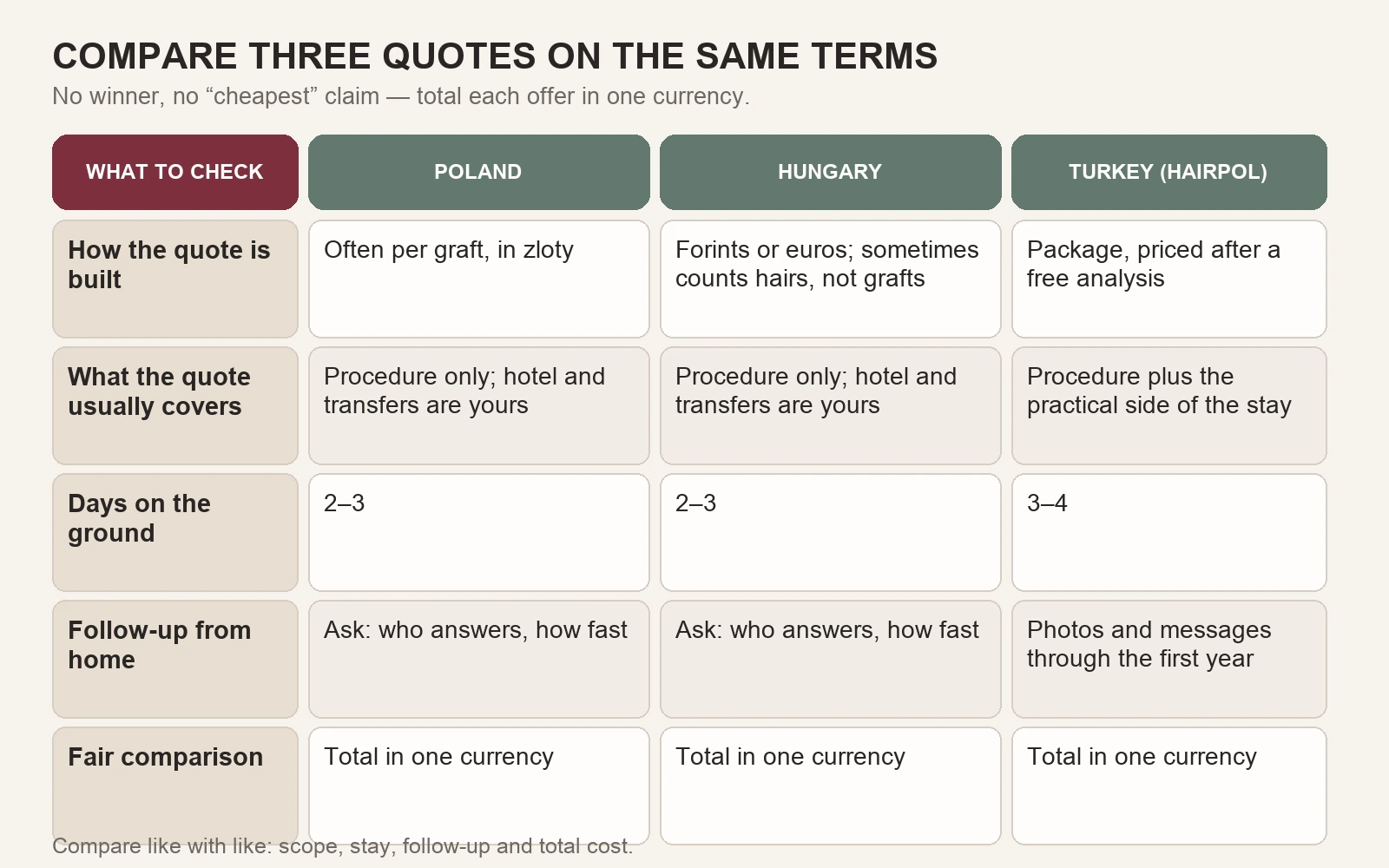
- Graft count, and whether the clinic counts grafts or hairs.
- Technique for each zone, and who performs extraction, channel opening and placement.
- What is included: hotel nights, transfers, medication, aftercare products, post-op wash.
- Follow-up: how long, how often, and how it works from your home country.
- The total in one currency, including flights and any extra nights.
- What happens if growth falls short, and on what terms.
Our broader article on Turkey vs Europe on quality and price looks at Western European clinics; this checklist is the part that applies to Poland and Hungary as well.
When you fill in the last line, notice how the answer is framed. A clinic that describes a review at twelve months, photos sent in advance and a decision made by the doctor is describing a process. A clinic that replies “don’t worry, we will fix it” is describing a mood, and moods are hard to rely on a year later.
Which kind of patient tends to choose which
Patterns are not rules, but some are common. A patient in Vienna with a small, stable recession who wants 1,000 grafts at the temples often finds Hungary practical: short trip, simple case. A patient in Berlin who prefers to travel by train and has a modest crown may price Poland seriously.
A patient in London or Manchester with a Norwood 4 or 5 pattern, who wants the front and crown planned together and the trip organised for them, usually finds Istanbul a better fit. So does a patient with afro or very curly hair who needs a team that sees that hair type often. And a patient whose priority is a single, all-in price tends to prefer a package over a per-graft quote plus extras.
Not sure where you sit? Open WhatsApp from this page, describe your pattern and where you would travel from, and ask for an honest view of whether travelling makes sense for a case your size.
Choose the clinic first, then the country
Countries do not perform surgery; teams do. There are careful clinics and rushed ones in Poland, Hungary and Turkey alike. Start with the plan, the doctor’s involvement, the technique and the follow-up. Then check the total. The country usually falls into place after that.
A short test helps. Ask each clinic who will draw your hairline, who will open the channels, who will place the grafts, and whether the same doctor will review your photos at month six. The clinics that answer those four questions quickly and in writing are usually the ones worth shortlisting, whichever country they are in.
If you want to see how we work before you compare, our about us page introduces the team and the clinic in Ataşehir. The way a plan is built, from photos to procedure day, is set out under hair transplantation; a free analysis gives you a figure to set beside every other quote on your list.
Find this helpful? Add Hairpol as a preferred source on Google.
Get a Free Consultation
Answer a few questions and the medical team will review your situation.
