
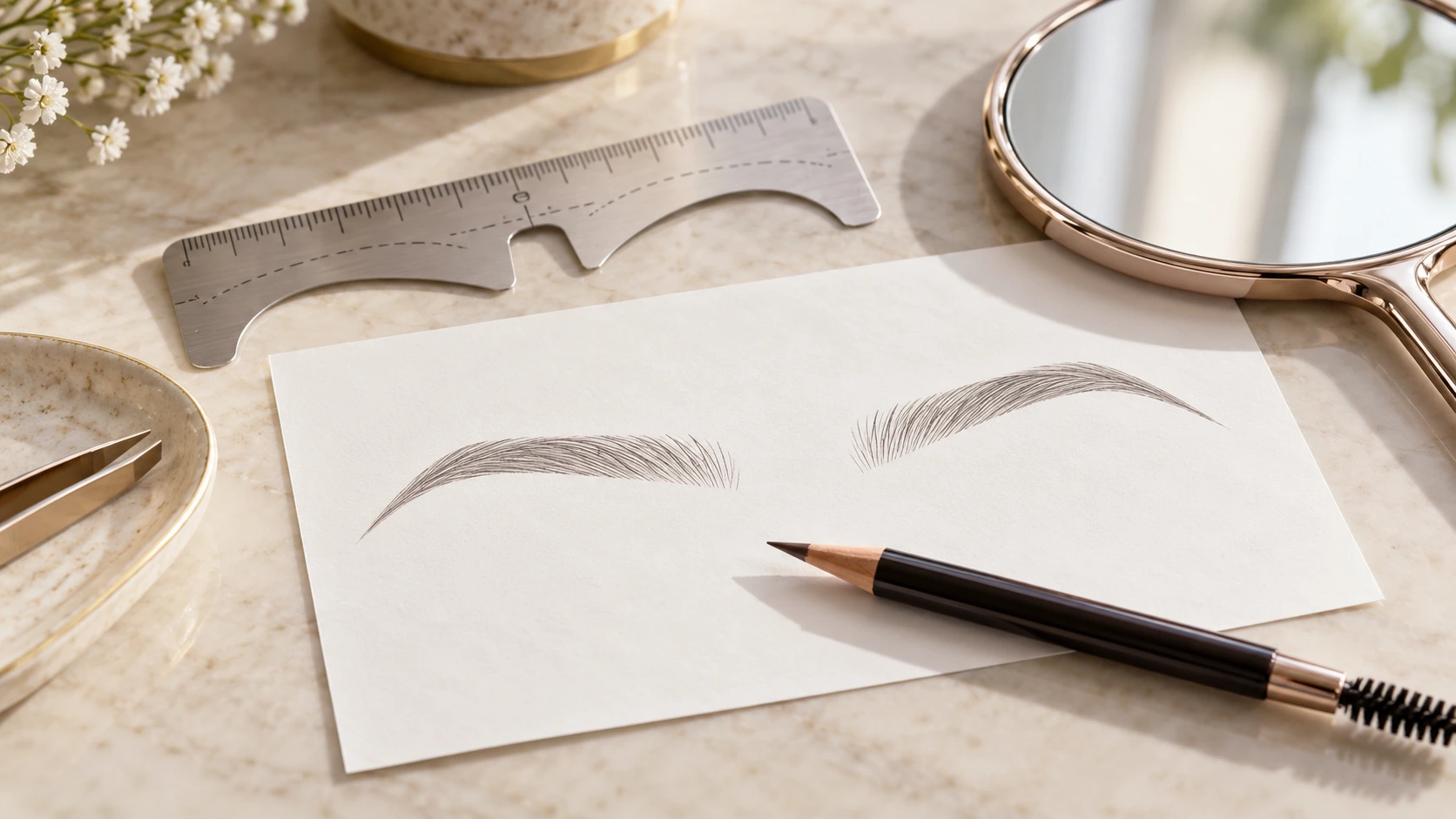
Most people researching eyebrows start with a number and work backwards. They type the price question into Google, get back a spread so wide it is useless — a few hundred dollars in one place, five figures in another — and come away suspecting that nobody wants to give a straight answer.
So here is ours, stated plainly before the explanation. At Hairpol, an eyebrow transplant is a flat package. It does not slide with graft count, it does not get renegotiated on the day, and the figure quoted in your first message is the figure on the invoice.
The short answer: the eyebrow transplant cost at Hairpol is a fixed $2,500 package, covering both brows, typically 200 to 600 grafts depending on the design. The price includes the consultation and design, the procedure itself under local anaesthesia, medication, aftercare products and follow-up. It is a flat figure rather than a per-graft rate, which means a denser design does not quietly become a more expensive one halfway through the appointment.
What the $2,500 eyebrow package actually includes
A package is only useful if you know its edges. Ours covers the pre-operative consultation and the brow design session, the local anaesthesia, the extraction of grafts from the donor area at the back of the scalp, the placement itself, the post-operative medication, the aftercare kit, and the follow-up checks over the first year.
It also includes the thing patients rarely think to ask about: the design time. Eyebrows are not a volume procedure. A scalp case might involve four thousand grafts placed over eight hours; a brow case might involve four hundred placed with far more deliberation per graft, because every single one has a direction, an angle and a depth that has to match the natural sweep of the hair around it. That planning time is in the price, not billed on top of it.
What we are describing here is the same structure used across our eyebrow transplantation work. The package exists because brow cases cluster tightly around a predictable amount of work. Scalp cases do not, which is why those are priced across a band instead.
How many grafts does an eyebrow transplant need?
The honest range is 200 to 600 grafts for both brows together, and where you land inside it is decided by how much native brow you still have.
Someone with thin but continuous brows who wants more definition at the tail typically needs 150 to 250 grafts per side. Someone rebuilding after years of over-plucking, or after a burn or scar, can need 250 to 350 per side. Full reconstruction where there is essentially no brow left sits at the top of the range and occasionally goes slightly beyond it.
Here is the part that surprises people: more is not better. An eyebrow that receives too many grafts looks like a hedge, not a brow. The natural brow has a density gradient — sparser at the head, denser through the body, tapering at the tail — and a surgeon who places grafts uniformly across that whole span produces something that reads as artificial from three metres away. Restraint is a design decision, not a cost-saving one.
Why eyebrows are priced as a package, not per graft
Per-graft pricing exists for a reason in scalp surgery: the work genuinely scales with the number. Two thousand grafts and five thousand grafts are different days, different teams and different consumable costs.
Brows do not scale that way. The difference between 300 and 500 grafts in a brow case is perhaps forty minutes of placement. What does not change is the design consultation, the extraction session, the anaesthesia, the theatre time, the aftercare and the follow-up year. When the fixed costs dominate, per-graft pricing stops being a fair model and starts being a mechanism for quoting low and invoicing high.
That is the real argument for a flat figure, and it is a patient-protection argument rather than a marketing one. If your quote is per graft, the clinic has a financial interest in placing more grafts than your brow design needs. If your quote is flat, it does not. Read a per-graft brow quote with that in mind.
What the price does not include
Three things sit outside the $2,500, and we would rather you knew now than found out later.
Flights are yours. Accommodation is not bundled into the brow package the way it often is with a full scalp package, because most brow patients are in and out inside forty-eight hours and prefer to choose their own hotel. Any treatment that is not part of the brow plan — an injectable course, for instance, or scalp work booked at the same time — is quoted separately.
What is not an extra: the second follow-up, the aftercare products, or the consultation if you decide against going ahead. We do not charge for advice. If the assessment concludes that your brows would be better served by waiting six months and treating an underlying cause first, you will be told that, and it will cost you nothing.
Who is a candidate, and who should wait
Good candidates usually fall into four groups: people whose brows never grew in densely, people who over-plucked through their teens and twenties and never recovered the tail, people with scar tissue from an injury or a previous cosmetic procedure, and people with stable loss from a condition that has been properly diagnosed and treated.
That last clause matters. If your brows are thinning right now and nobody has established why, transplanting into an active process is the wrong sequence. Thyroid dysfunction, iron deficiency, alopecia areata and a handful of dermatological conditions all thin brows, and all of them need to be settled before surgery makes sense. We wrote about the causes in detail in our piece on why eyebrows thin and when a transplant helps, and it is worth reading before you book anything.
The other group who should wait: anyone whose expectation is a brow that never needs attention. Transplanted brow hairs come from the scalp, and scalp hair keeps the growth cycle it was born with. They will need trimming. That is not a flaw in the technique, it is the technique.
How the shape is designed before anything is opened
Design happens before anaesthesia, with you sitting up, looking straight ahead, in natural light. That last detail is not an aesthetic flourish — brow asymmetry is invisible in overhead clinic lighting and obvious in daylight, and almost every human face has some.
Three reference points are marked: the head of the brow, aligned to the inner corner of the eye; the peak, set by the natural arch of the orbital bone rather than by a template; and the tail, which sets how lifted or how flat the whole brow reads. These are drawn, photographed, adjusted and then drawn again with you holding a mirror. Nobody proceeds until you have agreed the shape in daylight.
The clinical side of that session — angles, direction, why brow grafts are placed almost flat against the skin — is covered in our article on how natural brow shapes are designed. The short version is that direction matters more than density here. A perfectly dense brow with grafts pointing the wrong way looks wrong and cannot be fixed with a comb.
What procedure day looks like
You arrive in the morning, the design is finalised, and the donor area at the back of the scalp is prepared. A small patch is trimmed — small enough that hair above it covers it completely when you walk out — and grafts are extracted one at a time.
Placement takes the bulk of the day, and it is deliberate work. Grafts are single hairs, almost never doubles, and each is set at a shallow angle so the hair lies along the skin rather than standing away from it. The whole appointment runs roughly four to six hours, including breaks. You are awake, under local anaesthesia, and most people spend the middle of it on their phone.
The technique used for placement is closely related to the DHI implanter method used on the frontal hairline, for the same reason: it gives fine control over angle and depth in an area where both are unforgiving.
The first fourteen days
You leave with tiny crusts along both brows and some redness. Swelling, if it happens, is mild and usually shows up on day two or three around the upper eyelid, then settles.
Washing starts gently on day three, exactly as instructed, and the crusts clear between days seven and ten. By around day fourteen most people are socially comfortable — not because the brows look finished, but because the evidence of surgery has gone. Sunglasses cover a great deal in the meantime.
Then the transplanted hairs shed, usually between weeks two and six. Every single patient finds this alarming and every single patient has been warned it is coming. The follicle stays; the shaft falls. Regrowth begins around month three, and the brow you are going to keep arrives somewhere between months six and nine.
The first trim and living with them long term
The first trim is a small ceremony in our aftercare. It happens once the new hairs are long enough to sit out of line, usually around month four or five, and it is the moment the brow starts reading as a brow rather than as a project.
After that, expect to trim every two to four weeks. The hairs do soften over the first two years — scalp hair transplanted into the brow gradually adapts in calibre and growth rate, though it never becomes identical to native brow hair. Our full guide to eyebrow aftercare, trimming and direction covers the routine in detail.
If regular trimming genuinely does not fit your life, say so at consultation. It is a reasonable reason to choose a lighter design or to choose something other than surgery, and it is far better raised before the design is drawn than discovered at month five.
Why eyebrow prices vary so much between countries
A brow procedure in western Europe or North America commonly lands between four and eight thousand dollars. The same work in Istanbul commonly lands between two and three. That gap invites suspicion, and the suspicion is healthy, so it deserves an answer that is not “we are cheaper”.
The cost difference is structural. Clinic overheads, salaries, insurance and facility costs are lower in Turkey; volume is high enough that surgical teams are genuinely experienced rather than occasionally practised; and medical tourism competition keeps the pricing tight. None of those factors involve cutting a clinical corner.
The factors that should worry you are different ones, and you can usually spot them in the quote: a price so far below the local market that something has to be missing, no named surgeon, no written graft range, and no stated follow-up. Our wider breakdown of what hair transplant pricing actually covers applies to brows as much as to scalps.
What a cheap eyebrow quote usually leaves out
Four omissions come up again and again when patients forward us a competing quote for a second opinion.
The first is who performs the placement. In brow work this is the entire procedure; if the quote does not name a role, ask. The second is graft range in writing — a quote with no number is not a plan. The third is follow-up: some packages end when you leave the building, which means month four, when the first trim question arrives, is your problem. The fourth is a revision policy. Brows occasionally need a small top-up at month twelve, and a clinic that has thought about that will tell you its position before you pay.
None of this means an inexpensive quote is a bad one. It means a quote that will not answer four direct questions in writing is a bad one, at any price.
Booking a brow case with a scalp case
A fair number of patients come to Istanbul for scalp work and add brows, or the other way around. When both are done in the same visit, the donor area is planned once and the two procedures are sequenced across the same trip.
The pricing does not merge — brows remain the flat $2,500 package and scalp work is quoted within our $2,500 to $5,000 band, driven by graft count and technique — but the logistics simplify considerably. If facial hair generally is what you are planning, the same visit can also cover beard transplantation, which sits at the same flat $2,500 figure.
If you are travelling for a combined case, the practical side of the trip is laid out in our Turkey package page, including what a typical three or four day schedule looks like.
One brow, scars and the cases that do not fit the template
Not every brow case is symmetrical, and the package has to survive that. A patient who lost one brow to a burn, a dog bite or a surgical scar is not paying half because only one side is being rebuilt. The design work is arguably harder in a single-brow case, because the finished side has to match a living reference sitting four centimetres away rather than a drawing.
Scar tissue changes two things. Blood supply through scarred skin is poorer, which means graft survival is lower and placement has to be less dense than it would be in healthy skin. And pigment behaves differently, so the surrounding skin tone can read the new hairs as darker or lighter than expected in the first months. We plan those cases conservatively, and we frequently stage them: a first pass, then a top-up at month twelve once we can see what took.
Two other situations sit outside the standard template. Brows thinned by trichotillomania are not transplanted until the pulling has been stable for at least a year, because grafts pull out exactly like native hair does. And brows affected by active alopecia areata are not transplanted at all while the condition is flaring — an immune process that attacked native follicles will attack transplanted ones.
None of these cases changes the $2,500 figure. They change the plan, the staging and sometimes the answer, and they are precisely why the assessment comes before the quote rather than after it.
What to send before you get a firm number
You can get a definitive answer without a flight. Send four photographs taken in daylight with no makeup and no brow product: straight on, both three-quarter angles, and one close frame of each brow. Add a short note about what you want changed — usually “fuller at the tail”, “more defined head”, or “rebuild after plucking”.
Tell us about any brow tattooing, microblading or previous procedure, because scarred or pigmented skin changes the plan, and about any condition that caused the loss. That is genuinely the whole intake. If you are ready to start, you can send those photographs here and get a design opinion back rather than a sales message.
If you want to calibrate your expectations before you write anything, spend ten minutes with our before and after gallery and look specifically at brow cases at month six rather than month two. And if the assessment ends up pointing toward scalp work instead, that conversation starts on our hair transplantation page. Either way, you should know the number before you know anything else — which is where this started.
Frequently Asked Questions (FAQ)
How much does an eyebrow transplant cost in Turkey?
At Hairpol the eyebrow transplant is a flat $2,500 package covering both brows. It includes the consultation and design, the procedure under local anaesthesia, medication, aftercare products and follow-up. The figure does not change with graft count.
How many grafts does an eyebrow transplant need?
Typically 200 to 600 grafts for both brows together. Adding definition to thin but continuous brows sits around 150 to 250 per side; a full rebuild after years of plucking or after scarring sits at the top of the range.
Is eyebrow transplant priced per graft?
Not at Hairpol. Brow cases cluster around a predictable amount of work, so fixed costs dominate and a flat package is the fairer model. Per-graft pricing in brow surgery gives a clinic a financial reason to place more grafts than the design needs.
What is not included in the eyebrow package?
Flights and accommodation are not included, and any treatment outside the brow plan is quoted separately. Follow-up visits, aftercare products and the consultation itself are included, including when the consultation concludes that you should wait.
Do transplanted eyebrows need trimming?
Yes. The grafts come from the scalp and keep a scalp growth cycle, so expect to trim every two to four weeks. The first trim is usually around month four or five. The hairs soften over the first two years but never become identical to native brow hair.
When do transplanted eyebrows look finished?
The transplanted hairs shed between weeks two and six, regrowth begins around month three, and the final result settles between months six and nine. Judging the outcome before month six is judging an unfinished process.
Can I have an eyebrow transplant if I have had microblading?
Often yes, but tell the clinic in advance. Pigmented or scarred skin changes graft placement and sometimes the design, and it should be assessed before a plan is drawn rather than discovered on the day.
Can eyebrows and a beard transplant be done on the same trip?
Yes. Both are flat $2,500 packages at Hairpol and the donor area is planned once for the visit. Scalp work is quoted separately within the $2,500 to $5,000 band, driven by graft count and technique.
Find this helpful? Add Hairpol as a preferred source on Google.
Get a Free Consultation
Answer a few questions and the medical team will review your situation.
