

Somewhere between the first message to a clinic and the morning of surgery, most people lose track of where they are. They have a quote but no date, a date but no flights, flights but no idea what happens when they land. The decision itself was made months ago. What makes the weeks before surgery stressful is not the decision; it is not knowing which step comes next.
Booking a hair transplant in Turkey is a short chain of steps, and each one has a clear purpose. Once you can see the whole chain, you can check each link properly and stop worrying about the rest.
In five steps: to book a hair transplant in Turkey, you send photos for a free analysis, receive a written plan with graft range, technique and price, ask your questions, confirm a date, then book flights and arrive the day before surgery. Most patients take two to eight weeks from first message to procedure. Hairpol packages are typically $2,500–5,000, with the exact price after the analysis; payment terms are communicated in writing together with the plan.
The whole path on one page
It helps to see the timeline before you start. Week one: photos and a first written plan. Week one to three: questions, perhaps a video call, and a decision. Then the booking itself: a date, written terms and confirmation. After that, flights and preparation, which can take anything from a fortnight to a few months depending on your calendar. Finally, the trip: arrival, an in-person consultation on the morning of surgery, the procedure, the first check, and home.
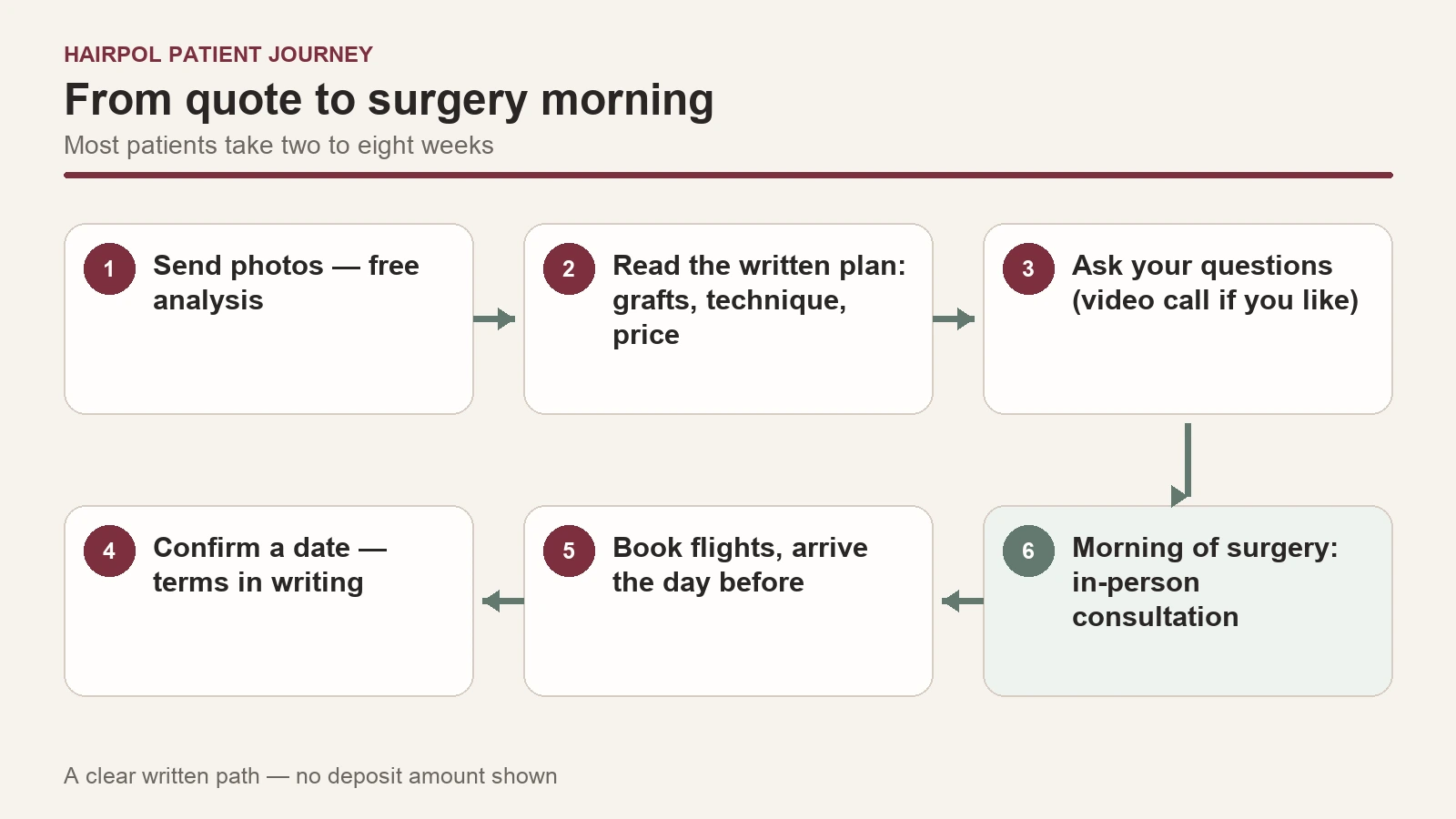
Nothing in that list needs to be rushed. A patient who sends photos in March and travels in June is not behind; a patient who is pushed to pay a deposit the same afternoon is not ahead. The right pace is the one that lets you check each step properly.
If you are comparing clinics, run them through the same steps side by side. It is the easiest way to see which ones answer quickly, in writing and with detail, and which ones go quiet when the questions get specific.
The sections below follow the same order. If you are already partway through, skip to the step you are on.
Step 1: how do you get a quote for a hair transplant in Turkey?
Almost every clinic starts with photos. You send clear pictures of your front, top, crown, both sides and the back of your head, taken in daylight with dry hair, along with your age and a short medical history. From those, the medical team estimates your pattern, your donor capacity and the number of grafts a realistic plan would need.
At Hairpol, this first step is a free hair analysis. The reply includes a graft range, the technique the team would suggest for each zone and the price for that plan. It is an assessment based on photos, so the final plan is confirmed in person on the day, but it is specific enough to compare with other offers and to plan a budget around.
A good first reply also tells you what it cannot yet know. Photos rarely show donor density precisely, so an honest plan gives a range rather than a single figure and says which details will be confirmed in person.
If you are ready to start, send your photos for a free analysis. There is no commitment in asking, and the answer gives you something concrete to think about instead of a forum average.
Step 2: reading the plan and what it should contain
A useful quote is more than a number. It should state the graft range and the zones it covers, the technique for each zone, and who performs each step: extraction, channel opening and placement. It should list what is included, such as hotel nights, transfers, medication and the first wash, and what is not.
Technique should be explained rather than sold. For a soft, dense hairline, DHI hair transplantation is often used; for covering larger areas, sapphire FUE is common. Many plans combine both. If a quote names a technique without saying why it suits your hair, ask.
Check, too, that the quote is in your name and dated, and that it says how long the price is valid. A plan that can be traced back to a specific assessment is far more useful than a figure sent in a chat.
Compare the quote with what is included in the package. Our Turkey hair transplant package page sets out what Hairpol’s package covers; check medication, aftercare products and extra nights too, because they are the items people most often forget.
Step 3: the questions to ask before you say yes
Once you have a written plan, the next step is a conversation. Ask who will design your hairline and whether a doctor will be present for the critical steps. Ask how many grafts are planned now and how many will be left in reserve for the future. Ask what results look like for patients with hair like yours, at twelve months rather than at three. Our before and after gallery shows real outcomes by graft count, which makes that conversation easier.
Ask practical questions too: how many days you should plan, where you will stay, how transfers work, what you need to stop taking before surgery, and how follow-up works once you are home. A video call often settles in twenty minutes what would take days of messages.
Our list of key questions to ask before you commit covers the full set. If any answer is vague, ask again. A clinic that wants you as a patient will not mind.
What a video consultation should cover
Many patients like to speak to someone before committing, and a video consultation is the easiest way to do it from home. It works best when you treat it as a working session rather than a sales call. Have your photos open, sit in good light, and be ready to turn your head so the team can see your crown and donor area on camera.
The call should cover four things: your goals in your own words, the proposed hairline and how it would age, the graft range and what it covers, and the practical side of the trip. Ask who you are speaking to and what their role is. If a doctor is not on the call, ask when you will speak to one and whether the doctor has reviewed your photos.
Afterwards, ask for a short written summary of what was agreed. A call is easy to misremember a fortnight later; a summary is not. If something you heard on the call does not appear in writing, raise it before you book.
Step 4: confirming a date — do you need to pay a deposit?
Many clinics ask for a deposit to reserve a surgery date. It is a normal part of booking, because the clinic is setting aside a full day of a surgical team’s time for you. The amount, how it is paid and what happens if you need to change the date vary between clinics, which is why the terms matter more than the figure.
Before you pay any deposit, make sure you have in writing: the amount, what it is deducted from, whether it is refundable and under what conditions, how much notice you need to give to move the date, and what happens if the clinic has to reschedule. Keep the receipt with your plan.
It is also reasonable to ask how the deposit is paid and to whom. A bank transfer to the clinic’s company account with a written receipt is far easier to trace later than a transfer to a personal account or a payment link with no invoice.
At Hairpol, payment terms are communicated in writing together with your plan, so you know what you are agreeing to before any money moves. If anything in them is unclear, ask the patient team before you pay; it is a fair question, and it gets a straight answer.
How and when is the rest of the price paid?
Clinics handle the balance in different ways. Some take it on the day of surgery, some on arrival, some in advance. Some accept card, others prefer bank transfer or cash. None of these is wrong, but you should know which applies before you travel, especially if you will be carrying money or paying from a foreign card.
Check the currency of the quote, any card surcharge, and whether your bank will apply a foreign transaction fee. If you are paying a large sum by card abroad, tell your bank in advance so the payment is not blocked on the day. And ask for an itemised invoice: it is useful for your own records, and you will need it if you ever ask an insurer about any part of the cost.
The price itself should not change unless the plan changes. If the in-person examination on the morning of surgery shows that a different number of grafts is needed, the reason and any effect on the price should be explained and agreed before anything starts. Our hair transplant cost guide explains how package prices are built.
Step 5: booking flights around a confirmed date
Book flights only after the date is confirmed in writing. It sounds obvious, but patients sometimes buy cheap fares first and then try to fit the surgery around them. A flexible or changeable ticket is worth a little extra in case the date moves.
Some patients like to fix the date first and work backwards from it: stop smoking two weeks before, arrange time off, book any hotel nights that are not part of the package. A simple countdown on your phone removes most of the last-minute rush.
Plan to arrive the day before surgery, ideally in the afternoon, and to leave a day or two after it. Most stays are built around three to four days: arrival, procedure, first check and wash, then home. If your plan is large, an extra night costs little and adds calm.
Think about the weeks after, too. Avoid booking surgery just before a wedding, a big work trip or a beach holiday. The first ten days need care, and the first months need patience. Our international patient guide to Istanbul covers the city side of the trip: where people stay, how long transfers take and what to expect.
What the clinic needs from you before you arrive
A few days to a few weeks before travel, the clinic will ask for an up-to-date medical history and a list of your medication. Be complete. Blood thinners, some supplements, diabetes, high blood pressure and heart conditions all matter for safe surgery. Never stop a prescribed medicine on your own; any change must be agreed with your doctor.
Mention previous hair procedures, scalp conditions such as psoriasis or seborrhoeic dermatitis, and any history of raised or keloid scarring. None of these automatically rules you out, but each one changes how the team plans your day.
Smokers heal better if they stop for at least two weeks either side of the procedure. Alcohol is best avoided for several days beforehand. Do not colour or chemically treat your hair in the days before unless the clinic says it is fine. Pack a loose button-up shirt, a neck pillow and a loose hat for the trip home.
Send any questions in this period rather than saving them for the day. A message on Tuesday is better than a worry on Thursday night in a hotel room.
Arrival and the morning of surgery
On arrival, a transfer usually takes you to the hotel. The next morning you go to the clinic for an in-person consultation before anything starts. This is when the doctor examines your scalp and donor area directly, draws the proposed hairline on your head, and confirms the final graft count and technique with you.
Take this step seriously. Look at the hairline in the mirror from several angles. Ask how it will look at forty and at fifty, not only next year. If you want it lower, higher or more irregular, say so now. Then read and sign the consent form, which should set out the procedure and its risks in a language you understand.
Only after you have agreed the final plan does the procedure begin. Most of the day is spent lying comfortably while the team works; local anaesthesia means the main sensation for most patients is pressure rather than pain.
Can the plan or price change on the day?
Sometimes the plan is refined on the day, and that is not a bad sign. Photos cannot show everything: donor density, skin thickness and the exact extent of thinning are clearer in person. A careful doctor may suggest a slightly different graft range or a different split between front and crown.
What matters is how it is handled. Any change should be explained, with the reason, and its effect on the price should be stated before you agree to anything. You should never discover a change after the procedure, or feel pressured to accept a larger plan while sitting in the chair.
A simple test is to ask, before you travel, what would happen if the in-person examination suggested more grafts than the photos did. A clear answer at that stage saves an awkward conversation on the day.
If the in-person examination ever shows that you are not a good candidate, for example because your donor area is too weak for the plan you hoped for, an honest clinic will tell you, even at that late stage. That conversation is disappointing, but it protects you.
What you should leave Istanbul with
Before you fly home, make sure you have a few things in hand. Written aftercare instructions in your language. Your medication with a clear schedule. A short summary of the procedure: date, technique, graft count. Your follow-up plan: when to send photos and who to contact. And at Hairpol, your guarantee certificate, which records the number of grafts placed.
The first wash at the clinic is part of this handover. It shows you how to clean the recipient area without disturbing grafts, and it is the routine you will repeat at home for the next ten days.
Keep these documents together with your pre-operative photos and payment receipts. Together they form a complete record of your procedure, useful for any later review and for any doctor who sees you at home.
If you are unsure about anything at this point, ask before you leave. It is much easier to clarify a question face to face than to message about it from your kitchen a week later.
Red flags in the booking process
A few patterns should make you pause, whichever clinic you are speaking to. A price given before anyone has seen your photos. Pressure to pay a deposit within hours to “hold the price”. No clear answer about who performs each step. A very high graft number with no comment on your donor area. Payment terms that exist only in a chat, never in writing. And a promise of a specific density or “guaranteed growth” from a single session.
None of these is proof of a bad clinic on its own, but together they describe a sales process rather than a medical one. You want the opposite: time to think, written terms and a plan built around your hair.
Notice the green flags too. A clinic that tells you to wait a few months, suggests stabilising your hair loss with medication first, or recommends fewer grafts than you asked for is usually thinking about your result in ten years, not just your booking this month.
Holding a quote you are not sure how to read, from us or from anyone else? Send it over WhatsApp and ask the patient team to walk you through it line by line.
Your first step today
If you have read this far, you probably do not need more information so much as a starting point. Take your photos in daylight this week: front, top, crown, both sides and the back. Write down your medication and any health conditions. Then send them, ask your questions and see what a written plan for your hair looks like.
If you already have a quote from another clinic, send that too. Comparing two written plans side by side is often the quickest way to see which questions still need answers.
The rest of the chain follows from there, one step at a time, and none of it needs to be decided today. If you would like to see how procedures are planned and performed before you send anything, it is all under hair transplantation.
Find this helpful? Add Hairpol as a preferred source on Google.
Get a Free Consultation
Answer a few questions and the medical team will review your situation.
