

It starts in the shower. One morning there are far more hairs in your hand than usual, and by the end of the week you are counting them. The pillow has hair on it. The bathroom floor has hair on it. You run your fingers through and three or four come away with no effort at all. Nothing about your life explains it, because whatever caused it happened months ago and you have already forgotten about it.
This is the single most frightening pattern of hair loss to experience, and the single least likely to end badly.
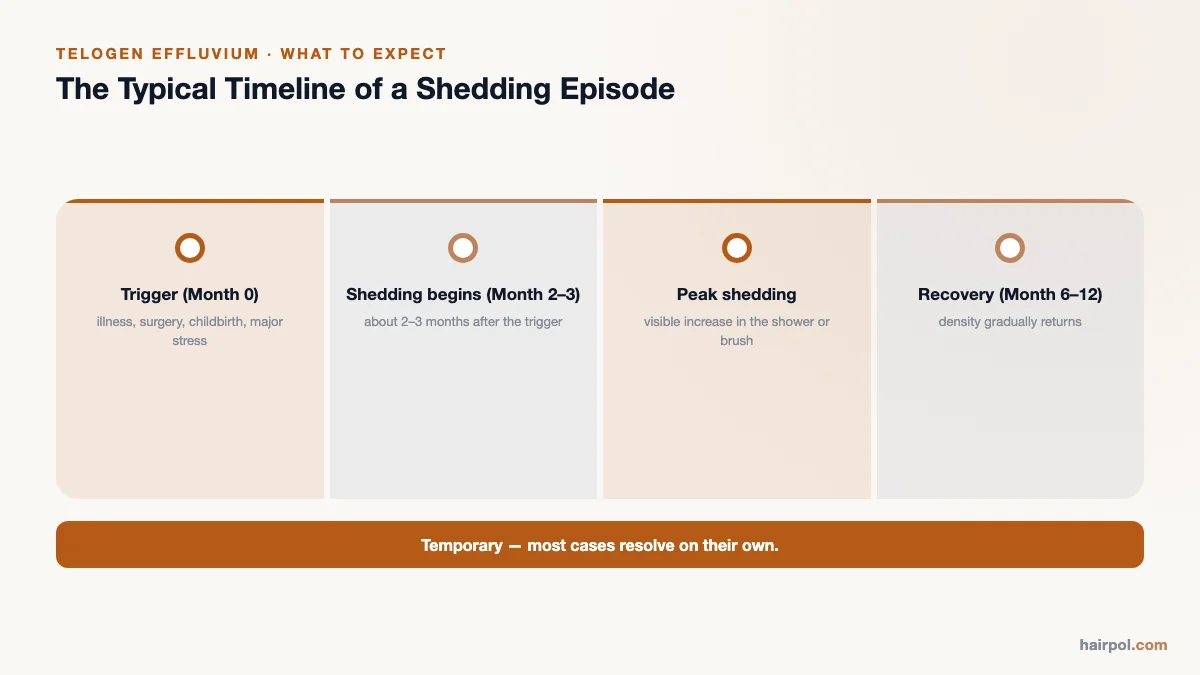
The short answer: telogen effluvium is a temporary shedding phase in which an unusually large share of follicles shift into rest at the same time. Shedding typically begins 2 to 3 months after the trigger, peaks over 6 to 8 weeks, and resolves within 3 to 6 months once the cause is gone. It thins the whole scalp rather than carving a pattern, and it is almost never a case for surgery — a hair transplant on an actively shedding scalp solves a problem that was going to solve itself.
What is actually happening to the hair cycle
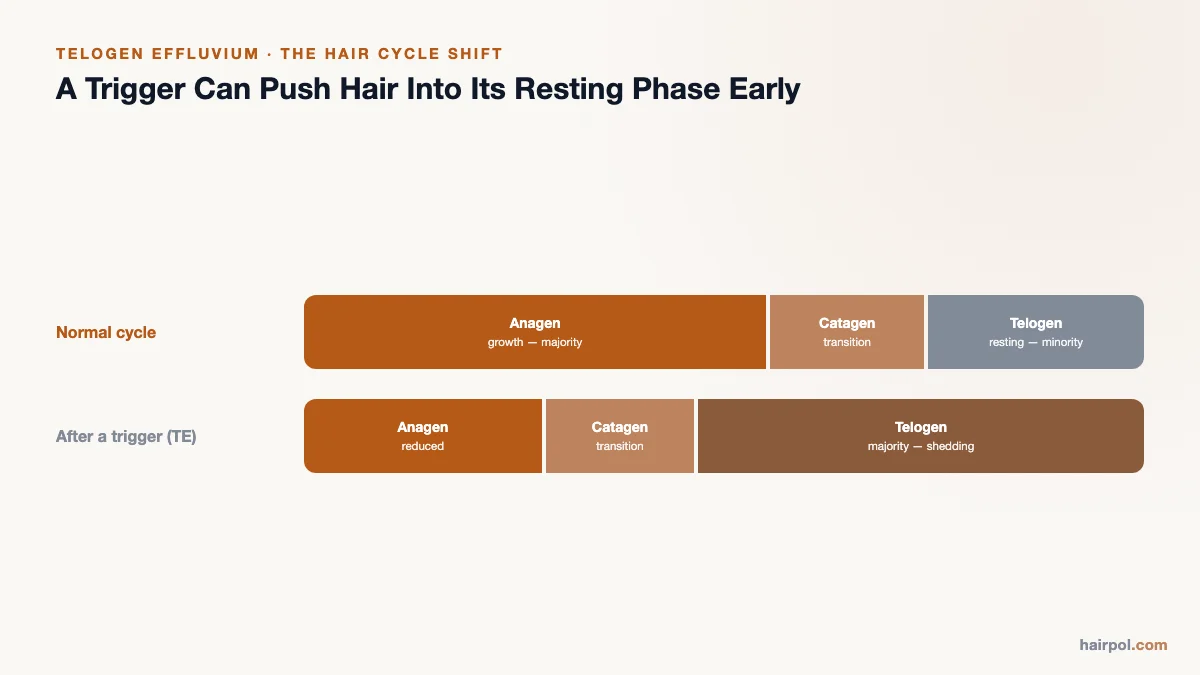
Every follicle on your head runs an independent cycle. Most are in anagen, the active growth phase, which lasts anywhere from two to six years. A small minority sit in a short transitional phase, and roughly 8 to 12 percent are in telogen, a resting phase of around three months that ends with the hair being released so a new one can start.
Because those cycles are staggered, you normally lose 50 to 100 hairs a day without noticing. The system is designed to be invisible.
Telogen effluvium breaks the staggering. A systemic stressor pushes a large batch of anagen follicles into telogen at once — sometimes 20 or 30 percent of the scalp instead of 10. Those follicles then sit quietly for about three months, and when their resting phase ends they all release their hairs within a few weeks of each other. That is the shower moment. The hair did not fall out on the day you noticed it; it was decided months earlier.
Why does the shedding start 2 to 3 months after the trigger?
This delay is the most confusing feature of the condition and the most diagnostically useful one.
The trigger does not cause hair to fall. It causes hair to stop growing. The fall happens at the end of the resting phase, which runs its normal three-month course regardless of how you feel now. So the person shedding heavily in September is often looking for a cause in September, when the answer is a high fever, an operation, or a crash diet in June.
We ask every patient with sudden diffuse shedding the same question at Hairpol: what happened three months ago? Nine times out of ten there is an answer, and finding it changes the entire conversation from “how do I fix my hair” to “how long until this settles”.
What triggers telogen effluvium?
The list is longer than people expect, and most items on it are ordinary life events rather than illnesses.
- High fever or acute infection — influenza, severe viral illness, anything that spikes temperature for several days.
- Surgery and general anaesthesia — the body treats a major operation as a systemic event, and shedding around month three afterwards is common.
- Rapid weight loss — particularly very low calorie diets, or losing more than roughly 10 percent of body weight in a short period.
- Severe or prolonged psychological stress — bereavement, a divorce, a period of sustained sleep deprivation.
- Childbirth — the postpartum shed is the best known form of telogen effluvium, driven by the oestrogen drop after delivery.
- Nutritional deficiency and thyroid disease — iron deficiency and both under- and over-active thyroid are recognised contributors, and both need a doctor’s blood work rather than guesswork.
- Starting or stopping certain medications — a decision that belongs entirely to your prescribing doctor.
Two things stand out about that list. First, most of the triggers are self-limiting: the fever passes, the operation heals, the diet ends. Second, several of them need medical testing rather than assumptions, which is why we send patients for blood work before anyone talks about grafts.
Is telogen effluvium the same as going bald?
No, and the difference is visible if you know where to look.
Telogen effluvium thins the entire scalp evenly. The hairline holds. The temples stay where they were. The crown gets less dense but does not develop a bald centre. What you lose is overall volume, and it shows up most obviously as a thinner ponytail, a wider parting, or a scalp that reflects more light in overhead photographs.
Androgenetic hair loss does the opposite. It is regional and it has a signature: recession at the temples, thinning that concentrates at the crown, a hairline that moves backwards over years rather than months. The hairs that remain in those zones get progressively finer and shorter — miniaturisation — rather than falling out at full thickness.
The practical test is what the shed hair looks like. Telogen hairs come out with a small white club-shaped bulb at the root and are full length. Broken shafts and short, wispy hairs point somewhere else entirely. If you want to see how pattern loss develops stage by stage, our guide to Norwood stage 1 shows what the earliest genuine pattern change looks like.
Can you have both at the same time?
Very often, and this is where self-diagnosis falls apart.
A man in his thirties with early pattern loss who then has surgery, or a bad flu, or six months of severe work stress, sheds from both processes at once. The effluvium resolves after a few months and the pattern loss does not. What he experiences is a frightening shed followed by partial recovery, and then the slow realisation that he did not quite return to where he started.
That is not the effluvium failing to resolve. It is the genetic pattern becoming visible because the effluvium stripped away the volume that was hiding it. We see this regularly, and it is one reason we never assess anyone’s candidacy during an active shed.
The same logic applies to women with early female pattern loss, where diffuse thinning and effluvium can look almost identical in photographs. Our article on diffuse thinning and transplant candidacy covers that overlap in more detail.
How long does telogen effluvium last?
Acute telogen effluvium follows a fairly predictable arc. Shedding starts 2 to 3 months after the trigger, runs heavily for roughly 6 to 8 weeks, then tapers. Most people are back to normal shedding by month 6, with density recovering visibly between months 6 and 12 as the regrown hairs reach useful length.
Regrowth is slow to see because hair grows around one centimetre a month. Even when every follicle has restarted, it takes half a year before the new growth is long enough to add visible thickness. Patients often tell us nothing is happening at month four; when we look closely, there is a fringe of short new hairs across the whole hairline that they have not noticed.
Chronic telogen effluvium is the version that lasts beyond six months, usually because the trigger is still present — an unresolved thyroid problem, ongoing iron deficiency, a diet that has not been corrected. It is less common and it needs a medical answer, not a surgical one.
What can you actually do about it?
The honest answer is that the most effective intervention is removing the cause, and the second most effective is time. Neither is satisfying when you are watching hair collect in the drain.
What genuinely helps: getting blood work done so that a correctable deficiency is found rather than assumed; eating enough protein and total calories, especially if a diet triggered the shed; protecting sleep; and treating any underlying condition with the doctor who diagnosed it. Iron supplementation in particular should follow a blood test, because taking iron you do not need is not harmless.
What does not help: switching shampoos every fortnight, aggressive scalp brushing, or buying supplement stacks marketed for hair. If someone is selling you a product that promises to stop a shed that is already three months into a six-month course, they are selling you the passage of time.
Medication is a separate conversation. Some patients with combined effluvium and early pattern loss do benefit from a prescribed treatment plan, but starting minoxidil during an active shed can briefly increase shedding before it helps, and that timing decision belongs to a doctor. Our piece on minoxidil timing and dose explains why the first weeks look worse before they look better.
Which tests are usually worth doing?
This is a question for your doctor, not for a clinic, but knowing what is normally checked stops you from either over-testing or missing something obvious. The usual panel for unexplained diffuse shedding includes a full blood count, ferritin to assess iron stores, thyroid function, and vitamin D. Some doctors add zinc or B12 depending on your diet and history.
Ferritin is the value that causes the most confusion. It can sit inside the laboratory reference range and still be low enough to matter for hair, which is why the interpretation belongs to a physician who is looking at your whole picture rather than a single number on a printout. The same goes for borderline thyroid results.
What testing will not do is tell you whether the shed is temporary. Blood work finds correctable contributors; it does not date the trigger or predict recovery. That part comes from the timeline and from photographs taken a few months apart. Patients who bring both to an assessment get a far more useful answer than those who bring a folder of results and no history.
When should you see a specialist?
Not immediately, in most cases. A shed that started two months after a documented trigger and is following the expected arc does not need urgent intervention.
Book an assessment if the shedding is still heavy past six months, if you cannot identify any trigger at all, if the scalp is itchy, painful, red or scaling, if you are seeing patchy loss with defined round borders rather than diffuse thinning, or if the hairline itself is visibly retreating. Each of those points somewhere other than a straightforward effluvium.
Round, well-defined patches in particular need a different assessment entirely — we cover that pattern in our article on alopecia areata versus pattern hair loss. And if you are unsure which specialist to start with, our guide on when to see a dermatologist for a receding hairline sets out the sequence.
Why we do not operate during an active shed
Three reasons, and all of them are about your result rather than our schedule.
The first is that surgery is itself a trigger. Operating on someone already in an effluvium can extend the shed, and it makes month three after surgery genuinely difficult to interpret — you cannot tell shock loss from ongoing effluvium from a poor result.
The second is planning. Graft numbers are calculated from what the scalp looks like at baseline. A scalp in the middle of a shed is not at baseline; it looks thinner than it will be in six months. Planning from that photograph means over-transplanting an area that was going to recover anyway, and spending donor hair that you will want later.
The third is simpler. A large share of people who come to us during a shed do not need surgery at all. Telling someone that is a better outcome than operating on them. If you are in the middle of a heavy shed and want a straight answer about whether this is temporary or the start of a pattern, send us photographs for an assessment — most of these questions can be settled without you travelling anywhere.
What the assessment actually looks at
A useful assessment for sudden shedding is more history than technology. We want the timeline: when the shedding started, what was happening three months before that, whether it has changed in intensity, and whether anyone in your family lost hair early.
Then we look at distribution. Photographs from directly above, from the front, and of the crown tell us whether volume loss is uniform or regional. We look at the density of the donor zone at the back and sides, because in a true effluvium that area thins too, whereas in pattern loss it stays dense.
Finally we look for miniaturisation — the mixture of thick and fine hairs in the same area that indicates a genetic process running underneath. That single finding is often what separates “wait four months” from “let us talk about a long-term plan”. Non-surgical support through our hair treatments department is sometimes appropriate at that stage, but it supports the scalp rather than stopping an effluvium that time will end anyway.
What recovery actually feels like month by month
Month 1 to 2 after the trigger is silent. Nothing visible happens, which is why the shed feels so sudden when it starts.
Months 3 to 4 are the worst. Shedding is heavy, and every wash produces a handful of hair. This is the period when people panic-buy products and book consultations. Months 5 to 6 bring the taper: still shedding, but noticeably less, and if you look carefully at the hairline you can see short new hairs standing up.
Months 6 to 9 are where volume starts returning, though usually not fast enough to satisfy anyone. By month 12 most people with a single resolved trigger are back to something close to their previous density. If you are at month 12 and clearly are not, the assumption should change: something else is going on, and that something is usually either an unresolved medical trigger or a genetic pattern that was there all along.
If you are at month nine and still shedding
Go back to the timeline before you go looking for treatments. Was there a second trigger you have not counted — a new diet, a medication change, another illness? Chained triggers are common and they reset the clock each time.
Then get the blood work repeated if it was done early in the shed, since iron and thyroid values can drift. And take photographs in the same light every month, because month-to-month change is invisible but month-three to month-nine change is not.
At Hairpol we would much rather tell you to wait than sell you an operation you do not need. If the picture turns out to be a genuine pattern underneath, that is a different conversation with a different plan, and our hair transplantation team will map it out honestly, including the parts that surgery cannot address. The one thing worth avoiding is making a permanent decision about your donor hair while your scalp is still in the middle of a temporary event. You can also review the questions patients ask most often before booking anything.
Find this helpful? Add Hairpol as a preferred source on Google.
Graft Range Calculator
Answer three questions to see the typical graft range for your situation — based on our published clinical guides.
This is a preliminary estimate, not a medical assessment. The exact number can only be determined by a doctor after examining your donor area and hair characteristics.
Get a Free Consultation
Answer a few questions and the medical team will review your situation.
