
Two men send us photographs on the same afternoon. Same age, same receding corners, almost the same amount of visible scalp. One gets a proposal for 2,600 grafts. The other for 4,800.
Nobody is being cheated. The difference sits in things a photograph shows only if you know how to read it: donor density, hair calibre, colour contrast against the skin, how fast the pattern moved in the last four years. Graft numbers are a conclusion, not a starting point, and the number you have been quoted online before anyone examined your scalp is closer to a guess than a plan.
The short answer: most first procedures fall between 2,000 and 4,000 grafts. A hairline and frontal third usually needs 2,000 to 3,000; front plus crown typically runs 4,000 to 5,000; anything approaching 7,000 grafts is a staged plan across two sessions, not a single day. Price follows the graft band, the technique, the number of surgical days and what the package actually includes, which is why a per-graft figure alone tells you almost nothing.
Why graft count is not the same as hair count
A graft is a follicular unit: the natural cluster your hair grows in. Depending on the person and the area harvested, a single graft can carry one, two, three or occasionally four hairs. So 3,000 grafts might mean 6,000 hairs on one patient and 7,800 on another.
This matters more than most people realise when comparing quotes. A clinic quoting 5,000 grafts with a low average of 1.8 hairs per graft is moving fewer hairs than a clinic quoting 4,000 grafts at 2.5. Neither number is dishonest on its own. Together they describe completely different operations.
At Hairpol we count and record grafts by hair number during extraction, because the placement plan depends on it. Single-hair grafts belong at the very front edge, where a soft, irregular transition is the difference between a hairline that looks grown and one that looks installed. Multi-hair grafts go behind it, where they build visual weight. If nobody is talking to you about that distribution, the graft total on your quote is doing more marketing work than surgical work. We unpack the same problem in how many grafts you actually need for a natural result.
Your Norwood stage sets the range before anything else
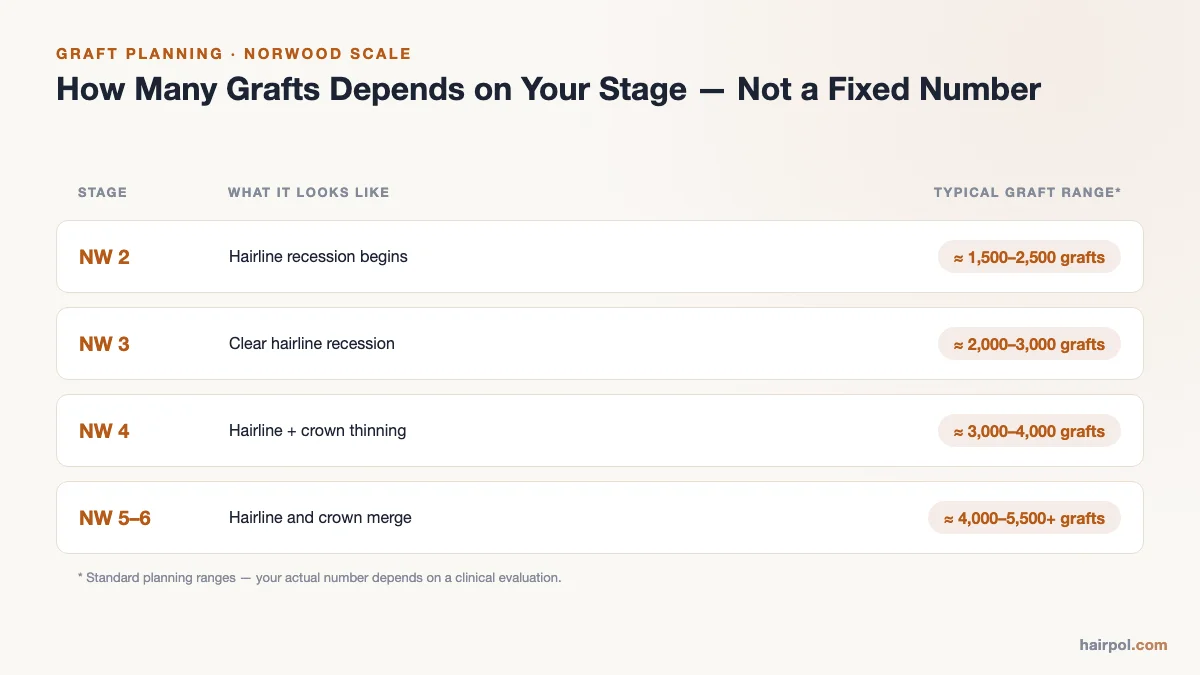
Every serious graft estimate starts with pattern classification. The Norwood scale describes how far male pattern loss has progressed, and each stage carries a broad, well-established graft range because each stage represents a roughly known surface area.
Norwood 2 and early 3 involve the temporal recessions and the front edge only, which is a small surface. Norwood 4 adds the mid-scalp and usually an opening crown. Norwood 5 and 6 mean the bridge of hair between front and crown has thinned or gone, and the bald surface has roughly doubled compared with stage 3.
Surface area is not the whole story, though. Two men at Norwood 4 can need very different numbers because one has coarse dark hair on pale skin, which covers efficiently, and the other has fine hair with high contrast, which needs more grafts per square centimetre to read as full. Reading your own stage honestly is the first step, and the Norwood scale explained walks through it without the sales overlay.
2,000 to 3,000 grafts: the hairline and the frontal third
This band covers most first procedures, and it is where the strongest visual return per graft lives. The frontal third frames the face. It is what people see in conversation, in photographs, in video calls. Restoring it changes how you read to others far more than the same number of grafts placed at the back of the head.
A patient at Norwood 2 to 3 with intact mid-scalp usually needs 2,000 to 2,500 grafts to rebuild the hairline and temporal corners with credible density. Add a thinning mid-scalp and you are looking at closer to 3,000. This is a comfortable single-day procedure for most clinics and most patients.
The mistake in this band is spending it badly. A hairline placed too low and too straight burns grafts on a design that will look wrong in fifteen years and leaves nothing for the area behind it. We would rather build a slightly higher, softly irregular line with 2,300 grafts than a dramatic one with 3,200. Technique matters here too, and single-follicle implantation methods such as DHI hair transplantation are used specifically to control angle and depth along that front edge.
4,000 to 5,000 grafts: front plus crown
Once the crown enters the plan, numbers climb quickly. The crown is not a flat panel; it is a spiral, and hair leaving a whorl in all directions gives less apparent coverage per graft than hair combed in one direction at the front. Practically, a crown that looks open on camera can absorb 1,500 to 2,500 grafts on its own without ever looking as dense as the hairline.
That is how a Norwood 4 or early 5 patient arrives at a 5,000 graft proposal: roughly 2,800 to 3,200 across the front and mid-scalp, plus 1,800 to 2,200 for the crown. Whether that happens in one long day or two sessions depends on your donor area, your health, and how your surgeon works.
Here is where honesty separates clinics. A 5,000 graft single-day extraction is physically possible, and it is also a very long day for both patient and team, with grafts spending more time outside the body. Many surgeons cap a single session lower for that reason and stage the rest. We explore the crown side of that arithmetic in what 2,000 grafts do for the crown.
The lower end of this band deserves its own look, because 4,000 grafts is one of the most common figures in Turkish quotes. It usually means around 8,000 to 9,000 hairs and, at a mix of front and mid-scalp densities, roughly 100 to 130 square centimetres of coverage. That suits most Norwood 4 patterns, where the hairline, temples and mid-scalp are restored together, and many Norwood 5 patterns if the plan finishes the front first and leaves the crown for later.
| Pattern | Front and mid-scalp | Crown | Total |
|---|---|---|---|
| Norwood 4, crown left for later | about 4,000 | none yet | about 4,000 |
| Norwood 4, modest crown | 2,800 to 3,000 | 1,000 to 1,200 | about 4,000 |
| Norwood 4 to early 5, full plan | 2,800 to 3,200 | 1,800 to 2,200 | about 5,000 |
A 4,000-graft session uses around half or more of what an average donor area can give over a lifetime, so the first question is not coverage but what remains afterwards. On cost, Hairpol packages are typically $2,500–5,000; graft count is the main driver of where a plan sits in that band, and the exact figure follows a free hair analysis. Many clinics complete 4,000 grafts in one long day, others split the same plan over two consecutive days; what matters is that grafts spend as little time outside the body as possible.
6,000 to 7,000 grafts: this is a plan, not a session
When someone searches for the price of 7,000 grafts, they are usually a Norwood 5 or 6 who wants everything solved at once. The honest answer is that this number describes a two-stage plan spread over at least ten to twelve months, not a procedure.
Two reasons. First, donor capacity: a strong donor area yields somewhere around 6,000 to 8,000 lifetime follicular units for many patients, less for those with fine hair or low density, and taking almost all of it in one go leaves the back of your head visibly depleted with nothing in reserve. Second, biology: the recipient area has a limited blood supply, and packing enormous numbers of grafts into it at once does not reliably produce proportionally more hair.
A staged plan does something a mega-session cannot. It lets your surgeon see how the first round grew, how your native hair behaved in the meantime, and where the second round should go. If your pattern advanced during that year, the plan adapts. Read donor area capacity over a lifetime before you accept any quote above 5,000 grafts in a single day.
How many grafts do you really need for your own head?
The ranges above are planning brackets, not prescriptions. Four measurements move you inside your bracket, and a proper consultation records all four.
Donor density, measured in follicular units per square centimetre, decides how much can safely be harvested. Hair calibre decides how much coverage each graft delivers; thick hair can look full at densities where fine hair still shows scalp. Contrast between hair and skin colour changes the perception of density dramatically, which is why dark hair on pale skin is the hardest combination to cover cheaply. And recipient area, measured properly rather than eyeballed, gives the surface you are filling.
Multiply surface by target density and you get a number. That number is then adjusted downward if your donor cannot support it and adjusted for staging if your loss is still moving. This is arithmetic, not intuition, and any consultation that skips it is selling you a package rather than planning an operation.
What actually determines the price of a 5,000 graft procedure
Graft count is only one of the inputs. Five others move the figure just as much.
Technique. Extraction and implantation methods differ in how much surgical time and how many trained hands they consume. Sapphire FUE and DHI have different workflows and different time costs per thousand grafts; neither is inherently better for every patient, and the right choice depends on your hair and your plan.
Surgical days. A staged 5,000 graft plan across two visits costs differently from one long day, because you are paying for theatre time, team time and anaesthesia twice, but transferring the same total number of follicles.
Who does what. The share of the procedure performed by the surgeon versus delegated technicians is the single biggest hidden variable in this industry, and it is the one you should ask about in writing.
What the package includes. Accommodation, transfers, medication, PRP sessions, aftercare kits and follow-up appointments are bundled by some clinics and billed separately by others.
Accreditation and follow-up. A clinic with a licensed facility, a named surgeon and a structured twelve-month follow-up carries costs a graft-mill does not. You can see how we structure that on our hair transplant cost page, which is the right place for current figures rather than a blog post that ages.
Why per-graft pricing misleads almost everyone
Per-graft pricing looks like transparency and often functions as its opposite. If a clinic charges by the graft, there is a commercial incentive to find more grafts in your scalp than your plan needs, and patients rarely audit the count.
The reverse distortion also exists. Fixed-price packages that advertise “unlimited grafts” sound generous, but no surgeon can safely take unlimited grafts from a finite donor area, and the phrase usually means the clinic will take whatever it decides on the day.
What you want is a written plan: a stated graft number, a stated recipient area, a stated technique, a named surgeon and a stated follow-up schedule, with the price attached to that plan. If the quote changes on the morning of surgery, that is a red flag regardless of how the price is structured. Our Turkey package page sets out what is and is not bundled, in writing, before you travel.
Donor capacity: the ceiling that no quote mentions
Every graft you use is permanently gone from the back of your head. That is the part the pricing conversation almost never covers.
Your donor rim has a finite number of follicular units that can be removed without making the area look thin. For most men that figure sits somewhere between 5,000 and 8,000 over a lifetime, spread across however many procedures they have. A first session that uses 5,000 of them at 27 does not leave a second session; it leaves a decision you cannot reverse.
This is why we are cautious with young patients who arrive asking for the maximum. If you are unsure whether your own situation calls for 2,500 grafts now or 4,500 grafts later, a photo assessment of your donor rim will settle it in a day rather than a year. Send images through the Hairpol assessment form and you will get a staged proposal with a graft range, not a single flattering number.
Is 5,000 grafts in one session safe?
It can be, in the right patient, with the right team, and it is not automatically the best choice just because it is possible.
The variables are your donor supply, your general health, how long you can tolerate lying still, and how many trained pairs of hands are working. Grafts survive best when their time outside the body is short and their handling is gentle. A team of two working for fourteen hours does not achieve the same graft survival conditions as a properly staffed theatre working a controlled schedule.
Ask three questions before agreeing to a very large session: how many people will be placing grafts, how long the grafts will be held outside the body, and what the clinic’s policy is if extraction runs slower than planned. The answers tell you more about your likely result than the graft number does.
There is also a version of this question nobody asks, which is what happens to the other half of the plan. If a clinic extracts 5,000 grafts and the last thousand are placed by tired hands at hour thirteen, you do not get a uniform result; you get a scalp where one region grew at ninety per cent and another at sixty, and that difference is visible from month nine onwards. Splitting the same total across two calm days almost always produces better placement quality, and it costs less in revision work later. Ask any clinic offering a very large single session how they protect the last thousand grafts, and listen carefully to whether the answer is about process or about reassurance.
Coverage or density: the trade-off inside your number
Suppose your plan allows 3,500 grafts and your bald area would need 6,000 to look genuinely dense. You now have a choice that no graft count can make for you.
Spread thinly across the whole area, you get light coverage everywhere and full density nowhere, which under bright overhead light can still read as thin. Concentrated in the frontal two-thirds, you get a convincing, dense front with the crown left for later or left to medical management. Most patients, once they see both simulated, choose concentration.
That decision changes the graft number as much as your Norwood stage does, and it is the conversation clinics skip when they lead with a price. We set out the whole trade-off in density versus coverage, and it is worth reading before your consultation rather than after it.
What a cheap maximum-graft package costs you later
The economics of the low-cost, high-graft offer are simple. Margin comes from volume, volume comes from short operating days and high patient throughput, and both come out of the time spent on your case.
The visible consequences show up between month eight and month eighteen: patchy density where placement was rushed, a front edge that looks drawn rather than grown, and a donor area with visible depletion because extraction was spread too widely or taken too far outside the safe zone. Repairing that costs more than the original saving, and it costs grafts you no longer have. Anyone weighing a bargain quote should first read what a full hair transplant really requires.
None of this means expensive equals good. It means the cheapest quote for the largest graft number is a specific combination that reliably produces the outcomes patients later ask us to revise.
How we arrive at your graft number at Hairpol
The consultation follows the same sequence for every patient, and it produces a range rather than a single figure.
We photograph and measure the recipient area, assess donor density under magnification, record hair calibre and contrast, classify your Norwood stage, and ask about the speed of change over the last three to five years. From that we produce a graft range for each zone, a recommendation on staging, and an honest statement of what will still be visible afterwards. If medical treatment should come first, we say so, even when it delays surgery by six months.
Then you get the number in writing, with the plan attached, and you take it away and compare it. Book through our hair transplantation department and ask us to show you the arithmetic behind your figure. Any clinic that cannot show it is guessing, and you are the one who pays for the guess.
Find this helpful? Add Hairpol as a preferred source on Google.
Graft Range Calculator
Answer three questions to see the typical graft range for your situation — based on our published clinical guides.
This is a preliminary estimate, not a medical assessment. The exact number can only be determined by a doctor after examining your donor area and hair characteristics.
Get a Free Consultation
Answer a few questions and the medical team will review your situation.
