
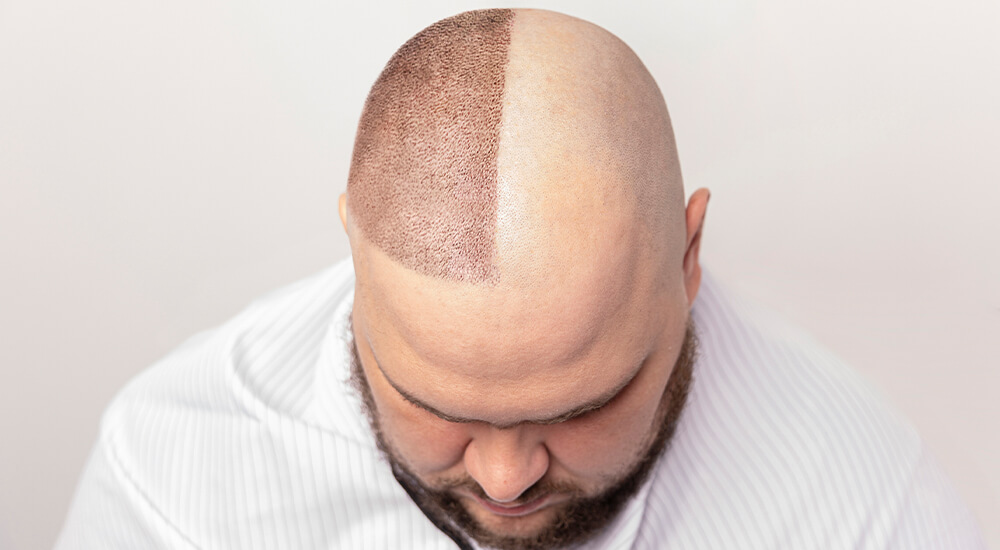
You take the dressing off, or the last crusts finally rinse away, and the first thing you notice is not the grafts. It is the light. Your scalp is catching it in a way it never used to, flat and smooth and faintly reflective, as if the skin on top of your head belongs to somebody else.
Then you search for it at eleven at night and the forums do what forums do. Somebody says shiny skin means scar tissue. Somebody else says shiny skin means the follicles died and the surface has sealed over. Neither of those people examined your head, and neither of them mentioned the far more ordinary explanation that applies to almost everyone reading this.
At Hairpol this is one of the most common messages we get between week two and month three, and it is almost always a question about skin rather than a question about hair, even though the person asking is convinced it is the other way round.
The short answer: Yes, a shiny scalp after a hair transplant is normal, and it is temporary. The shine peaks between roughly day 10 and week 6, softens through months 2 to 4, and is usually unremarkable by month 6 as new growth reaches 1 to 2 cm and breaks up the reflection. It comes from three ordinary things at once: thin new skin that has not rebuilt its texture, residual swelling that pulls the surface taut, and oil glands that have been washed and interrupted for weeks. Shine only becomes a concern when it is white rather than pink, permanently hairless, and still there past month 12.
Why Does the Scalp Look Shiny After a Hair Transplant?
Ordinary scalp skin is not smooth, even though it looks that way from a metre away. Up close it is a mildly uneven surface of tiny ridges, pores and follicular openings, with hair shafts of varying thickness standing out of it at an angle. All of that scatters light in dozens of directions at once, which is exactly why a scalp with hair on it reads as matte.
Surgery removes both halves of that. A recipient area receives somewhere between 1,500 and 4,000 tiny incisions in a session, opened with the fine blade tips used in sapphire FUE hair transplantation, and the healing response resurfaces the whole zone at more or less the same time with a fresh, extremely thin layer of skin. New epithelium is uniform in a way that mature skin never is. It has not yet rebuilt the micro-texture that took your body decades to develop, and it has almost no hair standing out of it to interrupt the surface.
A uniform surface with nothing standing on it reflects light in one direction instead of scattering it. That is the entire mechanism. The shine you are seeing is new skin behaving exactly like new skin, and it is the same reason a healed graze on your forearm looks glossy for a few weeks before it settles back into looking like the rest of your arm.
Is the Shine the Same Thing as Swelling?
In the first week, largely yes. Swelling and shine are hard to separate at that stage because fluid does the same thing to skin that a hand does to a bedsheet: it pulls the surface tight and flattens every wrinkle out of it. Taut skin is reflective skin.
Post-operative oedema usually appears on day 2, peaks somewhere around day 3 or 4, then drains downward with gravity into the forehead and occasionally the eyelids before settling by the end of the first week. The whole forehead and frontal scalp can look polished during those days, and it can look dramatic in a bathroom mirror at close range. We wrote about the fluid side of this in detail in our guide to swelling after a hair transplant and how to reduce it.
The useful distinction is timing. If the shine came with puffiness in the first four or five days and eased as the puffiness eased, that was fluid. If the shine appeared later, around the time the crusts cleared, and the swelling was long gone, that is skin rather than fluid, and it runs on a much longer clock. Most of the messages we receive are about the second kind, from people who assumed the first week was the difficult part. The broader picture of that opening stretch is covered in what to expect in the first 7 days after a hair transplant.
What Happens to Your Scalp’s Oil After Surgery?
Sebaceous glands live alongside your follicles and spend their whole existence coating the scalp with a thin film of oil. That film is part of why your skin normally looks the way it does. Then you spend two to three weeks washing daily with a medicated foam or lotion, at a frequency you would never use in ordinary life, precisely to clear crusts and keep the area clean.
The result is a two-phase oil story that confuses almost everyone. In the first weeks the scalp is stripped, tight and papery, and the shine it produces is the dry, matte-hard kind you see on a wind-burned face. Then somewhere between week four and week eight the glands rebound and often overshoot, and the shine changes character entirely and becomes slick and greasy, sometimes worse than anything you experienced before surgery.
You can tell them apart with a fingertip. Dry shine feels tight and slightly rough, and the skin may flake at the hairline. Oil shine leaves a trace on your finger and looks worse by the end of the day. Both of them are self-limiting. The oil balance usually settles between month two and month four, and the people who chase it with aggressive degreasing shampoos generally make it last longer rather than shorter.
The Pink, Glossy Stage After the Crusts Come Off
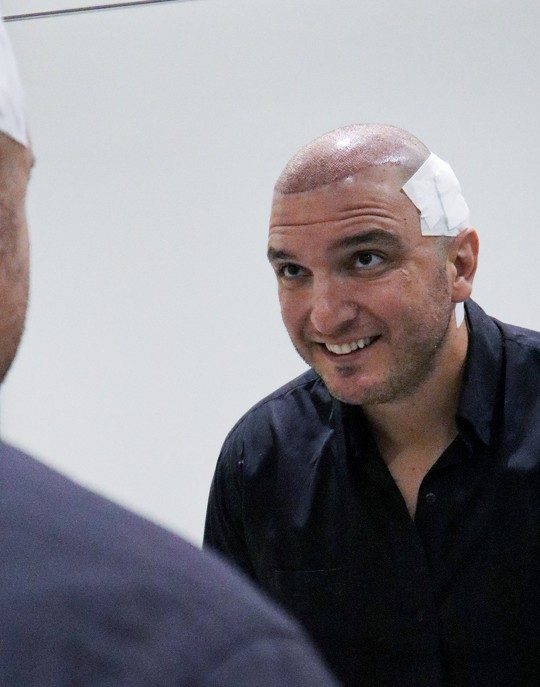
Between roughly day 10 and day 21 the crusts release and take a lot of your anxiety with them, right up until you see what is underneath. The skin that emerges is pink to red, tight, and distinctly glossy. Two things are happening at once: the new epithelium is thin enough that the capillary network underneath shows through, and those capillaries are genuinely dilated because healing tissue needs a heavy blood supply.
Pink plus glossy is a combination that photographs terribly and looks worse under an overhead bathroom light than it does in daylight, which is why so many people take a photo at midnight and conclude something has gone wrong. Comparing against a set of before and after photographs taken at matched stages is far more informative than a mirror check.
The redness fades on its own schedule and it is slower than most patients expect. Three to eight weeks is typical. Fair skin can hold visible pinkness for two to three months, and men who flush easily hold it longer still. The gloss fades along the same curve, though it lags slightly behind the colour, because the surface texture takes longer to rebuild than the capillaries take to calm down. Neither of them is scar tissue, and neither of them says anything about whether the grafts took.
How Long Does the Shine Last, Month by Month?
The honest version of the timeline looks like this, with the usual caveat that healing speed varies by skin type, age and how the recipient area was designed.
- Week 1 to 2: shine is mostly swelling and fluid. Surface looks taut and polished. Crusts still present in patches.
- Week 2 to 6: the most visibly shiny phase. Crusts gone, new epithelium exposed, skin pink and reflective, no hair to break up the light.
- Month 2 to 3: redness fading, oil production rebounding and sometimes overshooting. Shine changes character from dry to slick.
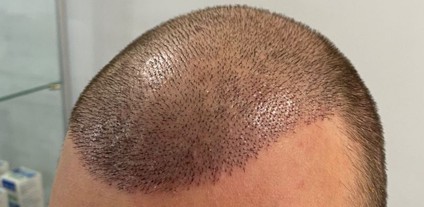
- Month 4 to 6: early regrowth reaches 1 to 2 cm across the zone and immediately cuts the reflection. Most people stop noticing it around here.
- Month 6 to 12: skin texture rebuilds, density fills in, and the shine stops being a separate thing you can point to.
The single biggest change is not the skin. It is the hair. Once the transplanted follicles start producing shafts that stand up out of the surface, they scatter light again and the whole effect disappears far faster than the underlying skin actually recovers.
Why Is the Recipient Area Shinier Than the Donor Area?
Patients notice this asymmetry constantly, and it worries them because it looks like two different healing outcomes on one head. It is not. The two zones were treated in completely different ways.
The donor area receives extraction punches of roughly 0.7 to 0.9 mm, spaced apart and taken selectively so that most of the surrounding follicles are left in place. The skin between the punches is untouched, mature, and still has its full texture. The hair around them is still growing and is usually left long enough to cover everything within two or three weeks. Donor skin therefore has both of the things that make a scalp look matte, and it goes back to normal fast.
The recipient area receives incisions at 30 to 45 per square centimetre in the front zone, which means the entire surface is remodelled at once rather than dotted. There is no untouched mature skin between the sites to break up the reflection, and there is no existing hair standing over it because the area was thin or bald to begin with.
So the donor settles in two to four weeks and the recipient takes months. That gap is expected, it is not a sign that one area healed better than the other, and it closes on its own as growth arrives.
Does a Shiny Scalp Mean the Grafts Failed?
This is the fear underneath the question, and it is worth separating clearly. Shine is a property of the outermost layer of skin, measured in fractions of a millimetre. The grafts you paid for sit 4 to 5 mm down, in the dermis and upper fat layer, with their bulbs well below anything you can see from the surface.
What the surface looks like tells you very little about what is happening at that depth. A perfectly healthy recipient area with 95 per cent graft survival will look glossy at week four, because those two facts are unrelated.
The genuine warning signs for graft survival look nothing like shine. They are the absence of any emerging hair across a whole zone by month eight to ten while neighbouring zones have clearly started, a patch that stays visibly different in density at month twelve, or crusting and discharge in the first two weeks that suggests infection. Shedding at week two to six, by contrast, is expected and universal, and the follicle stays behind when the shaft leaves.
At Hairpol we would rather a patient send a photo at month three and be told the boring answer than sit with it until month nine. The questions we field most often about this stage are collected in our frequently asked questions.
When Is a Shiny Scalp Actually a Warning Sign?
There is a version of this that deserves attention, and it looks different enough that you do not need a medical degree to flag it.
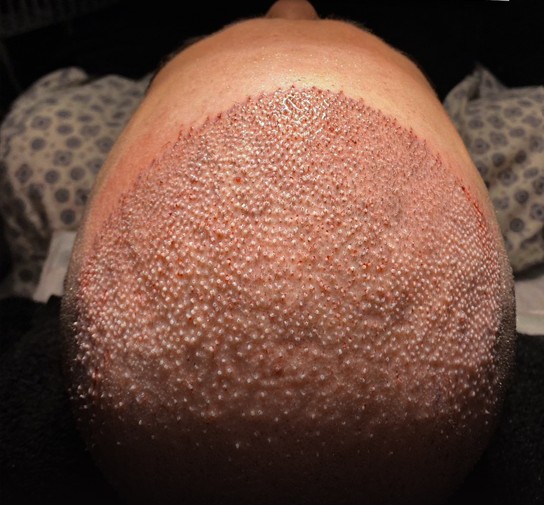
Scar tissue is the main one. Atrophic scarring after over-dense implantation, poor incision technique, or a healing complication produces skin that is white or pearly rather than pink, that sits slightly depressed or slightly raised compared to the skin around it, that has a sharp visible border, and that stays permanently hairless. It also does not change over months, which is the clearest tell of all. Normal post-operative shine looks different every few weeks. A scar looks the same in month three and month nine.
Infection is the second. Shine combined with spreading redness, warmth, tenderness that increases rather than decreases after week two, pus, or fever is not a wait-and-see situation. Contact your surgeon the same day.
The third is a shiny patch that persists past month twelve with no hair emerging in it at all while the rest of the zone has filled. That deserves an in-person look, because the causes range from a localised graft loss that can be topped up in a small second session to scarring that needs a different plan altogether. Our guide on hair transplant scars and how visible they really are goes through what can and cannot be improved.
How to Tell Normal Shine From Scar Tissue at Home
Four checks get most people to a reasonable answer before they call anyone.
Colour first. Pink, red or slightly darker than your usual tone points to healing skin. White, pearly or waxy points to scar. Push the skin gently with two fingers and see whether it gathers into fine wrinkles the way normal skin does; scar tissue is stiffer and tends to stay flat rather than crease.
Then look for hair. Take a photo in daylight, near a window rather than under a ceiling light, and zoom in. Fine, pale, barely visible hairs emerging across the shiny area mean follicles are alive in it and the surface will change. A shiny area with genuinely nothing coming out of it anywhere, at month nine or later, is a different conversation.
Then look at the edge. Post-operative shine fades gradually into the surrounding skin with no obvious boundary. Scars usually have a defined border you could trace with a pen.
Finally, compare across time rather than across mirrors. Photograph the same spot, same window, same angle, once a month. Change means healing. If you have a patch you genuinely cannot classify, send those monthly photos in daylight and ask for an assessment rather than deciding alone at midnight; it usually takes a day to get a straight answer and it saves months of quiet worry.
Why Shiny New Skin Needs More Sun Protection, Not Less
This is the section people skip and later regret. The new epithelium over a recipient area is thin, poorly pigmented, and has no hair over it to act as shade. It is, for several months, the least sun-resistant skin on your body, and it happens to be pointed directly at the sky.
Ultraviolet exposure on healing skin does two things you do not want. It prolongs the redness, which means the pink glossy phase stretches out for months rather than weeks. And it can produce uneven pigment: post-inflammatory darkening in some patches, pale patches in others, both of which stay visible long after the shine itself would have resolved.
The practical rules are simple. Keep the recipient area out of direct sun as much as you reasonably can for the first three months. Use physical cover before you use product; a loose, clean hat that sits without pressure on the grafts, once your surgeon says a hat is acceptable, does more than any cream. Sunscreen goes on only after the skin is fully intact and your surgeon has cleared it, which is usually somewhere after week four, and a mineral SPF 30 to 50 is the sensible category. Reapply it, because one morning application on a reflective scalp in July is close to no protection at all. Both sides of this are covered in protecting new grafts from the sun in the first year.
Moisturising a Shiny Scalp Without Risking Your Grafts
The instinct when skin looks tight and glossy is to put something on it. The instinct is reasonable and the timing is where people get hurt.
For the first ten to fourteen days, use nothing except what your clinic gave you. The lotion, foam or spray you were sent home with was chosen to work with the crusting process, and adding a second product on top of it is how grafts get rubbed loose by someone trying to be helpful to their own head.
Once the crusts are gone and the skin is intact, a light, fragrance-free, non-comedogenic moisturiser is often reasonable, applied by patting rather than rubbing. But get it approved by the surgeon who operated on you rather than by a forum, because they know what was already applied to that scalp and how the incisions were made. What to avoid is easier to state: alcohol-heavy tonics, retinoids, AHA or BHA exfoliants, essential oils, anything marketed as a scalp detox or scrub, and anything with a strong fragrance, all of which are better left until at least month three.
One practical note that surprises people. Heavy or occlusive products make the scalp look shinier, not less shiny. If your goal is to reduce the appearance rather than treat the skin, a light lotion beats an ointment every time. On the medication side, if minoxidil is part of your plan it can add its own dryness and flaking in the first weeks, and whether and when to start it after surgery is a decision for your physician rather than a default. Where supportive hair treatments such as PRP and mesotherapy fit belongs in the same conversation.
Can You Camouflage the Shine While You Wait?
You can, within limits, and the limits matter more than the tricks.
Nothing goes on the recipient area until the skin is fully intact and your surgeon has cleared it, which realistically means week four to six at the earliest. After that, matte-finish products help and shine-finish products make it worse. Clays, pastes and powders sit dry on the surface and scatter light. Gels, silicone serums and most leave-in conditioners add gloss to a surface that already has too much of it.
Hair length does more than any product. Leaving the surrounding and donor hair a little longer than usual for the first few months lets it fall across the recipient zone and break up the reflection, which is the same reason the donor area stops looking shiny so quickly. A very short crop everywhere is the least forgiving choice you can make during months two to four.
Lighting is the other free variable. Overhead light is the worst possible angle for a reflective scalp, which is why offices and lifts feel exposing while daylight does not. That is worth knowing simply so you stop judging your result under the harshest condition available.
Scalp micropigmentation genuinely reduces the appearance of shine by adding visual texture, but it is not a month-three decision. Give the transplant a full twelve months to declare itself first, then decide whether anything is still worth adding.
What to Do If Your Scalp Still Looks Shiny at Month Nine
By month nine most of the reassurance in this article has expired, and the question becomes a real one rather than an anxious one.
Start by separating the whole area from a specific patch. Generalised mild shine across a recipient zone at month nine, with hair emerging throughout it, is usually just density that has not finished arriving; months nine through fifteen add noticeable thickness as shafts mature and calibre increases, and that alone will change how the area reads. A defined patch with no hair in it is the case that needs looking at, and the difference between the two is the single most useful thing you can establish before any appointment.
Get a proper assessment rather than another six months of monitoring. A surgeon can tell fairly quickly whether they are looking at healing skin, localised graft loss, or scarring, and the answers diverge sharply. Healing skin needs time and sun protection. Localised loss is often a small top-up session at the twelve to fourteen month mark. Scarring needs a different conversation about what is realistically improvable and what is not, and honest clinics say so.
What none of this deserves is a second full procedure booked in a panic at month five, which is a pattern we see more often than we would like and one that costs people donor hair they will want later.
If you are somewhere in the middle of this and cannot tell whether what you are looking at is normal healing or something that needs attention, bring it to a surgeon who will examine the scalp rather than reassure you by message. At Hairpol, assessments of hair transplantation results include the skin as well as the graft count, because the two questions are genuinely different and you deserve a separate answer to each.
Find this helpful? Add Hairpol as a preferred source on Google.
Get a Free Consultation
Answer a few questions and the medical team will review your situation.
