
Nobody warns you about the mirror on day three.
You went in for your hairline. You came out with a neat little cap of dressing, a donor area that stings, and a plan you understood. Then somewhere between the second and fourth morning, you wake up and your forehead has quietly taken over your face. The skin above your brows looks tight and glossy. Your eyelids feel heavy in a way that has nothing to do with sleep. One eye might be more closed than the other. And your first thought, almost always, is the same one: something has gone wrong.
It hasn’t. Or at least, it very probably hasn’t. Swelling after a hair transplant is one of the most predictable, most misread, and most temporary parts of the whole recovery. It is also the part that patients photograph in panic and send to their clinic at 2 a.m. At Hairpol, we would genuinely rather get that message than have you spend three days quietly convincing yourself your result is ruined. But it helps even more if you know what’s coming before it arrives.
So let’s go through it properly: what the puffiness actually is, why gravity picks your forehead instead of your scalp, when it peaks, what shortens it, what does nothing at all, and the narrow set of circumstances where swelling is worth a phone call rather than a shrug.
The Fluid Has to Go Somewhere
Here’s the thing most consultations skip over. A hair transplant is not just a series of tiny incisions. Before a single graft is placed, your scalp is injected with a large volume of fluid — local anaesthetic mixed with saline and usually adrenaline, delivered in what surgeons call tumescent anaesthesia. The word tumescent means swollen, and that’s exactly the point. The fluid inflates the tissue plane, numbs the area thoroughly, firms up the scalp so the surgeon can work at a consistent depth, and constricts blood vessels so you bleed less.
It is a genuinely elegant technique. It is also the reason your face changes shape for a few days.
Depending on the size of your session, several hundred millilitres of fluid can end up in your scalp tissue over the course of a long day. Your body doesn’t absorb all of that immediately. It sits in the loose connective tissue under the skin and slowly drains away through your lymphatic system over the following days. Add to that your body’s own inflammatory response — every one of those thousands of micro-incisions triggers a normal healing cascade that brings more fluid to the area — and you have a scalp holding more liquid than it was designed to hold.
The scalp itself doesn’t have much room to expand. It is tethered tightly to the skull by dense connective tissue. So the fluid takes the path of least resistance, and that path leads downhill.
Why It’s Your Forehead and Not Your Crown
This is the part that confuses people most. The grafts went into your hairline and mid-scalp. So why is your forehead swollen — and worse, why are your eyes swollen, when nobody touched them?
Gravity and anatomy. The tissue of your scalp is thick and fibrous. The tissue of your forehead is looser. The tissue around your eyes is the loosest and thinnest soft tissue on your entire body. Fluid that can’t stay in the scalp migrates downward through connective tissue planes and pools where there is space to pool. Your forehead has space. Your eyelids have even more.
So you get a cascade. Fluid leaves the scalp overnight while you’re horizontal, spreads across the forehead, and by the time you stand up in the morning it has settled into the lowest available compartment — around your brow and eyes. That’s why the swelling almost always looks worst first thing in the morning and improves as the day goes on. You spend the night letting it flow forward, and the day letting gravity pull it back down and out.
It’s also why the crown almost never swells visibly. There’s nowhere below it for fluid to travel except the back of the neck, which is far more resistant. A crown-only session tends to produce dramatically less facial puffiness than a hairline-heavy one — one of many reasons your swelling may look nothing like the guy in the forum photo.
The Timeline: When It Starts, Peaks and Ends
Swelling has a rhythm, and knowing it removes most of the fear.
Day 0 to 1: usually nothing dramatic. Your scalp feels tight and full, your forehead may feel slightly firm, but you look essentially like yourself. Many patients fly home in this window feeling perfectly fine and assume they’ve escaped it.
Day 2 to 3: the arrival. This is when the forehead genuinely puffs. You’ll notice it on waking. It usually builds through the second night into the third morning.
Day 3 to 4: the peak. For most patients this is the worst of it, and it’s the day the swelling may reach the eyelids. Sometimes one side more than the other, depending on how you slept. This is the day that generates the panicked messages.
Day 5 to 7: the retreat. It drains fast once it turns. Many patients go from noticeably swollen to essentially normal in forty-eight hours.
Beyond day 7 to 10: gone. Residual puffiness past ten days is uncommon and worth mentioning to your clinic.
If you want the wider context of what else is happening in that window — scabbing, redness, the first shedding — our guide to the first 14 days after a hair transplant maps the whole two weeks day by day.
Why Some People Swell Dramatically and Others Barely At All
Two men can have the same surgeon, the same technique, the same graft count on the same day. One looks mildly tired. The other looks like he’s been in a bar fight. This is not a quality signal. It’s biology.
The variables that actually matter: how much tumescent fluid your session required, which strongly tracks with graft count and session length. Where the grafts went — frontal work swells more than crown work, as we covered. Your baseline tissue laxity, which is largely genetic. Your age, since younger, tighter tissue often holds fluid differently than older, laxer tissue. How much you slept flat versus elevated in the first three nights. Your salt intake. Whether you drank alcohol. And plain individual variation in how briskly your lymphatic system clears a fluid load.
Some clinics also inject a small dose of corticosteroid into the tumescent mix specifically to blunt the inflammatory component. This makes a measurable difference for many patients and is one reason two clinics’ patients can look so different at day three despite identical surgery.
At Hairpol we tell patients this plainly at consultation, because the expectation is half the battle. A man who is told “you may look puffy around day three, it peaks day four, it’s gone by day seven” experiences an inconvenience. A man who wasn’t told experiences a crisis.
Swelling Tells You Nothing About Your Result
This deserves its own section because it is the single most common anxiety underneath the question.
The amount you swell has no bearing on your graft survival, your density, or your final result. None. A swollen forehead does not mean the grafts are being squeezed out, drowned, starved, or displaced. The fluid is in a tissue plane below and in front of the recipient area; the grafts are seated in their incisions and are being nourished by the beginnings of a new blood supply that swelling does not interrupt.
Heavy swellers do not get worse results than light swellers. If anything, the correlation runs the other way — a generous, well-distributed tumescent field is part of good surgical technique, and a big session that produces a big fluid load is often a session that’s covering a lot of ground.
What you’re seeing in the mirror on day four is a plumbing event, not a surgical one. It has a start, a peak and an end, and none of those points touch the twelve-month outcome you actually care about.
Sleep Position Is the Single Biggest Lever You Control
If you do one thing about swelling, do this one.
Sleep with your head and upper body elevated at roughly 45 degrees for the first four to five nights. Not one pillow. Not two flat pillows that slide out from under you at 3 a.m. A wedge, a stack of firm pillows against a headboard, or — the option most of our travelling patients end up using — a recliner or a sofa with a solid armrest.
The logic is direct. Fluid pools where you let it pool. Lie flat for eight hours and you’re actively irrigating your forehead all night. Stay at 45 degrees and gravity keeps the fluid in the scalp, where your lymphatics can process it out through the neck rather than sending it on a tour of your face.
The practical difficulty is that this is exactly the period where you also can’t rest the transplanted area on anything. So you’re elevated and on your back, which for a lifelong side-sleeper is genuinely hard. A neck pillow — the U-shaped travel kind — helps enormously here, because it stops your head rolling sideways in the night. Our full breakdown of positions, pillows and how long the caution lasts is in how to sleep after a hair transplant without damaging grafts.
Patients who commit to elevation for four nights routinely report far milder swelling than those who give up after one. It’s the least glamorous advice in this article and by some distance the most effective.
Cold Compresses: Right Idea, Wrong Place
Cold is useful. It’s also the instruction people most often get wrong, and getting it wrong can cost you grafts.
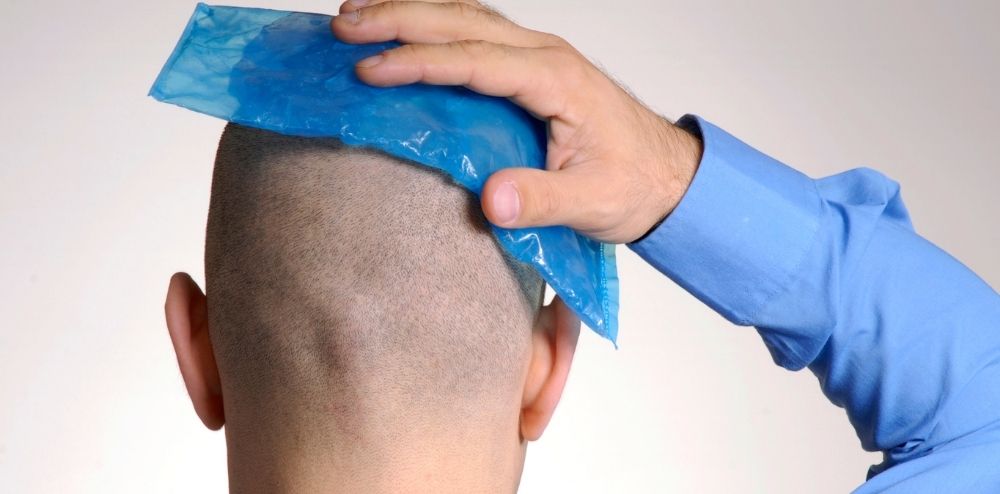
The rule: never apply anything cold to the recipient area. Not ice, not a gel pack, not a cold cloth, not for a second. The transplanted zone is untouchable in the first days — pressure and cold both risk dislodging grafts and compromising the fragile new blood supply. Nothing touches it.
Where cold does help is the forehead below the hairline, the brow ridge, and the area around the eyes. A gel pack wrapped in a thin towel, held gently against the brow for ten to fifteen minutes at a time, several times a day, constricts the vessels in that loose tissue and slows the pooling. Start it on day one or two, before the swelling arrives — it is far better at prevention than at cure. Once your forehead is fully puffy at day four, cold is a comfort measure more than a treatment.
Keep a clear mental line, roughly two centimetres below your new hairline. Below it: cold is fine, gently. Above it: nothing.
Headbands, Massage and the Things That Don’t Work
Some clinics send patients home with an elastic headband and tell them to wear it above the brows for the first few days. The idea is to create a barrier that stops fluid tracking down into the face.
Honest answer: the evidence is thin and the experience is mixed. It seems to help some patients modestly. It does nothing for others. And it carries a real risk — worn too high or too tight, it presses on grafts or the lower edge of the recipient zone, which is a bad trade for a marginal cosmetic benefit over four days. If your clinic gives you one and shows you exactly where it sits, use it as instructed. If you’re improvising one from a sports store on day three because a forum told you to, don’t.
Gentle lymphatic massage of the forehead and temples — light, downward strokes, never near the grafts — is harmless and mildly useful. Vigorous rubbing is not.
Things that do nothing: sitting in a sauna, which makes it worse. Vigorous exercise, which makes it worse and risks bleeding. Antihistamines, since this isn’t an allergic reaction. Over-the-counter anti-inflammatories, which you should in any case clear with your clinic first because some affect bleeding. Herbal diuretics. Drinking dramatically less water — dehydration makes your body hold fluid more stubbornly, not less.
Salt, Alcohol and Water: The Boring Levers That Actually Work
Your fluid balance for those first five days is partly a kitchen decision.
Salt is the obvious one. Sodium pulls water into tissue and holds it there. A heavily salted week — restaurant meals, takeaway, processed snacks, which is exactly what many patients eat while recovering in a hotel — will visibly worsen and prolong facial swelling. Keeping sodium low for five days is one of the cheapest interventions available.
Alcohol is worse, and for more reasons than swelling. It dilates blood vessels, which increases both bleeding and fluid leakage into tissue. It disrupts sleep, which is the exact window your lymphatics are working hardest. It dehydrates. And it interacts with the painkillers you may still be taking. Skip it entirely for the first week.
Water, counterintuitively, should go up rather than down. Well-hydrated tissue drains more efficiently. Restricting fluid to “dry out” swelling is a folk remedy that backfires.
And walk. Not a workout — a walk. Gentle upright movement for twenty or thirty minutes a few times a day drives lymphatic drainage far better than lying still does. Upright, unhurried, no sweating. It’s a surprisingly effective use of an otherwise slow recovery day.
What About Medication?
Corticosteroids are the pharmacological answer to post-operative swelling, and clinics take different positions on them.
Some add a small dose to the tumescent solution during surgery. Some prescribe a short oral course — typically a few days of a tapering dose starting the day after. Some prescribe nothing and rely on positioning and time, on the reasonable grounds that a self-limiting cosmetic swelling doesn’t necessarily justify systemic steroids in every patient.
All three are defensible. What isn’t defensible is you deciding independently. Steroids interact with blood pressure, blood sugar, mood and sleep; there are patients for whom a casual course is a bad idea, and your clinic knows your file. Never take a leftover prescription or a friend’s tablets because your day-three face alarmed you.
Painkillers are a separate question, and it’s worth understanding that swelling and pain are largely uncoupled — the puffiest day is rarely the sorest day. If you want the honest version of what the discomfort actually feels like and when, we wrote about what patients actually feel during and after the procedure.
If you’re mid-recovery right now and unsure whether something you’ve been prescribed is doing what it should, send us a message. A photo and two sentences on WhatsApp will get you a straight answer in minutes — that’s a far better use of your day four than an hour of searching forums for a face that looks like yours.
Swelling and the Travel Problem
This is where the timeline becomes a logistics problem rather than a medical one, and it’s why so many people searching for a hair transplant Turkey package find themselves reading about swelling in the first place.
Look at the arithmetic. The standard trip is three to four nights. Surgery on day one. Your first wash and check on day two or three. Flight home on day three or four. Which places your flight home almost exactly on the peak of your swelling.
That’s not a flaw in the plan — it’s simply what the schedule produces, and it is entirely survivable. But it means the man in seat 14C with the puffy brow and the baseball cap is a very common sight on the Istanbul routes. It also means you should plan the two days after landing rather than assuming you’ll walk straight back into a meeting.
Practical points: keep the aisle seat and keep drinking water, because cabin air is dehydrating. Don’t sleep slumped forward on the tray table. Sunglasses solve most of the self-consciousness. And build in a buffer day at home before you face anyone who matters.
The wider reality is that a well-run hair transplant Turkey experience should have prepared you for all of this before you booked — the swelling, the timeline, the flight, the buffer. When a clinic’s aftercare briefing consists of a laminated card and a taxi, the swelling isn’t the problem. The information gap is.
When Swelling Is Actually a Warning Sign
Almost never — but not never, and you should know the difference.
Normal swelling is symmetrical or near-symmetrical, painless or nearly so, soft, not hot, not red, appears around day two to three, peaks by day four, and is clearly retreating by day six.
Contact your clinic promptly if you see: swelling that arrives late, after day five, having previously been absent or resolving. Swelling that is markedly hot to the touch. Swelling accompanied by spreading redness, throbbing pain, pus or a foul smell from the donor or recipient area. Fever. Swelling that is dramatically one-sided with pain rather than just gravity-driven asymmetry. Swelling that hasn’t clearly improved by day eight to ten. Or any swelling that comes with visual disturbance or a headache unlike anything you’ve had.
These are uncommon. Infection after a hair transplant is genuinely rare because the scalp has an outstanding blood supply. But the point of knowing the normal pattern is precisely so you can recognise a departure from it — and so you can stop worrying about the ninety-eight percent of cases that are just fluid obeying gravity.
What This Actually Says About Choosing a Clinic
Here’s an underrated way to assess a clinic before you commit: ask them about swelling.
Ask whether they use steroids in the tumescent solution and why. Ask what their patients typically look like on day three. Ask what they tell people about sleeping position, and for how long. Ask what their aftercare contact looks like at 11 p.m. on day four when you’re worried.
A clinic that answers those questions specifically and without irritation is a clinic that has thought about the whole arc of your experience, not just the six hours in the chair. A clinic that waves it off — “no problem, no swelling” — is either not paying attention or not being straight with you. Both should concern you more than the puffiness itself.
At Hairpol, swelling is part of the consultation conversation, not a surprise you discover in a hotel bathroom mirror. It’s a small thing. But how a clinic handles the small things tells you almost everything about how it will handle the large ones.
The Short Version
Your forehead puffs up because a lot of fluid went into your scalp, your scalp can’t hold it, and gravity is undefeated. It starts around day two, peaks around day three or four, reaches your eyes because eyelid tissue is the softest real estate on your body, and is gone within a week.
Sleep at 45 degrees. Cold on the brow, never on the grafts. Low salt, no alcohol, plenty of water, gentle walks. Take what your clinic prescribed and nothing it didn’t. Wear sunglasses on the flight. Then forget about it, because it has nothing to do with your result.
The men who handle this well aren’t the ones who swell least. They’re the ones who knew it was coming.
Talk to Us Before You’re Worried, Not After
If you’re weighing up a hair transplant Turkey trip and this is the level of detail you want before you book — not brochure language, but what day four actually looks like — that’s the conversation we prefer to have. Send us a message with a few photos of your hairline and crown in normal daylight, tell us what you’re hoping for, and we’ll give you an honest read on grafts, technique and timeline, including the unglamorous parts.
And if you’re already three days post-op and staring at a face you don’t recognise: message us. That’s what we’re here for. You can see how we approach the whole process on our hair transplantation page, or just get in touch and ask. No swelling question has ever been too small.
Frequently Asked Questions (FAQ)
Is swelling after a hair transplant normal?
Yes. It is one of the most predictable parts of recovery. Most patients notice forehead puffiness around day two or three, it peaks around day three or four, and it resolves within a week. It comes from the tumescent fluid injected into your scalp during surgery plus a normal inflammatory response, and it says nothing about your result.
Why does my forehead and not my scalp swell?
Your scalp is tethered tightly to the skull and cannot expand much, so excess fluid drains downhill through looser connective tissue. Your forehead has more room, and your eyelids have the loosest tissue in your body. Gravity moves the fluid overnight and it settles around your brow and eyes by morning.
When does hair transplant swelling peak?
Usually day three or four. It typically begins on day two, worsens through the second and third nights, peaks on day three or four when it may reach the eyelids, and drains quickly between day five and seven. Swelling that persists past day ten is unusual and worth reporting to your clinic.
How can I reduce swelling after a hair transplant?
Sleep with your head elevated at about 45 degrees for four to five nights, apply cold packs only to the brow and below the hairline, keep salt low, avoid alcohol, drink plenty of water, and take gentle upright walks several times a day. Elevation is by far the most effective single measure.
Can I put ice on my transplanted area?
No. Never apply ice, gel packs or cold cloths to the recipient area in the early days. Both cold and pressure can dislodge grafts and compromise the fragile new blood supply. Cold is only for the forehead below your hairline, the brow ridge and around the eyes, always wrapped in a thin towel.
Does more swelling mean a worse hair transplant result?
No. There is no relationship between how much you swell and your graft survival, density or final result. The fluid sits in a tissue plane below and in front of the grafts and does not interfere with them. Swelling is a plumbing event, not a surgical one.
Should I take steroids for swelling after a hair transplant?
Only if your clinic prescribes them. Some clinics add a small corticosteroid dose to the tumescent solution, some prescribe a short tapering oral course, and some rely on positioning and time. All are defensible approaches. Never take leftover prescriptions or someone else's tablets on your own initiative.
Will I be swollen when I fly home from Turkey?
Possibly, yes. A standard three to four night trip places your flight home close to the peak of swelling. It is entirely manageable. Take an aisle seat, keep drinking water, avoid sleeping slumped forward, wear sunglasses, and plan a buffer day at home before returning to work or social commitments.
Find this helpful? Add Hairpol as a preferred source on Google.
Get a Free Consultation
Answer a few questions and the medical team will review your situation.
