
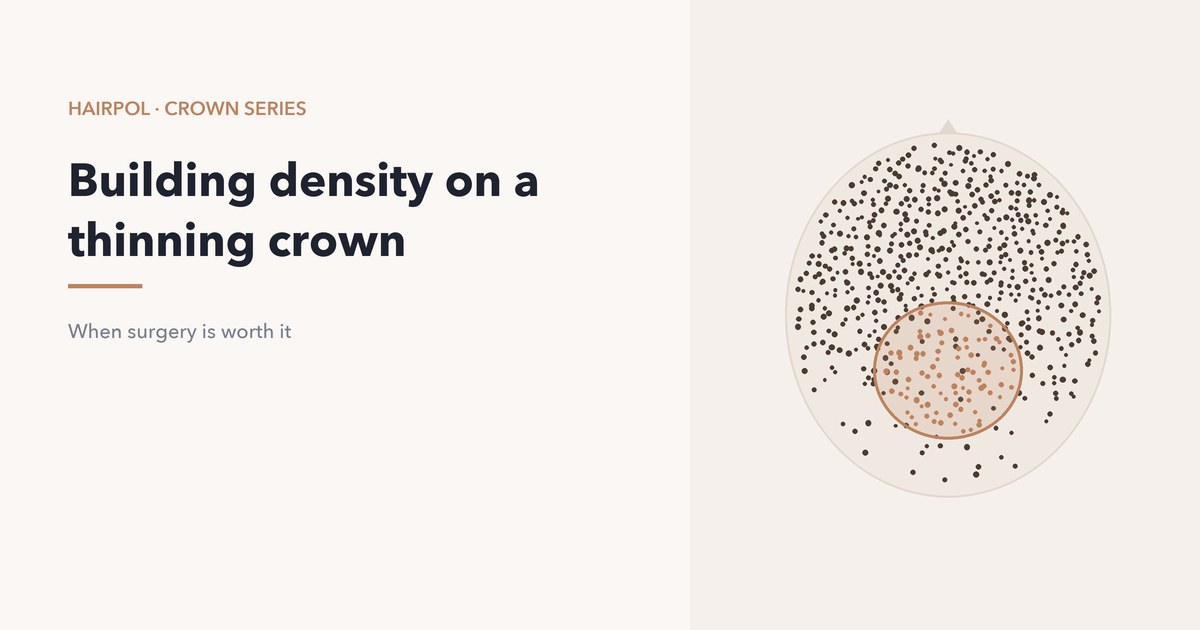
The crown is the one part of your head you almost never see. Everyone standing behind you sees it constantly. That is usually how this story starts: a photo taken from behind at a wedding, your barber holding the mirror up a second too long, an elevator with overhead lighting that seems personally offended by you. The hair is still there — but the scalp has started showing through it, and once you have seen it, you cannot unsee it.
If that describes you, you are in a strangely frustrating position. You are not bald, so the obvious transplant story does not apply to you. You are not fully covered either, so doing nothing feels like slow surrender. Most of what you will read online is written for one of those two extremes, which is why searching for a hair transplant for a thinning crown produces advice that never quite fits your head. This article is written for the middle: the thinning-but-not-bald crown, and the very specific questions it raises — medication or surgery, shock loss, realistic density, and why this area sometimes needs a second session.
Thinning Is Not Bald — and That Changes Every Decision
A completely bald crown is, surgically speaking, a simple canvas. There is nothing to protect, nothing to work around, and every graft placed is pure gain. A thinning crown is something else entirely: a live ecosystem of healthy hairs, weakening hairs, and follicles quietly on their way out. Every decision you make has to account for all three groups at the same time.
That is why the standard transplant conversation does not transfer cleanly to your situation. Surgery adds hair, but it does nothing to stop the hair you still have from continuing to weaken. Medication protects what remains, but it rarely rebuilds what is visibly gone. Most people with a thinning crown eventually need to think about both, in the right order — which is a very different proposition from the “book the operation, problem solved” framing you will meet in aggressive marketing.
We have written more broadly about whether a transplant is the right solution for thinning hair in general. The crown deserves its own discussion, though, because almost everything that makes transplant surgery difficult — changing angles, optical exposure, ongoing loss, limited blood supply — is concentrated in this one spiral of scalp.
What Is Actually Happening in a Thinning Crown
The thinning you can see is the visible end of a process called miniaturization. Under the influence of DHT, genetically sensitive follicles produce progressively finer, shorter, paler hairs with each growth cycle. The number of hairs falls more slowly than you would expect; what collapses first is the quality of each hair. Thick terminal hairs become wispy, intermediate ones, and coverage evaporates long before the follicles themselves die.
The crown makes this process look worse than it is, for a purely geometric reason. Hair there grows in a spiral — the whorl — radiating outward from a central point. Right at that point, hairs diverge away from each other, so even a modest drop in density opens a visible window of scalp. Add overhead lighting, which strikes the crown at exactly the angle that maximizes scalp reflection, and a thirty percent density loss can read as sixty.
This matters for your decision because it cuts both ways. The crown exaggerates early thinning, which panics people into premature surgery. But it also responds visibly to modest improvements — which is why medication alone sometimes produces a cosmetic result at the crown that it never achieves at the hairline.
Medication or Surgery First? The Honest Order of Operations
Here is the part some clinics soften because it delays a sale: the crown is the region of the scalp that responds best to medical treatment. Finasteride trials consistently report their strongest regrowth numbers at the vertex. Minoxidil was originally studied on the crown. If there is one area where a tablet and a foam can genuinely move the needle, it is exactly the area you are worried about.
At Hairpol, we routinely tell patients with early crown thinning to treat medically for nine to twelve months before anyone draws on their scalp. If your miniaturized hairs recover, you may not need surgery this year — or at all. If they do not, nothing has been lost: the transplant is still available, your loss pattern is now clearer, and your surgeon can plan against a stable baseline instead of a moving target. Supportive options such as PRP and mesotherapy can strengthen the response further, though they work best as reinforcement rather than as a substitute.
We compared the three paths in detail in hair transplant vs PRP vs medication. The short version for the crown: medication defends, surgery rebuilds, and the best long-term results usually come from doing both in that order rather than picking a side.
When a Hair Transplant for a Thinning Crown Makes Sense
So when does surgery become the right tool? A hair transplant for a thinning crown starts to make sense when a few conditions line up at the same time.
- Your loss has been broadly stable for at least a year — on medication, or clearly slow-moving without it.
- Scalp is visible under normal indoor light, not only under a harsh flash you had to hunt for.
- You have tried medical treatment, or you have made an informed decision not to use it and you understand what that means for the native hair around the grafts.
- Your donor area can fund the crown without bankrupting the front of your head for the next twenty years.
Notice what is not on that list: age alone, panic, or an event on the calendar. A transplant into a thinning crown is a planning decision, not an emergency response. When those conditions are met, results in this area can be quietly excellent — the crown is nobody’s favorite region to operate on, but it rewards disciplined work more than any other zone.
When Waiting Is the Smarter Decision
There are also situations where the honest recommendation is to wait, and a good clinic will say so to your face.
If you are in your early twenties with a crown that has only just started to open, transplanting now means placing permanent hair into a pattern that has not declared itself. The native hair around the grafts will keep thinning, and within a few years you risk an island of transplanted density surrounded by a widening ring of loss — which then demands another surgery to repair. If your shedding is progressing quickly, surgery does not stop it; it just redecorates the middle of the process. And if you have never tried medication, you are skipping the one intervention that could shrink the problem before you spend grafts on it.
Waiting is not doing nothing. It means stabilizing medically, photographing your crown every few months under the same light, and letting the pattern show its hand. At Hairpol, some of the best crown results we deliver belong to patients we first advised to wait a year — because by the time we operated, we were transplanting into a known situation instead of a guess.
Implanting Between Existing Hairs: The Real Shock Loss Question
This is the fear that brings most thinning-crown readers here: if grafts are placed between my existing hairs, will the surgery itself make me thinner? It is a fair question, because the risk is real. It is called shock loss — a temporary shedding of native hair in and around the transplanted zone, triggered by the local trauma and anesthesia of the procedure.
Two things are worth understanding. First, shock loss in healthy hair is almost always temporary; the follicles survive and the hair returns within a few months. Second — and this is the part that matters for you — miniaturized hairs are the vulnerable ones. A follicle already near the end of its lifespan can be pushed into shedding and never return. In a thinning crown, some of the hairs surrounding your grafts are exactly that fragile. We explain the full mechanism in shock loss after a hair transplant.
The practical answer is technique. Working between existing hairs demands finer punches, restrained density per pass, careful control of the anesthetic, and implantation angles that respect the neighbors. Methods such as DHI, which implant without pre-made channel incisions, give the surgeon tighter control in occupied territory. Shock loss cannot be reduced to zero. In careful hands, it becomes a footnote instead of a disaster.
How Density Is Built in a Crown Transplant
Density in a thinning crown is built, not poured. This is what most people actually mean when they search for a crown density hair transplant: not covering bare skin, but thickening a see-through area back to opacity.
The work starts with a map. Under magnification, your surgeon identifies which zones of the whorl have lost the most terminal hairs and where the strongest survivors stand. Grafts are then distributed strategically rather than evenly: fine single and double grafts into the most exposed central spiral, stronger three-hair units into the periphery where they add bulk without looking coarse. The goal is to interrupt the reflective window of scalp — because what your eye registers as “thin” is mostly light bouncing off skin, and breaking up that reflection restores the impression of fullness faster than raw numbers suggest.
This is also why two crowns with the same graft count can look completely different. Placement inside an existing pattern is a judgment skill. A surgeon who simply fills space produces patchy density; one who reads the miniaturization map produces coverage that blends invisibly into what you still have.
The Whorl: Angles, Direction and Why the Crown Forgives Nothing
At the hairline, transplanted hairs broadly point forward, and small angle errors hide inside the general flow. The crown offers no such mercy. Hair direction rotates through a full circle around the whorl, changing every few millimeters, and every graft has to continue that rotation precisely. Set the angle a little too steep and the new hairs stand up like brush bristles against the flat spiral around them. Miss the direction and the pattern visibly breaks.
Here your thinning crown hands you one genuine advantage over a bald one: your remaining hairs are a living map. The surgeon does not have to reconstruct the spiral from memory — it is still written on your scalp, and each recipient incision can follow it. This is precision work at the level of individual incisions, which is where blade quality and channel control matter; it is a large part of why we often prefer Sapphire FUE in this region.
If you want the deeper anatomy of the area — whorl types, zones, planning — our complete guide to crown hair transplants covers it. The short truth: in hair restoration of the crown area, direction and angle decide whether the result reads as natural long before density enters the conversation.
Realistic Density Targets: What the Crown Can and Cannot Get
Time for honest numbers. Native crown density typically runs around 70 to 90 follicular units per square centimeter. A transplant session into a thinning crown usually adds in the range of 35 to 45 units per square centimeter to the areas it treats — deliberately, because packing tighter between existing hairs raises shock loss risk and can outrun the area’s blood supply.
On paper, that sounds like half a result. In the mirror, it rarely looks that way. Visual opacity arrives well before native density is matched: hair shaft thickness, curl, and a low color contrast between hair and scalp all do heavy lifting, and grafts placed among surviving native hairs are additive — your total is transplant plus whatever medication is protecting.
What the crown cannot get is a teenager’s density under a dermatoscope, and any clinic promising that is selling you a disappointment. The realistic goal is a crown that looks closed under the lighting of everyday life — offices, restaurants, photographs, the dreaded elevator. For most patients with thinning rather than bare crowns, that goal is fully achievable, sometimes in a single well-planned session.
Why a Second Session Is Sometimes Part of the Plan
The crown has a structural constraint the front of the head does not: a comparatively modest blood supply. Every graft placed is a small wound that must be nourished to survive, and beyond a certain density per session, survival rates begin to drop. A responsible surgeon caps the first pass below that threshold — which sometimes means the crown genuinely needs two visits to reach its final look. This is the story behind the common search for crown hair transplant second session density.
A second pass, performed after twelve to eighteen months once the first grafts have matured and circulation has recovered, layers new units between the established ones and lifts the area from “covered” to “dense.” Separately, ongoing native loss can create a later need: if the hairs between your grafts keep miniaturizing over the years — especially without medication — a top-up restores what the pattern took. We cover the wider logic in when and why you might need a second hair transplant.
The key is sequencing honesty. At Hairpol, if we believe your crown will likely need two sessions, you hear it in the consultation — with the graft math on the table — not as a surprise sales call a year after your first procedure.
Your Donor Area Is a Budget — Spend It Like One
Every decision about a thinning crown ultimately answers to one bank account: your donor area. A typical head offers roughly 5,000 to 6,500 safely extractable grafts across a lifetime. The crown is quietly expensive — it is a large, curved surface, and restoring it convincingly can absorb 1,200 to 2,500 grafts or more, as we break down in how many grafts a crown transplant needs.
That budget has to be planned across decades, not around this year’s mirror. If your pattern is still evolving, the front and mid-scalp — the zones that frame your face in every conversation — may need grafts later. Spending the majority of your lifetime donor supply on the crown at thirty can leave you without reserves at forty-five. This is not an argument against crown surgery; it is an argument for doing it inside a whole-head plan, with a reserve deliberately left untouched. Good clinics think in decades. Your crown is one chapter of that plan, not the whole book.
The Crown Timeline: Slower Than You Think — and That Is Normal
Whatever you have read about hair transplant timelines, add a few months for the crown. The same blood supply constraint that limits per-session density also slows regrowth: transplanted crowns routinely lag the frontal zone by three to four months at every milestone.
Expect the transplanted hairs to shed in the first weeks — normal, and temporary. Expect the area to look unimpressive at six months, when a frontal transplant would already be presentable. Real change tends to arrive between months eight and twelve, and the mature result — the one worth judging — settles between twelve and eighteen months. If shock loss has thinned your native hair early on, the trough around month two or three can feel alarming; it recovers as both populations regrow.
The practical advice is simple: photograph monthly under identical light, compare quarterly rather than daily, and do not let the month-six crown convince you the procedure failed. In this region, patience is not a virtue — it is a requirement written into the biology.
How Hairpol Approaches a Thinning Crown
By now the theme is obvious: a thinning crown is a planning problem before it is a surgical one. At Hairpol in Istanbul, that is exactly how we treat it. Your consultation starts with magnified analysis of the whorl — how much miniaturization, where, and how stable — and an honest conversation about medication, because if a year of treatment could spare you an operation, you deserve to know that before anyone quotes you a graft count.
When surgery is the right answer, we plan it as one chapter of a whole-head strategy: graft budget mapped against your likely future pattern, density targets set to what the crown’s blood supply can actually sustain, technique chosen to protect the hair you still have, and second-session possibilities discussed before the first incision, not after. And when the right answer is to wait, we say so — a recommendation that costs us a booking and earns your crown a better outcome.
If your crown has started showing through and you want a realistic assessment rather than a sales pitch, explore our hair transplantation department and book a consultation. We will tell you what your crown actually needs — even when the answer is “not surgery, not yet.”
Frequently Asked Questions (FAQ)
Can you get a hair transplant on a thinning crown, or do you need to be completely bald first?
You do not need to be bald. Transplanting between existing hairs in a thinning crown is common and effective, but it demands more planning than a bald crown: the surgeon must protect your native hair, follow the whorl pattern, and keep density per session at safe levels. The key requirement is that your hair loss is reasonably stable first.
Will a crown transplant damage the existing hair I still have?
There is a real but manageable risk called shock loss, where native hairs around the grafts shed temporarily after surgery. Healthy hairs almost always grow back within a few months. Already-miniaturized hairs are more fragile and may not return, which is why careful technique, finer instruments and restrained density matter so much when working between existing hairs.
Should I try finasteride or minoxidil before getting a crown transplant?
In most cases, yes. The crown is the area of the scalp that responds best to medication, and 9 to 12 months of treatment can thicken miniaturized hairs enough to delay or even avoid surgery. If medication does not produce enough improvement, you can still have the transplant — now with a more stable baseline and a clearer loss pattern to plan around.
How many grafts does a thinning crown usually need?
It depends on the size of the area and the degree of thinning. Early thinning confined to the whorl may need 800 to 1,200 grafts, while more advanced or wider thinning commonly requires 1,500 to 2,500 or more. Because grafts are placed between existing hairs, the exact number is decided after magnified analysis of your crown in consultation.
Why do crown transplants sometimes need a second session for density?
The crown has a more limited blood supply than the front of the scalp, so surgeons cap the density placed in one session to keep graft survival high. A second pass after 12 to 18 months can then lift the area from covered to dense. Ongoing thinning of native hair around the grafts can also create a later need for a top-up session.
How long does it take to see results from a crown hair transplant?
Longer than the front of the head. The crown typically lags the frontal zone by three to four months: expect little visible change before month six, real improvement between months eight and twelve, and the mature result between twelve and eighteen months. Judging the outcome earlier than that usually leads to unnecessary panic.
Will my crown keep thinning around the transplanted grafts?
It can. Transplanted hairs are taken from DHT-resistant donor areas and are permanent, but the native hairs between them remain genetically vulnerable. Without medical treatment, they may continue to miniaturize over the years, gradually reducing overall density. This is why many surgeons recommend finasteride or minoxidil alongside a crown transplant.
Is PRP alone enough to fix a thinning crown without surgery?
PRP can improve the quality and thickness of hairs that are weakening but still present, and it works well as a supportive treatment alongside medication. What it cannot do is create new follicles or restore areas where scalp is clearly visible. For genuinely see-through crowns, PRP is reinforcement, not a replacement for a transplant.
Find this helpful? Add Hairpol as a preferred source on Google.
Graft Range Calculator
Answer three questions to see the typical graft range for your situation — based on our published clinical guides.
This is a preliminary estimate, not a medical assessment. The exact number can only be determined by a doctor after examining your donor area and hair characteristics.
Get a Free Consultation
Answer a few questions and the medical team will review your situation.
