
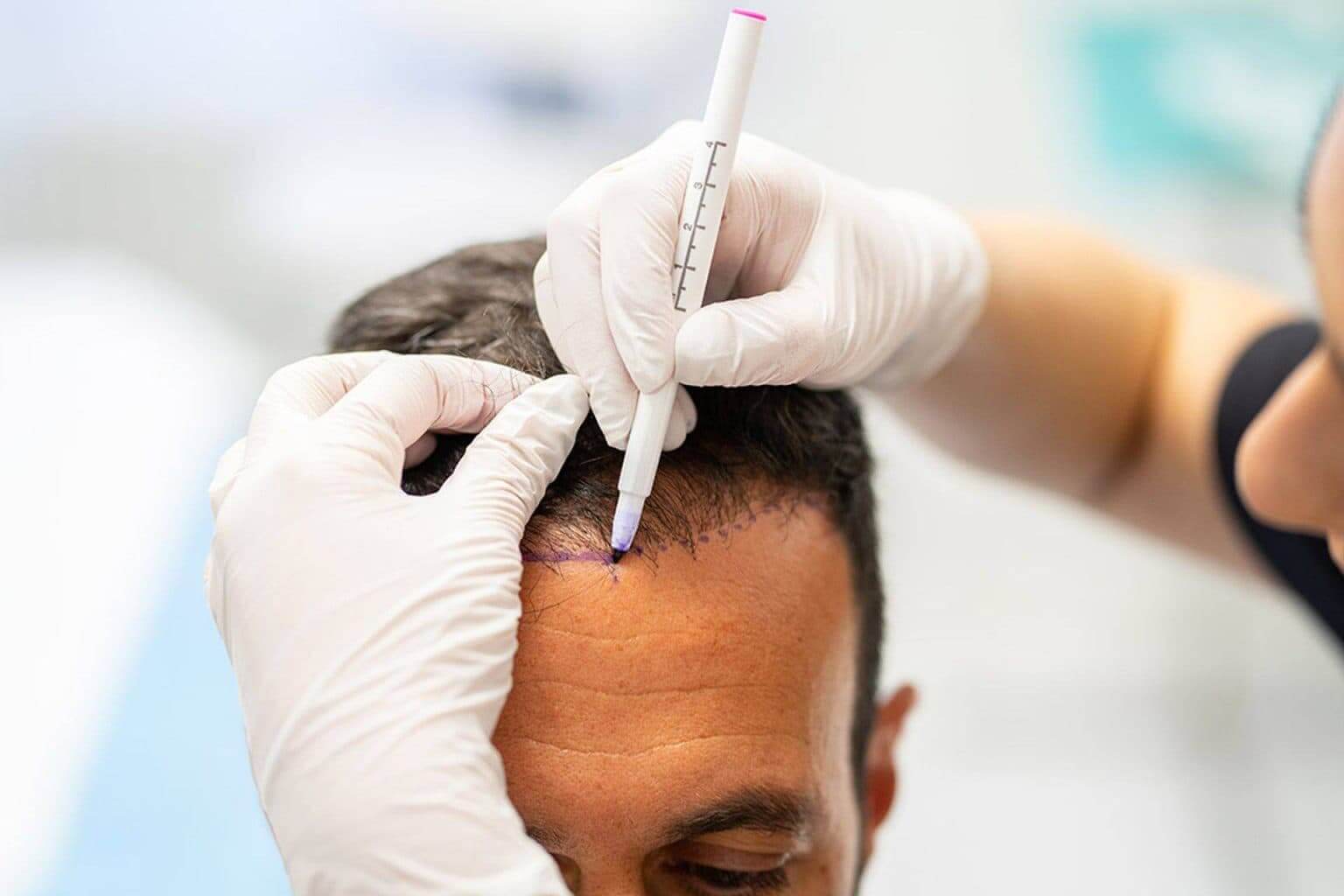
For many patients, the phrase “second hair transplant” sounds like an admission that something went wrong with the first one. Sometimes that’s true — revision procedures exist precisely because not every first procedure delivers what it should. But far more often, a second hair transplant is a planned, predictable, and entirely reasonable part of a long-term hair restoration strategy rather than evidence of failure.
Hair loss is progressive. Donor supply is finite. Safe per-session graft limits exist. The combination of these three facts means that for a substantial share of patients — particularly those who started losing hair young or who have advanced loss patterns — a single procedure was never going to be the complete answer. Understanding when and why a second procedure makes sense, how it differs from the first, and how to plan for it intelligently is part of approaching hair restoration as the long-term project it actually is.
This guide covers the full picture: the legitimate reasons patients need second procedures, the timing rules that protect both your result and your donor supply, what changes the second time around, and how to make decisions that preserve your options for the decades ahead.
A Second Transplant Is Not Automatically a Sign of Failure
The first distinction worth making is between a revision procedure and a planned second session. A revision corrects problems from an unsatisfactory first procedure — poor graft survival, an unnatural hairline, visible donor damage. A planned second session, by contrast, is a continuation of a strategy that was always likely to involve more than one stage.
Quality clinics are explicit about this distinction from the very first consultation. A 28-year-old patient with a Norwood 3 pattern and a family history of advanced baldness should hear, before their first procedure, that hair loss will likely continue and that a second session in five to ten years is a realistic part of their future. A patient with a Norwood 6 pattern should hear that the coverage they want simply cannot be achieved in one session at safe extraction limits. When that conversation happens honestly upfront, the second procedure arrives as expected maintenance of a long-term plan — not as a disappointment.
The Five Most Common Reasons for a Second Hair Transplant
1. Hair loss continued after the first procedure. This is by far the most common reason. Transplanted follicles come from the DHT-resistant donor zone and are permanent — but the native hair surrounding them remains genetically vulnerable. A patient who had their hairline restored at 30 can find, at 38, that the native hair behind the transplanted zone has thinned, creating a gap between the permanent transplanted hair in front and the receding native hair behind it. The first procedure didn’t fail; the underlying condition simply kept progressing. This is also why finasteride and minoxidil matter so much — medical management dramatically slows this progression, but it doesn’t always stop it completely, and not every patient stays on medication long term.
For a closer look at what a second session can realistically add, read our second hair transplant guide.
2. The loss pattern was too large for one session. Safe, quality-focused procedures typically transplant between 3,000 and 4,500 grafts in a single session, depending on the patient and the clinic’s protocols. Advanced patterns — Norwood 5, 6, and 7 — can require 5,000 to 7,000+ grafts for meaningful coverage. For these patients, a staged approach across two sessions spaced at least a year apart was the correct plan from day one. Attempting to do it all at once invites the over-harvesting and marathon-session quality problems that produce genuinely bad outcomes.
3. Adding density to a successful first result. A first procedure establishes the framework — the hairline, the coverage map. Once the result has fully matured at 12 to 18 months, some patients want more density than the first pass delivered, particularly under bright light or with shorter hairstyles. A density-focused second session, adding grafts between existing transplanted hair, is a refinement rather than a correction.
4. Addressing a new zone — usually the crown. Many well-planned first procedures deliberately prioritize the hairline and frontal zone, because that’s what frames the face and delivers the greatest visual impact per graft. The crown is often consciously deferred. When the patient later decides the crown matters enough to treat, that second procedure is the planned execution of a staged strategy.
5. Revising an unsatisfactory first procedure. The genuine correction scenario: low graft survival, a hairline placed too low or designed unnaturally, pluggy appearance, or visible donor damage from a poorly executed first procedure — often performed at a high-volume, low-cost clinic. Revision work is real surgery with real constraints, and it demands a higher standard of clinic than the original procedure, because it must work with a depleted donor supply and existing scar tissue.

When Is the Right Time for a Second Procedure?
The near-universal rule: wait at least 12 months after the first procedure, and many surgeons prefer 12 to 18 months. This isn’t arbitrary caution. Several biological and planning realities sit behind it.
- The first result must fully mature before it can be assessed. Transplanted hair emerges around months 4-5 and continues gaining density, caliber, and coverage through month 12 and beyond — the crown often later still. Operating at month 8 means adding grafts to areas where hair was still coming in, wasting both grafts and donor supply on zones that would have filled in on their own.
- The donor area needs time to recover. Extraction sites heal, redness resolves, and the surrounding skin regains its normal character over months. Re-entering a donor zone too early means working in tissue that hasn’t finished healing, with worse extraction conditions and higher transection risk.
- Scalp vascularity needs to normalize. The recipient area’s blood supply — the network that keeps newly implanted grafts alive — is disrupted by the first procedure and rebuilds over months. A second procedure into a recipient zone with compromised vascularity risks lower graft survival.
- Accurate planning requires a stable picture. Only when the first result is mature can the surgeon see precisely what survived, what density was achieved, where the gaps are, and how much donor supply realistically remains. Planning a second session on a moving target produces bad plans.
For patients whose second procedure is driven by continued hair loss rather than a staged plan, the timing question is different: the right time is when the loss has been stabilized — ideally with medical management — and the new pattern is clear enough to plan around. Transplanting into an actively, rapidly progressing loss pattern without stabilization repeats the most common planning mistake of first procedures.
The Donor Supply Question
Everything about second procedures ultimately runs through one constraint: donor supply is finite and irreplaceable. The safe donor zone at the back and sides of the scalp contains a limited number of follicular units that can be extracted over a lifetime without producing visible thinning — for most patients, roughly 6,000 to 8,000 grafts in total, with significant individual variation based on donor density, hair characteristics, and scalp laxity.
What this means in practice:
- A first procedure of 3,500 grafts leaves a patient with perhaps 2,500 to 4,500 grafts of remaining lifetime capacity — enough for a meaningful second session, but not unlimited.
- A first procedure that over-harvested — extracting too many grafts or extracting them unevenly — both damages the donor’s appearance and reduces what remains available for any future work.
- The remaining supply must be assessed honestly before planning a second session. A quality consultation measures donor density per square centimeter, evaluates the distribution of previous extractions, and calculates what can still be taken safely.
- For patients with depleted scalp donor zones, beard hair (typically 500-2,000 additional grafts in suitable candidates) and body hair can supplement — with the caveat that these hairs have different texture, growth cycles, and caliber, making them better suited to adding density behind the hairline than to building the hairline itself.
This finite-resource reality is also the strongest argument for conservative, intelligent first procedures. Every graft spent carelessly in round one is a graft unavailable for round two.
How a Second Transplant Differs From the First
Patients often assume the second procedure will be a repeat of the first experience. It’s similar in structure — extraction, channel creation, implantation, the same recovery arc — but several things genuinely differ.
The donor area is a different working environment. Density is lower than it was originally, because grafts were already removed. Microscopic scar tissue from previous extractions changes skin texture and can make individual follicular units slightly harder to extract cleanly. Experienced surgeons work more slowly and selectively in a previously harvested donor, choosing extraction points that maintain even distribution and avoiding clustering that would create visible thin patches.
The recipient area contains hair that must be protected. In a density or blending session, new channels are created between existing transplanted follicles. This demands precision — both to avoid transecting grafts that are already growing and to match the angles and direction of existing hair so new growth integrates invisibly. This is one of the scenarios where DHI has genuine advantages: the implanter pen’s control allows precise placement between existing hairs with minimal trauma to surrounding follicles. Sapphire FUE also performs well here, with its fine blades creating clean channels in tight spaces.
Planning is more constrained and more consequential. The first procedure worked with a full donor supply and a blank recipient canvas. The second works with what remains of both. Graft allocation decisions — how many to the crown, how many to density, how many held in reserve for the future — carry more weight when the reserves are smaller.
Expectations are calibrated differently. Second sessions typically involve fewer grafts than first sessions, and the visual change is often refinement rather than transformation. Patients who experienced the dramatic before-and-after of a first procedure should expect the second to be more subtle — which is usually exactly what’s wanted.
Who Is a Good Candidate for a Second Procedure?
The candidacy assessment for a second transplant is, if anything, stricter than for a first:
- At least 12 months from the previous procedure, with the first result fully matured and assessable.
- Adequate remaining donor supply, confirmed by actual measurement rather than assumption.
- Stabilized hair loss — either naturally plateaued or managed with finasteride/minoxidil — so the second result isn’t undermined by the same progression that created the need for it.
- A healthy donor and recipient scalp, fully healed from the first procedure, without active skin conditions.
- Realistic goals that match what the remaining supply can deliver. A patient with 2,000 remaining grafts and a Norwood 6 pattern needs an honest conversation about prioritization, not a clinic willing to promise full coverage.
The Role of Medical Management Between Procedures
The period between a first and potential second procedure is exactly when medical management earns its keep. Finasteride slows or halts the androgenetic progression that creates most second-procedure demand in the first place. Minoxidil supports the native hair surrounding the transplanted zones. Patients who stay on effective medical management after a first procedure frequently delay the need for a second by years — or avoid it entirely. Patients who skip it often find themselves back in a consultation chair watching the native hair behind their transplant recede.
The honest framing: surgery addresses the hair already lost; medication protects the hair still there. A long-term result depends on both.
Planning the First Procedure With the Second in Mind
If there’s one strategic lesson in everything above, it’s that the best second procedures are made possible by well-planned first ones. Quality clinics plan first procedures with the patient’s lifetime in view:
- A hairline placed conservatively — age-appropriate, not the aggressive low line a 25-year-old requests — so it still makes sense at 50.
- Donor extraction distributed evenly and kept well within safe limits, preserving both appearance and future capacity.
- Graft allocation that prioritizes the zones of highest visual impact, with an explicit understanding of what’s being deferred.
- A documented master plan, so that whoever performs future work knows exactly what was done and what was intended.
A clinic that promises maximum grafts, maximum density, and a teenage hairline in session one isn’t being generous — it’s spending your future options to inflate today’s result.
What Recovery Looks Like the Second Time
The recovery arc of a second procedure follows the same timeline as the first: scabbing and initial healing in the first two weeks, shock loss in weeks two to six, the quiet phase through months two to four, new growth from months four to five, and maturation through twelve months. A few second-time specifics worth knowing:
- Shock loss can temporarily affect previously transplanted hair near the new channels. This is alarming to see and almost always reverses — transplanted follicles are robust, and the shed hair returns with the new growth wave.
- The donor area may feel different during healing — some patients report slightly more sensitivity in previously harvested zones, others notice no difference.
- Patients are typically calmer the second time. Having lived through shock loss and the quiet phase once, the timeline holds fewer surprises.
If you would rather see a figure before a consultation, the hair graft calculator asks a few questions about your loss stage and the area you want covered, then gives back the graft range cases like yours tend to fall into. It is an estimate; your own number follows an assessment of your photographs.
Choosing the Clinic for Round Two
A second procedure demands a higher standard of clinic than a first, because the margin for error is smaller. The verification fundamentals remain — Ministry of Health authorization, surgeons who personally perform the surgical stages, ISHRS engagement, twelve-month result documentation — but second-procedure consultations should additionally demonstrate: a genuine assessment of your remaining donor capacity with actual measurement, a willingness to review your first procedure’s records and photographs, honest graft-allocation math rather than optimistic promises, and a plan that explicitly preserves reserves for the future where the loss pattern justifies it.
Bring documentation: your first procedure’s graft count, technique, date, clinic records, and progress photos. The more the planning surgeon knows about round one, the better round two can be designed.
At Hairpol, second procedures — whether planned staged sessions, density refinements, or revisions of work done elsewhere — begin with exactly this kind of honest assessment: measuring what donor supply remains, evaluating how the first result matured, stabilizing any ongoing loss medically, and designing a session that delivers meaningful improvement while protecting what the future may still require. A second hair transplant done for the right reasons, at the right time, with the right planning isn’t a setback. It’s the second chapter of a strategy that treats your hair — and your finite donor supply — as the long-term asset it is.
Find this helpful? Add Hairpol as a preferred source on Google.
Get a Free Consultation
Answer a few questions and the medical team will review your situation.
