
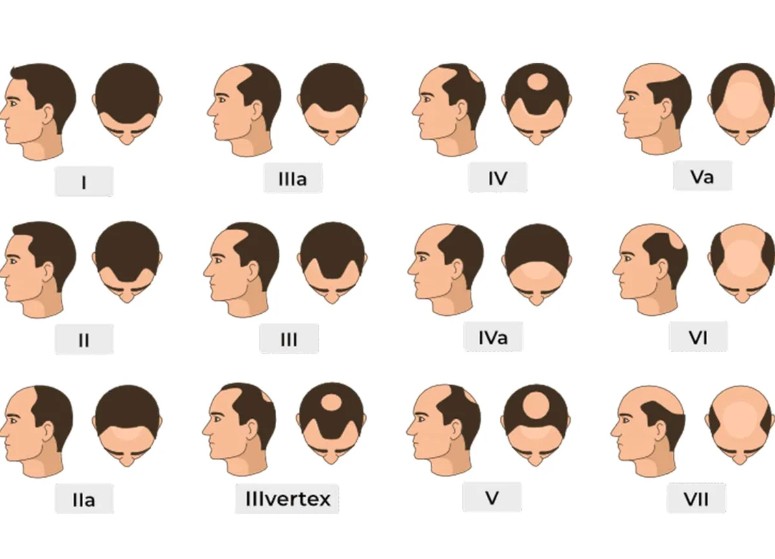
Anyone seriously considering a hair transplant will, sooner or later, run into the Norwood Scale. It is the diagram of male heads — from a full head of hair on the left to an almost bare scalp on the right — that appears on nearly every clinic’s website and in nearly every consultation. Far from being a marketing graphic, the Norwood Scale is the standard medical classification system used worldwide to describe male pattern baldness, and learning to read it is one of the most useful things you can do before making any decision about surgery.
The reason it matters so much is that your position on the scale shapes almost every part of a transplant plan. It influences how many grafts you are likely to need, how your hairline should be designed, how your limited donor hair should be managed, and — crucially — how your hair loss is likely to progress in the years ahead. A patient at an early stage and a patient at an advanced stage are facing very different procedures, even though both are described by the same word: “baldness.”
This guide explains what the Norwood Scale actually is, walks through all seven stages and the important variants, shows you how to identify your own hair loss pattern, and explains what each stage means in practical terms for a hair transplant. The goal is to turn that intimidating row of diagrams into something you can genuinely use.
What Is the Norwood Scale?
The Norwood Scale is a classification system that describes the typical stages of male pattern baldness, medically known as androgenetic alopecia. It was first developed by Dr. James Hamilton in the 1950s and later revised and expanded by Dr. O’Tar Norwood in the 1970s. Because of this shared history, the system is sometimes called the Hamilton-Norwood Scale, though most people today simply refer to it as the Norwood Scale.
Its purpose is to provide a common, standardized language for describing how far hair loss has progressed. Instead of vague descriptions like “a bit thin on top” or “going back at the front,” the scale assigns a clear stage — from 1 to 7 — that both patients and surgeons can use to mean the same thing. This shared vocabulary is what makes it so valuable: when a surgeon says you are a “Norwood 3 Vertex,” that phrase carries precise meaning about exactly where and how much hair has been lost.
The scale maps the two areas where androgenetic alopecia typically attacks: the frontal hairline and temples, and the crown — the vertex, at the back top of the head. As the condition progresses, these two zones enlarge and eventually merge, and the scale describes that journey in defined steps.
Why the Norwood Scale Matters Before a Hair Transplant
Understanding your Norwood stage is not just an academic exercise. It has direct, practical consequences for any transplant you might consider.
First, it drives the graft estimate. The number of grafts required to restore an area is roughly proportional to how much ground has been lost, so your stage gives a surgeon a starting point for estimating the size — and therefore the cost and duration — of your procedure. Second, it helps predict future loss: hair loss is progressive, and knowing your current stage helps a surgeon anticipate how your hair loss pattern may develop, which is essential for designing a hairline that will still look natural in ten or twenty years. Third, it informs donor area planning, because the higher your stage, the more demand is placed on a finite supply of permanent hair. Finally, it sets realistic expectations — the single most important factor in whether a patient is happy with their result.
The Seven Stages of the Norwood Scale
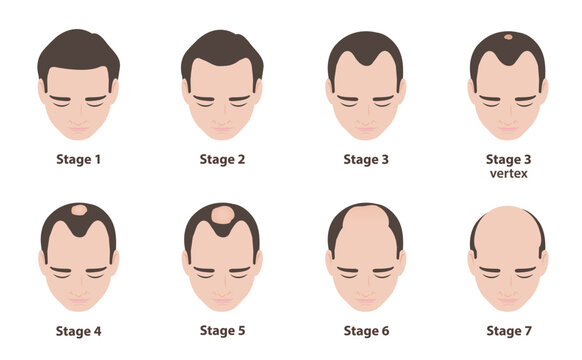
The classic Norwood Scale runs from Stage 1 to Stage 7, with each stage representing a recognizable point in the progression of male pattern baldness. Here is what each stage describes:
- Stage 1. No significant hair loss or recession of the hairline. This is essentially the baseline — a full, adolescent hairline with no visible thinning. Most men do not stay at this stage permanently.
- Stage 2. A slight, symmetrical recession of the hairline around the temples, often called a “mature hairline.” This is extremely common and is not always a sign of progressive balding; many men reach Stage 2 and remain there.
- Stage 3. The first stage considered to represent clinically significant androgenetic alopecia. The temporal recession deepens, creating the classic “M,” “U,” or “V” shape as the receding hairline becomes more pronounced. A separate variant, Stage 3 Vertex, describes loss concentrated at the crown rather than the hairline.
- Stage 4. More severe recession at the front and temples, combined with a distinct, enlarging area of loss at the crown. At this stage the two areas are still separated by a band of hair across the top of the scalp.
- Stage 5. The two areas of loss — frontal and crown — are larger than in Stage 4, and the band of hair separating them is narrower and sparser. The two zones are clearly heading toward each other.
- Stage 6. The bridge of hair that once separated the front and crown is largely gone, so the two balding areas merge into one large region. Only the sides and a thinning area remain on top.
- Stage 7. The most advanced stage. Only a horseshoe-shaped band of hair remains around the sides and back of the head, with the entire top of the scalp bald. This band corresponds to the permanent donor area.
The Norwood Type A Variant
Beyond the standard progression, the scale recognizes a less common pattern known as the Norwood Type A variant. In Type A balding, the hairline recedes uniformly from front to back, rather than the temples and crown thinning separately and later merging. There are two defining features: there is no isolated bald spot at the crown, and there is no persistent bridge of hair across the mid-scalp.
This distinction matters for planning because the Type A pattern tends to advance in a more front-to-back direction, which can affect both how grafts are distributed and how future loss is anticipated. Recognizing whether you follow the classic pattern or a Type A variation helps a surgeon design a more accurate long-term plan.
How to Identify Your Own Norwood Stage
You can get a reasonable sense of your own Norwood stage at home, even though a professional assessment is always more accurate. The key is to look honestly at the two areas the scale tracks.
Start with your hairline. Using a mirror in even, neutral lighting, look at how far your hairline sits above your eyebrows and whether the temples have receded into an “M” shape. Compare what you see to the diagrams on a Norwood Scale chart. Then check your crown: because it is hard to see directly, use two mirrors or, more easily, take a photograph of the top and back of your head. This is the only reliable way to assess vertex thinning that you cannot feel.
A few cautions make self-assessment more accurate. Harsh overhead or bathroom lighting can exaggerate thinning by casting shadows, and wet hair almost always looks thinner than dry hair, so judge yourself in normal conditions. It is also worth taking photos over several months, because a single snapshot cannot tell you whether your hair loss pattern is stable or progressing. When in doubt — and especially if you are weighing surgery — a clinical assessment will measure not just your stage but the density and health of your hair in a way that a mirror cannot.
What Your Norwood Stage Means for Graft Numbers
One of the most common questions patients ask is how many grafts they will need, and your Norwood stage provides a useful starting estimate. The following ranges are approximate and vary considerably between individuals, but they illustrate how graft requirements scale with hair loss:
- Norwood 2 to 3: roughly 1,500 to 2,500 grafts, typically to restore or reinforce a receding hairline and temples.
- Norwood 3 Vertex to 4: roughly 2,500 to 3,500 grafts, addressing both the hairline and an emerging crown.
- Norwood 5: roughly 3,500 to 4,500 grafts, as the areas of loss enlarge.
- Norwood 6: roughly 4,500 to 6,000 or more grafts, often requiring more than one session.
- Norwood 7: the area of loss may exceed what the donor area can realistically cover, so full restoration is frequently not possible and priorities must be set.
It is important to treat these figures as a guide rather than a promise. The actual number depends on your individual donor density, the caliber and curl of your hair, the contrast between your hair and skin color, and your personal goals for density. Two men at the same Norwood stage can need quite different graft counts.
The Norwood Stage and the Donor Area
Every hair transplant draws from the donor area — the band of hair at the back and sides of the head that is genetically resistant to androgenetic alopecia and therefore tends to be permanent. This donor supply is finite, and it is the single biggest constraint in any transplant.
As your Norwood stage increases, the demand for grafts rises, but the donor supply does not. This is why advanced stages can be challenging: there may simply not be enough permanent hair to cover a large bald area at full density. A skilled surgeon manages this by harvesting conservatively, distributing grafts strategically, and prioritizing the areas that frame the face. Over-harvesting the donor area to chase coverage is a serious mistake, because it can leave the donor zone visibly thin and limit future procedures.
This is also why donor assessment is measured so carefully. Surgeons evaluate donor density in follicular units per square centimeter and estimate the total number of grafts that can be safely harvested over a lifetime without thinning the area. A patient with high donor density has more flexibility at higher Norwood stages, while someone with a naturally sparse donor may be limited even at a moderate stage. In most cases it is the donor, not the size of the bald area, that sets the real ceiling on what a transplant can achieve.
The Limitations of the Norwood Scale
For all its usefulness, the Norwood Scale has real limitations that are worth understanding. It describes male pattern baldness specifically, so it does not fit female hair loss, which follows a different distribution and is usually classified with the Ludwig scale instead.
The scale also captures the pattern of loss rather than its finer details. It does not measure hair density or caliber, so two men classified at the same stage may have very different amounts of remaining hair. It does not handle diffuse thinning well — a generalized thinning across the whole scalp, including the donor area, which does not match any of the defined stages neatly. And because miniaturization — the gradual shrinking of hairs before they are lost — is not visible in a simple diagram, the scale can understate early loss. Finally, the Norwood Scale is a snapshot: it tells you where you are now, not how fast you are progressing or where you will end up.
How the Norwood Scale Compares to Other Hair Loss Scales
The Norwood Scale is the standard for men, but it is not the only hair loss classification system in use. For women, the Ludwig scale is the most common, describing female pattern loss in three grades based on the severity of diffuse thinning across the crown while the frontal hairline is preserved. The Savin scale is similar but adds an assessment of overall density, which can be useful for tracking change over time. There are also more detailed research tools, such as the Basic and Specific (BASP) classification, which separates the basic shape of the hairline from specific areas of thinning and aims to describe both male and female patterns more precisely.
For practical purposes, though, the Norwood Scale remains the reference point for men considering a hair transplant, because it captures the specific way male pattern baldness progresses. Knowing that other scales exist is mainly useful for understanding why a one-size-fits-all diagram cannot describe every kind of hair loss — and why your own assessment should always consider the details the scale leaves out.
Why Stage Progression and Age Matter
Because androgenetic alopecia is progressive, your current Norwood stage is only part of the picture — the direction and speed of change matter just as much, and this is closely tied to age. A man who reaches Stage 3 in his early twenties is statistically likely to progress further than a man who reaches the same stage in his fifties, and that difference has major implications for surgery.
This is why responsible clinics are cautious about operating on very young patients with early but actively advancing loss. Transplanting a low, dense hairline at twenty-two can look good initially but become unnatural if the hair behind it continues to thin, leaving an isolated band of transplanted hair. For this reason, medical therapies such as finasteride and minoxidil are often recommended first to stabilize loss, and hairlines are designed conservatively to account for future progression. Planning for the hair loss pattern you are likely to have in the future — not just the one you have today — is what separates a result that ages well from one that does not.
From Norwood Stage to a Treatment Plan
In a good consultation, your Norwood stage is the starting point rather than the conclusion. A surgeon combines it with an assessment of your donor area density, your age and family history, the caliber and characteristics of your hair, and your personal goals to build a realistic plan. The stage tells the surgeon how much has been lost and where; the donor assessment tells them what is available to work with; and your goals determine how those limited resources should be prioritized.
This is also where expectations are set honestly. A patient at an early stage with strong donor hair may be able to achieve a dense, natural restoration in a single session, while a patient at an advanced stage may need to accept a focus on framing the face and adding overall coverage rather than restoring the density of youth. Neither outcome is a failure — but only an honest, stage-aware plan makes the difference clear before any surgery takes place.
At Hairpol, every plan begins exactly here: an honest assessment of your Norwood stage and hair loss pattern, a careful analysis of your donor area, and a frank conversation about what is realistically achievable for your specific situation. Rather than promising a number before understanding your hair, the goal is to design a result that looks natural now and continues to look natural as the years pass — because a transplant is not just about the hair you have today, but about the hair loss pattern you are planning around for the rest of your life. If you are trying to understand where you fall on the scale and what it means for you, a proper consultation is the right next step.
Find this helpful? Add Hairpol as a preferred source on Google.
Graft Range Calculator
Answer three questions to see the typical graft range for your situation — based on our published clinical guides.
This is a preliminary estimate, not a medical assessment. The exact number can only be determined by a doctor after examining your donor area and hair characteristics.
Get a Free Consultation
Answer a few questions and the medical team will review your situation.
