
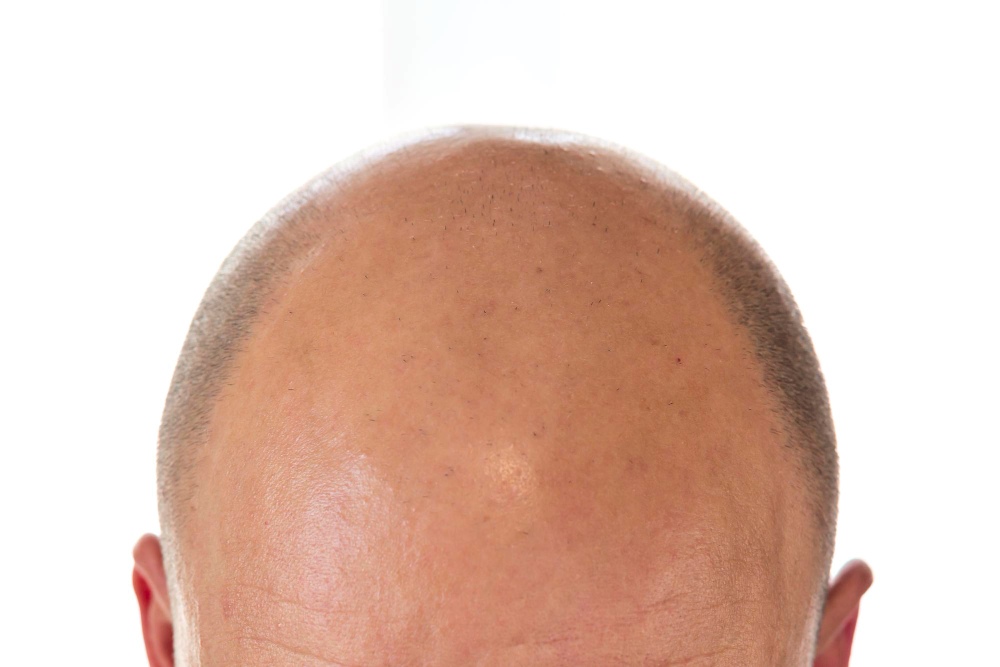
Diffuse thinning means hair loses density fairly evenly across the scalp, including the sides and back, rather than receding in the predictable pattern of male or female pattern baldness. Because the loss is spread out, it can go unnoticed until roughly 50% of local density is gone.
That distribution is what decides transplant suitability: surgery relies on a stable donor area, and diffuse loss can make donor hair unreliable. Accurate diagnosis and medical treatment usually come first.
Two people can look at the same thinning hair and be facing completely different problems. One has hair vanishing from a predictable place: the temples creeping back, the crown opening up, while the sides stay thick. The other notices their whole scalp getting see-through, the part widening, light passing through where it never used to, with no obvious bald patch anywhere. They might describe it the same way at the dinner table, “my hair is thinning,” but under a microscope these are two different stories with two very different endings.
The distinction between diffuse thinning and pattern baldness is not academic. It is the single biggest factor in whether a hair transplant will help you or harm you. Get it right and surgery can be life-changing. Get it wrong and you can spend a permanent resource on a problem surgery was never going to fix. At Hairpol, sorting out which one you actually have is the first real conversation, long before anyone talks about grafts or dates.
Thinning vs Balding: The Difference That Actually Decides Things
Strip away the medical vocabulary and the core difference is simple. Pattern baldness takes hair from specific, predictable areas and leaves other areas untouched. Diffuse thinning takes a little hair from everywhere, thinning the whole scalp more or less evenly rather than carving out bald zones. One is a map with clear borders. The other is a fog that settles over the entire head.
This matters for one reason above all others: a hair transplant works by moving hair from an area that keeps its hair to an area that has lost it. That only makes sense when some of your hair is genuinely safe and permanent. Pattern baldness usually leaves exactly that, a reliable band of hair at the back and sides that is not programmed to fall. Diffuse thinning may not leave any safe zone at all, because the thinning reaches into the very areas a surgeon would want to harvest from.
So before anyone counts grafts, the question that has to be answered is which of these patterns you are dealing with. Everything else, the technique, the graft number, the expected result, depends on that answer. It is the fork in the road, and choosing the wrong branch is expensive in a way you cannot undo.
What Pattern Baldness Really Is
Pattern baldness, known medically as androgenetic alopecia, is by far the most common cause of hair loss in both men and women. It is driven by genetics and by hormones, specifically the sensitivity of certain hair follicles to a derivative of testosterone called DHT. Follicles that are sensitive to DHT gradually shrink with each growth cycle, a process called miniaturization, producing finer, shorter, weaker hairs until eventually they stop producing visible hair at all.
The defining feature is the pattern itself. In men it tends to follow a recognisable sequence, mapped out on the Norwood scale, starting at the temples and crown and progressing in stages. In women it more often shows up as a widening part and general thinning over the top, described by the Ludwig scale, while the frontal hairline is usually preserved. Crucially, the hair at the back and sides of the head is generally not DHT-sensitive, which is why it survives.
That surviving band is the entire basis of hair transplant surgery. Because those follicles are genetically resistant to thinning, they keep growing even after they are moved into a bald area. That is what makes pattern baldness, in most cases, a problem that surgery can genuinely solve.
What Diffuse Thinning Hair Looks Like
Diffuse thinning behaves differently. Instead of retreating from defined zones, the hair thins across the whole scalp at once. People often describe noticing it in specific moments rather than in the mirror: more hair in the drain, a ponytail that has lost its thickness, a scalp that shows through under bright bathroom light or in flash photographs. There is no single bald spot to point at, which is part of what makes it so unsettling.
Because the loss is spread out, it can be slow to recognise. The overall shape of the hairline may stay intact while density quietly drains away everywhere. Someone can keep what looks like a full head of hair from a distance and still feel their hair has become noticeably thinner, weaker, and harder to style. Parting lines widen, coverage drops, and the scalp becomes easier to see, all without the obvious landmarks of classic balding.
This even, all-over quality is exactly why diffuse thinning complicates the surgical question. When thinning is everywhere, the comfortable assumption behind a transplant, that there is a stable reservoir to borrow from, can no longer be taken for granted. The first job is to find out whether that reservoir exists at all.
Diffuse Thinning in Men
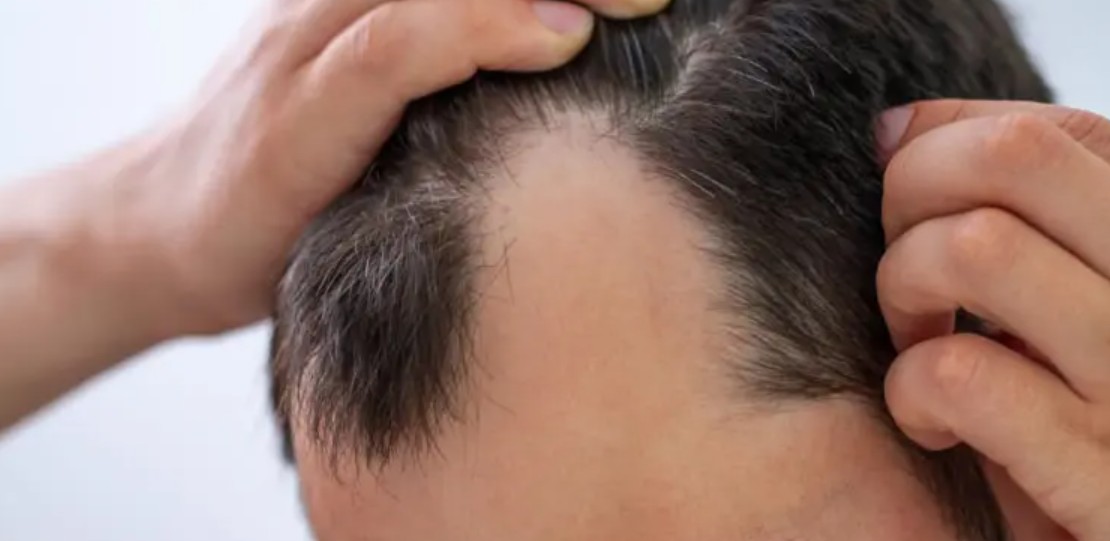
In men, diffuse thinning most often turns out to be androgenetic hair loss that has spread across the top of the scalp instead of following the classic recession at the temples and crown. The hairline may keep its shape for years while the whole top becomes finer and more see-through, which is why many men with this pattern do not recognise themselves anywhere on the Norwood scale.
Surgeons sometimes call this diffuse patterned alopecia, and the name points to the detail that matters: the thinning is spread out, but it stays within the DHT-sensitive zone. The back and sides remain healthy. That makes it a very different situation from DUPA, covered below, where the donor area thins as well. Two men can show the same see-through top in a photo and have opposite surgical outlooks, depending entirely on what the back of the head is doing.
Not every case in men is genetic, either. Telogen effluvium after an illness or a stressful period, a crash diet, thyroid problems and low iron can all make men shed evenly across the scalp, and these often settle once the trigger is dealt with.
So the practical order for a man with all-over thinning is the same as for anyone else: find the cause, look closely at the donor area, and stabilise the hair you have before deciding anything permanent. If the assessment shows a stable donor and a patterned top, surgery may be back on the table, and we explain how that call is made in hair transplant for diffuse thinning: are you a candidate?
Why the Donor Area Is the Whole Story
Every hair transplant lives or dies on the donor area, the band of hair at the back and sides that gets harvested and redistributed. In classic pattern baldness, this zone is a genuine safe haven. The follicles there are resistant to DHT, so they keep their hair for life, and that permanence is what gets transferred when they are moved. A graft taken from a stable donor keeps growing in its new home for the same reason it would have kept growing where it started.
This is where diffuse thinning becomes dangerous. If the thinning is truly diffuse, it does not politely stop at the borders of the donor zone. It can reach into the back and sides too, meaning the very hair a surgeon would harvest is itself in the process of thinning. Move that hair into a bald area and it may continue to miniaturize there, leaving a result that fades rather than lasts, while also depleting a region that was never as stable as it looked.
This is why a careful clinic spends real time examining the donor before promising anything. The visible top of your head is only half the picture. The honest answer to whether surgery can help often lives in the back and sides, in whether that hair is permanent or quietly on its way out.
DUPA: The One That Changes the Answer
There is a specific form of diffuse loss that surgeons take very seriously, and its name is worth knowing: DUPA, or diffuse unpatterned alopecia. Unlike ordinary pattern baldness, DUPA thins the entire scalp including the donor area, and it tends to do so faster and more aggressively. The hallmark is that there is no stable safe zone; the back and sides are affected just like the top.
For hair transplant surgery, this changes the answer completely. If there is no permanent donor hair, there is nothing reliable to move, and a transplant performed anyway is likely to thin out along with everything else, sometimes leaving visible harvesting in an already compromised donor. For this reason, DUPA is widely considered a contraindication to surgery. It is one of the clearest cases where the responsible recommendation is not to operate.
Identifying DUPA takes more than a quick look, because in its early stages it can resemble routine pattern thinning. Examining the donor zone under magnification for unusually high miniaturization is what separates the two. At Hairpol, this is exactly the kind of finding that leads to an honest no rather than a quick yes, because performing surgery here would take a permanent resource and waste it.
Diffuse Thinning Isn’t Always Genetic
Here is the more hopeful side of the story. Not all diffuse thinning is permanent, and not all of it is even genetic. A significant share of all-over shedding comes from causes that are temporary and treatable, which means the right move is often to investigate before assuming the worst, and certainly before reaching for surgery.
One of the most common culprits is telogen effluvium, a temporary shift that pushes a large number of hairs into the shedding phase at once. It is typically triggered by a shock to the system, a major illness, surgery, childbirth, severe stress, rapid weight loss, or starting and stopping certain medications, and it usually shows up a few months after the event. Thyroid imbalances and low iron stores, reflected in ferritin levels, are also frequent contributors, as are crash diets and nutritional gaps. The encouraging part is that when the underlying trigger is corrected, the hair often recovers on its own.
This is precisely why a good clinic does not rush a thinning patient into the operating room. If the cause is reversible, the smartest treatment is to fix the cause, and our hair treatments are aimed at exactly these situations, supporting and stabilising hair rather than surgically replacing it. Surgery cannot fix a thyroid problem or an iron deficiency, and it should never be used to paper over one.
How a Surgeon Tells Them Apart
Distinguishing diffuse thinning from pattern baldness is not something you can reliably do in front of a mirror, and it is not something a clinic should do with a glance either. It calls for proper examination, and the difference between a casual estimate and a real diagnosis is the difference between a safe plan and a costly mistake.
The key tool is trichoscopy, examining the scalp under magnification with a dermoscope. This lets a surgeon see what is actually happening at the follicle level: how much miniaturization is present, whether the thinning is concentrated in pattern zones or spread evenly, and, critically, whether the donor area shows signs of instability. A pull test can reveal active shedding, and the distribution of affected hairs tells its own story. Where a reversible cause is suspected, bloodwork checking thyroid function, ferritin, and other markers fills in the rest of the picture.
This is also why a remote quote based on a couple of phone photos is worth so little for a thinning scalp. You cannot assess donor stability or measure miniaturization from a snapshot. A trustworthy assessment looks closely, and sometimes the most valuable thing it produces is the realisation that what looked like simple balding is something else entirely.
Why Pattern Baldness Responds Well to Surgery
When the diagnosis really is straightforward pattern baldness, the outlook for surgery is genuinely good, and it is worth understanding why. The logic is almost mechanical. You have bald or thinning areas on top that have lost their hair, and you have a band at the back and sides whose hair is genetically programmed to stay. A transplant simply relocates the permanent hair into the areas that need it.
Because the moved follicles keep their original resistance to DHT, they behave in their new location the way they behaved in the old one, growing for the long term. This is why a well-planned transplant in a good pattern-baldness candidate can produce results that last for decades rather than fading after a few years. The defined nature of the loss also makes planning more predictable, since the surgeon can see where the stable hair ends and the thinning begins.
None of this means the result takes care of itself. Native hair around the transplanted grafts can keep thinning over time if it is not supported, which is why even ideal candidates are often advised to protect their existing hair alongside surgery. But the fundamentals are sound, and that is what makes pattern baldness the situation hair transplant surgery was essentially designed for.
Why Diffuse Thinning Often Doesn’t
The flip side is harder to hear. When thinning is genuinely diffuse and genetic, surgery often cannot deliver, and pushing ahead anyway tends to disappoint at best and cause harm at worst. The reason traces straight back to the donor. If the hair at the back and sides is itself thinning, there is no dependable reservoir to draw from, and a transplant built on unstable hair is built on sand.
Even where some surgery is technically possible, the risks are different. Harvesting from a thinning donor can make that area look sparser, and grafts taken from compromised hair may continue to miniaturize after transplantation, so the early result quietly erodes. You can end up having spent grafts, money, and recovery time on coverage that does not hold, while leaving the donor visibly thinner than before. That is the opposite of what anyone wants from the procedure.
This is the heart of why the diffuse-versus-pattern distinction matters so much. It is not about discouraging people. It is about not spending an irreplaceable resource on a problem that surgery was never built to solve. A clinic willing to say so is protecting you, even when the message is not the one you were hoping to hear. Our honest look at whether a hair transplant works for everyone goes further into where the limits genuinely lie.
Where Medical Treatment Comes First
For a great many people with diffuse thinning, the real answer is not a scalpel, it is treatment aimed at the cause and at stabilising the hair you still have. This is not a consolation prize. For diffuse loss, medical management is frequently the more appropriate and more effective path, and in plenty of cases it is the only thing that genuinely helps.
Depending on the cause, that can mean addressing an underlying issue like thyroid function or low iron, supporting the follicles with treatments such as mesotherapy or PRP, or using established medical therapies to slow hormone-driven thinning. The aim is to protect and strengthen existing hair across the whole scalp rather than to redistribute it, which is exactly what diffuse thinning calls for. Our hair treatments are designed around this goal. For women in particular, whose loss is more often diffuse than sharply patterned, this approach is frequently the right starting point, something our guide to hair transplants for women explores in more depth.
Starting with treatment also has a strategic benefit even when surgery may eventually play a role. Stabilising ongoing loss before any operation protects both the result and the donor, and it gives everyone a clearer view of what the hair is really doing. Rushing to transplant a moving target rarely ends well.
Mixed Pictures and What to Do
Real scalps are not always tidy. Plenty of people do not fall cleanly into one camp, carrying defined pattern baldness in some areas while also experiencing a degree of diffuse thinning across the top. These mixed pictures are common, and they are exactly why a careful, individual assessment matters more than any rule of thumb.
In these cases the approach is usually layered. The diffuse component is addressed first with medical treatment, both to stabilise ongoing loss and to clarify how much hair is genuinely permanent. Once things are stable and the donor has been properly evaluated, a transplant can be planned for the clearly patterned areas where stable hair is being moved into reliably bald zones. Done in that order, surgery and medical treatment support each other rather than working against each other.
What this really comes down to is honest, careful evaluation rather than a one-size-fits-all yes or no. The same outward complaint, thinning hair, can mean a perfect surgical candidate, a poor one, or someone who needs treatment first and surgery later, if at all. At Hairpol, that sorting is the whole point of the first consultation, because the right plan can only follow an accurate picture of what is actually happening on your scalp.
If your hair is thinning and you are not sure which of these stories applies to you, the most useful thing you can do is get a proper look rather than guess. Understanding whether you are dealing with pattern baldness, diffuse thinning, or a mix of both is what turns a vague worry into a clear plan. At Hairpol, our team assesses your scalp and donor area honestly and tells you what will actually help, whether that is surgery, treatment, or a combination of the two. To explore your options and find out where you really stand, visit our hair transplantation department and book a consultation.
Find this helpful? Add Hairpol as a preferred source on Google.
Get a Free Consultation
Answer a few questions and the medical team will review your situation.
More Questions About Diffuse Thinning
Can you get a hair transplant with diffuse thinning?
Sometimes, but not automatically. It depends on whether your donor area at the back and sides is genuinely stable. If donor density is normal and the thinning is limited to the top, surgery can still work. If the donor zone is also thinning, as in DUPA, transplanting risks poor growth and visible donor damage, so most surgeons decline.
How do I know if my thinning is diffuse or pattern?
Pattern loss follows a map: a receding hairline, temples and crown, with the back and sides untouched. Diffuse thinning shows up as an overall loss of volume, a wider parting and more scalp showing everywhere, often including the sides. Only a scalp exam with trichoscopy, comparing hair caliber in the top and donor zones, can confirm which you have.
Does diffuse thinning always mean DUPA?
No. DUPA is one cause among several. Diffuse shedding also follows telogen effluvium after illness, surgery, childbirth or stress, and can come from thyroid problems, iron deficiency or certain medications, many of which improve once treated. Diffuse unpatterned alopecia is different because the donor area itself miniaturizes, which is what rules out transplant surgery.
