

A scar on the scalp, in the eyebrow or through the beard can bother you far more than its size suggests. Hair simply does not grow there, so a burn, an accident or an old operation leaves a smooth patch that a haircut cannot always hide. Many people with scars like these wonder whether a hair transplant could fill the gap.
Often it can, at least in part. Scar tissue behaves differently from normal skin, though, and the plan, the expectations and the timeline need to reflect that. This article explains how transplants into scars work, which scars respond best and what to ask before you consider one.
The honest answer: a hair transplant into a burn or injury scar can often be considered once the scar is mature and stable, usually at least twelve months after the injury. Scar tissue has a poorer blood supply, so grafts go in at lower density and survival is usually lower, which is why a small test session often comes first. Whether grafting is suitable for your scar is decided at an examination.
Why hair does not grow in a scar, and which scars can be considered
When skin heals after a deep injury, the body repairs it with dense, fibrous tissue. Hair follicles and many of the small blood vessels that fed them are lost in the process. The result is scar tissue: tougher or thinner than normal skin, often paler, and without follicles of its own.
A transplant does not repair the scar itself. It moves healthy follicles from a donor area into the scar so that hair can grow where none grew before. Whether those follicles survive depends mostly on how well the scar tissue can supply them with blood.
Many different scars can be considered for grafting. The most common are surgical scars, for example after neurosurgery, a facelift or the removal of a skin lesion; injury scars from accidents, falls or sports; and burn scars on the scalp or face. This article is about scars that came from somewhere else. Scars left by a hair transplant itself are a separate subject, covered in our guide to hair transplant scars on the donor and recipient area.
In the face, scars in the eyebrow, the beard line or the upper lip can sometimes be camouflaged with grafts as part of eyebrow or beard work. Our article on patchy beard causes touches on scars as one reason for gaps in facial hair.
When a scar is a different problem, and how long to wait
Not every bald, scar-like patch is an old injury. Scarring alopecia describes a group of inflammatory conditions, such as lichen planopilaris or frontal fibrosing alopecia, in which the body itself destroys follicles and replaces them with scar tissue. While the condition is active, transplanted hairs can be destroyed in the same way.
These conditions need diagnosis and treatment first, and sometimes a biopsy. Our article on scarring alopecia and when a transplant won’t work explains the difference between an old, stable scar and an active disease.
A scar needs time to mature. In the first months it is often red, raised or tight, and it is still remodelling underneath. Most surgeons wait at least twelve months after the injury or operation, and longer for large burn scars, until the scar is pale, flat and stable.
Grafting into an immature scar risks poor survival and can irritate the tissue. Waiting is frustrating, but it gives the transplant its best chance.
Can hair be transplanted into a burn scar?
Burn scars vary more than any other type. A superficial burn may leave skin that is close to normal apart from the missing hair. A deep burn can leave thin, shiny, tight skin with very limited blood supply, sometimes over a large area. The deeper and wider the burn, the more cautious the plan.
Small, stable burn scars can respond well to grafts placed at modest density. Large or very tight burn areas may first need reconstructive surgery, such as tissue expansion or scar release by a plastic surgeon, before grafting is considered. A hair restoration team should tell you honestly when your scar falls into that group.
With burns, the history of the wound matters as much as its current look. A burn that was covered with skin grafted from elsewhere on the body, one that healed slowly over months, or one that has already been released surgically will each behave differently. Bring whatever records you have, even old ones, because they tell the team how deep the original damage went and how much blood supply the area is likely to have now.
Injury scars and other surgical scars
Scars from cuts, falls and accidents are often linear or irregular and of moderate size. Many have reasonable blood supply once mature, and they frequently respond well to a transplant. The aim is usually to place hairs into and along the scar so that it disappears into the surrounding hair.
Angles matter here. Grafts must follow the direction of the surrounding hair so that the filled scar blends in rather than forming a visible line of differently angled hairs.
Injury scars also tend to sit in awkward places: across a parting, at the edge of the hairline or along the side of the head where hair is worn short. The plan should take into account how you wear your hair, because a scar that disappears under moderate length may need more grafts if you keep the sides clipped close.
Scars from planned operations follow similar rules, with a few advantages.
Surgical scars are usually clean and linear, which makes them among the more predictable to treat. Scars from neurosurgery, from cosmetic surgery around the hairline or ears, or from the removal of a cyst or skin lesion are common examples, and many of them sit exactly where a parting or a short haircut exposes them.
If you have had neurosurgery or have any implanted material under the scalp, your surgeon’s notes and approval are important before any plan is made.
Scars in the eyebrows, beard and upper lip
A scar through an eyebrow, from a cut in childhood or a sports injury, leaves a visible eyebrow gap that is hard to hide with make-up or grooming alone. Eyebrow grafts are placed as single hairs at very flat angles, following the direction of the brow, and the number of grafts is usually small.
Because eyebrow skin is thin, scar tissue there can be particularly delicate. Expectations should be realistic: a softened, much less visible gap is a good outcome, even if the density does not quite match the rest of the brow.
Facial scars from acne, injury or earlier surgery can leave bare lines through the beard or moustache. Grafting into these areas follows the same rules as beard work, with fine single-hair grafts at sharp angles, and the scar tissue rules described above: maturity, modest density and sometimes two sessions.
Because the face is so visible, design is everything. The aim is for the beard or moustache to look continuous across the scar, not for the scar area to look denser than its surroundings.
Why survival is lower in scar tissue, and why density stays modest
Grafts need blood supply to survive the first days, before new vessels grow into them. Scar tissue has fewer vessels and is often stiffer, so grafts there have a harder start. As a result, graft survival in scars is usually lower than in healthy scalp, and it varies a lot between scars.
That is not a reason to avoid treatment, but it shapes the plan. Our article on graft survival rate explains the factors that clinics control, from handling to time outside the body, which matter even more in a scar.
That limited supply shapes the whole plan.
Because the tissue can only support so many grafts at once, they are placed at a lower density than in normal scalp. Placing too many too close together can overload the limited blood supply and reduce survival for all of them.
For larger scars, the usual answer is two sessions: a first one to establish growth and improve the tissue, and a second one, often a year later, to add density. Our article on when a second hair transplant is needed explains how second sessions are timed.
Why a test session helps, and where the donor hair comes from
When it is unclear how a scar will respond, many surgeons start with a test session: a small number of grafts placed into part of the scar. After six to twelve months, the growth shows how well the tissue supports grafts and helps plan the rest.
A test session uses few donor grafts and avoids committing a large number to tissue that may not support them. It is especially useful for burn scars and for scars that are tight or shiny.
If you have a burn or injury scar and want to know whether grafting is worth considering, close-up photos in daylight are the place to start. You can send photos of your scar for a first assessment, with a short note on how and when it happened. Whether a transplant is suitable is assessed at examination, and for some scars the right first step is a plastic surgeon’s opinion rather than grafts.
Grafts for a scar usually come from the back and sides of the scalp, the same donor area used for any hair transplant. For a small scar, the number of grafts is modest; for large burn areas it can be substantial, and it then competes with any future needs from pattern hair loss.
If you are also losing hair elsewhere, plan both together. Our article on donor area capacity over a lifetime explains how that budget is estimated.
The procedure, healing and aftercare
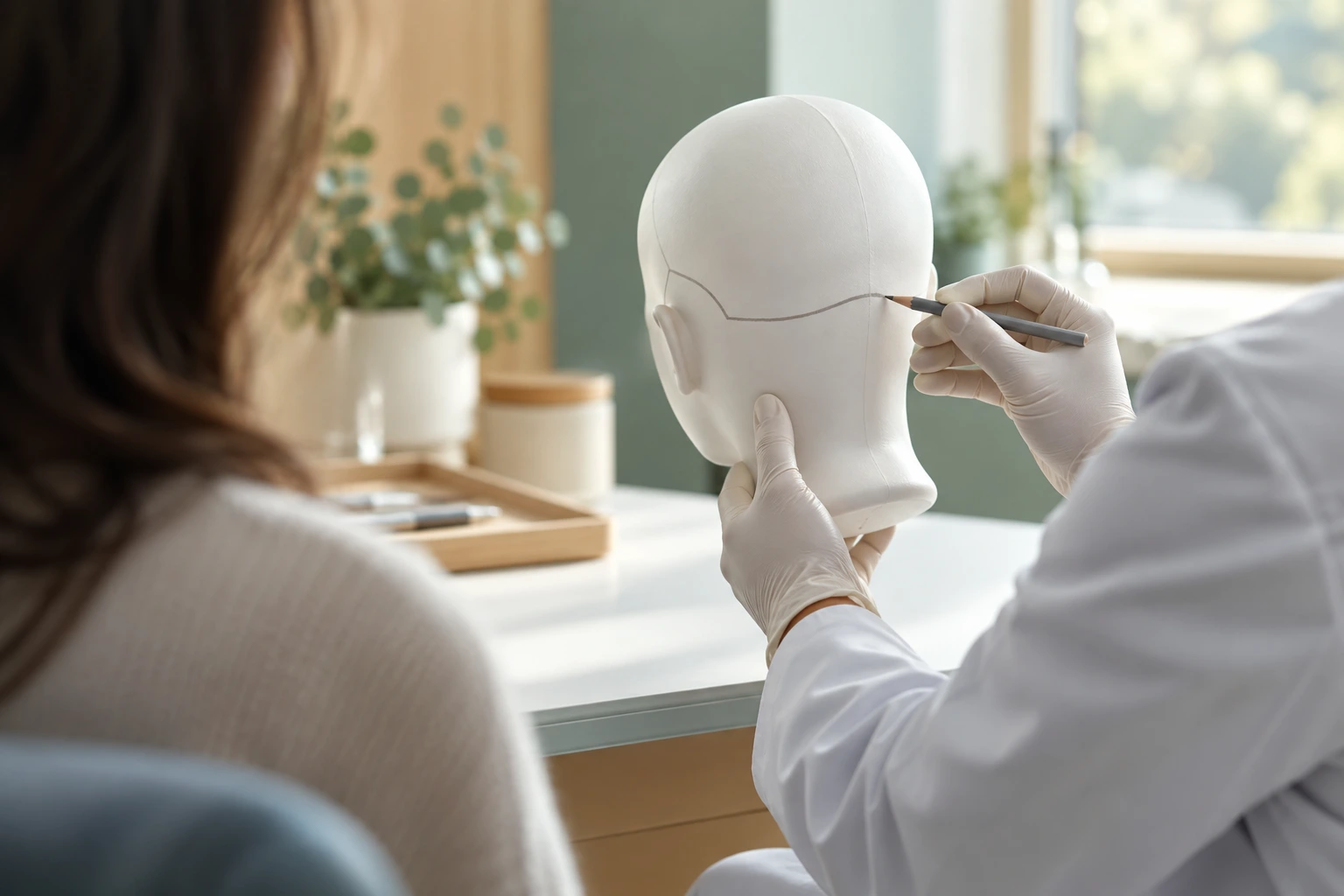
The procedure is similar to a standard FUE transplant. After examination and marking, the donor area is numbed and grafts are extracted. The scar is numbed, small channels are opened at the right angle and depth for the tissue, and grafts are placed. Scar tissue can feel different to work in, which is one reason experience with scars matters.
For a small scar, the procedure may take only a few hours. For larger areas, or when the scar is treated along with pattern hair loss, it can take most of a day.
Healing follows the usual pattern: small crusts that fall away within about seven to twelve days, a donor area that settles over two to three weeks, and shedding of transplanted hairs in the first weeks. Scar tissue can stay pink a little longer.
Good aftercare matters even more than usual. Gentle washing, no rubbing, protection from strong sun and avoiding smoking all support the limited blood supply. Our article on how smoking affects graft survival explains why stopping before and after the procedure helps.
Realistic results, including scars within an area of hair loss
A successful transplant into a scar usually makes the scar much less visible, especially when the hair is worn at a moderate length. In small surgical or injury scars, the result can be close to invisible. In large burn scars, the realistic goal is often improvement rather than full, normal density.
Growth in scars is sometimes slower than in normal scalp, and the final result may take twelve to eighteen months to judge. A plan that sets out these expectations honestly is a good sign; a promise of full density in one session is not.
It also helps to judge the result from a normal distance and in everyday light. Close-up photos under bright light will always show a scar more than people around you see it. For most patients, the meaningful question at twelve months is whether the scar still draws attention, and for many well-planned cases the answer is that it no longer does. Our article on what a hair transplant cannot fix puts these limits in context.
Scars rarely exist in isolation from the rest of the scalp.
Some people have both a scar and pattern hair loss, for example a surgical scar near a receding hairline. In that case, the scar is usually treated as part of a wider plan. Grafts for the scar are placed more carefully and at lower density, while the surrounding thinning area is treated in the usual way.
Combining the two in one session is often possible for small scars. For larger ones, treating the scar in a first stage and the pattern loss later can make more sense, so that each area gets the attention it needs.
Planning the trip, and the alternatives to grafting
A small scar case usually fits into a short stay in Istanbul: arrival, the procedure day, a check and the first wash, then the flight home. Larger cases, or cases combined with pattern hair loss, follow the usual three- to four-day stay. Bring any medical reports about the original injury or operation, translated if possible, because they help the team understand the tissue they will be working in.
Grafting is not the only option. Scalp micropigmentation can camouflage a scar by tattooing tiny dots that mimic hair follicles, alone or combined with a transplant. Hair styling and hair fibres can hide smaller scars day to day. For large or tight scars, a plastic surgeon may suggest scar revision or reconstruction first.
Some surgeons also use treatments intended to improve the quality of scar tissue before grafting. Evidence and practice vary, so ask what is suggested for your scar and why.
Who is not a candidate, choosing who treats your scar and what to ask
A transplant into a scar is usually not advisable when the scar is less than a year old or still red, when the cause is an active scarring alopecia, when the skin tends to form keloids, or when the scar area is very large and the donor supply very limited. Ongoing skin infection or uncontrolled medical conditions also need to be addressed first.
If you take medication that affects bleeding or healing, tell the team, and do not stop or change it without your doctor’s approval.
Ask to see scar cases specifically, ideally at twelve months, and ask how many the team treats. Ask who examines the scar, who decides on density and who places the grafts. A team experienced with scars will talk about blood supply, test sessions and staged plans without being prompted. Our guide to hair transplants in Turkey explains how to compare clinics on these points.
Five questions sum up what to ask before you commit:
- Is my scar mature and stable enough for grafting now?
- Could this be an active condition rather than an old scar?
- How many grafts do you suggest, at what density, and in how many sessions?
- Would you start with a test session, and when would you judge it?
- What results are realistic for this type of scar?
Clear, cautious answers to these questions are worth more than any single before and after photo.
Before anyone talks about grafts
The first conversation about a burn or injury scar should be about the scar, not the transplant: how old it is, how it healed, whether it is still changing and how the skin feels when you pinch it gently. Those answers decide whether grafting is the right next step, a later step after reconstructive work, or not the right tool at all. A clinic that skips straight to a graft number has skipped the part that matters most.
Whether a scar is suitable for grafting is something only an examination can answer, and for some scars the honest answer is that a plastic surgeon should see it first. How grafting itself is planned is covered under hair transplantation.
Find this helpful? Add Hairpol as a preferred source on Google.
Get a Free Consultation
Answer a few questions and the medical team will review your situation.
