

You have probably been told it is just dandruff. A stronger shampoo, a little patience, it will settle down. Except it has not settled. The itch returns every few weeks, the flakes look greasy and yellowish rather than dry and white, and somewhere in the last two years the hair along your temples and crown started looking thinner in photographs than it does in the mirror.
That combination walks into consultation almost every week at Hairpol. And it comes with a question most people are afraid to ask out loud: does a scalp that behaves like this disqualify you from surgery altogether?
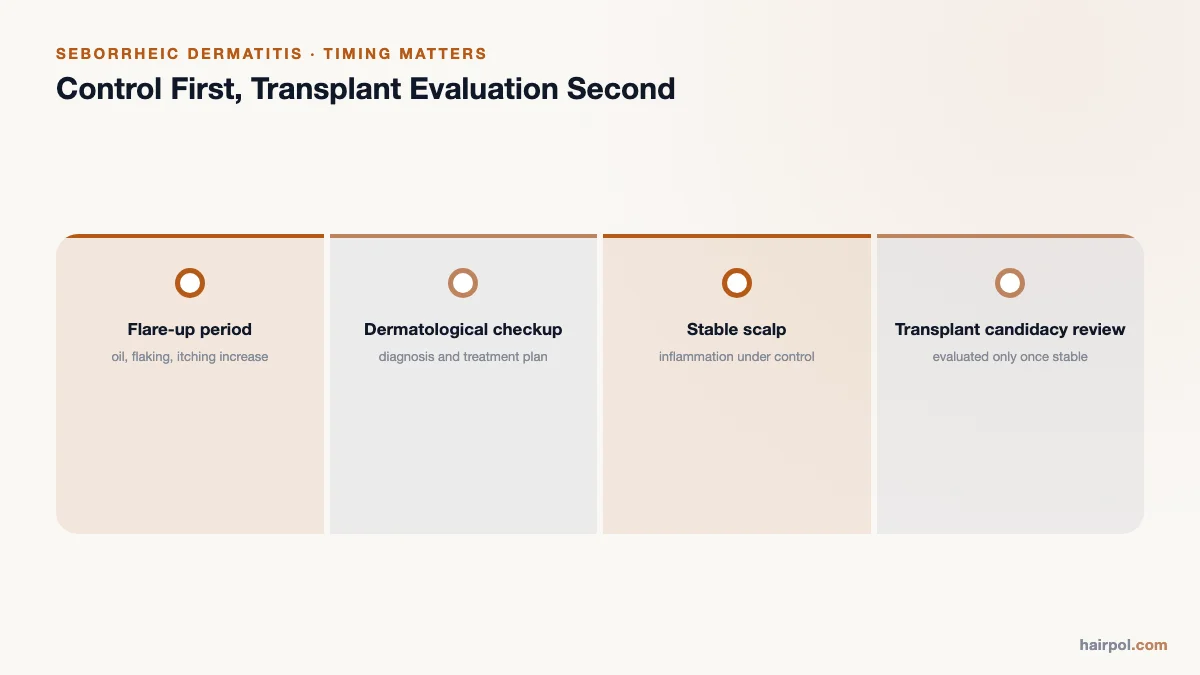
The short answer: seborrheic dermatitis does not permanently disqualify you from a hair transplant, but it has to be brought under control first. In practice that means roughly 4 to 8 weeks of a dermatologist-directed routine, with no active redness, scaling or itching on the day of surgery. Operating on an inflamed scalp raises the risk of folliculitis and unpredictable graft survival. Once the scalp is quiet, your candidacy is assessed exactly like anyone else’s.
Is it dandruff or seborrheic dermatitis?
The two words get used interchangeably, and that is where most of the confusion starts. Simple dandruff is a mild, dry, white flaking with little or no redness underneath. Seborrheic dermatitis sits further along the same spectrum: the flakes are larger, often oily and yellow-tinged, and when you part the hair you can see pink or red skin beneath them. It tends to favour the areas where oil glands are dense — the scalp margins, the eyebrows, the sides of the nose, behind the ears.
It also behaves differently over time. Dandruff responds to an anti-dandruff shampoo and stays away. Seborrheic dermatitis relapses. It quiets down in summer, comes back in winter, flares during periods of poor sleep or high stress, and settles into a rhythm that patients recognise long before anyone gives it a name.
That relapsing pattern is the clinically important part. A one-off flake problem is not a surgical consideration. A recurring inflammatory condition is, because it determines when you operate rather than whether you operate.
How does seborrheic dermatitis actually cause shedding?
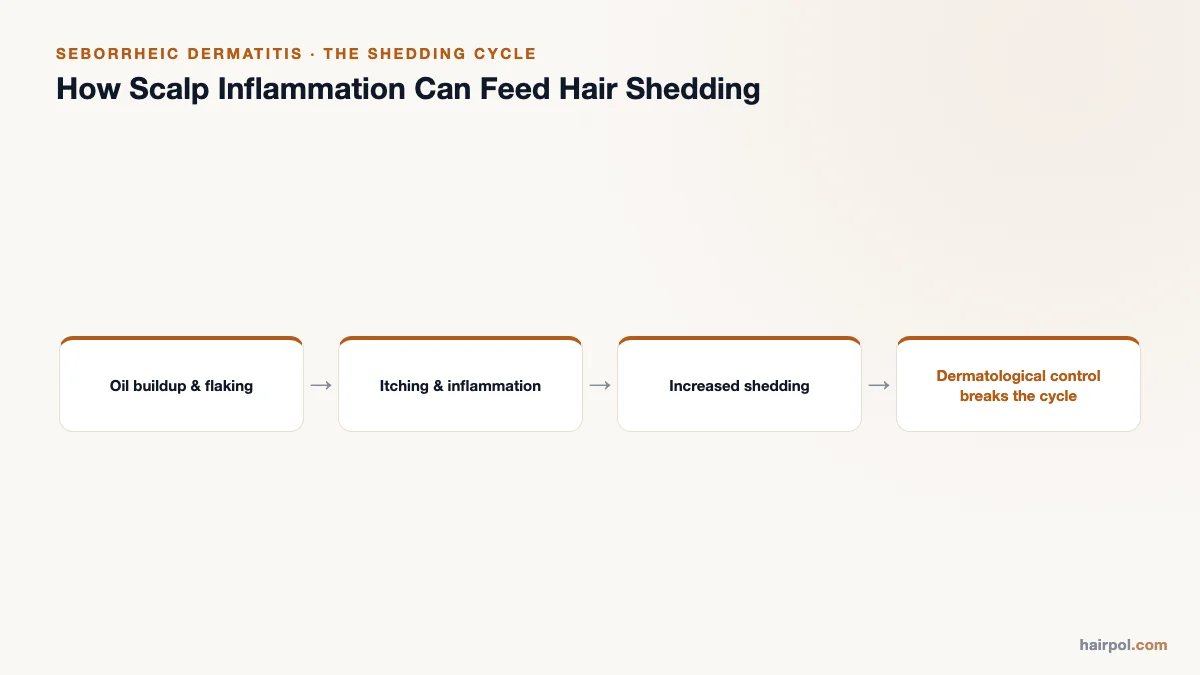
It rarely destroys follicles. What it does is push them out of rhythm. Chronic inflammation around the follicular opening shortens the growth phase, so hairs that should have stayed in place for three or four years exit early. You see this as diffuse shedding across the whole scalp, worse during flares, better during calm months.
There is a mechanical layer too. An itchy scalp gets scratched, and scratching over months produces breakage and traction on hairs that were already fragile. Patients often describe finding short broken shafts rather than full hairs with a white bulb at the end — that is a scratching signature, not a genetic one.
The distinction matters because hair loss from seborrheic dermatitis is largely reversible. Control the inflammation and much of the density comes back over two or three cycles, typically across six to twelve months. That is a very different prognosis from androgenetic miniaturisation, which does not reverse on its own.
Is the thinning from the dermatitis or from genetics?
Usually both, and untangling the two is the single most useful thing a consultation can do for you.
A scalp with active seborrheic dermatitis in a man whose father and grandfather went bald early is almost never a pure inflammatory case. What you tend to see is a genetic pattern underneath — receding temples, a thinning crown — with an inflammatory layer on top making the whole scalp shed more than the pattern alone would explain. Treating one and ignoring the other produces half a result.
The clue is distribution. Inflammatory shedding is diffuse and follows the flare calendar. Genetic loss is regional, progressive, and does not care whether your scalp is calm this month. If you are not sure which one you are looking at, the same triage logic we describe for alopecia areata versus pattern hair loss applies here: pattern first, then everything else layered on top.
Why we do not operate on an inflamed scalp
A hair transplant is thousands of small wounds made in a controlled way in skin that is expected to heal cleanly. Inflamed skin does not heal cleanly. It heals slower, it crusts differently, and it is far more likely to develop folliculitis in the weeks after the procedure — the pustules and inflamed bumps that make month two miserable and, in a minority of cases, cost you grafts.
There is a second reason that gets less attention. Post-operative care depends on the patient being able to wash the scalp gently and consistently from around day three, and on not scratching. Someone in the middle of a flare will scratch. That is not a discipline failure, it is what an itching scalp does at three in the morning during the exact window when grafts are still fragile.
So the rule at Hairpol is straightforward: we treat the skin first, then we operate. Not because the condition is dangerous, but because the outcome is measurably better on a calm scalp, and because a delayed operation is far cheaper than a compromised one. Some of the swelling and crusting questions people bring us in month one turn out to have started as an untreated scalp condition in the weeks before surgery.
What does “controlled” mean before surgery?
Controlled is not the same as cured. Seborrheic dermatitis is a chronic condition and it will very likely come back at some point in your life. What we are looking for on the day of surgery is a scalp with no visible erythema in the donor or recipient zones, no active scaling, and no itch that you are actively managing.
Most patients reach that state in 4 to 8 weeks with an appropriate topical routine supervised by a dermatologist. Stubborn cases take longer, particularly if there is an untreated trigger in the background such as chronic sleep debt, a period of high stress, or another skin condition sharing the same territory.
We also want the control to be stable rather than freshly achieved. A scalp that looked perfect for four days after an intensive treatment burst is not the same as a scalp that has been quiet for a month on a maintenance routine. The second one predicts good healing; the first one predicts a flare somewhere around week two after surgery.
Why the dermatologist assessment is not optional
We are a hair restoration clinic, not a dermatology practice, and that boundary is worth stating plainly. Diagnosing a scalp condition — telling seborrheic dermatitis apart from scalp psoriasis, tinea capitis, contact dermatitis, or the early scarring alopecias that can look deceptively similar — is a dermatologist’s job, sometimes with a biopsy behind it.
That distinction is not bureaucratic. Some conditions that flake and redden are scarring alopecias, and in scarring disease transplanted grafts can be lost to the same process that destroyed the original hair. Operating on a misdiagnosed scarring condition is one of the few genuinely irreversible mistakes in this field. A dermatologist rules it out; a surgeon looking at a photograph cannot reliably do so.
What we do bring is the surgical read: whether the donor area is dense enough, how the pattern is likely to progress, and how much of your current shedding is inflammatory noise rather than permanent loss. Those two assessments belong together, and they belong in that order.
What treatment usually looks like
Treatment is medical and it belongs to your doctor, so what follows is a map rather than a prescription. Typical dermatologist-led routines use antifungal shampoos containing ketoconazole or ciclopirox, sometimes alternating with zinc pyrithione or selenium sulphide formulations, and a short course of a low-potency topical anti-inflammatory during flares. Frequency, strength and duration are decisions for your dermatologist, not for a blog and not for a clinic coordinator.
Two practical notes that come up constantly in our consultations. First, medicated shampoo needs contact time — a few minutes on the scalp, not thirty seconds under the shower. Most people who tell us a shampoo did not work were rinsing it straight off. Second, over-washing with harsh products often makes things worse by stripping the barrier and provoking rebound oiliness.
If you are already on minoxidil or another hair loss medication, tell the dermatologist. Alcohol-based topical solutions can irritate a dermatitis-prone scalp, and the answer is sometimes a formulation change rather than stopping treatment. Again, that call is your prescribing doctor’s.
After control, are you a candidate?
Usually yes — and often a better one than you assumed, because part of what you have been reading as baldness is inflammatory shedding that comes back on its own.
This is the moment where an honest assessment earns its keep. We regularly see patients who arrive convinced they need 3,500 grafts, whose scalp calms down over two months and who then genuinely need 2,200. The reverse also happens: the flare was masking a pattern that turns out to be more advanced than the patient thought. Either way, planning a graft number on an inflamed scalp is guesswork.
If you are unsure whether your thinning is inflammatory, genetic, or a mix of the two, a photo assessment with our team plus a dermatology opinion usually settles it within a week — you can send photographs for an assessment without committing to anything. The realistic limits of what surgery can and cannot correct are set out in our piece on what a hair transplant cannot fix.
Does seborrheic dermatitis change the surgical plan?
Modestly, yes. A dermatitis-prone scalp is slightly more reactive, which influences a few decisions around the edges of the procedure.
Density placement in the first session is often a touch more conservative in the crown, because a scalp that inflames easily benefits from a less crowded recipient bed and a second pass later if needed. Antiseptic protocol is tightened. And we plan the post-operative wash schedule with more precision than usual, since a patient who is afraid to touch the scalp will let crusts sit far longer than they should.
None of this changes the technique itself in any dramatic way, and it does not change what technique suits you. Sapphire FUE and DHI both work on a well-controlled dermatitis-prone scalp; the choice is made on hair characteristics and the area being treated, not on the skin condition. Any clinic telling you one method is inherently safer for seborrheic dermatitis is selling you something.
The first two weeks after surgery
The window that worries patients most is days three to fourteen, when crusts form and itching begins. On a normal scalp that itch is a healing signal. On a dermatitis-prone scalp it can be a healing signal, an early flare, or both at once, and telling them apart from your bathroom mirror is genuinely hard.
The rule we give is simple: itch without redness between the crusts is expected, itch with spreading redness or greasy scale returning at the hairline margins gets photographed and sent to us the same day. Early flares are easy to settle. Flares that run for ten days while the patient waits for the follow-up appointment are not.
Practical details matter here more than they do for other patients. Wash exactly on schedule rather than skipping days out of fear. Keep the water lukewarm, since heat provokes both itching and oil production. And resist the urge to restart your medicated shampoo early — most dermatologists reintroduce it somewhere between week two and week four, but the timing is theirs to set, not yours. Our guide on managing an itchy scalp after a transplant covers the general version of this problem.
Flare-ups at month two and month six
Month two is when shock loss and a dermatitis flare can arrive together, and the combination frightens people badly. The transplanted hairs shed on schedule, the scalp reddens, and it genuinely looks like the procedure has failed. It has not. Shock loss is a normal phase, and a flare on top of it changes the appearance without changing the underlying result.
Month six is different. By then grafts are growing and any flare is a maintenance question rather than a survival question. What you are protecting at that stage is comfort and the native hair around the grafts, not the transplanted follicles themselves.
If you see pustules rather than diffuse redness, that is worth a message regardless of the month. Distinguishing ordinary post-operative bumps from something that needs treatment is exactly what we cover in our article on ingrown hairs and pimples after a transplant, and the threshold for asking is deliberately low.
Long-term scalp maintenance after a transplant
Transplanted follicles are not immune to seborrheic dermatitis. They came from the donor zone, they keep donor-zone genetics with respect to DHT, but they sit in skin that still has the same tendency to inflame. If you let the condition run unmanaged for years, you get the same accelerated shedding of native hair around the grafts that you had before — and a result that thins around a preserved transplanted core.
That is why we treat scalp maintenance as part of the long-term plan rather than a pre-operative hurdle. A maintenance shampoo routine, a plan for winter flares, and a dermatologist you can reach are worth more to your ten-year result than any single procedural detail. Supportive treatments in our hair treatments department — mesotherapy and PRP among them — are used to support the surrounding hair, not to treat the dermatitis itself.
Patients who keep their scalp calm also tend to be the ones whose before and after photographs hold up at three and five years, because their native hair is not being lost to a second, avoidable process running quietly in the background.
What to do if your scalp still flares at month nine
Occasionally a patient reaches month nine with grafts growing well and a scalp that still will not behave. The temptation is to blame the surgery. In our experience the cause is almost always elsewhere: a treatment routine that was abandoned once the hair looked better, a trigger that was never addressed, or a diagnosis that needs revisiting because the condition was not purely seborrheic to begin with.
The sequence we recommend is unglamorous. Go back to the dermatologist before you change anything about your hair routine. Bring photographs from month one, month four and now. Ask specifically whether the picture is still consistent with seborrheic dermatitis or whether something else has emerged. And keep your hair loss medication decisions in the same conversation, since some formulations irritate and others do not.
At Hairpol we would rather see you at month nine with an honest problem than not see you at all. If your scalp is unsettled, whether you had surgery with us or elsewhere, book a review through our hair transplantation team and bring the dermatology notes with you. A controlled scalp is not a precondition we invented to slow you down — it is the difference between a result that looks good in year one and a result that still looks good in year five.
Find this helpful? Add Hairpol as a preferred source on Google.
Graft Range Calculator
Answer three questions to see the typical graft range for your situation — based on our published clinical guides.
This is a preliminary estimate, not a medical assessment. The exact number can only be determined by a doctor after examining your donor area and hair characteristics.
Get a Free Consultation
Answer a few questions and the medical team will review your situation.
