
A quote lands in your inbox and the whole decision has been compressed into one line: 2,000 grafts, crown. No square centimetres. No density figure. No honest picture of what that will look like in a mirror at month twelve. Just a number, with a price stapled to it.
So the question you are really asking is not whether 2,000 grafts is a lot. It is whether 2,000 grafts is enough for your crown, and that is a different question with a different answer depending on how wide the bald patch actually is, how coarse your hair happens to be, and how much of your scalp is still losing ground. At Hairpol we field this several times a week, usually from someone holding three quotes that disagree with each other by a thousand grafts.
The short answer: 2,000 grafts placed at a typical crown density of 30 to 40 grafts per square centimetre covers roughly 50 to 65 cm² — enough to rebuild an early to moderate crown, broadly a Norwood 3 vertex through early Norwood 5, at a density that reads as hair rather than scalp. A fully bald crown of 80 to 120 cm² usually needs 2,500 to 3,500 grafts and sometimes two sessions. The number you should be quoted on is area, not grafts alone.
What 2,000 Grafts Actually Cover on a Crown
Divide, and the fog clears. Two thousand grafts placed at 40 per square centimetre covers 50 cm². The same 2,000 spread at 30 per square centimetre stretches across roughly 66 cm². That single division is the most useful piece of arithmetic in the entire consultation, and almost nobody performs it out loud.
Fifty square centimetres is not an abstraction. It is a circle roughly eight centimetres across — a little smaller than the palm of an adult hand. Stand in front of a mirror with a phone camera angled at the back of your head and you can estimate your own bald zone against that reference in about a minute.
Crown density is also deliberately planned lower than frontal density, and that is not a shortcut. The front is usually built at 40 to 50 grafts per square centimetre because it frames the face and sits on a flat plane. The crown is typically built at 30 to 40 because the scalp curves away from the eye there, because the spiral growth pattern eats visual density, and because pushing implantation too tight into a curved, spiralling field raises the risk of poor graft survival. A surgeon quoting you 55 grafts per square centimetre across a whole crown is quoting an ambition, not a plan. The instrument matters less than the plan here, but channel-based work such as sapphire FUE does let the surgeon match incision width to graft size, which counts for more at crown densities than at the front.
How Big Is Your Crown, Really?
Nobody arrives at a consultation knowing their crown in square centimetres, and yet it is the number the entire budget hangs on.
An early vertex thinning — the see-through spiral that shows up under overhead light but disappears in a bathroom mirror — is usually somewhere between 15 and 30 cm². A moderate crown, the classic bald patch that friends have started to mention, tends to land between 40 and 70 cm². A fully open crown in an advanced pattern, where the bald area has widened toward the mid-scalp, can measure 80 to 120 cm² on its own, before anything at the front is even discussed.
Put those ranges against the division above and the answers write themselves. Two thousand grafts is generous for a 30 cm² whorl, well-matched to a 55 cm² crown, and openly insufficient for a 110 cm² one. At Hairpol the crown gets traced and measured against a reference during assessment, because guessing at this stage is how patients end up with a result they were never actually promised.
Is 2,000 Grafts Enough for a Crown Hair Transplant?
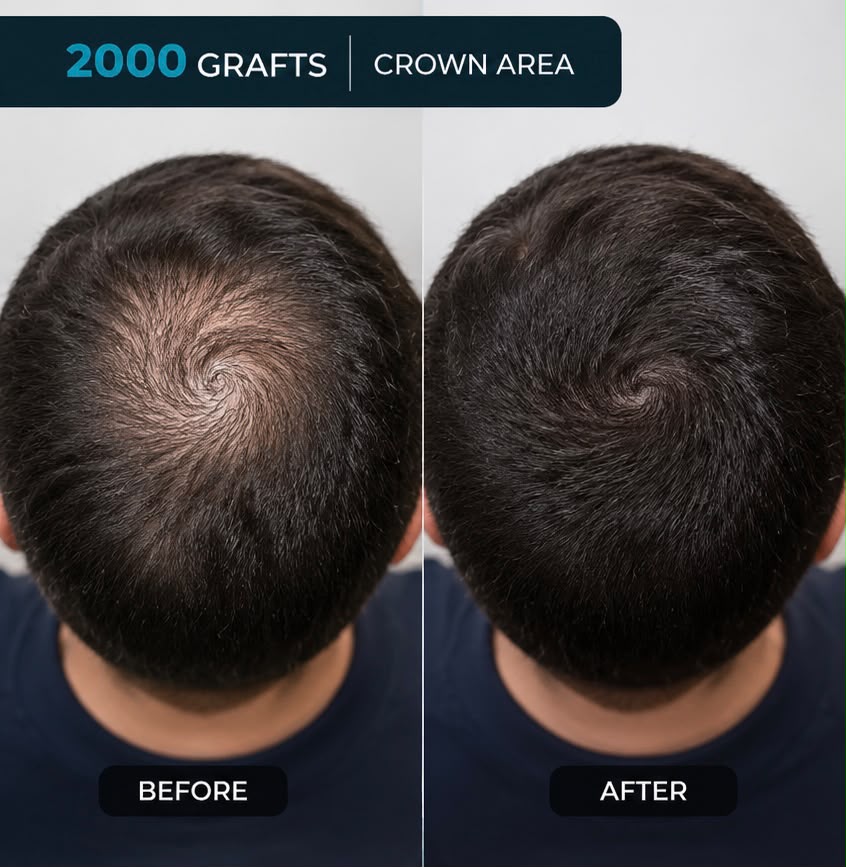
For most men who come in worried about their crown rather than devastated by it, yes. The moderate crown is the commonest presentation, and 2,000 grafts placed intelligently across it produces a scalp that reads as covered in ordinary light, from ordinary distances, at ordinary hair length.
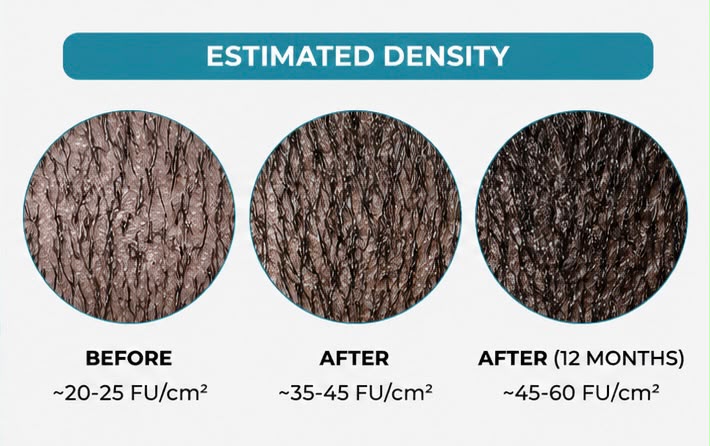
That word “enough” deserves unpacking, though, because it does not mean what most people assume. The human eye does not register hair loss until roughly half the density is gone. Run that in reverse and it becomes the most practical fact in transplant planning: restoring a bald area to somewhere near 50 percent of native density is usually the point at which observers stop seeing scalp. Native crown density sits around 70 to 90 follicular units per square centimetre. Getting to 35 or 40 is therefore not a compromise on the goal — for most patients it is the goal.
Where 2,000 stops being enough is at the far end. If your crown has merged with thinning at the mid-scalp, 2,000 grafts will produce a visible island of density surrounded by scalp that is still bare, which almost always looks worse than a smaller, well-blended patch. In that situation the honest options are a larger plan, a staged plan, or a decision to treat the front first and leave the crown alone. Our fuller breakdown of how many grafts a crown hair transplant needs walks through the sizing logic in more detail if you want the general framework rather than this specific number.
1,500 vs 2,000 Grafts for the Crown: What the Extra 500 Buys
The gap between these two quotes looks small on paper and is surprisingly large on a head.
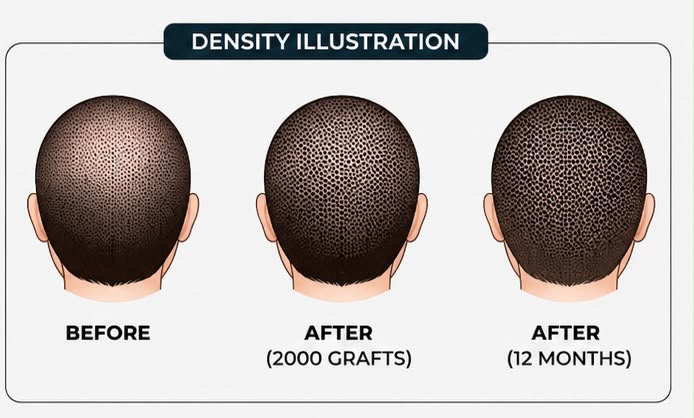
Fifteen hundred grafts at 35 per square centimetre covers about 43 cm². Two thousand at the same density covers 57 cm². That extra 500 grafts is roughly fourteen additional square centimetres, which in practice is the difference between filling a whorl and filling a whorl plus the ring of thinning around it. Alternatively, the surgeon can spend those 500 grafts on the same 43 cm², lifting density from 35 to nearly 47 per square centimetre — a genuinely denser result across a smaller field.
Neither use is automatically better. If your crown is a compact, well-defined spiral with strong hair on all sides, 1,500 grafts concentrated there can look excellent, and the 500 you did not spend stays in the donor bank for a decade from now. If the crown edges are soft and fading gradually into thinning hair, spreading is usually the right call, because a hard density border against thinning hair is one of the most obvious tells of a transplant done to a budget rather than to an anatomy.
What should never happen is choosing 1,500 purely because it is cheaper, and then asking the surgeon to cover the 2,000-graft area with it. Thinly spread grafts across too much ground produce a uniformly see-through crown — donor spent, problem unsolved.
When 2,500 to 3,000 Grafts Is the Honest Number
Several situations push the figure up, and a clinic that never mentions them is not being kind to you.
Large, fully open crowns are the obvious one: at 80 to 100 cm², reaching 35 grafts per square centimetre requires 2,800 to 3,500. Dark, coarse hair on pale skin is the second, though it works in an unintuitive direction — the contrast is punishing, so gaps show at densities that would look perfectly full on someone with lighter or greyer hair. The third is the blend zone. A crown never ends in a clean circle, and 200 to 400 grafts often go into feathering the border into surrounding hair so the treated area does not announce itself.
If you are holding one quote for 1,500 and another for 3,000, the disagreement is almost never about surgical skill. It is about area, and about whether the clinic intends to blend the edges. A photo assessment with the crown actually measured settles the argument in a day rather than a month — you can send images through our appointment form and get the square centimetres and the arithmetic back, not just a bigger number.
Why the Whorl Changes the Arithmetic
The crown is the only zone on the scalp where hair grows out of a spiral, and that single fact is why crown quotes run higher than frontal ones for the same visible area.
At the front, hairs lie in roughly one direction and lend each other cover. Each shaft casts shadow over the scalp beside it, so 40 grafts per square centimetre reads as more than 40. In the crown, follicles radiate outward from a central point in every direction at once. Nothing shields anything. The same 40 grafts stand more independently and reveal more scalp between them, which is why surgeons commonly reckon a crown needs 20 to 30 percent more grafts than a frontal zone of identical size to produce a comparable impression.
Angle compounds it. Crown hairs exit the scalp at shallow, constantly rotating angles, and reproducing that rotation is genuinely difficult technical work. A crown implanted at a uniform angle looks wrong even at good density — flat, brushed, slightly artificial. A crown implanted along the original spiral looks like hair even when the count is modest. Implanter-pen work such as DHI hair transplantation exists largely to give the surgeon that angle control at the moment of placement. This is where surgical judgment earns more than graft count does.
Why Two Patients Get Different Results From the Same 2,000
Two men can receive an identical graft count across an identical area and walk away with visibly different crowns, because perceived density is not the same thing as follicle count.
Hair calibre does most of the work. A coarse shaft covers substantially more scalp surface than a fine one, and the difference is not marginal. Someone with thick hair can reach with 30 grafts per square centimetre what a fine-haired patient needs 45 to approach. If your hair is fine, the honest planning response is to accept a smaller treated area at a higher density rather than stretch the same grafts thinner.
Colour contrast is the second lever. Dark hair against pale skin exposes every millimetre of gap; grey hair, or light hair on light skin, forgives a great deal. Some patients hear, quietly and correctly, that letting the grey come through will do more for their crown than another 500 grafts.
Curl adds the third. Wavy and curly shafts occupy more space and throw shadow across the scalp, which is why textured hair types often achieve convincing crown coverage at counts that would look sparse on straight hair. Length and styling finish the job — a slightly longer crown, dried with lift rather than pressed flat, buys visual density at no surgical cost at all.
What Your Donor Area Says About the Number
Every graft you place in the crown is a graft that will not be available for your hairline in fifteen years, and the crown is the zone where that trade matters most.
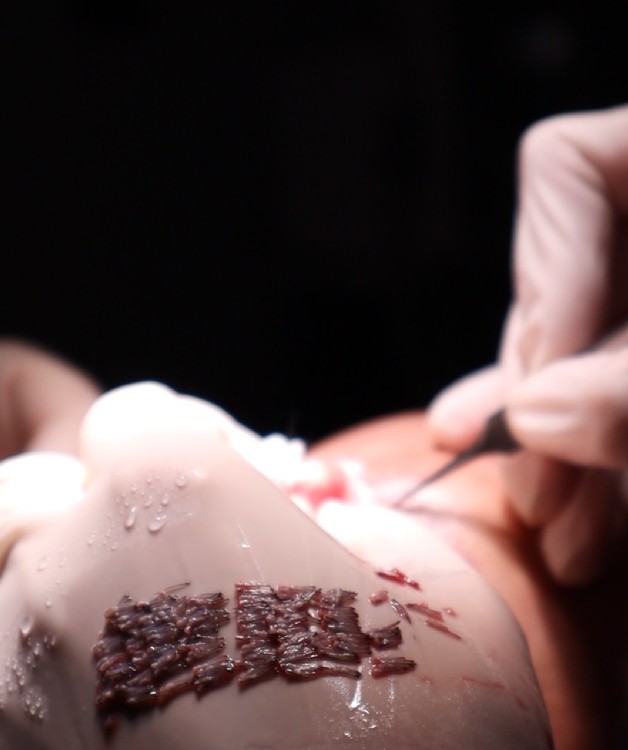
A typical safe donor area yields somewhere between 4,000 and 7,000 grafts across a lifetime, spread over all sessions. Spending 2,000 of those on a crown at 32 is a reasonable decision if the pattern has stabilised and the front is secure. It is a much riskier decision at 26 with an actively receding hairline, because pattern loss usually expands outward from the crown, and an island of transplanted hair ringed by newly bald scalp two years later is a repair job, not a result. We have covered the ceiling in detail in how many grafts your donor area can give across a lifetime, and it is the constraint that quietly governs every number in this article.
Medical therapy sits alongside this rather than replacing it. Finasteride and minoxidil, used under a doctor’s supervision and with the side-effect conversation had properly, are what keep the hair around the transplanted crown from receding while the grafts grow in. Whether they suit you is a clinical decision, not a blog decision, but a crown plan that ignores the question entirely is an incomplete plan. At Hairpol these sit inside our hair treatments programme and are discussed alongside the surgical plan rather than after it.
One Session or Two? How That Decision Gets Made
Two thousand grafts is a comfortable single session. Most well-staffed clinics place it in one day without pushing extraction into risky territory, and there is no medical reason to split a 2,000-graft crown for its own sake.
The decision to stage comes from other directions. If the crown needs 3,500 grafts and your donor can safely give 2,200 in one sitting, a second session at 10 to 12 months is simply the arithmetic. If your loss pattern is still moving, staging lets the surgeon see where the border settles before committing the remaining grafts. And if you want both the front and the crown restored, the front nearly always goes first, with the crown following once the frontal result has grown in and you have seen what your donor actually produces.
There is a quieter argument for staging that patients rarely hear. A second pass over an already-transplanted crown is far more forgiving than a first one, because the existing grafts provide cover and the surgeon can place the new ones exactly where the eye still finds scalp. Some of the best crown results are two modest sessions rather than one heroic one.
How Long Before 2,000 Grafts Look Like Coverage?
Longer than you want, and longer in the crown than anywhere else on the head.
The transplanted hairs shed between weeks two and six, which is expected and still unnerving. Real growth starts somewhere between months three and five. Month four is the low point for almost everyone — thin, patchy, and slightly worse-looking than before the operation, which is when the panicked emails arrive. By month six there is visible improvement, by month nine the crown is clearly filling, and the honest final assessment sits at twelve to fifteen months. The crown consistently lags the frontal zone by two to three months, partly because of the spiral and partly because the blood supply at the vertex is a little less generous.
If you want a realistic sense of what the endpoint looks like rather than what stock photography suggests, our piece on whether hair transplants actually work on the crown covers success rates, limits and candidacy without the marketing gloss. Our before and after gallery shows the same endpoint in photographs rather than percentages.
Does the Graft Number Set the Price?
Partly, and less than most quotes imply. Clinics that price per graft have an obvious commercial incentive to quote generously, which is exactly why a 3,000-graft quote for a 50 cm² crown deserves a question rather than gratitude. Clinics that price by package have the opposite incentive, and the thing to check there is what happens if the surgeon decides on the day that you need fewer grafts than the package covers.
Either way, the graft count should be a consequence of the measurement, not the starting point of the negotiation. If you are comparing offers across cities or countries, our hair transplant cost breakdown explains what actually sits inside the figure, from surgical team composition to what a package includes and excludes. Read it before you let a graft number do the deciding.
What 2,000 Grafts Will Not Do
They will not stop hair loss. Transplanted follicles are genetically resistant to the hormone driving your pattern, but the native hair around them is not, and surgery has no effect on that process at all.
They will not reproduce the crown you had at nineteen. Native density is not the target and cannot be, because the donor supply that would fund it does not exist on your head. What 2,000 grafts buy is the perception threshold — the point where an observer stops noticing.
They will not cover a crown and a hairline together. Two thousand grafts spread across both zones leaves each of them at roughly 20 per square centimetre, which is not enough to look like hair anywhere. And they will not fix an unstable pattern in a man in his mid-twenties whose loss is still accelerating; that is a case for a medical plan first and a surgical one later.
If you would rather see a figure before a consultation, the hair graft calculator asks a few questions about your loss stage and the area you want covered, then gives back the graft range cases like yours tend to fall into. It is an estimate; your own number follows an assessment of your photographs.
Getting a Number That Belongs to Your Head
The reason quotes disagree so wildly is that most of them are answering a question nobody measured. Ask any clinic for the square centimetres of your crown, the planned grafts per square centimetre, and how many grafts are reserved for blending the border. Three answers, thirty seconds, and the quality of the plan becomes obvious.
At Hairpol in Ataşehir, that mapping is where a crown consultation begins rather than where it ends, and we would rather tell you that your crown needs 2,800 grafts across two sittings than sell you 2,000 that will leave you disappointed at month twelve. If you want your own crown measured and the arithmetic explained in plain language, our hair transplantation department is the place to start — bring every quote you have already received, and we will go through the numbers with you.
Find this helpful? Add Hairpol as a preferred source on Google.
Graft Range Calculator
Answer three questions to see the typical graft range for your situation — based on our published clinical guides.
This is a preliminary estimate, not a medical assessment. The exact number can only be determined by a doctor after examining your donor area and hair characteristics.
Get a Free Consultation
Answer a few questions and the medical team will review your situation.
