
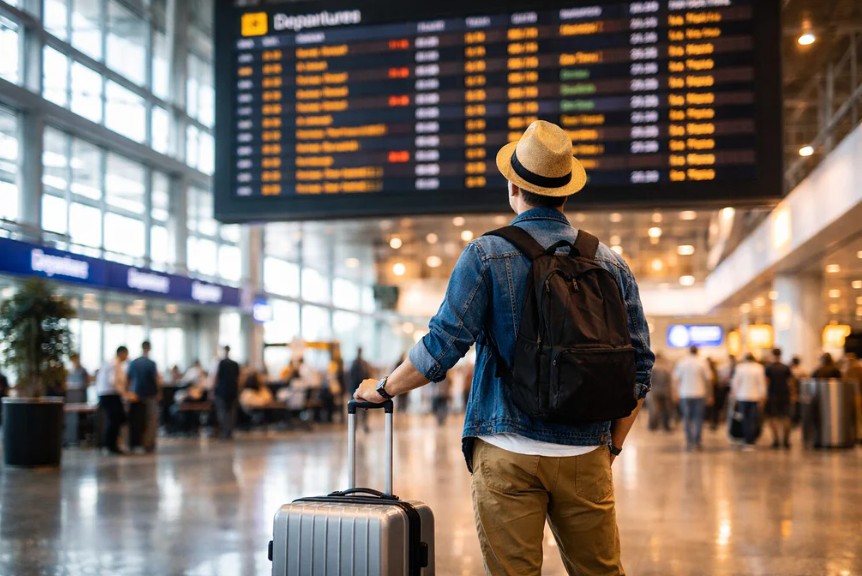
The procedure is done. The clinic was everything you hoped, your new hairline is mapped out under a light dressing, and now there is one logistical worry nagging at you that nobody in the consultation quite covered: how do you actually get home without undoing any of it? For most international patients, the flight home is the single most nerve-wracking part of the whole trip, precisely because it happens right in the window when your grafts are at their most fragile.
This is the guide we wish every traveling patient had before they booked their return ticket. When it is safe to fly, how to protect your grafts at the airport and in the air, and the small decisions that make the difference between arriving home calm and arriving home worried. At Hairpol, a large share of our patients travel to Istanbul from abroad, so this is a conversation we have every week, and the answers are more reassuring than the anxiety suggests.
Why the flight home feels so daunting
Part of the stress is simply timing. A hair transplant leaves your recipient area studded with tiny grafts that, for the first ten days or so, are held in place by nothing sturdier than a fragile clot. The flight home usually happens two to three days after surgery, right in the middle of that most vulnerable stretch. You are asked to sit in a crowded environment, handle luggage, and navigate an airport, all while instinctively protecting a scalp you cannot cover the way you would like.
The good news, and it is genuinely good news, is that flying after a hair transplant is safe when it is done sensibly. The altitude, the cabin pressure, the flight itself, none of these harm your grafts. The risks that do exist are practical and manageable: accidental bumps, friction from bags or headrests, and the mild swelling and dehydration that long travel can bring. Once you know what to watch for, the flight becomes a task to manage rather than a threat to fear.
When is it actually safe to fly?
Here is the reassuring part. For most patients, flying home two to three days after the procedure is completely fine, and many clinics, including ours, schedule the return with exactly that in mind. There is no medical need to wait a week to fly. The grafts are not affected by air travel itself, and the swelling that peaks around days two to four is uncomfortable rather than dangerous.
What matters is not the date but the handling. A patient who flies on day two and protects their scalp carefully is in a far better position than one who flies on day five but lets a rucksack scrape across their hairline in a rush to make a connection. At Hairpol, we time each patient’s return around their specific procedure and give them a clear plan for the journey, because the flight is part of the aftercare, not an interruption to it. If your trip involves a tight connection or very long haul, tell your coordinator so the plan can account for it.
The first, non-negotiable rule: do not let anything touch the grafts
If you remember one thing about the flight, make it this: nothing should press or rub against your recipient area. That means no leaning your head back against the seat headrest in a way that contacts the grafted zone, no pulling a hoodie up and down over your hairline, and no resting your forehead on a tray table to sleep. The single biggest in-flight risk is friction, and friction is entirely within your control.
The recipient area, usually the front and top of the scalp, is the zone to guard. The donor area at the back is more robust by this stage but still tender, so a headrest touching the very back of your head is less risky than a headrest dragging across your crown. If you can book a seat that lets you sit upright comfortably without your head falling back onto the grafts, do it. Our overview of how to sleep without damaging grafts applies directly to dozing on a plane, where the same rules about angle and contact hold.
Choosing the right seat
Small choices at booking make the journey easier. An aisle seat is usually better than a window, because it lets you move, stand and reach the overhead bin without twisting past other passengers, and it keeps you away from the hard cabin wall people tend to lean their head against while sleeping. If you can, avoid the middle seat entirely, where you are boxed in and more likely to bump against a neighbor.
Consider whether a little extra legroom or an earlier boarding option is worth it for this one flight. Being able to settle in without jostling, stow your bag calmly, and sit upright with space around you removes most of the accidental-contact risk in one move. This is not the trip to squeeze into the cheapest packed-in seat to save a little money, because the grafts you protect are the result you traveled for.
The airport: bags, security and crowds
The airport is where most of the real hazards live, not the flight itself. Crowds mean people brushing past you, security lines mean bending and reaching, and luggage means lifting. Every one of these is a chance for something to knock your head or for you to strain in a way that increases swelling. The fix is to travel light and travel slow.
Wherever possible, check your main bag rather than wrestling it into an overhead bin, and keep only a small, easy-to-carry item with you. Avoid a backpack for this trip, since swinging it onto your shoulders passes a strap right past your head; a small wheeled case or a shoulder bag you can keep low is far safer. Move deliberately, give yourself extra time so you are never rushing, and do not be shy about asking for help with lifting. At security, a quiet word that you have had a recent medical procedure usually smooths the way if you are asked about your scalp.
Managing swelling on the day you travel
Swelling is the most common travel complaint, and it tends to peak around days two to four, which often lands squarely on your travel day. It is harmless and temporary, usually settling on the forehead and around the eyes rather than the grafts themselves, but it can be startling if nobody warned you. Long periods of sitting and the dehydration of air travel can make it a little more pronounced.
There are simple ways to keep it in check. Stay well hydrated by drinking water before and during the flight, since dehydration worsens both swelling and general recovery. Follow any guidance your clinic gave about keeping your head slightly elevated, and if you were shown how to apply cold compresses or given specific advice about swelling, carry what you need in your hand luggage. Knowing the swelling is expected takes most of the fear out of it. Our guide to the first seven days sets out the normal arc so nothing on your travel day catches you off guard.
What to wear and carry on board
Dress for easy, contact-free travel. A front-buttoning shirt or a zip-up top means you never have to pull anything over your head, which is exactly the motion you want to avoid in the first days. Leave the pullover hoodies and tight beanies at the bottom of your case, because tugging fabric across the hairline is one of the easiest ways to catch a graft.
In your hand luggage, keep the essentials your clinic gave you: any prescribed medication, saline spray if you were told to keep the grafts moist, and any written aftercare instructions in case you need to reference them. If your clinic provided a loose, oversized hat specifically for travel, that is the only headwear to use, and only in the way they showed you. It sits high off the grafts to shield them from sun and stray contact without pressing down. Do not substitute your own cap for it.
Long-haul flights and connections
A short hop home is one thing; a long-haul flight with a connection is another, and it deserves a little extra planning. On a long flight, the challenges compound: more hours sitting still, more dehydration, more temptation to sleep with your head lolling against something. Break the flight up by standing and walking the aisle periodically, which helps circulation and keeps swelling down, and keep sipping water throughout.
Connections are the trickiest part because they add rushing, more crowds, and another round of security. If you have a choice, a longer, calmer layover beats a tight sprint between gates. Give yourself time so you never have to run with a bag near your head. If your journey home is genuinely long or complicated, mention it to your Hairpol coordinator before you travel, so your medication timing and any advice can be tailored to the actual shape of your trip rather than an idealized short flight.
Sleeping on the plane without wrecking your grafts
Most people want to sleep on the flight home, especially if they are tired and a little sore. The trick is to sleep without letting your head fall onto the grafts. A neck pillow can help here, but only if you use it to support your head upright rather than to cushion the back of a reclined seat against your crown. The goal is to keep the recipient area free of contact even while you doze.
If you find yourself nodding forward or sideways onto the grafts, it is better to stay awake or to reposition. This is the same principle you will follow at home for the first couple of weeks: back-sleeping, head elevated, nothing pressing on the front and top of the scalp. Treating the flight as the first night of your at-home routine, rather than an exception to it, keeps you on the safe side without much effort.
The transfer and the drive to the airport
The part of the journey people forget to plan is the bit before the flight even starts: the transfer from your hotel or the clinic to the airport. If your clinic arranges transport, use it, because a driver who is used to post-procedure patients will take the corners gently and give you time to get in and out of the car without knocking your head on the door frame. That door frame, low and unforgiving, is a classic spot for an accidental bump.
Get into the car slowly, mind the top of the doorway, and settle into the seat before you relax. On the drive, keep your head supported upright rather than letting it roll against the window. It sounds trivial, but the transfer is often the first real test of the contact-free habit you will keep all the way home, and starting it well sets the tone for the whole trip. If you are arranging your own taxi, give yourself the same care you would on the plane.
Keeping calm and pacing yourself
Travel stress has a way of making people rush, and rushing is where accidents happen near a fresh scalp. The antidote is to build slack into every stage. Leave for the airport earlier than you normally would, so a slow security line or a gate change does not tip you into a sprint. Sit down when you can, keep your movements unhurried, and let other travelers flow around you rather than weaving through them with your head down.
It also helps to accept that you may feel a little tired, tender or self-conscious, and that this is normal for the first days. You are not expected to travel as briskly as you would in perfect health. Giving yourself permission to move slowly is not indulgence, it is aftercare. The patients who arrive home in the best shape are almost always the ones who treated the journey as part of their recovery rather than a race to get it over with.
After you land: the routine begins at home
Arriving home is not the finish line, it is the handover point. The careful habits you kept on the plane are the same ones that carry you through the rest of the fragile window: gentle washing exactly as instructed, back-sleeping with your head elevated, no hats or friction on the grafts, and no rushing back into the gym or a heavy social schedule. The flight is often the last time a clinic team is physically near you, so the discipline you bring home matters.
Keep your clinic’s contact details easy to reach. One of the advantages of traveling for surgery with an established team is that support does not end at the airport. If something worries you once you are home, a swelling that seems excessive, a graft area that looks wrong, a question about washing, message your coordinator rather than guessing. At Hairpol, our aftercare relationship continues long after you have flown home, and reaching out is always better than wondering.
Why Istanbul makes the travel logistics easier
There is a practical reason so many patients feel comfortable traveling for this procedure, and it is partly about how well-worn the path has become. Istanbul is one of the most connected cities in the world for medical travel, with frequent direct flights to most of Europe, the Middle East and beyond, which keeps journeys short and connections avoidable for many patients. That connectivity is not a small detail; a shorter, simpler flight home is a safer flight home.
It also means the whole system, from clinic scheduling to airport familiarity with medical travelers, is used to patients flying out days after a procedure. If you want a fuller sense of why the city became such a hub, our piece on what makes Istanbul a global destination gives the background. For your purposes, the upshot is simple: the travel logistics are a well-solved problem, and your job is just to handle your own scalp with care.
Planning the trip so the flight is the easy part
The patients who have the calmest journey home are the ones who planned it before they ever flew out. That means booking a return date that gives you two or three days of recovery in Istanbul, choosing a sensible seat, packing front-opening clothes and leaving pullovers at home, and building in enough time that no part of the journey involves rushing. None of it is complicated, but it all works better decided in advance than improvised at the gate.
Think of the return flight as the final, supervised step of your procedure rather than a separate ordeal. Handled with a little care, it is genuinely uneventful, which is exactly what you want. At Hairpol, we plan the whole arc with you, from the day you arrive to the moment you are safely home protecting your new hairline, so that the flight is the easy part and the result is the part you remember.
If you are weighing up a hair transplant abroad and the logistics of getting home feel like the intimidating part, talk to our team. We coordinate the timing, the aftercare and the travel guidance around your specific journey, so you can focus on the result. Explore our approach to hair transplantation and let Hairpol handle the details that make traveling for surgery feel simple.

Find this helpful? Add Hairpol as a preferred source on Google.
Get a Free Consultation
Answer a few questions and the medical team will review your situation.
