
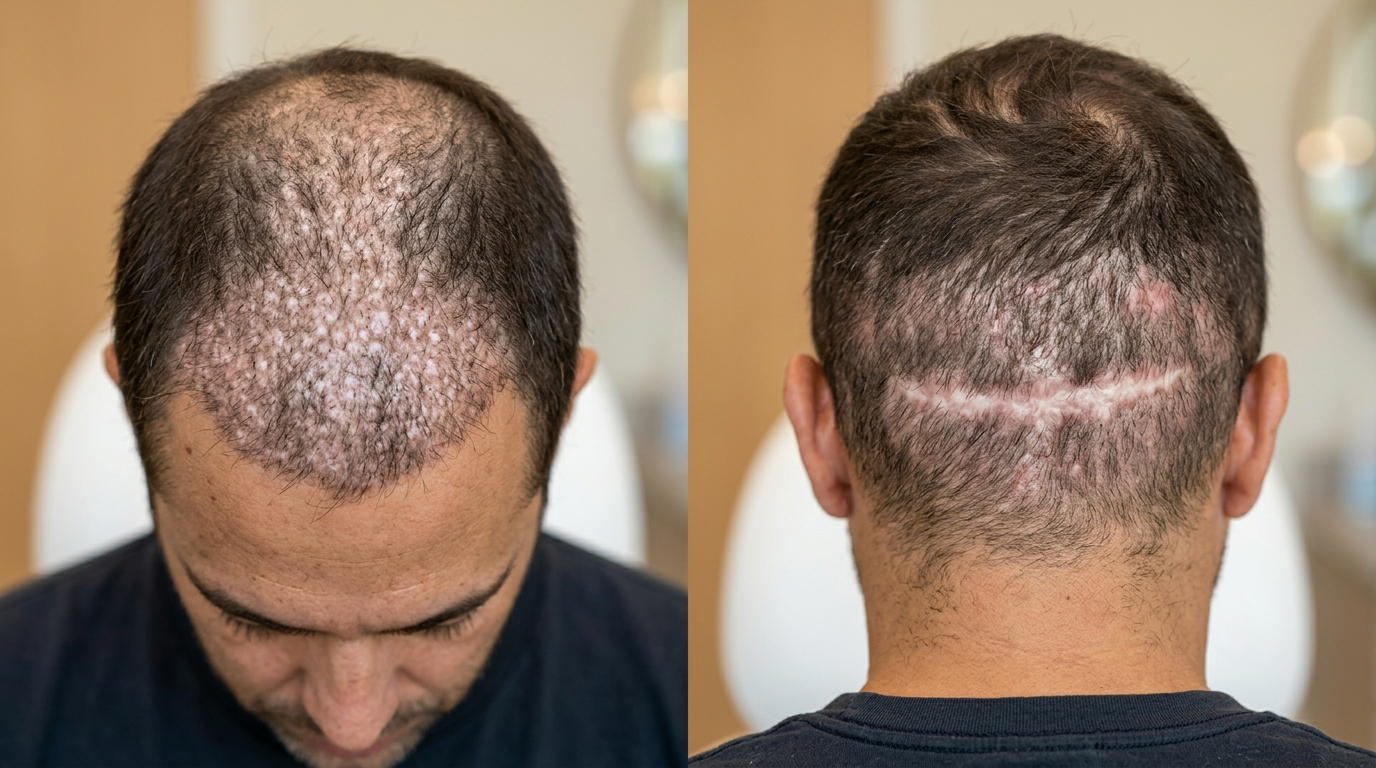
Most of the attention in a hair transplant goes to the front of your head. The hairline, the density, the before-and-after photo everyone will judge. Almost nobody talks about the back and sides until something goes wrong there, and then it becomes the only thing you can see in the mirror. You tie a good result at the front to a thinned-out, patchy strip at the back that was quietly stripped of hair to make it happen. That is the trade-off nobody warned you about, and it is more common than the marketing lets on.
So let us talk about it plainly. What an overharvested donor area actually is, how to recognise the signs before and after surgery, why it happens far more often than it should, and what can genuinely be done to improve it, along with the honest limits of those fixes. At Hairpol, this is a conversation we would rather have with you before your first procedure than after a botched one, because donor damage is one of the few parts of a transplant that can be very hard to undo.
What an overharvested donor area actually means
Your donor area is the horseshoe of hair at the back and sides of your scalp, the zone that is genetically resistant to pattern hair loss. A transplant takes grafts from here and moves them to where you have thinned. The donor is a finite reserve, not a renewable field, and every graft removed is one that does not grow back. An overharvested donor area is what you get when a clinic takes too many grafts from this reserve, or takes them too aggressively from one spot, leaving the donor visibly depleted rather than just thinned.
The distinction matters. A well-managed harvest thins the donor slightly and evenly, in a way that stays hidden even at short lengths. Overharvesting crosses a line: it removes so much density, or concentrates the extraction so unevenly, that the depletion becomes visible to anyone standing behind you. If you want the full picture of how much your donor can actually give over a lifetime, our guide to donor area capacity and how many grafts you have lays out the maths that responsible planning depends on.
The see-through, moth-eaten look
The most recognisable sign of an overharvested donor is a see-through quality when you cut the back and sides short. Instead of a solid wall of hair, the scalp shows through in patches, giving what people often describe as a moth-eaten or motheaten appearance. In good light, or under a barber’s clippers, the thinned zones catch the eye immediately because they sit next to areas of normal density and the contrast gives them away.
This is not the same as normal post-surgery thinning, which recovers as surrounding hairs are cut to a matching length and the eye stops separating donor from non-donor. A genuinely overharvested donor area stays sparse no matter how you style it, because the follicles that would fill those gaps are simply gone. The tell is permanence: if the back looks thin at every length, in every light, months after healing, you are likely looking at true overharvesting rather than a temporary phase.
Widened extraction dots and visible scars
Every FUE extraction leaves a tiny round scar where a graft was punched out. Individually these dots are meant to be invisible, scattered thinly through the donor so no single area loses too much. When a donor is overharvested, those dots crowd together, and healing can pull them into slightly larger, whiter marks that become visible against the scalp, especially on shaved or very short hair. A dense field of pale dots reads as a hazy, scarred texture rather than clean skin.
If your earlier surgery was a strip procedure, the equivalent sign is a linear scar that has stretched wider than it should, sitting in a band of hair too thin to hide it. Either way, the scarring becomes part of the problem rather than an invisible byproduct. Our detailed look at what to expect from donor and recipient scarring explains the difference between normal, well-hidden marks and the visible scarring that overharvesting produces.
Unnatural density gradients at the back and sides
A healthy scalp fades gradually. Density is highest low on the back and sides and thins naturally toward the crown and temples, and your eye reads that gradient as normal. Overharvesting disrupts it. When a clinic takes too much from a central patch, or digs into the safe zone’s edges to chase graft numbers, you end up with abrupt jumps: a normal band, then a suddenly sparse one, then normal again. The scalp stops looking like it thinned naturally and starts looking like something was removed from it.
One of the more damaging versions is extraction that strays outside the truly permanent zone, into the higher or lower borders where hair is not loss-resistant. Those areas may look fine at first, then thin further with age as pattern loss catches up, deepening the depletion years later. A donor should be harvested conservatively from within its stable core, not stretched to its outer limits to hit a number. When you see a patchy gradient rather than a smooth fade, careless planning is usually behind it.
What an overharvested donor area looks like (and what normal looks like)
The back of your head almost always looks worse in the first weeks than it will at month six, so timing decides how you read what you see. A normal donor area shows pink dots and a slight, even thinning for 2–4 weeks. The dots fade to pale marks by around month 3 and are hard to find under a short clipper by months 6–12. Some patients also get temporary donor shock loss, a patchy shed that grows back over 3–4 months.
| What you see | Normal healing | Overharvested donor |
|---|---|---|
| Scalp showing through | Even, fades as the hair grows | Patches that stay see-through at every length |
| Extraction dots | Spread out, pale, hidden at a grade 2–3 clipper | Crowded white dots that still show at a grade 3 |
| Density pattern | Smooth fade towards the crown | Bands or holes, the moth-eaten look |
| After 12 months | The back looks untouched in daily life | The same gaps you saw at month 6 |
The simplest self-check: from month 9 onwards, ask someone to photograph the back of your head under overhead light, once with your usual cut and once at a grade 3. If the gaps sit in the same place in both photos, right where grafts were taken, you are looking at overharvesting, not healing. At Hairpol we read those two photos together in a free donor assessment before suggesting anything.
Why overharvesting happens in the first place
Overharvesting is rarely an accident of biology. It is almost always a decision, made somewhere in the chain between the sales pitch and the operating room. The most common driver is a promise of coverage the donor cannot actually support: a patient with advanced loss is told they can have a full, dense result in one go, and the only way to chase that promise is to strip the donor beyond what it can spare. The front looks impressive in the after-photo; the back pays for it.
At Hairpol, we would rather tell you honestly that your donor has limits than sell you a number it cannot sustain. The donor is the single most precious and least renewable resource in the whole procedure, and treating it as an unlimited quarry is how good intentions turn into permanent damage. Understanding why it happens is the first step to avoiding it, because almost every cause traces back to prioritising a short-term wow over the long-term health of the donor zone.
The graft-count arms race and the single mega-session
A lot of donor damage is driven by the way transplants are marketed and priced. When clinics compete on graft numbers, and packages are sold as flat fees for enormous counts, the incentive is to extract as many grafts as possible in a single session to justify the figure. Four or five thousand grafts in one day sounds generous. In practice, pulling that many from a donor that can only comfortably spare a fraction is one of the fastest routes to an overharvested donor area.
The safer approach treats the donor as a budget to be spent carefully, not emptied at once. A conservative session, sometimes split into two procedures over time, protects the donor’s appearance and leaves reserves for the future, since most patients with pattern loss will keep losing native hair and may need grafts again years later. A clinic chasing a headline graft number in one sitting is optimising for the invoice, not for the long-term look of your scalp. Bigger is not automatically better; over-extracted is simply damaged.
Inexperienced hands and the technician question
Who actually performs your extraction matters enormously, and it is one of the least transparent parts of the industry. In high-volume clinics, harvesting is frequently delegated to technicians whose skill and experience vary widely, sometimes working fast across many patients a day. Extraction is a precise, judgement-heavy task: how densely to punch, where to stop, how to read a particular scalp’s tolerance. Done by someone rushing or under-trained, it is easy to take too much from one region and leave the donor patchy.
Punch size and technique feed into this too. Oversized punches remove more surrounding tissue and leave larger scars; careless spacing clusters the extraction dots. None of this is visible to you on the day, under the numbing and the adrenaline, which is exactly why it goes unnoticed until the hair grows out weeks later. When you are choosing a clinic, who holds the punch and how they are supervised is not a detail. It is one of the decisions most directly tied to whether your donor ends up looking untouched or overharvested.
What can be done: start with an honest assessment
If you suspect your donor has been overharvested, the first move is not a quick fix but an honest assessment of what is actually there. A proper evaluation looks at your remaining donor density, the pattern and severity of the depletion, whether extraction strayed outside the safe zone, and how much stable hair you have left across the scalp, including beard and body. Only then can anyone tell you what is genuinely recoverable and what is not.
At Hairpol, this assessment is deliberately unglamorous and honest, because the worst thing you can do to a damaged donor is attack it again with the same aggressive thinking that caused the problem. Some of what overharvesting takes is gone for good, and pretending otherwise sets you up for a second disappointment. The realistic goal is usually improvement and camouflage, not perfect restoration. Managing your expectations here is not pessimism; it is the only foundation on which a sensible plan can be built, and it protects you from being sold another round of damage.
Beard and body hair as a supplementary donor
When the scalp donor is depleted, one of the most useful options is to look elsewhere on your body for grafts. Beard hair, in particular, is often plentiful, coarse and a genuinely valuable supplementary source that can add density to a thinned area or even, in some cases, help soften the appearance of the donor itself. Chest and other body hair can contribute too, though it behaves differently and is generally used as a supporting rather than a primary source.
This does not magically undo scalp overharvesting, but it expands your total pool of usable grafts without taking any more from an already stressed scalp donor. Our overview of beard transplantation explains how facial hair is harvested and placed, and our deeper guide to using beard and chest hair as donor grafts covers where body hair helps and where its limits lie. Used thoughtfully, these sources can be the difference between a plan that works and one that simply cannot find enough hair.
SMP: reducing the contrast without adding hair
Scalp micropigmentation, or SMP, deserves a place in this conversation because it solves a specific part of the problem that hair cannot. Overharvesting reads to the eye largely as contrast: pale scalp showing through against darker hair. SMP deposits tiny pigment dots between the existing follicles, darkening the scalp so it no longer flashes through the thin areas. It does not grow a single hair, but it dramatically reduces the see-through, moth-eaten look that makes overharvesting so noticeable.
For a scarred or depleted donor, SMP can also soften the appearance of extraction dots and a widened strip line by blending them into a more uniform tone. It works best in partnership with realistic expectations: it is camouflage, not regrowth, and it needs upkeep as the pigment fades over years. But as a tool for making an overharvested donor area look fuller and less patchy, especially at short hair lengths, it is one of the most reliable options available, and often the single most effective step for the visual contrast that bothers people most.
Growth support and medication for the donor
You cannot regrow follicles that have been removed, and it is important to be clear about that. But you can support the health and thickness of the hair that remains around the depleted zone, and that can make a meaningful cosmetic difference. Medication such as finasteride, where appropriate, helps protect the surrounding native hair from further pattern thinning, which matters because a donor that keeps losing background density will look worse over time even without more surgery.
Minoxidil and supportive treatments like PRP or mesotherapy can help existing hairs grow thicker and healthier, improving coverage at the margins and making the remaining density work harder to hide the gaps. None of this replaces lost grafts, and anyone promising regrowth of extracted follicles is misleading you. What these tools do is optimise what you still have and slow further loss, so the depletion does not deepen. For a donor already pushed to its limit, protecting the rest of the hair is not a minor add-on; it is part of stopping the situation from getting worse.
Careful planning so you don’t make it worse
The single most important principle in managing an overharvested donor is to avoid compounding the damage. It is tempting to want another transplant immediately to fix the disappointing front, but taking more grafts from an already depleted donor is exactly how a bad situation becomes an irreversible one. Any further surgery has to be planned around the donor’s true remaining capacity, drawing on beard or body hair where possible, and spacing extraction so the scalp is never pushed again.
This is where a conservative, honest clinic earns its value. At Hairpol, we plan around the donor you actually have, not the result you wish you had, because protecting the remaining reserve is what keeps future options open. Sometimes the right advice is to do less, or to wait, or to reach for camouflage rather than more harvesting. That restraint is not a lack of ambition; it is the discipline that separates a plan that helps from one that quietly makes a fragile donor even thinner and even harder to rescue later.
What is realistically permanent
Honesty requires being clear about limits. Follicles that were extracted are gone, and no treatment brings them back, so a donor that has been genuinely stripped will never return to its original density. Widened strip scars and dense fields of extraction dots can be softened and camouflaged, but the scar tissue itself is permanent. This is the hard truth that responsible clinics say out loud and irresponsible ones avoid until it is too late to matter.
Within those limits, though, real improvement is usually possible. A combination of supplementary grafts from beard or body, SMP to kill the contrast, medication to protect what remains, and careful planning to avoid further damage can take a donor from obviously depleted to genuinely acceptable, especially once hair is grown to a length that helps. The goal is not to pretend nothing happened, but to make the back of your head look normal again in ordinary life. That is an achievable outcome for many people, provided it is approached with realism rather than another round of overpromising.
How to avoid it from the start
If you have not yet had surgery, the best treatment for an overharvested donor is never getting one. That means choosing a clinic that talks openly about your donor’s limits, plans a graft number your scalp can actually spare, and does not promise a full head in a single mega-session if your loss is advanced. Ask who performs the extraction, how they protect the donor, and what your donor will look like afterwards, not just what your hairline will look like.
Be wary of any pitch built around a huge graft count for a low flat fee, because that pricing model rewards over-extraction. A donor harvested conservatively today keeps your options open for the decades of potential hair loss ahead, while a donor emptied for one impressive result leaves you with nowhere to turn later. At Hairpol, we treat the donor as the long-term asset it is, because the difference between a good transplant and a regretted one is very often decided at the back of your head, not the front.
If you are worried that your donor has been overharvested, or you are planning a first procedure and want it done in a way that protects that reserve, the most useful next step is a candid, individual assessment rather than a sales pitch. Explore our approach to hair transplantation, where the health of your donor is treated as central to the result from the very first consultation, and reach out to our team to talk through what is realistic for your scalp.
Frequently Asked Questions (FAQ)
What is an overharvested donor area?
It is what happens when a clinic takes too many grafts from the back and sides of your scalp, or extracts them too aggressively from one spot, leaving the donor visibly depleted rather than evenly thinned. Because the donor does not regrow, the depletion becomes a lasting cosmetic problem.
How can I tell if my donor area has been overharvested?
The main signs are a see-through, moth-eaten look at short lengths, crowded or whitened extraction dots or a widened strip scar, and abrupt density jumps rather than a smooth fade. If the back stays thin at every length and in every light months after healing, it is likely true overharvesting.
Why does overharvesting happen?
It usually traces back to promising more coverage than the donor can support, chasing high graft numbers in one mega-session to justify a flat fee, and extraction performed by rushed or under-trained technicians. In most cases it is a planning decision, not an accident of biology.
Can an overharvested donor area be fully repaired?
No. Follicles that were extracted are gone and cannot be regrown, and scar tissue is permanent. But real improvement is usually possible through supplementary grafts, camouflage, medication, and careful planning, so the goal is a normal-looking result in everyday life rather than perfect restoration.
Can beard or body hair help fix a depleted scalp donor?
Yes, to a degree. Beard hair is often plentiful and coarse and makes a valuable supplementary donor, and chest or body hair can support the total graft pool. This expands your usable grafts without taking more from an already stressed scalp donor, though it does not undo the original damage.
Does scalp micropigmentation help an overharvested donor?
Often significantly. SMP deposits pigment between existing follicles to darken the scalp and reduce the pale, see-through contrast that makes overharvesting so noticeable. It grows no hair and needs upkeep, but for softening the moth-eaten look and blending scars it is one of the most reliable options.
Will another transplant fix a bad donor?
Not on its own, and rushing into one can make things worse. Taking more grafts from an already depleted donor risks turning a bad result into an irreversible one. Any further surgery must be planned around the true remaining capacity, using beard or body hair where possible and spacing extraction carefully.
How do I avoid an overharvested donor in the first place?
Choose a clinic that is honest about your donor's limits, plans a graft number your scalp can actually spare, and does not promise a full result in a single mega-session for advanced loss. Ask who performs the extraction and what your donor will look like afterwards, and be wary of huge graft counts at low flat fees.
Find this helpful? Add Hairpol as a preferred source on Google.
Get a Free Consultation
Answer a few questions and the medical team will review your situation.
Related articles
- Hair Transplant Scars: How Visible Are They and Can They Be Hidden?
- Itchy Scalp After a Hair Transplant: Why It Happens and How to Cope
- Swelling After a Hair Transplant: Why Your Forehead Puffs Up and How to Reduce It
- Crown Hair Transplant Before and After: What Results Really Look Like at 6, 8, and 12 Months
