
Nobody warns you about the roots. You spend months thinking about grafts, density, hairlines, healing — and then one morning, somewhere around week six, you’re standing in front of the mirror and you notice that the grey you’d been quietly covering for three years is back, sitting right on top of the most expensive hair you’ve ever owned. And you have absolutely no idea whether you’re allowed to touch it.
This is one of the most common questions we get after the first month, and it almost never appears in the glossy brochures. People ask about washing, sleeping, flying, the gym. Colour comes later, and it comes with a specific kind of anxiety, because a bottle of dye feels like something you could genuinely ruin things with. The honest answer is that you can colour your hair again, the timing matters more than the product, and the risks are real but narrower than most people fear.
Why This Question Makes People Nervous
There’s a logic to the worry. You’ve just paid for a surgical procedure where the entire outcome depends on tiny follicles surviving in a new home. Then you’re asked to consider pouring an alkaline chemical mixture over the exact area where those follicles are settling in. It sounds reckless. Instinct says wait forever.
But instinct overshoots here. Hair dye doesn’t reach follicles the way people imagine. It works on the hair shaft — the dead protein fibre growing out of your scalp — not on the living structure below. The reason timing matters isn’t that dye poisons your grafts. It’s that the scalp skin during the healing window is not the same organ it was before surgery, and that’s where the actual risk lives.
At Hairpol, we’d rather explain the mechanism than hand you a number, because once you understand what’s actually vulnerable and when, you can make sensible decisions about your own head without calling a clinic every time you consider a box of dye.
What Hair Dye Actually Does to Your Scalp
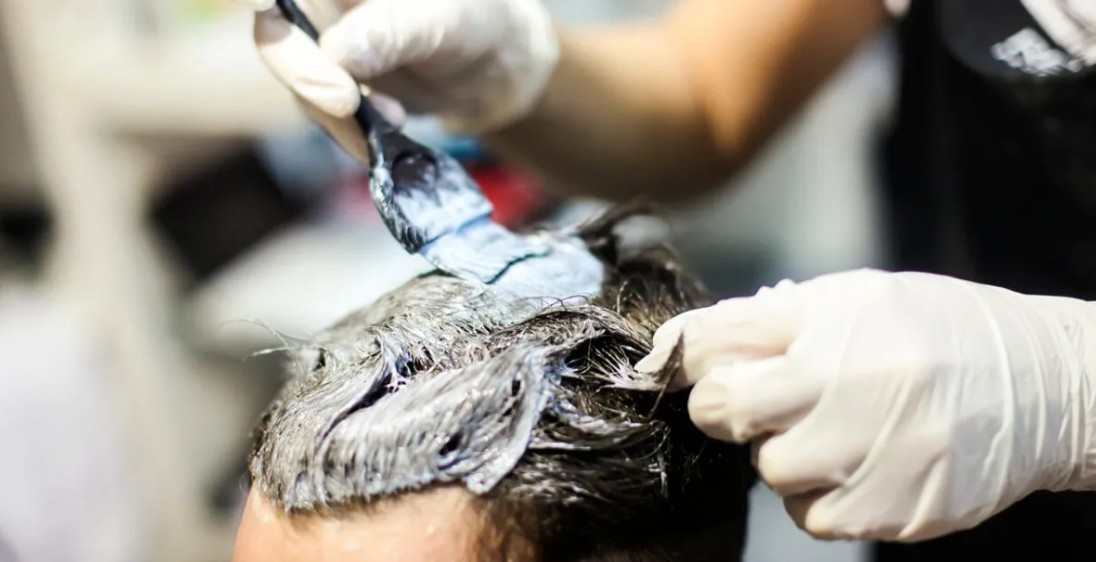
Permanent colour is a chemical process, not a coating. An alkaline agent — usually ammonia or an ammonia substitute — swells the hair shaft and lifts the cuticle so that pigment can get inside. Hydrogen peroxide strips existing melanin. Then oxidative dye molecules develop inside the shaft and become too large to wash out. That’s the whole trick.
All of that chemistry happens on hair. The problem is that hair grows out of skin, and you cannot apply anything to the hair at the roots without also applying it to the scalp. Normal scalp handles this fine. It has an intact barrier, a healthy stratum corneum, and an oil layer that buffers the contact. A scalp six weeks out from a transplant has thousands of microscopic puncture sites that have closed on the surface but are still remodelling underneath.
So the risk isn’t “dye kills grafts.” The risk is irritation, inflammation, and chemical contact with skin that hasn’t finished rebuilding its defences. Inflammation around a healing follicle is not neutral — it can affect how well that follicle transitions into its growth phase. That’s the connection people miss.
The Timeline: When Colour Becomes Safe
Here’s how we frame it for patients, and why each window exists.
Weeks 0 to 4 — absolutely not. Your scalp is scabbing, then shedding scabs, then flaking. The barrier is compromised in obvious, visible ways. Chemicals applied here can cause real burns, infection risk, and prolonged inflammation. There is no version of this that’s worth it. Nothing goes on your scalp in this window except what your clinic tells you to use.
Weeks 4 to 8 — still no, even though it looks fine. This is the trap. By week five, the recipient area looks unremarkable. Redness has faded, scabs are gone, and most of the transplanted hairs have already shed. Cosmetically you look normal. Biologically, the follicles are in telogen, sitting quietly underground, preparing to push new hair out. Skin is still remodelling collagen and re-establishing its barrier. It looks healed. It isn’t finished.
Months 2 to 3 — the conservative window opens. Most surgeons, including our team, place the earliest reasonable dyeing point somewhere between the eight-week and twelve-week mark, depending on how you healed. If you had an uneventful recovery, no persistent redness, no folliculitis, and your scalp isn’t reacting to normal shampoo, this is where colouring becomes defensible.
Month 6 onwards — genuinely routine. By this point the recipient area is fully healed and new hair is well into its growth phase. Colour here carries essentially the same risk it did before your transplant, which for most people is none at all.
If you want a single number to hold onto, use three months. If you want the honest version: it depends on your healing, your scalp’s sensitivity history, and how aggressive the product is. If you’re unsure where your own scalp sits, send us a message — a photo of your scalp at the roots tells us more in ten seconds than a paragraph of description ever will, and we’d genuinely rather answer that than fix something afterwards.
The Donor Area Is a Separate Conversation
People fixate on the recipient zone and forget the back of the head. The donor area also went through surgery — thousands of extraction punches, each one a small circular wound. It closes faster than the recipient zone because the wounds are shallower and the skin there is thicker, but it’s still healing tissue.
The complication is that the donor area is often the region that shows grey first, and it’s the region a barber will be blending. If you’re colouring to hide grey at the sides and back, you’re applying product directly onto skin that has hundreds of recent micro-wounds. Treat it with the same timeline as the recipient area. Faster surface healing doesn’t mean it’s finished remodelling.
Semi-Permanent, Permanent, and Bleach Are Not the Same Risk
Lumping all colour into one category is where people get bad advice. The gradient matters.
- Temporary and semi-permanent colour deposits pigment on or just under the cuticle with no ammonia and little or no peroxide. Least aggressive. Fades in weeks.
- Demi-permanent uses a low-volume developer, no ammonia. Blends grey rather than covering it fully. A good compromise for the earlier end of the window.
- Permanent colour uses ammonia plus peroxide. Full grey coverage, and full chemical exposure.
- Bleach and lightening is the most aggressive process available, using high-volume peroxide and persulphate salts. It’s also the one most likely to cause scalp burning even on undamaged skin.
If you’re at the three-month mark and you want to do something, a demi-permanent or semi-permanent product is a genuinely safer starting point than a permanent box dye. If you want to go lighter than your natural colour, wait longer. Six months minimum, and we’d argue closer to a year for anything involving significant lift.
Ammonia-Free Doesn’t Mean Chemical-Free
The salon industry has trained everyone to hear “ammonia-free” as “gentle,” and it’s a half-truth worth unpicking. Ammonia-free permanent colours substitute ethanolamine or a similar alkaliser. It smells better and it’s less volatile. It is still raising your cuticle with an alkaline agent and still developing with peroxide.
Meanwhile, PPD — paraphenylenediamine — is the dye molecule doing the actual colouring in most permanent formulas, and it’s the most common allergen in the whole category. It’s present in plenty of ammonia-free products. If you’ve had a mild reaction to dye before, a healing scalp is exactly the wrong place to find out whether that sensitivity has grown. Patch test. Every time, on the inner forearm or behind the ear, forty-eight hours ahead. Especially the first time after surgery.
Root Touch-Ups Versus Full Colour
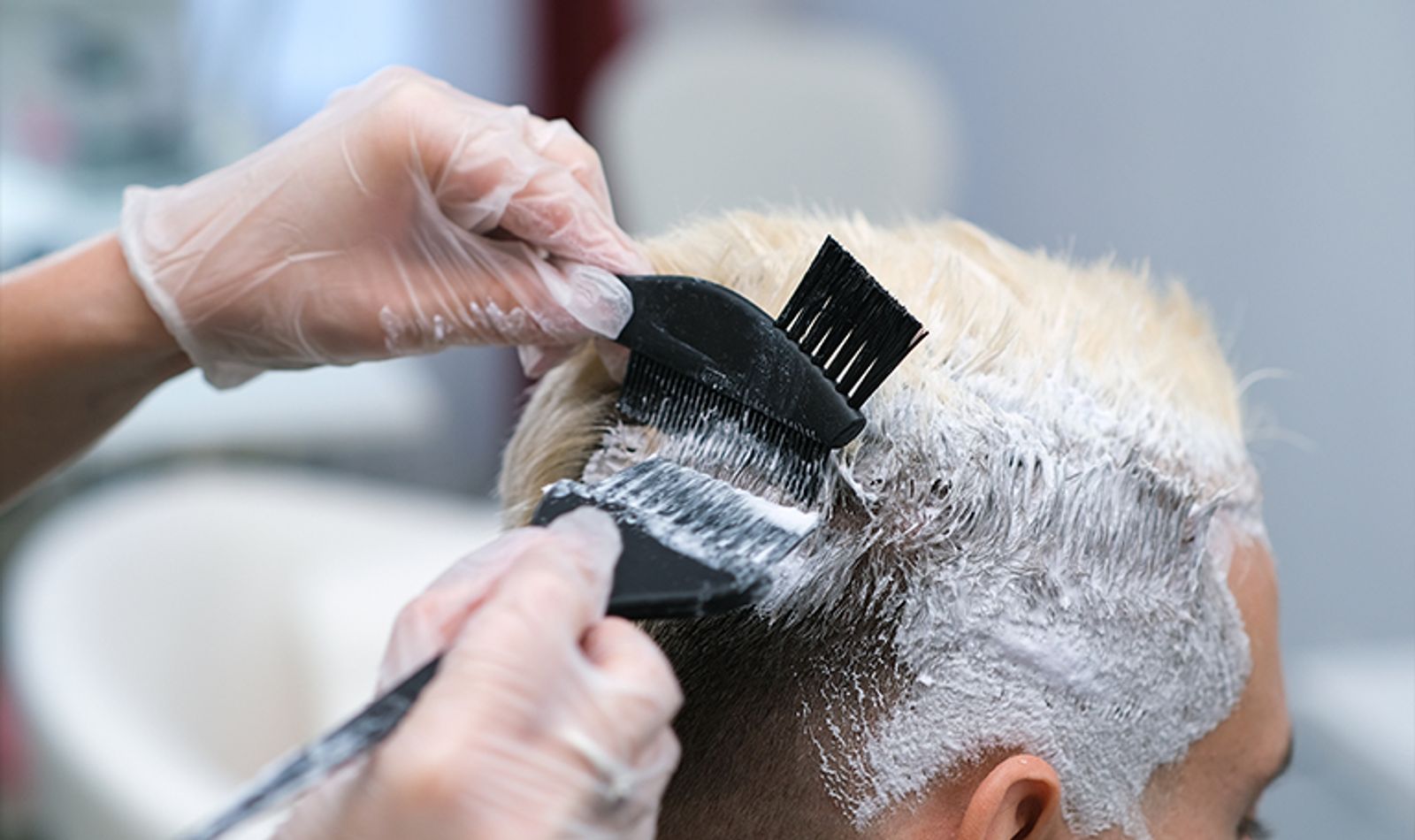
Here’s a practical distinction that solves most people’s problem. The reason you want to dye is almost always the roots — the half-centimetre of grey growing in at the hairline and temples. But a root touch-up is, by definition, the application method with the most scalp contact. Full-length colour on already-coloured hair barely touches skin at all.
So the thing you actually need is the thing with the highest exposure. There’s no clever way around that. What you can do is control how it’s applied: a foil or a fine-brush application that sits a few millimetres off the scalp, done by someone who understands why you’re asking, dramatically reduces contact. Ask for it. A colourist who knows you’ve had a transplant will work differently than one who doesn’t.
Talk to Your Colourist Before You Sit Down
Barbers and colourists notice transplanted hair. They see scalps all day. Pretending otherwise wastes the one advantage you have, which is that a professional who knows the situation will adapt to it.
Tell them the date of your surgery. Tell them which areas were transplanted. Ask them to work off the scalp, to use the lowest developer volume that achieves the result, and to reduce processing time if the scalp starts feeling warm. Any decent colourist will take this seriously. If one waves it off and reaches for the same bottle they’d use on anyone, that’s information about the colourist, not about your scalp.
The same conversation applies to the barber’s chair generally. The people who get the best long-term results after a hair transplant Turkey patients travel for are usually the ones who bring their local barber into the process rather than keeping it a secret. Your surgeon designed the hairline. Your barber maintains it every four weeks for the next decade. Those two should agree with each other.
What Colour Does to the Hair Itself, Not the Scalp
Set the scalp aside for a moment. There’s a second question: does dye damage the transplanted hair?
Transplanted hair is your hair. It has the same shaft structure, the same cuticle, the same response to chemistry as the hair it came from. It isn’t more fragile in some special way. But new hair emerging in months three to six is fine, thin, and often lightly pigmented — it hasn’t matured into its final calibre yet. That baby hair takes colour differently. It can grab pigment faster and end up darker than the surrounding hair, and it’s more prone to breakage from repeated processing.
This matters cosmetically more than medically. If you colour at month four and the result looks patchy at the hairline, that’s usually immature hair behaving differently, not damaged grafts. It resolves as the hair thickens. But it’s a reason to be conservative early: your colour result at month four will not represent your colour result at month twelve.
Grey Coverage and Hairline Planning
There’s a design conversation hiding inside the colour conversation, and it’s one worth having before surgery rather than after. If you dye your hair, your surgeon should know. A hairline designed for someone who colours their hair jet black needs different density thinking than one designed for someone going naturally grey.
Dark hair against pale scalp is high contrast, and contrast is what makes thin areas look thin. Grey hair against pale scalp is low contrast, which is why grey hair often looks fuller than it is. If you’re planning to keep colouring aggressively dark, you’re choosing the visual setting that demands the most density. That’s not a reason to stop — it’s a reason to say it out loud during the consultation, so the plan accounts for it. Our team at Hairpol builds this into hair transplantation planning when patients tell us, and can’t when they don’t.
The Realistic Risk List
Let’s be specific about what can actually go wrong, because vague warnings help nobody.
Contact dermatitis. The most likely problem. Redness, itching, burning, sometimes swelling. On a healing scalp it’s more likely and more uncomfortable, and it triggers inflammation exactly where you don’t want it.
Folliculitis. Irritated follicles get inflamed and pustular. It’s usually treatable but it’s a genuine setback in months two to four, when follicles are trying to enter anagen.
Chemical burn. Rare with sensible products, real with bleach on compromised skin. This is the one that can cause lasting damage.
Delayed or patchy growth. Not from the dye reaching the follicle, but from sustained inflammation in the area. This is the mechanism people can’t see and therefore discount.
Cosmetic mismatch. The most common outcome by far, and the least serious. New hair takes colour differently. It corrects itself.
Notice what isn’t on this list: dye does not cause your grafts to fall out. It does not undo a successful transplant. The catastrophic scenario people imagine when they hesitate at the third month isn’t the realistic one. The realistic one is a scalp that gets angry and slows things down.
Aftercare Around a Colour Appointment
If you’re going to colour at the earlier end of the window, build a bit of protection around it. Skip washing for a day or two before, so your natural oils are sitting on the scalp as a buffer — this is standard advice for sensitive scalps and it applies doubly here. Use a barrier cream along the hairline if your colourist offers it. Rinse thoroughly with cool water, not hot. Follow with a mild, sulphate-free shampoo rather than a stripping clarifier.
Afterwards, watch the scalp for forty-eight hours. Mild transient tingling during application is common. Burning is not. Persistent redness, bumps, or itching after two days deserves attention. Our hair treatment team sees this occasionally and it’s almost always manageable early and annoying late, which is the argument for asking sooner rather than waiting to see.
The Bigger Point About Post-Transplant Life
Colour is one instance of a broader pattern. After a transplant, everything you used to do without thinking becomes a question — sun, gym, hats, dye, styling products. The instinct is to freeze, to treat your head as permanently fragile. That’s not the goal. The goal is a head of hair you stop thinking about.
The healing window is finite. Three months of caution buys you decades of normal. The people who struggle are usually the ones at either extreme: the ones who reach for the bleach at week three, and the ones who are still afraid to dye at month eighteen. Neither is respecting what the timeline actually says.
What separates a good outcome from a mediocre one over ten years usually isn’t the surgery. It’s the accumulation of ordinary decisions afterwards — whether you protected the scalp when it needed protecting, whether you kept your medical maintenance going, whether you found people who understood what you’d had done. That’s as true for someone who had a hair transplant Turkey flights and hotels included as it is for someone who had it done down the road.
How Hairpol Handles This
We don’t hand out a laminated card with a date on it. When a patient asks about colouring, we look at their healing photos, their history with dye, their scalp sensitivity, and what they’re actually trying to achieve. Someone covering a few greys at the temples with a demi-permanent at month three is a different conversation from someone who wants a full bleach and tone at month four.
Ataşehir is a short trip for our Istanbul patients and a long one for everyone else, which is why most of this happens over messages. Genuinely — send us a message on WhatsApp with a clear photo of your roots in daylight, tell us your surgery date and what product you’re considering, and you’ll get a straight answer rather than a defensive one. That’s what the follow-up is for. Choosing where to have a hair transplant Turkey offers should include asking whether anyone will still be answering your questions at month four, because that’s when the questions actually start.
Your hair is yours again. Colour it, cut it, style it, get on with your life — just give the scalp the first three months it needs first. If you’re weighing up timing, technique, or whether your own healing is on track, our team at Hairpol’s hair transplant department is a message away, and you can see how our patients’ results settle over time on our before and after page.
Find this helpful? Add Hairpol as a preferred source on Google.
Get a Free Consultation
Answer a few questions and the medical team will review your situation.
