
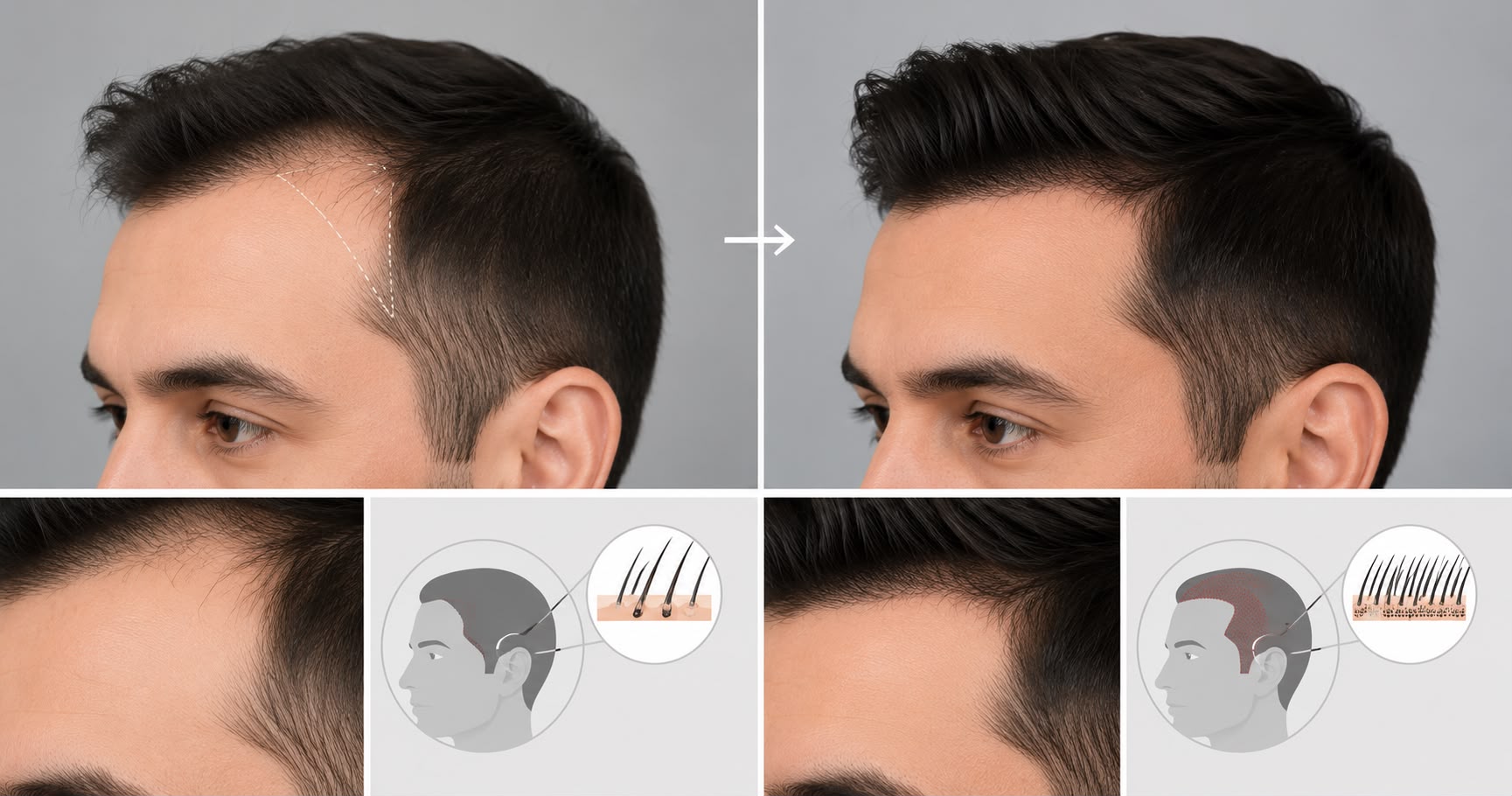
You can spend a year studying your hairline in the mirror and never once look at the two small wedges of scalp sitting above and behind the outer corners of your eyebrows. Almost nobody names them. But when a colleague says you look tired, or a photograph makes you look five years older than you feel, or something about your face has changed in a way nobody can quite articulate — the temples are very often the reason.
At Hairpol we see this play out in consultations constantly. A man arrives convinced his problem is the middle of his hairline. We take photographs from the side, put them next to a picture of him at twenty-five, and the frontal midline has barely moved. What disappeared were the corners. The face got wider at the top, the eyes drifted toward the centre, and the whole structure lost its taper. That is what a temple point does, and it is why restoring one changes a face more than an equivalent number of grafts anywhere else on the scalp.
The Temple Point Is Not Part of Your Hairline
It sits next to the hairline, but it behaves like a separate structure and it should be planned like one. Your frontal hairline runs across the forehead. At each end it turns and descends — that turn is the frontotemporal angle — and below it, hugging the side of the head, is a narrow triangular wedge of hair that points forward toward the eye. That wedge is the temple point. Its tip usually falls somewhere in line with the outer edge of the eyebrow, sometimes a little lower.
Anatomically the hair there is different from the hair two centimetres above it. It is finer, often lighter in colour, sparser in density, and it lies almost flat against the skin rather than standing up from it. It also has a specific flow: forward and down at the top of the wedge, then sweeping backward toward the ear as it meets the sideburn. Treat it as a continuation of the hairline and you will build something that reads as a hard corner instead of a soft point. The eye catches that instantly, even when the viewer cannot say why.
Why the Temples Decide How Wide Your Face Looks
Faces are read as shapes before they are read as features. A face with intact temple points has a visible taper at the top: hair comes down on both sides, narrowing the upper third and pushing attention inward toward the eyes. Lose that taper and the forehead does not just get taller, it gets wider. The skull’s widest point becomes visible. The distance between the outer corner of the eye and the nearest hair grows, and that single measurement is one of the most reliable visual cues of age we have.
This is why two men with identical frontal hairlines can look a decade apart. One has temple points holding the frame; the other has bare skin curving back toward his ears. Photographers, casting directors and barbers have known this forever, which is why the standard advice for a receding client is to keep length at the sides. They are compensating for a missing frame.
The taper also affects how the rest of your features are perceived. Narrow the upper third and the cheekbones read as more prominent, the jaw looks proportionally stronger, and the eyes sit closer to the visual centre of the face. Widen it and the reverse happens. None of this is vanity mysticism. It is geometry, and it is measurable in the before-and-after photographs of anyone who has had a temple restored properly.
The Unfinished Look: A Perfect Hairline With Empty Corners
This is the single most common repair request we see relating to this zone, and it usually comes from a patient who is not unhappy with his surgery so much as puzzled by it. The frontal hairline was rebuilt well. Density is respectable. Growth came in on schedule. And yet, looking straight at himself, something is off.
What has happened is that the surgeon treated the hairline as a line and stopped where the line stopped. The corners were left as they were, or worse, they were deliberately recessed to look mature while the centre was brought forward. The result is a hairline that hangs in space — a band of new hair with nothing anchoring it to the sides of the head. From the front it can look acceptable. From any three-quarter angle, which is how most people actually see you, it looks like a hairpiece edge.
At Hairpol we think of the front zone as a frame rather than a line, and the temple points are the corners of that frame. You can build the top edge beautifully, but if the corners are missing the frame does not close. The eye keeps searching for the boundary and never finds it. Correcting this afterwards is entirely possible, and often it takes surprisingly few grafts — but it is much cheaper, in donor terms and in time, to plan the corners into the original design. If you are still at the planning stage, our piece on why hairline design matters more than graft count covers the same principle from a different angle.
How Temples Recede Differently From the Rest of the Scalp
Temporal recession is one of the earliest signs of androgenetic hair loss, and it follows its own timetable. Many men lose temple density in their twenties while the midline stays intact, which is why a Norwood II or III can already have visibly altered facial framing. The hair does not usually vanish overnight. It miniaturises: each cycle produces a thinner, shorter, paler hair, until what remains is vellus fuzz that reflects no light and casts no shadow.
Because the hair there is naturally fine to begin with, miniaturisation is harder to notice than it is at the crown or hairline. You do not see a bald patch appear. You see a slow softening of the edge, until one day the temple has simply retreated a centimetre and a half and you have no idea when it happened.
There is a second pattern worth separating out. Some men — and a great many women — have temple points that were never strong to begin with. This is congenital, not progressive. The wedge is short, high, or almost absent, and it has looked that way since adolescence. That distinction matters clinically, because congenital weakness is stable and can be built out with confidence, while active miniaturisation needs medical stabilisation alongside surgery or the surrounding native hair will keep retreating around your new grafts.
The Angle Problem: Ten to Fifteen Degrees, Almost Flat
If there is one technical fact that separates a convincing temple from an obvious one, this is it. Hair in the temple region exits the skin at an extremely acute angle — commonly quoted as ten to fifteen degrees, and in the sharpest part of the wedge closer to flat than not. It does not stand up. It lies along the skin like it has been combed there and left.
Compare that to the frontal hairline, where grafts are placed at roughly forty to sixty degrees, or the crown, where they spiral out at angles that shift across the whorl. The temple is the most extreme angle anywhere on the scalp, and creating it means driving the incision almost parallel to the surface, through skin that is thin, mobile and sitting directly over the superficial temporal artery and its branches.
Get the angle wrong and the failure is not subtle. Hair placed at thirty or forty degrees in a temple stands away from the head. It catches light differently from the native hair beside it. It refuses to lie down no matter how it is styled, it looks bristly in close photographs, and the effect worsens as the hair grows longer. There is no product and no haircut that fixes a graft implanted at the wrong angle. The follicle grows in the direction it was placed, permanently. That is why, of all the ways a transplant can look artificial, a badly angled temple is the most visible and the least forgiving.
Why Every Graft Here Must Be a Single Hair
Follicular units come out of the donor area in groups of one, two, three and occasionally four hairs. In the mid-scalp, multi-hair grafts are exactly what you want: they build density efficiently and nobody examines them from ten centimetres away. In the temple, they are a liability.
Native temple hair grows sparsely and thinly. Place a three-hair graft there and you create a tuft — a small cluster of hairs emerging from one point, surrounded by skin that is meant to be visible. Because the surrounding hairs are fine and pale, that tuft is high contrast. It reads as dots. This is the same mechanism that made old punch-graft work look pluggy, compressed into a much smaller and much more visible area.
So the rule at Hairpol is simple and non-negotiable: temple points are built from single-hair grafts only, ideally the finest single hairs available in the donor pool. Some surgeons go further and split larger units under the microscope to harvest suitable singles, or take from areas of the donor zone known to produce finer hair, such as the nape periphery. It slows the day down. It uses more of the surgical team’s attention per graft than almost any other part of the operation. It is also the only way the finished temple survives a close look.
Direction: Down, Forward, Then Back Toward the Ear
Angle is how steeply the hair leaves the skin. Direction is where it points once it is out. Both have to be right, and in the temple they change across a very short distance.
At the upper border, where the temple meets the frontotemporal angle, hair tends to sweep forward and slightly down. Move a centimetre lower into the body of the wedge and the flow rotates: hairs run downward and increasingly backward, angling toward the ear, until at the sideburn they are running almost straight down. In many people there is also a subtle fanning where these two flows meet, and reproducing that fan is a large part of what makes a rebuilt temple look native rather than drawn on.
The practical consequence is that a surgeon cannot set one angle and one direction and work through the zone mechanically. Direction has to be adjusted graft by graft, and the reference is always the surviving native hair adjacent to the site. Where no native hair remains, the reference becomes the patient’s own old photographs and the symmetry of the opposite side. This is slow, deliberate work on a patch of scalp that might hold only a few hundred grafts, and it is precisely where experience shows.
Why the Choi Pen Earns Its Place in This Zone
The temple is the strongest argument anyone can make for DHI hair transplantation. With an implanter pen, the incision and the placement happen in one motion, which means the angle the operator sets with the pen is the angle the graft actually ends up in. There is no separate insertion step in which a graft can be nudged upright, seated too deep, or rotated out of line.
That control matters more here than anywhere else, because the tolerances are tighter. A graft that lands at fifty degrees instead of forty-five in the mid-scalp is invisible. The same five-degree error in a temple, where you are working at ten to fifteen degrees to begin with, is a proportionally enormous deviation and it shows. The Choi pen also handles fine single grafts gently and places them at a consistent depth, which reduces the risk of pitting or elevation in skin that is thin enough to reveal both.
None of this makes DHI magic. The pen does not know what a good temple looks like; the person holding it does. But when the plan calls for a few hundred ultra-fine singles laid nearly flat in a specific fan, the instrument genuinely helps. We have written more about the mechanics of this in our article on why the Choi pen suits the front zone.
Who Actually Needs Temple Restoration
Three groups come up again and again. The first is the man with advanced loss — Norwood V, VI or VII — who is having his front rebuilt. Here the temples are not optional decoration. When the whole frontal third is being reconstructed, leaving the corners bare produces exactly the disconnected look described earlier, and the temples become part of the core plan rather than an extra.
The second group is post-surgical: patients who have had a facelift, brow lift or temporal lift. These procedures lift and rotate tissue, and one common consequence is that the sideburn and temple hair migrate upward and backward, leaving a bare strip in front of the ear or a temple point that has been pulled out of position. The hair itself is usually healthy and non-hormonal, which makes the outcome of restoration predictable.
The third is congenital weakness — high, short or absent temple points that have always been that way. This includes a large number of women, whose hairlines are frequently intact while their temples are naturally sparse. Because these follicles are not under hormonal attack, restored temples in this group tend to be extremely stable over time.
A fourth, smaller group is worth mentioning: patients with traction-related or scarring loss at the temples, whether from years of tight ponytails, extensions, or trauma. Candidacy there depends entirely on whether the underlying process has stopped and whether the skin will support grafts, which is a matter for examination rather than a rule of thumb.
Graft Numbers: Small Investment, Disproportionate Return
Most temple restorations sit somewhere between one hundred and fifty and four hundred grafts per side. A mild refinement in someone whose wedge is mostly intact might take one hundred and fifty. A complete rebuild in an advanced Norwood, where the temple has to be constructed from nothing across a broad area, can run to four hundred or a little beyond. Both sides together, then, most cases land between three hundred and eight hundred grafts.
Put that against a typical session of three to four thousand grafts and the arithmetic becomes interesting. You are spending somewhere around ten to twenty per cent of a session’s donor supply on a zone that occupies a tiny fraction of the scalp’s surface area — and getting a change in facial framing that is often more noticeable than the change from filling the crown.
Grafts spent on the crown disappear into a large surface area and produce coverage, which is valuable but rarely dramatic. Grafts spent on temples produce shape. They restore the taper, close the frame, and shorten the visual distance between hair and eye. Per graft, we consider this the highest-yield real estate on the head. At Hairpol we routinely build a temple allowance into front-zone plans even when the patient has not asked for it, because in ten years of photographs it is the part they thank us for.
The Risk Nobody Warns You About: Building Them Too Strong
Temple restoration has a specific failure mode that has nothing to do with technique and everything to do with judgement. It is entirely possible to place every graft at a perfect angle, in a perfect direction, with perfect single-hair units — and still produce a result that looks wrong in a decade.
The mechanism is over-design. A patient in his early thirties, remembering the temples he had at nineteen, asks for them back. The wedge is drawn low, long and pointed. It looks striking at twelve months. Then the surrounding native hair continues to thin, the frontal hairline recedes a little more, and by his mid-forties he has two strong, dark, low-set temple points sitting in the middle of a thinning frame. Instead of framing the face, they now advertise the surgery. Nothing was implanted badly. The design simply did not account for time.
The honest approach is conservative. Temple points should be placed slightly higher and slightly shorter than the patient’s teenage anatomy, with soft irregular borders rather than a crisp edge, and with density that suggests rather than declares. The goal is a temple that looks unremarkable at forty-five, not spectacular at thirty-two. At Hairpol we would rather add a second small session later — temples are easy to extend and impossible to un-build — than commit donor hair to a shape that stops making sense.
Temples and Sideburns in Women
Women come to this zone by a different route. Female pattern loss usually diffuses across the top of the scalp rather than retreating in the male pattern, so the frontal hairline often stays where it was while the temples thin quietly on either side. The effect is a widening at the top of the face that many women describe as looking severe or masculine, and it is one of the most common complaints in female consultations that have nothing to do with an overall thinning.
Traction is the other major cause. Years of tight ponytails, braids, buns and extensions apply constant tension exactly where the hair is finest, and temporal traction alopecia is the predictable result. Caught early it is partially reversible. Left long enough, the follicles scar and only grafting will restore the area. Sideburn loss frequently accompanies it, and the two are usually planned together because they share a flow.
Technically the work is the same, with even less margin. Female temple hair is finer still, the skin is thinner, and the acceptable density is lower — an over-dense female temple looks harder and more masculine, which is the opposite of what the patient came for. Our approach to female cases is set out in more detail on our hair transplantation for women page, and temple and sideburn work is one of the areas where a modest graft count changes a face most.
What Healing Looks Like in the Temple Zone
Recovery here follows the same broad timeline as the rest of the scalp, with a few local quirks. Crusting is usually minimal because the grafts are small and the incisions are shallow and nearly parallel to the skin. Redness, however, can linger longer than it does in the mid-scalp, since the skin is thin and pale and shows vascular change readily. Fair-skinned patients occasionally see faint pinkness in the temples for eight to twelve weeks.
Swelling from the forehead often tracks down through the temples in the first three or four days and can make the area feel tight. It resolves on its own. Numbness is common and temporary. Because the region sits over branches of the superficial temporal artery, a careful surgeon works with deliberate depth control, which is another argument for an instrument that sets depth consistently.
Shock loss deserves a specific warning. The native hairs around a temple are fine and already fragile, so they shed readily after surgery. Many patients reach week four convinced their temples look worse than before they started. They almost always do. Regrowth begins around month three to four, and because the hairs are fine, the temple is usually one of the later zones to look convincing — twelve months is a fair assessment point, not eight.
How We Plan Temples at Hairpol
Planning starts before any marker touches skin. We photograph the face from the front, from both three-quarter angles and in profile, because a temple that looks correct head-on can be a centimetre out of position from the side. We ask for old photographs whenever the patient has them — your own temple at twenty-two is a better design brief than any template.
Then we look at what is left. Surviving native hairs, however sparse, dictate angle and direction more reliably than any rule, so the design follows them where they exist. We assess donor quality specifically for fine singles, because a patient with uniformly coarse donor hair may need a more restrained temple than someone with fine hair available. We measure both sides independently, since natural temples are rarely perfectly symmetrical and forcing symmetry can look stranger than accepting a small difference.
And we discuss trajectory openly: what your hair loss is likely to do over the next fifteen years, whether medical treatment is stabilising it, and how the temple design should be positioned to still make sense at the end of that period. That conversation is not a formality. It is the difference between a detail that quietly improves your face for decades and one that has to be revised.
If the corners of your frame have gone soft — whether alongside a larger procedure or as a small standalone case — it is worth having them assessed properly rather than assuming the hairline is the whole story. You can read more about how we approach the front zone on our hair transplantation page, or bring your photographs to a consultation at Hairpol in Ataşehir and we will tell you honestly what a few hundred grafts in the right place would do for your face.
Frequently Asked Questions (FAQ)
What exactly is a temple point?
It is the narrow triangular wedge of hair that sits below the corner of your frontal hairline, on the side of the head, pointing forward toward the outer edge of the eyebrow. It is anatomically distinct from the hairline: the hair there is finer, sparser, lies almost flat against the skin and flows down and back toward the ear.
Why do temple points make such a difference to how my face looks?
They create the taper at the top of the face. With them intact, the upper third narrows and attention moves inward toward the eyes. Without them, the forehead reads as both taller and wider, and the distance between the outer corner of the eye and the nearest hair increases, which is one of the strongest visual signals of ageing.
How many grafts does temple restoration usually take?
Most cases fall between 150 and 400 grafts per side, so roughly 300 to 800 for both. A light refinement in a mostly intact temple sits at the lower end, while building a temple from nothing in an advanced Norwood pattern sits at the upper end.
Why do surgeons use only single-hair grafts in the temples?
Native temple hair is fine and sparse, so a two or three hair graft produces a visible tuft against skin that is meant to show through. That high-contrast clustering is the same effect that made old plug transplants look artificial, concentrated in a small and very visible area.
What angle is used when implanting temple grafts?
Roughly 10 to 15 degrees, which is the most acute angle used anywhere on the scalp and far flatter than the 40 to 60 degrees typical of the frontal hairline. The incision runs almost parallel to the skin surface so the hair lies down rather than standing away from the head.
What happens if the angle is wrong?
The hair stands away from the head instead of lying flat, catches light differently from surrounding native hair, looks bristly in photographs and cannot be styled down. There is no product or haircut that corrects it, because a follicle grows permanently in the direction it was implanted. It is the most visible way a transplant can look artificial.
Is DHI better than FUE for temple restoration?
For this specific zone, the implanter pen has a genuine advantage. It creates the incision and places the graft in one action, so the angle the surgeon sets is the angle the graft keeps, and depth stays consistent in thin skin. That control matters more here because the tolerances are far tighter than elsewhere on the scalp.
Can temple points be designed too aggressively?
Yes, and it is the most common design mistake in this area. Temples drawn as low, long and pointed as they were at nineteen can look striking at twelve months and unnatural fifteen years later, once the surrounding hair has thinned further. A slightly higher, shorter shape with soft irregular borders ages far better.
Find this helpful? Add Hairpol as a preferred source on Google.
Get a Free Consultation
Answer a few questions and the medical team will review your situation.
