
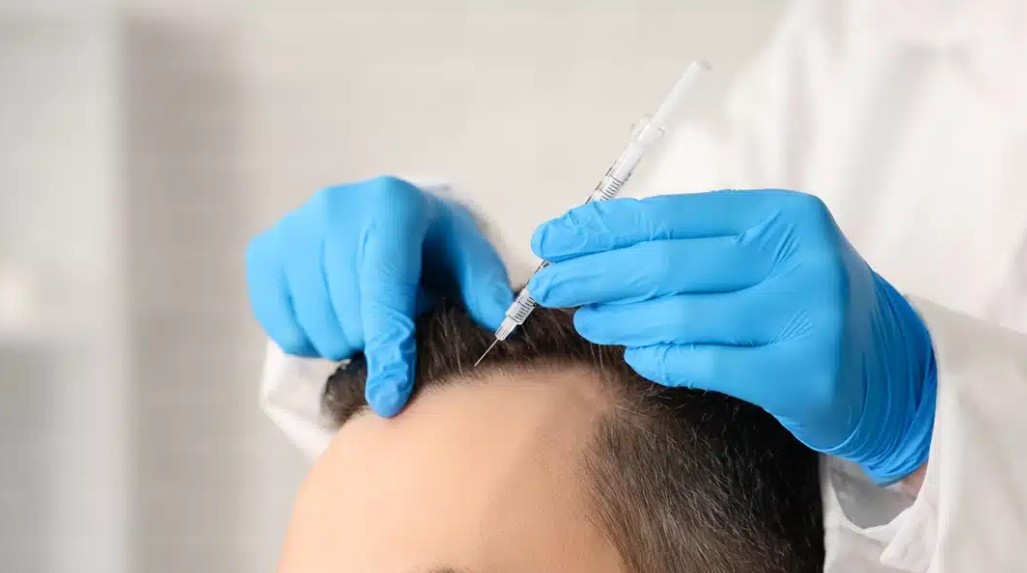
Somewhere between “I’m not ready for surgery” and “I have to do something,” most people find mesotherapy. It gets offered in that exact gap. You walk into a consultation worried about a thinning crown or a hairline that’s crept back a centimetre, you hear that you’re not a great surgical candidate yet, and then someone mentions a course of injections that will “feed the follicles.” It sounds gentler than surgery, more active than shampoo, and it usually costs less than either.
That’s the marketing version. The clinical version is narrower, more useful, and worth understanding before you commit to a course of anything. Mesotherapy for hair is a genuine tool. It is not a replacement for grafts, it is not a cure for pattern baldness, and it works best when it’s aimed at a specific problem rather than sprayed at a vague sense of “my hair looks worse than it did.”
What Is Actually Being Injected Into Your Scalp
Hair mesotherapy means delivering a prepared solution into the upper layers of the scalp through very fine needles, placed in a grid across the thinning area. The depth is shallow — roughly the dermis, where the follicle sits and where its blood supply runs. That shallowness is the entire point. Instead of relying on something applied to the surface and hoping it penetrates, or swallowed and hoping enough reaches the scalp, the active ingredients are placed directly beside the structures you want to influence.
The solution itself is a cocktail, and that word is accurate. Typical formulations contain B-group vitamins, biotin, zinc, copper and other trace minerals, amino acids that serve as raw material for keratin, hyaluronic acid, and increasingly a group of peptides and growth-factor analogues designed to signal follicles rather than simply feed them. Some clinics add low-dose vasodilators to encourage local blood flow. Formulations vary between manufacturers, and honest clinics will tell you which one they use and why.
At Hairpol, that transparency matters to us, because the composition determines what you can reasonably expect. A vitamin-heavy mix supports hair shaft quality. A peptide-led mix aims at the follicular cycle. They are not interchangeable, and neither of them creates a follicle that no longer exists. You can read more about how these solutions sit alongside our other non-surgical options on our hair treatments page.
Mesotherapy and PRP Are Not the Same Treatment
These two get bundled together constantly, usually because they involve similar-looking needles and similar-sounding promises. The difference is fundamental, and once you understand it, choosing between them gets much easier.
PRP uses your own blood. Blood is drawn, spun in a centrifuge to concentrate the platelets, and that concentrate is injected back into your scalp. The active agents are your own growth factors — biological, personal, and variable in strength depending on your platelet count, your health, and the preparation protocol. Mesotherapy uses a manufactured solution. The contents are known, standardised, identical from vial to vial, and completely independent of your own biology.
That distinction cascades into everything else. PRP requires a blood draw and a processing step, which makes each session longer. Mesotherapy skips both, so a session can be over in fifteen minutes. PRP has a larger body of published evidence behind it in androgenetic alopecia. Mesotherapy has less. PRP is generally the stronger choice when the goal is to stimulate underperforming but living follicles; mesotherapy is more often chosen when the goal is scalp condition, shaft quality, and supporting hair through a stressed period. We’ve written about the surgical pairing in detail in our piece on PRP therapy with hair transplants, and the honest limits described there apply here too.
What Mesotherapy Is Realistically Trying to Do
It helps to be precise about the mechanism, because the vague version — “it nourishes your hair” — invites disappointment.
A follicle that is miniaturising under hormonal pressure is not starving. It’s receiving a signal, from DHT binding at receptor sites, that tells it to produce progressively finer hair over successive cycles. No vitamin cocktail overrides that signal. What mesotherapy can plausibly do is improve the local environment those follicles operate in: better microcirculation, better hydration in the dermis, more available building blocks for the keratin your hair is made of, and a less inflamed scalp surface.
In practice that translates into hair that feels thicker to the touch, looks less dull, breaks less easily, and sheds slightly less during the daily count. Those are real, measurable-by-you improvements. They are also modest, and they belong in the “supportive” column rather than the “corrective” one. Mesotherapy does not regrow a bald scalp. Anyone telling you otherwise is either confused or selling.
Early Thinning: The Clearest Place It Fits
The candidate who benefits most is the one whose hair is still there, just less of it and finer than it used to be. Diffuse thinning across the mid-scalp. A crown that’s showing more scalp under bright light. A part line that’s widened by a couple of millimetres over two years. Density is reduced but the follicular units are alive and cycling.
In that scenario, mesotherapy has something to work with. Living follicles can respond to an improved environment; dead ones cannot. This is also the stage at which people are least willing to consider surgery, and quite reasonably so — operating on a scalp that’s early in its loss trajectory means committing donor hair before you know where the pattern is heading.
Hairpol’s usual position with early thinners is that mesotherapy makes sense as part of a medical plan rather than instead of one. Combined with a proven medication where appropriate, and reviewed with photographs at six-month intervals, it becomes a reasonable holding strategy. Alone, unmonitored, and expected to stop genetic loss, it becomes an expensive way to delay a decision.
Telogen Effluvium and Stress-Driven Shedding
This is where mesotherapy arguably earns its keep most convincingly. Telogen effluvium is a shedding event, not a pattern. A surgery, a serious illness, rapid weight loss, a period of severe stress, a childbirth, a thyroid swing, an iron deficiency — any of these can push an unusually large share of your follicles into the resting phase at once. Two or three months later the hair falls out in handfuls, and it is frightening in a way that gradual loss is not.
The good news is that telogen effluvium is usually self-limiting. The follicles are not damaged; they’re paused. They restart. What mesotherapy offers during that window is support for the regrowth phase: raw material for the new shafts, better scalp circulation, and — a factor nobody should dismiss — the sense of doing something structured during a period that otherwise feels entirely out of your control.
The honest caveat is that the underlying cause still has to be addressed. If your ferritin is low, injections into your scalp will not fix that. Blood work first, correction of the trigger second, mesotherapy as an accelerant third. In that order, it’s useful. Out of that order, it’s a distraction with a price tag.
Seasonal Shedding and the Autumn Panic
Every autumn, clinics fill with people convinced they’ve suddenly gone bald. Seasonal shedding is a genuine phenomenon — a mild, temporary increase in telogen-phase hairs, most commonly reported in late summer and autumn. For most people it resolves without any intervention at all.
Where mesotherapy comes in is with the group whose baseline density is already borderline. If you have plenty of hair, seasonal shedding is a nuisance you’ll forget about by winter. If you’re already thinning, losing an extra chunk temporarily can push your scalp from “you can’t really tell” to “you can definitely tell,” and the recovery from that visible dip takes months you’d rather not spend.
A short course of mesotherapy timed around that period is a defensible use of the treatment. Not because it prevents seasonal shedding — it doesn’t — but because it supports the regrowth that follows and shortens the psychological ordeal in between. We’re candid with patients at Hairpol that this is a comfort-and-quality intervention, not a structural one.
Hair Quality: The Benefit People Underrate
Most conversations about hair loss focus obsessively on count. How many follicles, how many grafts, how many hairs in the shower drain. But a great deal of how your hair looks in a mirror comes down to the quality of each individual shaft: its diameter, how it reflects light, whether it holds a shape, whether it snaps halfway down.
Mesotherapy’s most consistent effect sits here. Patients frequently report, after a course, that their hair feels heavier in the hand, styles more predictably, and looks less flat. Scalp condition often improves alongside it — less tightness, less flaking, less of that irritated feeling that makes you scratch and make things worse.
Is that worth paying for? That depends entirely on what’s bothering you. If your complaint is a receded hairline, better shaft quality won’t touch it, and you’d be buying the wrong product. If your complaint is that your hair has gone limp, dull and lifeless over the last two years while the density is broadly intact, then shaft quality is precisely the problem, and this is one of the few treatments aimed squarely at it. Our scalp and hair treatment consultations are designed to separate those two complaints before anyone books a course.
After a Transplant: Supportive, Not Essential
Mesotherapy is frequently offered as part of post-operative care, and it has a logical place there — provided the claims stay modest.
After a transplant, two things are happening in your scalp at once. The transplanted grafts are establishing a blood supply and heading into their shedding-then-regrowth cycle. Meanwhile, the surrounding native hair has been through a surgical insult and often responds with its own temporary shedding, the phenomenon usually called shock loss. Mesotherapy is aimed mainly at that second group: the existing hair around and between the grafts.
The timing matters. Nothing is injected into a healing recipient area in the early days; the grafts need to be left completely alone. Most protocols begin somewhere around the one-month mark, once the scalp has settled, and continue at intervals through the first several months while regrowth is underway. It’s a supportive layer, not a determinant of the result. The quality of your transplant is decided by planning, extraction technique and graft handling — not by what’s injected afterwards. Any clinic implying otherwise is shifting responsibility away from where it belongs.
What a Course Actually Looks Like
Mesotherapy is not a one-off. That’s the single most important logistical fact about it, and the one most often glossed over when the price of a single session is quoted.
A standard course runs somewhere between six and ten sessions. The early sessions are usually spaced closely — weekly or fortnightly at the start — then stretch out to intervals of roughly four to six weeks as the course progresses. The reason for that structure is the hair cycle itself: you’re trying to influence follicles across multiple phases, and follicles don’t all cycle in unison.
After the initial course, most protocols move to maintenance: a session every one to three months, indefinitely, for as long as you want the effect maintained. Before you start, ask for the whole schedule and the whole cost, not the per-session figure. A treatment that looks inexpensive at one session becomes a genuine annual commitment at fourteen. At Hairpol we’d rather have that conversation at the beginning than watch someone abandon a course halfway through because the arithmetic surprised them.
What It Actually Feels Like
Let’s deal with the needles, since that’s what most people are really asking about.
The needles are very fine and the injections are shallow, which makes each individual one closer to a sharp pinch than a conventional injection. The catch is volume: a session involves dozens of them, distributed across the treatment zone, and the cumulative sensation is more tiring than any single stick. Most patients rate the discomfort as moderate and entirely tolerable. Some areas are more sensitive than others — the frontal zone and the temples tend to be sharper than the mid-scalp.
A topical anaesthetic cream applied thirty to forty-five minutes beforehand takes the edge off substantially, and many clinics use a mechanical injector gun that standardises depth and speed, which both reduces sensation and makes the grid more even. Sessions run ten to twenty minutes. Afterwards the scalp feels tender and looks slightly red and bumpy where the fluid sits under the skin, and that settles within a few hours. You go back to work the same day. If you have a genuine needle phobia, say so before you book — there’s no prize for enduring a course you dread, and other options exist.
The Evidence, Honestly
Here’s where we part company with a lot of clinic marketing.
The published evidence base for hair mesotherapy is thinner than for finasteride, thinner than for minoxidil, and thinner than for PRP. The studies that exist tend to be small, heterogeneous in formulation, short in follow-up, and often lacking a proper control group. Because “mesotherapy” describes a delivery method rather than a fixed drug, results from a study of one cocktail don’t automatically transfer to another. That’s a real methodological problem, not a technicality.
What the evidence does reasonably support is modest improvement in hair density and shaft calibre in some patients, better outcomes when it’s combined with proven therapies rather than used alone, and a good safety profile. What it does not support is mesotherapy as a standalone treatment for androgenetic alopecia. As monotherapy, it does not reverse pattern baldness. Any clinic presenting it as an alternative to surgery for someone with significant loss is misrepresenting what the treatment can do, and you should treat that as information about the clinic rather than about the treatment.
Who It Is Not For
Mesotherapy is the wrong choice for advanced hair loss, and no amount of enthusiasm changes that arithmetic. If your hairline has receded past the point where thinning describes it, if your crown is bare rather than sparse, if you look at a bright bathroom mirror and see scalp rather than reduced density — the follicles in those zones are largely gone. Nothing injected into skin restores a structure that no longer exists. In those areas, moving follicles from a donor zone that isn’t affected by DHT is the only intervention that adds hair.
It’s also a poor fit for anyone hoping to avoid a decision indefinitely. Some patients cycle through years of injectable courses, spending steadily, while the underlying pattern advances quietly in the background. At the end of it they’re in the same place surgically, minus the money and the years. Our article comparing hair transplant, PRP and medication walks through where each option genuinely belongs.
And it’s not appropriate during active infection or inflammation of the scalp, in pregnancy or breastfeeding, with clotting disorders or on anticoagulant therapy without medical clearance, or where there’s a known allergy to any component of the solution. Undiagnosed hair loss should be worked up before it’s treated — mesotherapy applied to an unrecognised autoimmune or thyroid problem simply delays the diagnosis that matters.
Side Effects and What Counts as Normal
The safety profile is one of mesotherapy’s genuine strengths, which is part of why it’s offered so widely.
Expect tenderness at the injection sites for a day or so, mild redness, small raised bumps where fluid sits under the skin for the first few hours, and occasional pinpoint bruising, particularly at the temples. Some people get a mild headache after a session. All of this is routine and resolves without intervention.
Less commonly, you might see a small amount of swelling that migrates downward to the forehead overnight — gravity, not complication. Rarely, an allergic reaction to a component of the cocktail can occur, which is why your clinic should know your allergy history before the first session rather than after it. Infection is rare with proper sterile technique but not impossible; spreading redness, increasing pain after day two, warmth or discharge all warrant a call rather than a wait-and-see.
One practical note: don’t book a session the day before an event you care about. The redness and bumpiness are short-lived but visible, and there’s no reason to schedule them into a wedding photograph.
How Long the Effect Lasts
This is the question people ask last and should ask first. Mesotherapy results are maintenance-dependent. They fade.
Once you stop, the improved shaft quality and scalp condition gradually revert over a period of months, and the follicles return to whatever trajectory they were on before you started. That’s not a failure of the treatment; it’s a consequence of what it does. It supports an environment. Remove the support and the environment reverts. The same is true of minoxidil, and for the same reason.
So the decision to begin a course is really a decision about ongoing commitment. If you’re prepared to attend maintenance sessions indefinitely and the cost fits your life comfortably, mesotherapy can be a reasonable long-term part of your plan. If you’re hoping for six sessions and a permanent change, you’ll be disappointed, and it’s better to know that now than eighteen months and several thousand lira later.
Building a Plan That Makes Sense
The way to think about mesotherapy is as one layer in a strategy rather than as a treatment in its own right. The layers, roughly in order of impact for pattern hair loss, run like this: medical therapy that addresses the hormonal driver, procedural support such as PRP or mesotherapy that improves the environment those follicles live in, and surgery that relocates follicles into areas where nothing else will produce hair.
Most people who are genuinely losing hair end up needing more than one of those layers, and the sequencing matters. Stabilise first. Support second. Rebuild what can’t be stabilised third. When mesotherapy is placed inside that structure, it does useful work. When it’s sold as a substitute for the layer above or below it, it wastes time that hair loss doesn’t give back.
At Hairpol, a consultation starts with what’s actually happening on your scalp — pattern, density, donor quality, family history, blood work where indicated — before anyone discusses which treatments to buy. Sometimes the answer is a course of mesotherapy. Sometimes it’s medication and a review in six months. Sometimes it’s a frank conversation that injections won’t achieve what you’re picturing and that grafts are the only route to the result you have in mind.
If you’re weighing up your options and you’d like an assessment that tells you where you actually stand rather than what’s easiest to sell, talk to us about hair transplantation and the non-surgical treatments that support it. You’ll leave knowing which layer you need — and which ones you can safely skip.
Frequently Asked Questions (FAQ)
What is hair mesotherapy?
Hair mesotherapy is the delivery of a prepared solution into the upper layers of the scalp using very fine needles placed in a grid pattern. The solution typically contains vitamins, minerals, amino acids, hyaluronic acid and peptides, and it is injected shallowly so the ingredients sit close to the follicles and their blood supply rather than being applied to the surface or taken orally.
How is mesotherapy different from PRP?
PRP uses your own blood, which is drawn, spun in a centrifuge to concentrate the platelets, and injected back into your scalp, so the active agents are your own growth factors. Mesotherapy uses a manufactured, standardised cocktail that is the same for every patient. PRP sessions take longer because of the blood draw and processing, and PRP has a broader published evidence base in pattern hair loss.
Can mesotherapy regrow hair on a bald area?
No. Where the follicles are gone, no injected solution restores them. Mesotherapy can only influence follicles that are still alive and cycling, which is why it suits early or diffuse thinning rather than areas that are genuinely bare. For bald zones, moving follicles from a DHT-resistant donor area through a transplant is the only intervention that adds hair.
How many sessions of mesotherapy do I need?
A standard course runs roughly six to ten sessions. The first few are spaced weekly or fortnightly, then intervals stretch to about four to six weeks. After the initial course most protocols move to maintenance sessions every one to three months for as long as you want the effect to continue. Always ask for the full schedule and total cost rather than the per-session price.
Does mesotherapy hurt?
Each injection feels more like a sharp pinch than a conventional needle because the needles are fine and the depth is shallow. The challenge is the number of them in one session. Topical anaesthetic cream applied thirty to forty-five minutes beforehand reduces the sensation substantially, and mechanical injector devices make the process faster and more even. Most patients describe it as moderate and tolerable.
Is mesotherapy useful after a hair transplant?
It can be, as a supportive layer aimed mainly at the native hair around and between the grafts rather than at the grafts themselves. Nothing is injected into a healing recipient area in the early days; protocols usually begin around one month after surgery. It does not determine your transplant result, which depends on planning, extraction technique and graft handling.
What are the side effects of hair mesotherapy?
Expect tenderness at the injection points for a day or so, mild redness, small raised bumps for a few hours and occasional pinpoint bruising, especially at the temples. Mild headache after a session is not unusual. Allergic reactions to a component of the cocktail are rare but possible, and infection is uncommon with proper sterile technique. Spreading redness or increasing pain after day two should be reported.
Do mesotherapy results last if I stop?
No. The improvements in shaft quality and scalp condition fade gradually over several months once treatment stops, and the follicles return to the trajectory they were on before. Mesotherapy supports an environment rather than changing the underlying cause of pattern loss, so the decision to start a course is really a decision about ongoing maintenance.
Find this helpful? Add Hairpol as a preferred source on Google.
Get a Free Consultation
Answer a few questions and the medical team will review your situation.
