
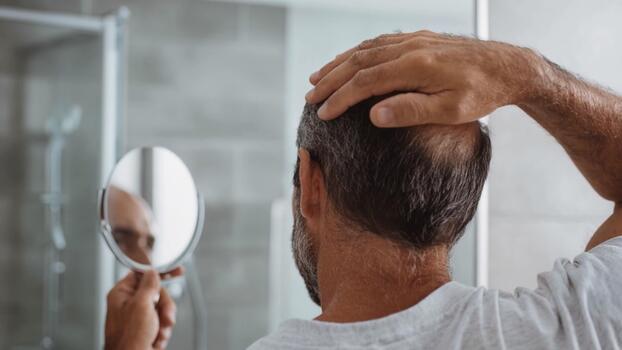
Somewhere in your fifties, a quiet assumption tends to settle in: that the window for doing something about your hair has closed. The before-and-after photos you see are mostly of men in their thirties. The marketing speaks to people at the start of their hair loss, not decades into it. So if you’re 52, or 58, or 63 and still bothered by a hairline that retreated years ago, it’s easy to conclude you’ve simply missed your chance — that a hair transplant is something for younger men, and that age has quietly disqualified you.
It usually hasn’t. Age, on its own, is one of the weakest reasons to rule out a hair transplant. The follicles in your donor area don’t expire on a birthday, and hair moved at 55 grows just as reliably as hair moved at 35. What actually decides whether surgery makes sense after 50 has very little to do with the number itself and almost everything to do with the condition of your donor, your general health, and whether your expectations match what the procedure can realistically deliver.
At Hairpol, plenty of the most satisfying cases are men well past 50 — partly because, by that age, a lot of the uncertainty that complicates younger patients has resolved. This guide walks through what being over 50 really changes about a hair transplant, where it helps you, where it demands extra caution, and when it genuinely is too late.
Why “Too Old” Is the Wrong Question
The idea that there’s an age cut-off for hair transplantation is one of the most persistent myths in this field, and it doesn’t hold up. A hair transplant doesn’t grow new hair out of nothing; it relocates your own permanent follicles from the back and sides of your head into thinning areas. Those donor follicles are genetically programmed to keep growing wherever they’re placed, and that programming doesn’t weaken with age the way people assume.
What this means in practice is simple: if the hair at the back of your head is still growing, it can still be transplanted, whether you’re 35 or 65. The biology that makes a transplant work is intact long into later life. The real questions are not about age at all. They’re about how much usable donor hair you have, whether you’re healthy enough for a minor procedure under local anaesthetic, and whether what you want is achievable with the donor you’ve got.
That reframing matters, because men over 50 often disqualify themselves before they ever ask. They assume the answer is no, when the honest answer is far more often “it depends on factors that have nothing to do with your age.”
The Hidden Advantage of Being Older
Here’s something the youth-focused marketing never mentions: being over 50 can actually be an advantage. The reason comes down to predictability. Hair loss is a moving target. In younger patients, the single biggest complication is that nobody knows exactly how far the loss will eventually go. Operating on a 25-year-old means planning around hair that may keep receding for another two decades, which is precisely why so many young men are advised to wait.
By the time you’re in your fifties or sixties, that uncertainty has largely resolved. Your pattern baldness has mostly declared itself. The hair you’ve kept this long is, in most cases, the hair you’re going to keep. That makes planning far more reliable. A surgeon can design a restoration around a loss pattern that’s stable and visible, rather than gambling on an unpredictable future, and the risk of ending up with transplanted hair stranded by further native loss is much lower.
In other words, the same age that makes you assume you’ve missed the boat is often the age that makes you a more straightforward case to plan for. Stability is an asset, and after 50 you usually have it.
The Donor Area Is Still the Deciding Factor
If there’s one thing that determines the outcome at any age, it’s the donor area. After 50, this is where the real assessment happens. The hair at the back and sides may be a little less dense than it once was, possibly greyer, and in some men it has thinned with age. None of that automatically rules out surgery, but it has to be evaluated honestly.
What a surgeon is looking for is whether the donor still has enough density and quality to supply the areas you want covered without leaving the donor itself looking depleted. Grey hair, incidentally, transplants perfectly well — the colour makes no difference to how the follicle behaves. What matters is the number of viable grafts available and how much can be taken safely without thinning the back of the head.
This is also why two men of the same age can get very different advice. One has a dense, stable donor and is an excellent candidate; the other has age-related thinning that extends into the donor zone and is far more limited. The donor, not the birth certificate, sets the ceiling on what’s possible.

Health and Medical Considerations Matter More After 50
If age changes anything meaningful about a hair transplant, it’s this: the older you are, the more your general health becomes part of the conversation. A hair transplant is a minor procedure performed under local anaesthetic, not major surgery, but it’s still a medical procedure, and being a candidate means being fit enough for it.
Past 50, more men are managing conditions like high blood pressure, diabetes, or heart issues, and more are taking medications — including blood thinners such as aspirin or warfarin — that affect bleeding and healing. None of these are automatic barriers, but they need to be known and managed. A responsible clinic will ask detailed questions about your health and medications, and may coordinate with your doctor, before going ahead.
The point isn’t that older patients can’t have transplants — most can. It’s that the screening is more thorough, and rightly so. The decision is about your overall fitness for the procedure, not your age in isolation, and a good clinic treats that assessment as seriously as it treats the hair itself.
If anything, this thoroughness should be reassuring rather than off-putting. A clinic that asks careful questions about your heart, your blood pressure, and your medications is one that’s taking your safety seriously — and that diligence is exactly what you want from the people performing any procedure on you, at any age.
Healing and Recovery After 50
Recovery after 50 is broadly similar to recovery at any age, with a few realistic caveats. Healing can be slightly slower than it would have been in your twenties — skin and tissue simply take a little longer to recover as we age — but the difference is usually modest, not dramatic. Most older patients move through the standard recovery timeline without any unusual difficulty.
One thing worth anticipating is shock loss: when grafts are placed among existing thinning hair, some of that surrounding native hair can temporarily shed in the weeks after surgery. This can happen at any age, but it’s worth being prepared for if you still have native hair in the area being treated. It looks alarming and feels like a setback, but it’s almost always temporary, and the hair generally recovers. Knowing it can happen takes most of the fear out of it.
Otherwise, aftercare is the same: protect the grafts, follow the washing instructions, avoid strain in the first days, and be patient through the months it takes for results to mature. Age doesn’t change the rules of recovery so much as ask for a little extra patience.
Does the Technique You Choose Change Anything After 50?
For older patients, the choice of technique is worth a little extra thought — not because one method is “better for your age,” but because the priorities shift. The two most common approaches, FUE with sapphire blades and DHI, both work perfectly well at any age; what matters is how each serves your particular situation, your donor, and your life.
Two considerations tend to come up after 50. The first is donor conservation. If your donor has thinned somewhat with age, careful, conservative harvesting matters more than ever, and an experienced team will extract in a way that protects the long-term appearance of the back and sides rather than chasing the maximum possible grafts in one sitting. The second is discretion. Many older men, especially those still working or in public-facing roles, would rather not advertise that they’ve had a procedure. Unshaven and partially shaven techniques, often performed with DHI implanter pens, allow the recipient area to be treated without shaving the head, so you can return to normal life without an obvious grow-out phase.
None of this is about chasing the newest-sounding method. It’s about choosing the approach that protects your donor and fits the way you live — which is exactly the judgment a good clinic brings to an older patient’s plan rather than applying a one-size-fits-all protocol.
Designing an Age-Appropriate Hairline
This is where the most important aesthetic difference lies — and where older patients are most often let down by clinics that don’t think it through. A 55-year-old should not be given the low, dense, aggressively straight hairline of a 25-year-old. It might sound like more hair is always better, but a youthful hairline on an older face looks exactly like what it is: artificial, mismatched, and instantly recognisable as work that was done.
A natural result after 50 comes from designing a mature, age-appropriate hairline — positioned and shaped to suit your face as it is now, with a slightly higher, softer outline that looks like hair you simply never lost. Done this way, the result is invisible as a procedure. People notice you look better without being able to say why.
At Hairpol, this is treated as a central part of planning rather than an afterthought. The goal for an older patient is restoration that looks honest and ages with you — not a reconstruction of a hairline you had thirty years ago, which rarely looks right and tends to look worse, not better, as the years pass.
Managing Expectations and Density
Honesty about density is essential after 50, particularly if your loss is extensive. The donor area is a finite resource — there’s only so much hair that can be moved — and when a large area needs coverage, full restoration of a young man’s thickness simply may not be achievable. That’s not a failure of the procedure; it’s arithmetic.
The smarter approach is strategic. Rather than spreading a limited donor supply thinly across the entire scalp in pursuit of total coverage, a good surgeon prioritises the areas that frame your face and have the greatest impact on how you look — typically the hairline and the front third of the scalp. Concentrating density where it matters most produces a result that reads as natural and full, even when not every area can be addressed.
Men who go in understanding this — that the aim is meaningful, natural improvement rather than the density of their youth — are consistently the happiest with their outcomes. As with patients of any age, realistic expectations are what separate satisfaction from disappointment.
Thinking Ahead, Even at 50
It’s tempting to assume that planning for the future only matters for younger patients, but a degree of forward thinking is wise at any age. While your loss is far more stable after 50 than it was at 25, a small amount of further thinning of your native hair is still possible over time, and your donor area remains a finite reserve that can only be drawn on so many times in a lifetime.
This is why a good surgeon doesn’t simply transplant as much as possible in one go. They plan conservatively, prioritise the zones that matter most, and where appropriate stage the work across more than one session rather than exhausting the donor in a single large procedure. Keeping something in reserve protects you if you decide to address another area later, or if your hair changes over the coming years. It’s the difference between a result designed for the photo at six months and one designed to still look right for the rest of your life.
At Hairpol, an older patient’s restoration is treated as a considered plan rather than a one-off transaction. The aim is a result that looks right not just next year but a decade from now — which means respecting the donor as the limited, valuable resource it genuinely is.
When It Genuinely Is Too Late or Inadvisable
For all the reassurance, there are real situations where a hair transplant after 50 isn’t the right call — and an honest clinic will say so. The clearest is an exhausted or unstable donor. If age-related thinning has spread into the back and sides, or the loss is diffuse and unpatterned rather than confined to defined zones, there may not be a stable donor to draw from, and surgery can’t deliver a lasting result.
Serious, poorly controlled health conditions are another genuine barrier, as are expectations that can’t be met — a man who wants the dense, low hairline of his twenties restored across a largely bald scalp is set up for disappointment no matter how skilled the surgeon. In these cases, the responsible answer is to decline surgery or redirect to other options, not to take the booking.
This is exactly why a proper evaluation matters more than a number. Plenty of men over 50 are excellent candidates; some are not, and the difference comes down to the specifics, assessed honestly.
Non-Surgical Support for the Hair You Still Have
Whether or not surgery is right for you, protecting the native hair you’ve kept is worth taking seriously after 50. Medical and in-clinic hair treatments — approaches that strengthen existing follicles and support scalp health — can help you hold on to what you have, and they pair well with a transplant by protecting the surrounding hair around a surgical result.
For some older men, this kind of maintenance is the whole answer; for others, it’s a complement to surgery rather than a replacement for it. Either way, the principle is the same as at any age: a transplant adds hair, but it doesn’t stop the underlying process, so looking after the hair you’ve still got is part of a sensible long-term plan.
At Hairpol, the first step for an older patient is never a booking — it’s an honest assessment of the donor, your health, and what’s realistically achievable. Age is rarely the thing that closes the door. If you’re over 50 and have spent years assuming you missed your chance, the truth is that the only way to know is to have it properly evaluated, by people who’ll tell you plainly whether it’s the right move and design a result that looks like it was always yours.
Find this helpful? Add Hairpol as a preferred source on Google.
Get a Free Consultation
Answer a few questions and the medical team will review your situation.
